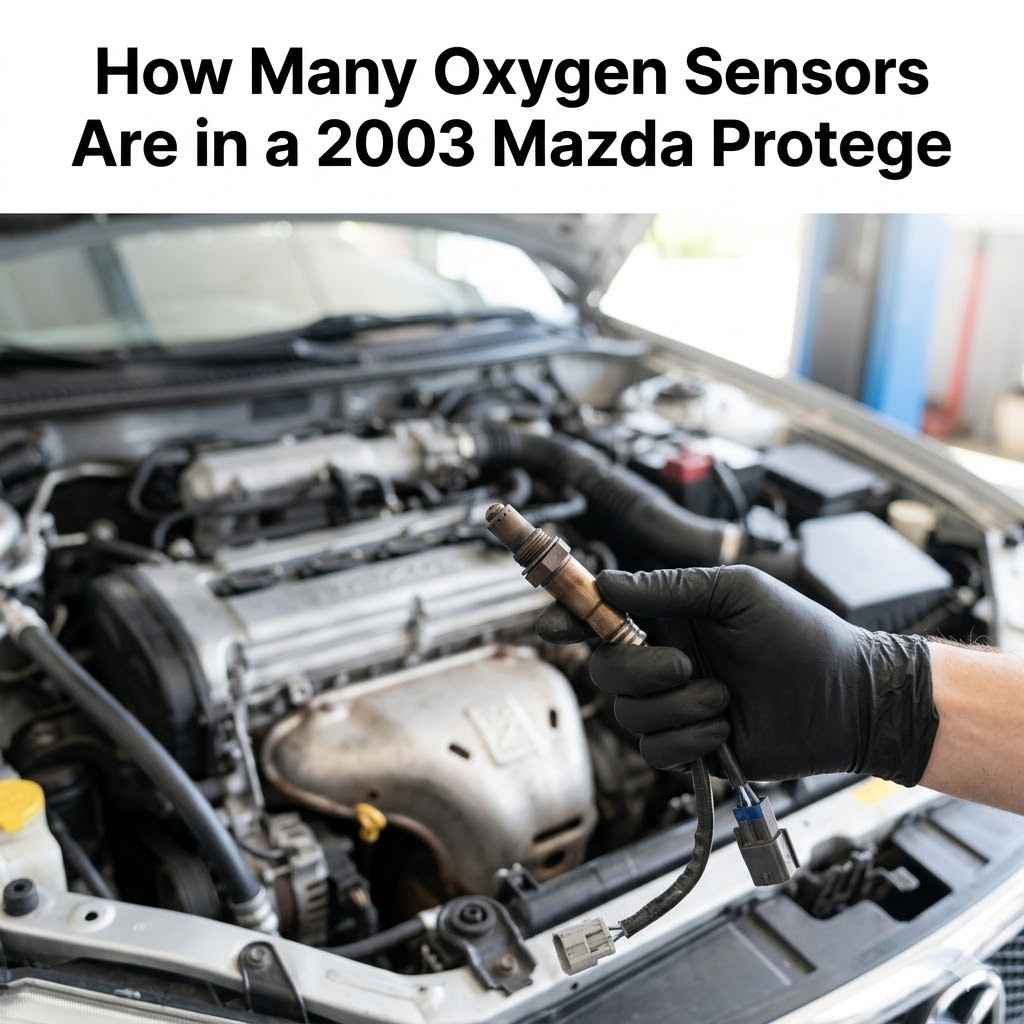
How Many Oxygen Sensors Are in a 2003 Mazda Protege
Finding out how many oxygen sensors are in your 2003 Mazda Protege can seem tricky, especially if you’re new to car maintenance. Many people wonder about this because knowing the sensor count helps with repairs or just understanding your car better. It’s totally normal to be a little unsure!
This guide will make it super simple and show you exactly what you need to know, step by step. We’ll cover everything you need to get you going on your way.
Understanding Mazda Protege Oxygen Sensors
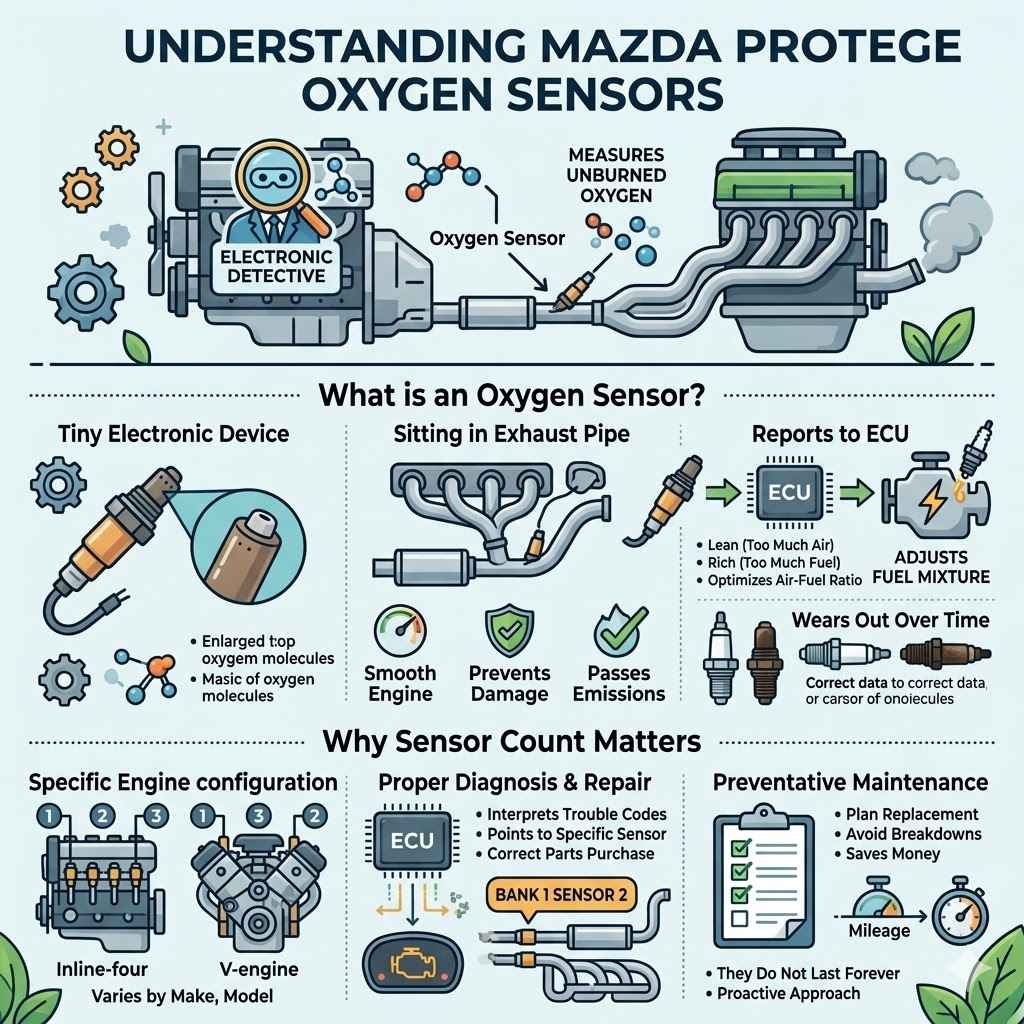
Oxygen sensors, often called O2 sensors, are vital parts of your car’s exhaust system. They measure the amount of unburned oxygen in your exhaust gases. This information helps your car’s computer adjust the fuel mixture for better efficiency and lower emissions.
For a 2003 Mazda Protege, knowing the number of these sensors is key for proper diagnosis and repair. This section will explore the basics of what these sensors do and why their quantity matters for your specific vehicle model.
What is an Oxygen Sensor?
An oxygen sensor is a small electronic device that acts like a tiny detector. It sits in your car’s exhaust pipe and looks for oxygen. The more oxygen it finds, the leaner your engine is running, meaning it’s using too much air or not enough fuel.
If it finds very little oxygen, it means your engine is running rich, using too much fuel. This data is sent to your car’s engine control unit (ECU), which then makes adjustments.
These adjustments are crucial for several reasons. They help your engine run smoothly, prevent costly damage, and ensure your car passes emissions tests. Without accurate readings from the O2 sensors, the ECU can’t optimize the air-fuel ratio.
This can lead to poor fuel economy, rough idling, hesitation during acceleration, and the dreaded check engine light.
Over time, O2 sensors can wear out. They get covered in carbon deposits or simply age, becoming less effective. When this happens, they send incorrect data to the ECU.
This is why knowing how many you have and where they are located is important for troubleshooting any engine performance issues you might experience.
Why Sensor Count Matters
The number of oxygen sensors in a car varies by make, model, and even the specific engine configuration. For a 2003 Mazda Protege, the exact number of sensors directly impacts how the engine’s performance is managed. Knowing the correct count helps in purchasing the right replacement parts and ensures that all sensors are accounted for during diagnostic checks.
If you’re dealing with a check engine light, the diagnostic trouble codes (DTCs) will often point to a specific sensor, like “Bank 1 Sensor 2.” Without knowing how many sensors your Protege has and where they are, interpreting these codes can be difficult. It helps to know if you’re looking for a sensor upstream or downstream of the catalytic converter, and if your car has multiple exhaust banks.
Understanding the sensor count also aids in preventative maintenance. Knowing you have a certain number allows you to plan for their eventual replacement, as they do not last forever. This proactive approach can save you from unexpected breakdowns and costly repairs down the road, keeping your vehicle running in top shape.
Identifying Oxygen Sensors on a 2003 Mazda Protege
Locating the oxygen sensors on your 2003 Mazda Protege involves understanding its exhaust system layout. Generally, cars have sensors both before and after the catalytic converter. The number and position can depend on whether your Protege has a four-cylinder or a V6 engine, though the 2003 model primarily came with four-cylinder engines.
We will cover the typical setup for these vehicles.
Identifying them is usually straightforward once you know where to look. They are threaded into the exhaust pipe and have electrical connectors. The wire coming from the sensor will typically lead to the engine’s wiring harness.
Safety is always paramount when working around vehicle exhaust systems, so ensure the engine is cool before attempting any inspections.
Upstream vs. Downstream Sensors
Oxygen sensors are typically referred to as “upstream” or “downstream.” The upstream sensor is located before the catalytic converter. Its main job is to monitor the exhaust gases leaving the engine and help the car’s computer fine-tune the air-fuel mixture in real-time. This sensor plays a critical role in engine performance and fuel efficiency.
The downstream sensor is located after the catalytic converter. Its primary function is to monitor the efficiency of the catalytic converter itself. It checks how well the converter is doing its job of cleaning up the exhaust gases.
If the downstream sensor detects too much oxygen, it signals that the catalytic converter might not be working effectively, and this can trigger a check engine light.
The positioning of these sensors is crucial for the ECU to make accurate calculations. The upstream sensor provides immediate feedback for fuel adjustments, while the downstream sensor offers a diagnostic perspective on the emissions control system. Both are important for overall vehicle health and performance.
Common Locations for Protege O2 Sensors
On most 2003 Mazda Protege models, you will find two oxygen sensors. One is the upstream sensor, located in the exhaust manifold or the pipe immediately after it, before the catalytic converter. This sensor is often referred to as “Bank 1 Sensor 1” if there’s only one bank of cylinders, which is common for inline engines.
The second sensor is the downstream sensor. This one is situated after the catalytic converter. It is typically identified as “Bank 1 Sensor 2.” The catalytic converter is usually a metal canister located under the car, along the exhaust pipe.
Accessing these sensors might require getting under your car. You’ll be looking for the exhaust pipe coming from the engine. The first O2 sensor is usually found quite close to the engine itself.
The second one will be further down the exhaust system, past the large lump that is the catalytic converter.
How Many Oxygen Sensors Are in a 2003 Mazda Protege?
For the vast majority of 2003 Mazda Protege models, the answer to how many oxygen sensors are present is two. This setup includes one upstream sensor and one downstream sensor, both situated along the exhaust system. This configuration is standard for inline four-cylinder engines typical of this vehicle year and model.
Understanding this number is fundamental for any maintenance or diagnostic work.
The upstream sensor, known as Bank 1 Sensor 1, is crucial for regulating the air-fuel mixture. It constantly sends data to the Engine Control Unit (ECU) to ensure optimal combustion. The downstream sensor, labeled Bank 1 Sensor 2, is positioned after the catalytic converter.
Its main role is to monitor the performance of the catalytic converter, ensuring it is effectively reducing harmful emissions.
Having these two sensors allows the vehicle’s computer to manage engine performance and emissions efficiently. If you’re troubleshooting issues or planning replacements, knowing that your 2003 Protege typically has these two sensors will guide your efforts. Always double-check your specific vehicle’s configuration if you suspect it might differ, though the dual-sensor setup is highly prevalent.
The Role of the Catalytic Converter
The catalytic converter is a critical component in your car’s exhaust system, designed to reduce harmful pollutants. It uses precious metals like platinum, palladium, and rhodium to convert toxic gases such as carbon monoxide, unburned hydrocarbons, and nitrogen oxides into less harmful substances like water vapor, carbon dioxide, and nitrogen gas.
It’s essentially a chemical reactor. When hot exhaust gases pass through it, a chemical reaction occurs. The upstream oxygen sensor monitors the exhaust gases before they enter the catalytic converter, providing data for the engine’s air-fuel ratio.
This ensures the converter receives gases it can process efficiently.
The downstream oxygen sensor then monitors the gases exiting the catalytic converter. By comparing the readings from the upstream and downstream sensors, the car’s computer can determine if the catalytic converter is functioning correctly. If the downstream sensor detects readings too similar to the upstream sensor, it indicates the converter isn’t doing its job, likely triggering a check engine light.
Typical Sensor Configurations
For a 2003 Mazda Protege, the engine is typically an inline four-cylinder. Inline engines generally have a single exhaust bank. This simplifies the sensor setup compared to V-shaped engines, which often have two exhaust banks (Bank 1 and Bank 2) and potentially more sensors.
With a single exhaust bank, the sensors are usually designated as “Bank 1 Sensor 1” (upstream) and “Bank 1 Sensor 2” (downstream). This means there is one set of upstream and downstream sensors serving the entire engine. This is a common and straightforward configuration for many vehicles with four-cylinder engines.
This two-sensor system is designed to provide the necessary feedback for both engine management and emissions control. It’s a balance between functionality and cost-effectiveness, providing sufficient data without excessive complexity. If your Protege has a different engine, the sensor count and designation might change, but the standard setup is two.
Example Scenario: Diagnosing a Check Engine Light
Imagine your 2003 Mazda Protege’s check engine light comes on. You take it to a mechanic or use an OBD-II scanner, and it reports a code like P0420 “Catalyst System Efficiency Below Threshold (Bank 1).” This code specifically relates to the catalytic converter’s performance on Bank 1.
Knowing that your Protege has two oxygen sensors, Bank 1 Sensor 1 (upstream) and Bank 1 Sensor 2 (downstream), you understand that the P0420 code implies an issue with the downstream sensor’s reading or the catalytic converter itself. The downstream sensor is comparing its readings to what it “expects” based on the upstream sensor’s input and the converter’s function.
If the downstream sensor were also reporting issues with the air-fuel mixture, it might point towards the upstream sensor (Bank 1 Sensor 1) being the primary problem. However, P0420 is almost always an indicator that the converter is not working as it should, or the downstream sensor is misreading its output. This highlights why knowing the sensor count and their roles is vital for accurate troubleshooting.
Replacing Oxygen Sensors
Replacing oxygen sensors is a common maintenance task that can often be done at home with the right tools and a bit of guidance. When one of your Protege’s O2 sensors starts to fail, it can lead to a variety of performance issues. Knowing when and how to replace them can save you money and keep your car running smoothly.
The sensors themselves are wear-and-tear items. Over time, the high heat and exhaust gases they are exposed to degrade their effectiveness. Signs of a failing sensor can include poor fuel economy, rough idling, or a persistent check engine light.
The diagnostic codes generated will often pinpoint which specific sensor needs attention.
Before you begin, ensure you have the correct replacement sensors. For a 2003 Mazda Protege, you’ll likely need two sensors, and it’s often recommended to replace them in pairs if you’re doing a major service, especially the upstream and downstream sensors together. Always make sure to disconnect the battery before starting any work to prevent electrical issues.
Signs of a Failing Oxygen Sensor
Several symptoms can indicate that one or both of your 2003 Mazda Protege’s oxygen sensors are not working correctly. The most common indicator is the illumination of the check engine light on your dashboard. This light is your car’s way of telling you that a system, often related to emissions or engine performance, has detected a problem.
Another significant sign is a noticeable decrease in fuel economy. When an oxygen sensor fails, it can no longer provide accurate data to the engine control unit (ECU). This can cause the ECU to operate with an incorrect air-fuel mixture, leading to the engine burning more fuel than necessary.
You might find yourself visiting the gas station more often than usual.
Other symptoms can include rough idling, engine hesitation or sputtering during acceleration, and a failed emissions test. In some cases, a failing sensor can even lead to a burnt or rotten egg smell from the exhaust, which may indicate the catalytic converter is overheating due to an improper air-fuel mixture caused by a faulty O2 sensor.
Tools and Techniques for Replacement
To
You will also need a standard socket set, a ratchet, and possibly some penetrating oil if the old sensors are seized in the exhaust pipe. Safety is key, so have jack stands if you need to lift the car, and wear safety glasses. Ensure the engine has cooled down completely before you start working.
The process usually involves locating the sensor, disconnecting its electrical connector, using the O2 sensor socket to unscrew the old sensor, applying anti-seize compound to the threads of the new sensor (be careful not to get it on the sensor tip), and then screwing in the new sensor. Finally, reconnect the electrical connector and clear any diagnostic trouble codes with an OBD-II scanner.
When to Replace Both Sensors
It’s often a good idea to
Oxygen sensors have a finite operational life. They degrade over time due to the harsh environment of the exhaust system. Replacing them as a set ensures that both sensors are operating within optimal parameters, providing the ECU with consistent and accurate data.
This proactive approach can prevent the other sensor from failing shortly after the first one is replaced, saving you another repair job.
Consider the age and mileage of your vehicle. If your Protege has high mileage, it’s highly probable that both sensors have accumulated significant wear. Replacing them simultaneously can be more cost-effective in the long run, especially when factoring in the labor involved, as much of the access work is the same for both sensors.
Troubleshooting and Maintenance Tips
Maintaining your 2003 Mazda Protege’s oxygen sensors is essential for optimal engine performance and fuel efficiency. Even though they are designed to last for many miles, they can be affected by various factors. Knowing how to troubleshoot common issues and performing regular checks can help you avoid unnecessary repairs.
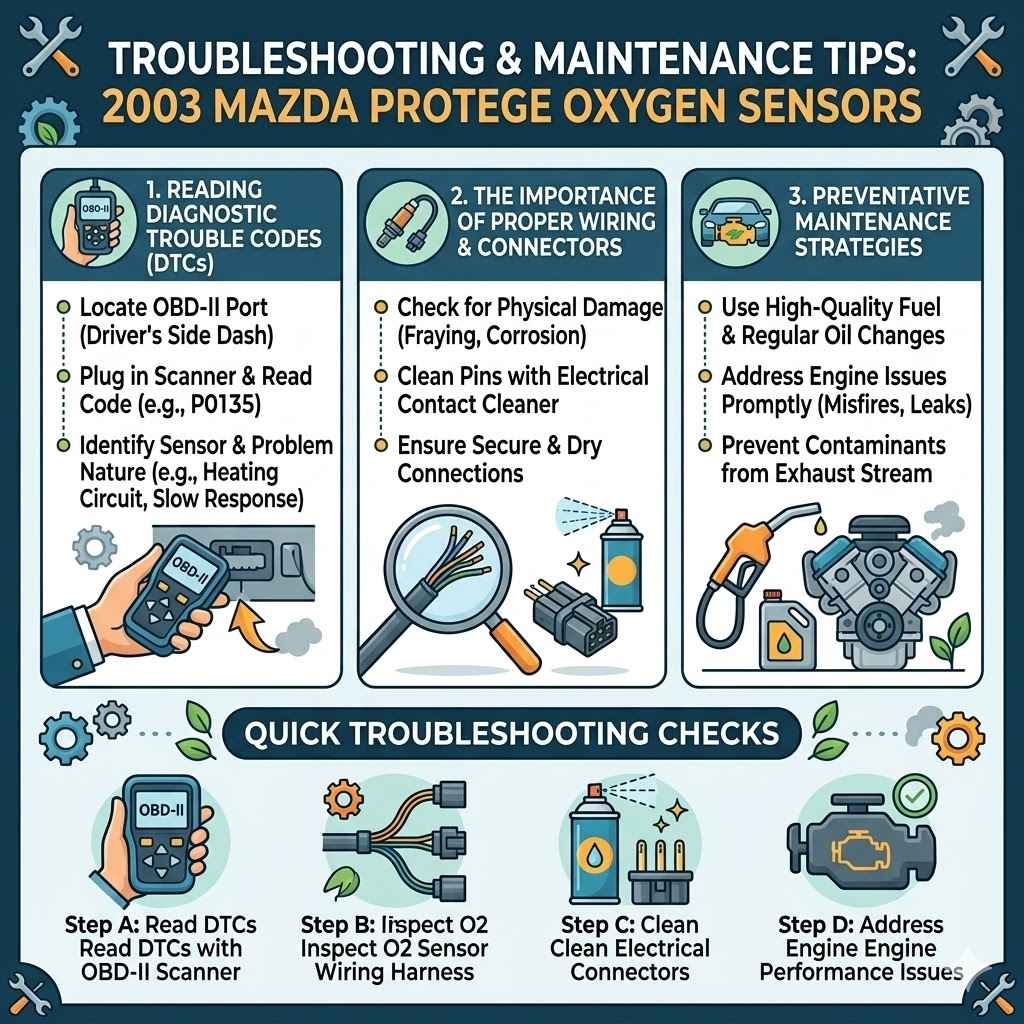
If your check engine light is on, the first step is always to read the diagnostic trouble codes (DTCs) using an OBD-II scanner. This will give you a much clearer idea of which sensor, if any, is causing the problem. Sometimes, a code might be triggered by a faulty wiring connection rather than the sensor itself.
Regularly inspecting the wiring for any signs of damage, such as fraying or corrosion, is also a good practice. Ensure that the electrical connectors are clean and securely attached. These simple checks can often prevent a small issue from becoming a larger problem.
Reading Diagnostic Trouble Codes
Reading diagnostic trouble codes (DTCs) is the most effective way to begin troubleshooting any check engine light on your 2003 Mazda Protege. You will need an OBD-II (On-Board Diagnostics II) scanner. These scanners are readily available online or at most auto parts stores and are relatively inexpensive.
To use the scanner, locate the OBD-II port, which is usually found under the dashboard on the driver’s side. Plug the scanner into the port and follow the on-screen instructions to read the codes. The scanner will display a code, such as “P0135,” which corresponds to a specific issue detected by the car’s computer.
For oxygen sensors, common codes include those related to sensor circuit malfunction (e.g., P0135, P0141 for heating circuit issues) or sensor performance issues (e.g., P0133 for slow response). Knowing the specific code will help you determine whether you’re dealing with Bank 1 Sensor 1 or Bank 1 Sensor 2 and what the nature of the problem is. This information is invaluable for deciding the next steps, whether it’s replacing a sensor or investigating further.
The Importance of Proper Wiring and Connectors
The wiring and electrical connectors associated with oxygen sensors are just as critical as the sensors themselves. A damaged wire or a corroded connector can lead to faulty readings or a complete loss of signal, even if the sensor element is perfectly fine. Therefore, inspecting these components is a vital part of troubleshooting.
Exhaust systems get hot, and vibration is constant. Over time, the wiring harness leading to the O2 sensors can become brittle, cracked, or chafed from rubbing against other parts of the car. Similarly, the connectors can accumulate dirt, moisture, or salt from the road, leading to corrosion that impedes electrical conductivity.
When you’re checking your sensors, pay close attention to the wiring loom. Look for any signs of physical damage, melting, or insulation breakdown. Ensure the electrical connectors are clean, free of debris, and snap together securely.
Sometimes, a simple cleaning of the connector pins with electrical contact cleaner can resolve issues. Proper connections ensure the reliable flow of data between the sensor and the ECU.
Preventative Maintenance Strategies
While oxygen sensors are designed to last a considerable time, employing certain preventative maintenance strategies can extend their life and ensure your 2003 Mazda Protege runs efficiently. One key strategy is to maintain a healthy engine overall.
Using high-quality fuel and ensuring your engine oil is changed regularly according to the manufacturer’s recommendations can prevent contaminants from reaching and damaging the O2 sensors. Contaminated fuel or oil can lead to faster buildup of carbon deposits on the sensor element, reducing its responsiveness and lifespan.
Another strategy is to address any engine performance issues promptly. Problems like misfires, excessive oil consumption, or coolant leaks can introduce harmful substances into the exhaust stream, negatively impacting the O2 sensors. By keeping your engine in good repair, you indirectly protect these sensitive components.
Frequently Asked Questions
Question: How many oxygen sensors does a 2003 Mazda Protege typically have
Answer: A 2003 Mazda Protege typically has two oxygen sensors: one upstream and one downstream sensor.
Question: Where is the upstream oxygen sensor located on a 2003 Mazda Protege
Answer: The upstream oxygen sensor is located in the exhaust manifold or shortly after it, before the catalytic converter.
Question: What is the function of the downstream oxygen sensor
Answer: The downstream oxygen sensor monitors the efficiency of the catalytic converter by measuring the exhaust gases after it.
Question: What happens if a 2003 Mazda Protege oxygen sensor fails
Answer: A failing oxygen sensor can cause poor fuel economy, rough idling, a check engine light, and failed emissions tests.
Question: Can I replace my own oxygen sensors
Answer: Yes, you can
Summary
Your 2003 Mazda Protege generally features two oxygen sensors, one upstream and one downstream. These sensors are vital for engine efficiency and emission control. Understanding their locations and functions helps in diagnosing issues like a check engine light.
Regular checks of wiring and connectors, along with proactive engine maintenance, can extend their lifespan. If a sensor fails, replacement is a manageable DIY task with the right tools, ensuring your Protege runs smoothly.