How Much Faster Is a 2011 BMW M3 After Remap
A remap on a 2011 BMW M3 may add roughly 10 to 15 wheel horsepower, with the bigger gain often being sharper throttle response and cleaner midrange pull rather than a dramatic peak-power jump. A poor tune can hurt drivability, trigger fault codes, or add risk without much extra speed. Here’s what the tune changes, what you can realistically expect, and when it is worth the money.
How much faster 2011 gain matrix

| Stock setup | Stage 1 expectations | Transmission effect | Fuel requirement | Real-world speed change | Risk notes |
|---|---|---|---|---|---|
| 6-speed manual, factory ECU calibration, 425 hp stock reference, 4.7 seconds to 60 mph | About 10 to 15 whp, stronger midrange, sharper throttle, better part-throttle response | Launches and shifts still depend on the driver, so the seat-of-the-pants gain is real but modest | High-octane fuel preferred; use the grade the tuner specifies for the file | 0-60: usually little change; quarter-mile: small improvement; overtakes: noticeably cleaner from 40 to 70 mph | Good file and healthy car only; poor calibration can add knock, faults, or rough fueling |
| DCT, factory ECU calibration, 425 hp stock reference, 4.5 seconds to 60 mph | About 10 to 15 whp, same power shape, slightly better response between shifts | DCT keeps the car quicker in repeat runs because shifts are faster and more consistent | High-octane fuel preferred; check the tuner’s octane requirement before flashing | 0-60: small gain only; quarter-mile: slightly better trap and consistency; overtakes: easier to stay in the meat of the power | DCT masks some lag in response, but a weak tune can still make the car feel jerky at low speed |
| UK-spec car with the factory 155 mph limiter | Limiter removal may be included if the tuner allows it | No gearbox swap needed for limiter removal, but DCT is usually the cleaner tool for repeated high-speed pulls | Fuel quality matters more at sustained high load | Top speed can move past 155 mph only where conditions and gearing allow | Track-use context matters; removal does not make the car safer at speed |
| Verdict | Worth it if you want response and drivability first | Manual cars feel more alive; DCT cars feel quicker | Use the right fuel or skip the tune | Do not expect turbo-style gains | Worth it for feel, not worth it if you want a big headline horsepower jump |
What a remap changes on the S65
The 2011 M3 is the E90 sedan, E92 coupe, or E93 convertible with BMW’s 4.0-litre S65 V8, not the later turbocharged M3. That matters, because the naturally aspirated S65 has far less ECU-only headroom than a turbo engine. A remap can still change fueling, ignition timing, throttle mapping, and some limiter behavior, but it cannot create boost that is not there.
ECU calibration basics
A remap rewrites the engine control software so the car requests more suitable fuel and spark values for the hardware and fuel being used. On the S65, that usually means cleaner throttle mapping, a more eager pedal, and a slightly stronger pull through the middle of the rev range. It can also remove the 155 mph limiter where the calibration and market allow it.
Why the V8 responds less than a turbo BMW
Turbo BMWs can gain a lot from software because boost, fueling, and torque targets leave more room to move. The 2011 M3 does not have that safety net. Its power gain comes from smarter calibration and a little extra efficiency, so the biggest change is in how the engine responds, not in a dramatic jump on the dyno sheet.
Suppose a car feels flat at half throttle in traffic. A good Stage 1 file can make that same pedal input feel cleaner and more immediate without making the car nervous or over-sensitive. The change is easy to notice. The stopwatch change is not.
How much faster is a 2011 BMW M3 after a remap?
Usually, only a little faster in straight-line terms. On a healthy 2011 M3, a Stage 1 remap is best understood as a response and midrange upgrade with a modest power increase, not a new performance class. Expect the biggest gains in 30 to 70 mph pulls, where the engine sits in the heart of its powerband.
Power and torque gains
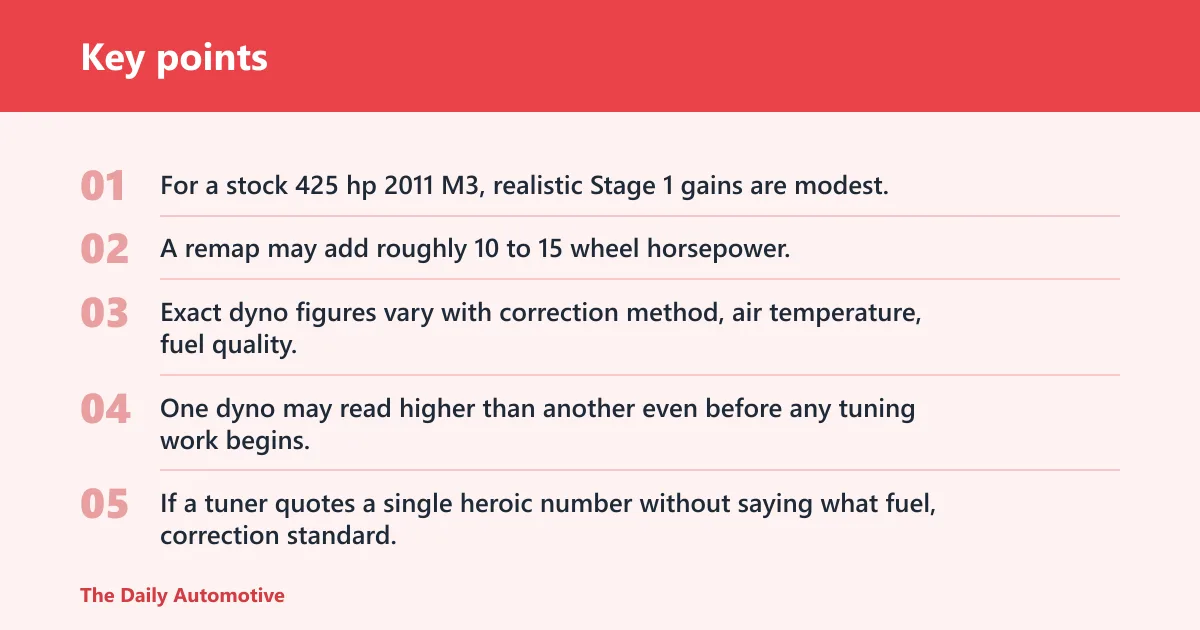
For a stock 425 hp 2011 M3, realistic Stage 1 gains are modest. A remap may add roughly 10 to 15 wheel horsepower, with a similar improvement in usable torque delivery rather than a huge peak number. Exact dyno figures vary with correction method, air temperature, fuel quality, and the specific car.
That variability is normal. One dyno may read higher than another even before any tuning work begins. If a tuner quotes a single heroic number without saying what fuel, correction standard, and car specification it used, treat that figure carefully.
0-60 and quarter-mile change
BMW says the manual 2011 M3 reaches 60 mph in 4.7 seconds, while the DCT car drops that to 4.5 seconds. A remap rarely shaves a dramatic amount off either figure because traction and shift quality matter as much as engine output. In real use, think tenths, not seconds.
Quarter-mile improvement is similar. A well-sorted tune can trim a small slice from the elapsed time and may improve the trap speed a little, but it will not turn the S65 into a different animal. The better improvement is the way it pulls through the middle gears.
Manual versus DCT difference
The DCT car will usually feel quicker after a remap because it shifts faster and more consistently than the 6-speed manual. The manual can still benefit, but the driver controls launch and shift timing, so repeatable 0-60 gains are harder to extract. The DCT leaves less on the table.
A common first-timer mistake is expecting a manual car to post the same gain as a DCT car with the same file. The calibration may be the same, but the launch and shift process is not.
Is a 2011 M3 remap worth it?
Yes, if your goal is sharper response, better throttle feel, and a cleaner midrange. It is less compelling if you want a big power jump for the money. For an S65, the best case is a car that feels more awake everywhere you drive it, especially in the lower and middle revs.
When the price makes sense
A remap makes the most sense when the car is otherwise healthy and you want a more alert road car without adding hardware. It is also easier to justify if you are already paying for dyno time, limiter removal, or a tune that is tailored to local fuel. In that case, the software change may be the best value upgrade in the package.
When to skip it
Skip the tune if the car has pending faults, poor maintenance history, or fuel quality that will not support the calibration. The S65 is not forgiving of neglected ignition, fuel, or cooling issues, and a tune will not fix those problems. Sort the base car first.
Stage 1, Stage 2, and Stage 3 explained
Stage 1 is the cleanest answer for most 2011 M3 owners. It usually adds power and torque without extra parts. Stage 2 and Stage 3 move beyond software alone, but the S65 still stays naturally aspirated unless the build becomes much more serious.
Stage 1 with no hardware changes
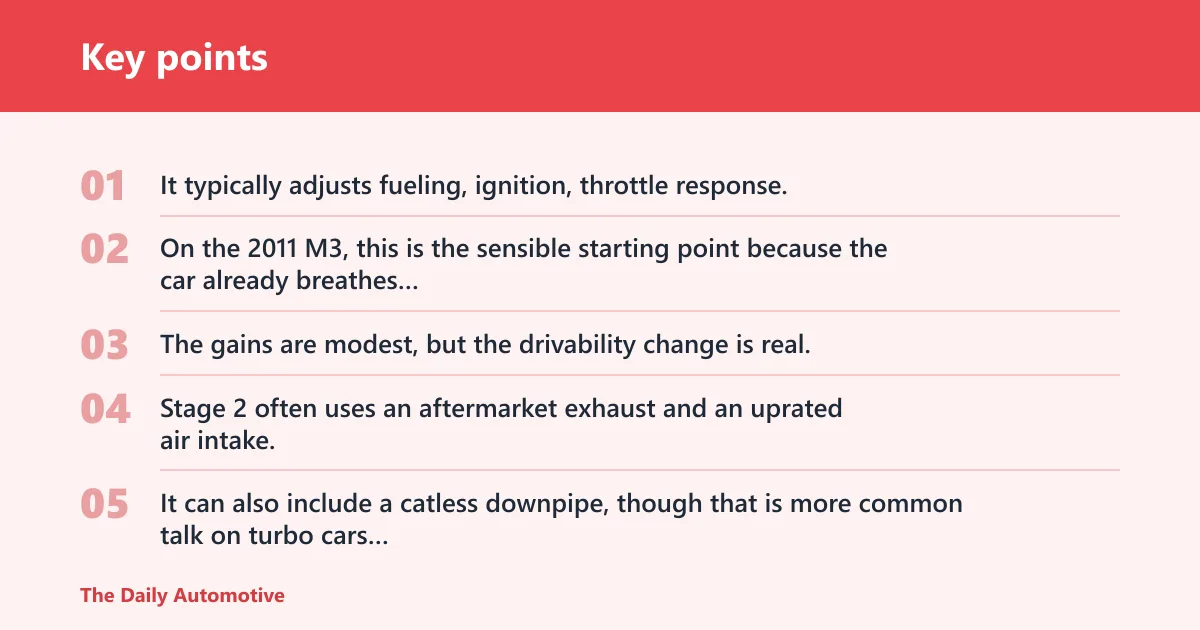
Stage 1 is a calibration-only package. It typically adjusts fueling, ignition, throttle response, and sometimes the rev or speed limiter behavior. On the 2011 M3, this is the sensible starting point because the car already breathes well from the factory. The gains are modest, but the drivability change is real.
Stage 2 with intake and exhaust mods
Stage 2 often uses an aftermarket exhaust and an uprated air intake. It can also include a catless downpipe, though that is more common talk on turbo cars than on this naturally aspirated BMW. On an S65, Stage 2 is more about sharpening the soundtrack and reducing restriction than unlocking huge extra output.
Stage 3 with fueling and internal upgrades
Stage 3 may add bigger injectors and pumps, and it may also require higher-rated spark plugs. On a naturally aspirated 2011 M3, that kind of build only makes sense when the goal is a serious engine package rather than a simple road tune. Camshaft changes, valve and spring work, and forged or billet internals belong in that discussion too.
That is the point where the budget starts making a different case. If you want a mild improvement, Stage 1 is the answer. If you want a much faster M3, saving for hardware makes more sense than chasing software alone.
Manual or DCT: which feels quicker?
The DCT feels quicker every time because it shifts faster and keeps the engine in its powerband. The 6-speed manual gives more driver involvement, but its acceleration depends on how well the driver launches and shifts it. After a remap, that difference still matters more than the tune itself.
6-speed manual baseline
BMW says the manual car reaches 60 mph in 4.7 seconds. That is a strong number for a naturally aspirated V8 coupe or sedan, but it leaves little room for a software-only leap. A remap improves the way the car responds, not the fact that a manual launch still depends on the driver’s footwork.
DCT launch and shift advantage
BMW says the DCT car reaches 60 mph in 4.5 seconds. The twin-clutch gearbox is the better match if your priority is repeatable acceleration. On a remapped car, the DCT will usually translate the calibration into a cleaner and more consistent result because the shifts are quicker and less dependent on the driver.
Reliability, fuel, and installation time
A safe remap is one that respects the car’s mechanical condition and fuel quality. Reputable tuners matter because the S65 is not an engine that rewards guesswork. If the map is too aggressive for the fuel or the hardware, the car can run poorly and may log faults.
Daily-driving safety
For daily use, a conservative Stage 1 map is usually the safest route. It should make the car feel cleaner, not rougher. If the tune adds throttle jerkiness, odd idle behavior, or warning lights, it is not a good file for road use.
How long a remap takes
The BMW remap process can take between a few minutes and an hour. That depends on the tuning method, whether the file is flashed in person or remotely, and whether the tuner needs to read the ECU first. Some shops can turn the car around quickly; others want more time for checks and revisions.
Fuel requirement
Higher-octane fuel may be needed. That is especially important on a naturally aspirated V8 that already runs close to the limits of what software can safely change. If a tuner asks for a specific grade, use it. The wrong fuel can erase the benefit and add risk.
Top speed limiter and supporting mods
BMW’s UK speed limiter figure mentioned in this remap context is 155 mph. A tune can remove that limiter on some cars, which is mainly useful for track work, high-speed driving, or top-speed testing rather than normal road use. It does not change the car’s legal responsibilities or road conditions.
Best bolt-ons to pair with a remap
On this platform, the best pairing is usually a quality intake, a well-chosen exhaust, and a tune that matches the hardware. Those parts can improve response and reduce restriction a little, but they should not be expected to create large gains on their own. The S65 responds best to careful calibration, not headline-grabbing parts lists.
When supporting mods matter more than software
Supporting mods matter more when the car already has maintenance issues, weak ignition parts, or a restrictive setup that needs attention before tuning. If the car is healthy, start with software. If it is not, spend the money fixing the base car first.
Picture a car with a clean service history, fresh plugs, and no faults. A Stage 1 remap is a sensible first upgrade. Picture another car with rough idle and warning lights. The tune should wait until the fault is found.
Frequently asked questions
What power and torque gains does a 2011 BMW M3 remap make?
A good Stage 1 file usually adds modest power and a cleaner torque curve rather than a huge peak figure. On the naturally aspirated S65, gains are limited by the engine’s design, so the real value is in drivability, throttle mapping, and more usable midrange pull.
Does a remap make a 2011 BMW M3 faster 0-60?
Only slightly, if at all. BMW says the manual car does 0-60 mph in 4.7 seconds and the DCT car in 4.5 seconds, and a remap does not change traction or launch technique enough to transform those numbers. The gain is usually too small to notice in daily driving.
What is the stock horsepower of a 2011 BMW M3?
The 2011 M3 makes 425 hp in stock form, according to the cited comparison. That figure is part of why software-only tuning on this car delivers limited peak-power gains. The engine already runs close to its naturally aspirated ceiling from the factory.
What is the top speed of a 2011 BMW M3?
The UK limiter figure mentioned for this car is 155 mph. A remap can remove that limiter where appropriate, but actual top speed still depends on conditions, gearing, and the car’s health. For most owners, the more useful benefit is stronger in-gear pull rather than a higher terminal speed.
Is a BMW M3 remap safe for daily driving?
A conservative Stage 1 remap can be safe for daily use if the car is healthy and the fuel matches the tune. The risk comes from poor calibration, poor maintenance, or the wrong octane. If the map is smooth and fault-free, it should improve, not hurt, everyday drivability.
Products related to this article
Sponsored / affiliate links. As an Amazon Associate I earn from qualifying purchases. I may earn additional commission from eligible campaigns.