How Much Does a Formula Car Cost?
A formula car can cost about $20,000 for a used entry-level chassis and well over $15 million for a current Formula 1 car, before running costs. Miss the full ownership stack and the budget blows up on spares, crash damage, and season support. This guide breaks down purchase price, required spares, and yearly running costs from Formula Ford and Formula Regional to Formula 2 and Formula 1.
The short answer is this: entry-level formula cars can be attainable, but a current Formula 1 car sits in a different financial category entirely. The car itself is only one part of the bill. Chassis, engine or lease, gearbox, aero, electronics, spares, tires, transport, and crew all matter.
Running costs and support budget
Used cars usually cost less because depreciation hits early and hard. A race-ready rolling chassis also costs less than a complete car with engine, gearbox, electronics, and setup parts. On top of that, season support can equal or exceed the buy-in if the car is competitive or crash-prone.
Formula car cost matrix
The table below separates three budgets that are often mixed together: what it costs to buy a car, what it costs to build or complete one, and what a season typically consumes. Figures are broad market bands, not sticker prices for every chassis or team.
| Formula tier | Chassis | Engine / lease | Gearbox | Electronics | Aero | Spares | Tires | Transport | Annual running cost |
|---|---|---|---|---|---|---|---|---|---|
| Formula Ford | Buy: $20,000-$60,000 | Build: $8,000-$20,000 | Season: $15,000-$40,000 | Build: $3,000-$8,000 | Buy: simple bodywork, low aero spend | Season: $5,000-$20,000 | Season: $6,000-$15,000 | Season: $5,000-$20,000 | $25,000-$90,000 |
| Formula 4 | Buy: $50,000-$120,000 | Build: $15,000-$40,000 | Season: $25,000-$70,000 | Build: $5,000-$15,000 | Buy: modest wings and floor | Season: $10,000-$35,000 | Season: $15,000-$45,000 | Season: $10,000-$35,000 | $60,000-$180,000 |
| Formula 3 | Buy: $250,000-$650,000 | Build: $80,000-$200,000 | Season: $80,000-$180,000 | Build: $20,000-$50,000 | Buy: high-downforce package | Season: $40,000-$120,000 | Season: $40,000-$100,000 | Season: $30,000-$80,000 | $180,000-$500,000 |
| Formula 2 | Buy: $900,000-$1.4 million | Build: $250,000-$450,000 | Season: $150,000-$300,000 | Build: $50,000-$100,000 | Buy: large ground-effect package | Season: $150,000-$350,000 | Season: $80,000-$180,000 | Season: $60,000-$150,000 | $450,000-$1 million+ |
| Formula 1 | Buy: over $15 million | Build: not a consumer build; team program only | Season: team inventory and rebuild cost vary widely | Build: team-spec systems and support contracts | Buy: full aero package updates through the season | Season: multiple millions possible after crashes and updates | Season: tire supply is team-controlled and event-specific | Season: global freight and race support are major costs | Hundreds of millions to run a team |
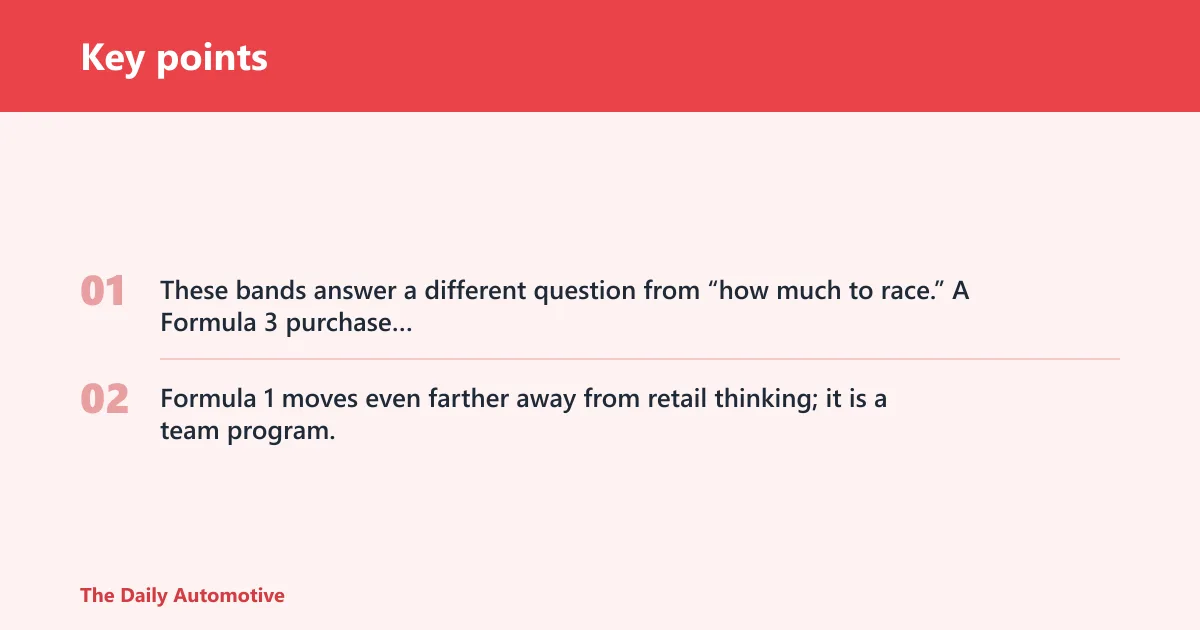
These bands answer a different question from “how much to race.” A Formula 3 purchase can sit in the low hundreds of thousands, while a full season can cost far more once tires, rebuilds, travel, and crashes enter the picture. Formula 1 moves even farther away from retail thinking; it is a team program, not a consumer product.
Why formula cars cost so much
Formula cars cost more than many touring cars because the basic shell is built around safety and low weight. The carbon-fiber monocoque, front and rear impact structures, and homologation work are expensive before the car ever sees a track. A damaged tub is not a simple panel repair.
Engine supply can be the second big split. Some quotes include the engine or lease it through a manufacturer or series partner; others exclude it entirely. Gearboxes, paddle-shift hardware, diff parts, and electronics add more, especially in categories with strict rebuild intervals.
Spares and crash exposure are the hidden budget killers. A front wing, floor section, upright, suspension arm, or wheel can end a weekend in one contact. Teams that want to keep running need inventory depth, not just one of each part.
Say your Formula 4 car arrives as a rolling chassis with no spare nose, no extra wheels, and only one set of dampers in the truck. A light contact in qualifying can turn a modest budget into a much larger bill before Sunday if replacement parts are not already on hand.
Chassis and homologation costs
The chassis is usually the biggest single piece of the base car cost. In modern formula racing, that means a carbon-fiber monocoque with impact structures that meet category rules. Once a tub takes a serious hit, replacement can be cheaper than repair, and sometimes repair is not allowed.
Engine, gearbox, aero, and electronics
Power units vary by category. Formula Ford may use a simpler package, Formula 4 often runs a controlled engine, and Formula 3 or Formula 2 brings more expensive race hardware and support. The gearbox is just as important. Sequential systems, clutch control, and differential setup all affect both performance and rebuild cost.
Aero also matters more as downforce rises. Wings, floors, diffusers, and track-specific trim can move the budget quickly, especially when upgrades are frequent. Electronics are not a small extra either. ECU hardware, dash/logger units, wiring looms, sensors, and software support all carry real cost.
Spare parts, crash damage, and support inventory
Spare parts are not optional if you want to race hard. Wings, suspension, uprights, floor sections, brake parts, fluids, fuel, and spare wheels all belong in the budget. More competitive programs also carry extra gearbox parts, bodywork, and a repair stock for weekend damage.
Transport and support are part of ownership, not afterthoughts. A trailer or race truck, setup tools, pit equipment, crew wages, hotel nights, freight, and event fees can add up quickly. The more remote the calendar, the higher the logistics bill.
What does a formula car cost to buy?
A formula car to buy can mean a used rolling chassis, a complete race-ready car, or a near-new package with engine and data systems. Used entry-level cars may start around $20,000, while a recent Formula 3 or Formula 2 package can be far higher. Formula 1 cars are not ordinary customer cars at all.
Used versus new price differences
Used cars usually cost far less because the first owner has absorbed the steepest depreciation. New cars also bring fresh homologation, untouched crash structures, and current components. In practice, the same category can have wildly different prices depending on year, mileage, and whether the car includes serviceable spares.
Race-ready rolling chassis versus complete car
A rolling chassis is only part of the answer. If the quote excludes engine, gearbox, electronics, seat, fire system, wheels, or aero pieces, the final total rises fast. That is why two cars with the same base shell can sit thousands or hundreds of thousands apart.
Engine included versus engine excluded
Engine-included pricing often looks higher because the seller is bundling a major cost block. Engine-excluded pricing can look attractive until the buyer adds the motor, calibration, cooling, and install hardware. In higher formulas, that gap can be dramatic because the power unit is tied to manufacturer support and rebuild control.
Picture a buyer comparing two Formula 3 listings. One is a bare chassis with no engine lease and minimal spares. The other includes a complete package, fresh belts, data kit, and spare bodywork. The second quote can be the better value even if the headline price is much higher.
What does it cost to build one?
Building a formula car means different things in different categories. For lower formulas, it can mean buying a chassis and adding the missing systems. For top-tier formulas, “build” is really a team engineering program, not a weekend project. The parts list, labor, and support structure decide the final number.
Parts you still need after buying a chassis
After the chassis, the buyer still needs engine or lease supply, gearbox and driveline parts, electronics, brakes, suspension hardware, fire system, seat fitment, and setup gear. Tires, fuel, and spares are separate again. If the car arrives incomplete, the total can climb above the price of a ready-to-run example.
Where build costs can outrun purchase price
Build cost outruns purchase price when the donor car is stripped or outdated. Missing aero pieces, damaged uprights, expired dampers, old electronics, and a worn gearbox can erase the saving. A cheaper shell is only cheaper if the missing parts are easy to replace.
Why F1 is not a build-it-yourself market
Formula 1 is the clearest example of why this is not a consumer market. A team does not simply buy a car and bolt on parts later. It designs, manufactures, validates, and updates a race program around the car, the power unit agreement, and the calendar.
Formula 1 costs in context
A current Formula 1 car is usually discussed in two separate ways: the cost to make the car and the cost to develop and race it over a season. Those are not the same number. A current car can be valued at well over $15 million, while the full team budget reaches into the hundreds of millions.
Car price versus yearly development spend
The car itself includes the carbon-fiber survival cell, crash structures, hybrid systems, gearbox, suspension, aero package, cooling, and electronics. Development spend then layers on top through wind tunnel work, CFD, upgraded bodywork, revised floors, and trackside parts manufacture. That is why F1 cost discussions often sound inconsistent unless the category is named carefully.
Why spares and crash repair change the number fast
Crashes are expensive because a top-tier formula car contains high-value parts in dense packaging. A front wing, nose, floor, suspension corner, or gearbox casing can disappear in one incident. Once a race weekend goes wrong, the repair bill can climb far beyond the headline car value people quote online.
Why F1 is a team program, not a consumer purchase
F1 cars are not sold like road cars, and they are not intended for private ownership in the normal sense. Teams own or control the car and the parts pipeline. That is why “how much does a F1 car cost to buy” is a useful search term but a misleading shopping question.
How running costs change after purchase
Running cost is the part many buyers miss. Tires, brakes, fuel, fluids, transport, crew, setup tools, and rebuild intervals can become the larger bill once the car is in action. A low entry price can still lead to a high season total.
Tires, brakes, fuel, and fluids
Tires are usually one of the most direct season costs because they are consumed by events rather than stored forever. Brake pads and discs wear with use, and fluids need regular replacement. Fuel and lubricants are smaller than a chassis purchase, but they are steady costs across a calendar.
Transport, crew, and event logistics
Transport is often overlooked by first-time buyers. Even a modest formula car needs a tow vehicle or trailer, spares storage, fuel, and tools. Add crew labor, event entry fees, and travel, and the annual cost can move far beyond the initial purchase quote.
Rebuild intervals and wear items
Gearboxes, dampers, engines, and hybrid systems all have service lives. Short rebuild intervals raise ownership cost because parts come out of the car before they fail. That is especially true in higher formulas, where a small mechanical issue can trigger a large parts order.
Frequently asked questions
How much does a F1 car cost?
A current Formula 1 car is commonly valued at well over $15 million before the full season budget is counted. That figure covers the car, not the team’s development, freight, staff, or crash exposure. In practice, the real annual program is much larger.
How much does a race car cost?
A race car can cost anywhere from a few thousand dollars for an old grassroots project to many millions for a top-tier open-wheel machine. For formula cars, the big variables are chassis, engine or lease, gearbox, electronics, spares, and how much support comes with the purchase.
How much does a F1 car cost to build?
Building a Formula 1 car is a team program, not a private build. The car’s physical value is often placed well above $15 million, but the build is only part of the equation. Development, testing, staff, and race operations push the total far higher.
How much does a F1 car cost without the engine?
Without the engine, an F1 car quote can fall sharply because the power unit is one of the biggest cost drivers. The exact reduction varies by deal structure, and in F1 the engine is tied to manufacturer support, hybrid systems, and contract terms rather than a simple parts price.
How much does a F1 car cost in Indian rupees?
The rupee answer changes with exchange rates, import rules, and whether you mean the car alone or the full program. A current Formula 1 car valued above $15 million converts to a very large INR number, but it should be checked against the latest market rate on the day you compare it.
How much does a F1 formula car cost to buy?
For Formula 1, “buy” is the wrong lens for most readers because these are team assets, not retail inventory. If you are comparing open-wheel categories, customer formula cars in Formula Ford, Formula 4, Formula 3, and Formula 2 are the practical buy-in benchmarks, not F1.
Products related to this article
Sponsored / affiliate links. As an Amazon Associate I earn from qualifying purchases. I may earn additional commission from eligible campaigns.