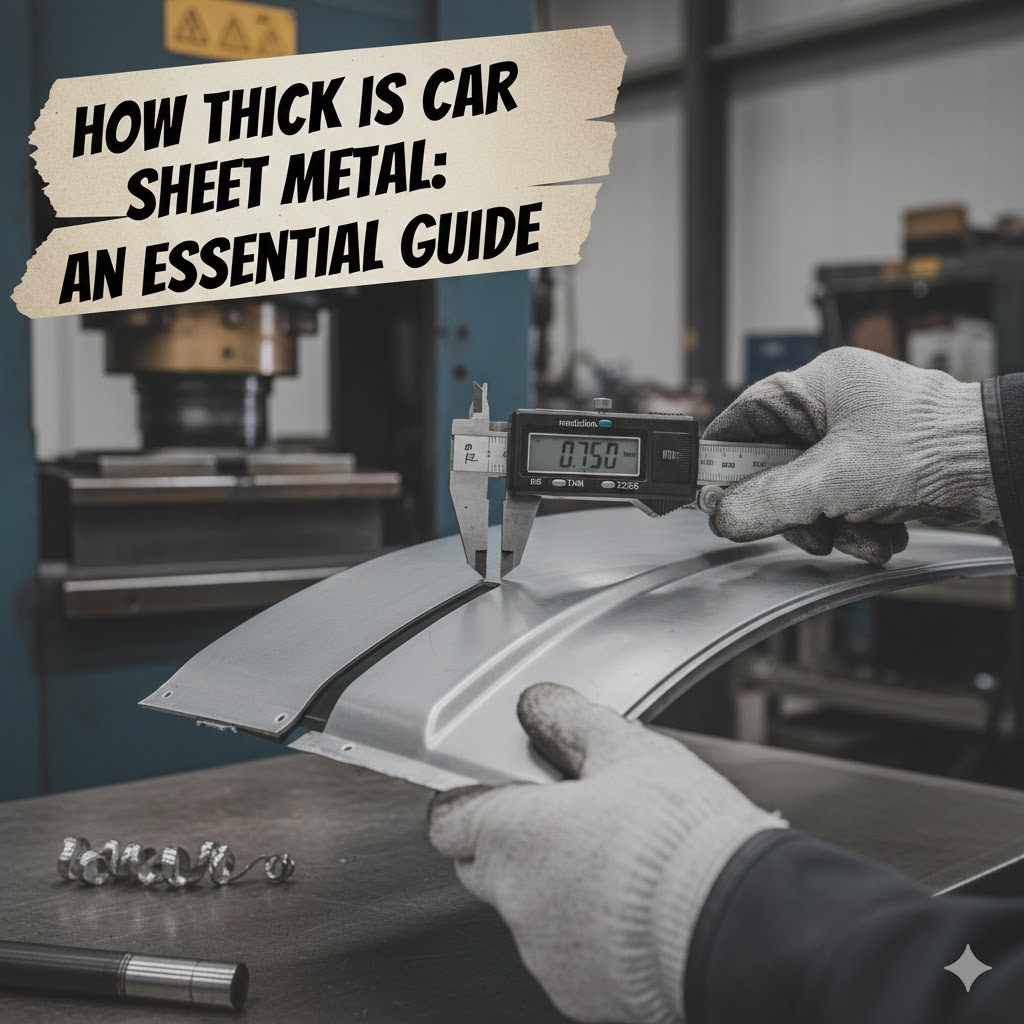
How Thick Is Car Sheet Metal: An Essential Guide
Most modern car sheet metal is between 0.7 to 1.0 millimeters thick (about 0.028 to 0.040 inches). This typically corresponds to a steel gauge of 20 to 24. Thickness varies depending on the car’s panel, with structural areas being thicker and outer panels like doors or hoods being slightly thinner for weight savings.
Have you ever tapped on your car’s fender and wondered what’s really underneath the paint? It might feel thin, but there’s a lot of science packed into that slim piece of metal. Understanding the thickness of your car’s body panels can feel like a complex mechanic’s secret, but it’s actually quite simple and useful to know.
Knowing about sheet metal helps you understand your car’s safety, how it’s repaired after a dent, and why modern cars are so different from classic models. Don’t worry, you don’t need an engineering degree for this! I’m here to break it all down for you in simple, easy-to-follow terms. Together, we’ll explore exactly how thick car sheet metal is and why it matters for you as a driver and owner.
Why Sheet Metal Thickness Matters for Your Car
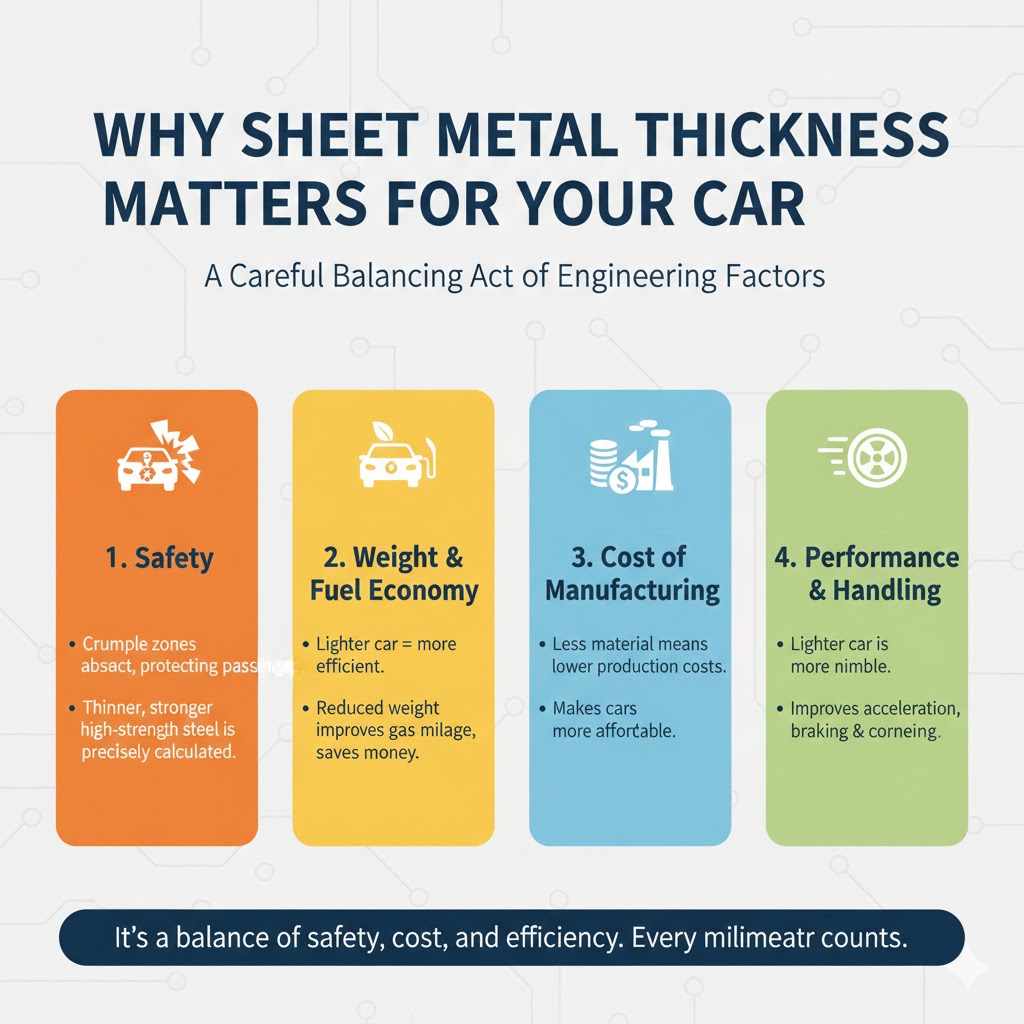
That thin layer of metal does more than just give your car its shape and shiny color. Its thickness is a careful balancing act between several important factors. Here’s why it’s a big deal:
- Safety: This is the number one priority. Modern cars use advanced high-strength steels that are thinner but much stronger than old-fashioned steel. This allows engineers to create crumple zones that absorb impact during a crash, protecting you and your passengers. The thickness is precisely calculated for optimal performance.
- Weight and Fuel Economy: A lighter car is a more efficient car. Using thinner (but still strong) sheet metal helps reduce the overall weight of the vehicle. This means the engine doesn’t have to work as hard, leading to better gas mileage and saving you money at the pump.
- Cost of Manufacturing: Steel and aluminum cost money. By using less material (thinner sheets), car manufacturers can keep production costs down. This helps make cars more affordable for everyone.
- Performance and Handling: A lighter car isn’t just more efficient; it’s also more nimble. Reduced weight improves a car’s acceleration, braking, and cornering, making it more responsive and fun to drive.
- Repairability: The thickness and type of metal affect how easily dents can be repaired. Thinner, high-strength steel can sometimes be more challenging to work with than the thicker, softer steel of older cars, requiring specialized tools for bodywork.
Understanding “Gauge”: The Language of Thickness
When professionals talk about sheet metal thickness, they often use the term “gauge.” It might sound technical, but the concept is straightforward. Gauge is simply a standardized way to measure thickness.
Here’s the one tricky part you need to remember: a higher gauge number means thinner metal. It’s a bit counterintuitive, but you’ll get the hang of it quickly. For example, 20-gauge steel is thicker and stronger than 24-gauge steel.
Most car body panels fall within the 20 to 24 gauge range. This is the sweet spot that provides enough strength and dent resistance without adding too much weight. To make it easier to visualize, here is a simple chart that converts steel gauge to actual measurements in millimeters and inches.
| Steel Gauge | Thickness in Millimeters (mm) | Thickness in Inches (in) |
|---|---|---|
| 18 Gauge | 1.21 mm | 0.0478″ |
| 20 Gauge | 0.91 mm | 0.0359″ |
| 22 Gauge | 0.76 mm | 0.0299″ |
| 24 Gauge | 0.61 mm | 0.0239″ |
As you can see, the differences are tiny—often less than the thickness of a credit card—but they make a huge impact on the vehicle’s overall design and performance.
How Thick Is the Sheet Metal on Different Car Parts?
Not all parts of your car are made from the same thickness of metal. Engineers strategically use different gauges for different panels depending on their function. Structural parts need to be thick and strong, while cosmetic panels can be thinner and lighter.
Let’s take a walk around a typical modern car to see how the thickness varies.
Doors, Hood, and Trunk Lid
These are often called the “outer skins.” They need to be strong enough to resist minor dents from shopping carts or hail, but light enough to open and close easily. They also play a role in crumple zones.
- Typical Gauge: 20 to 22 gauge
- Typical Thickness: 0.8 mm to 1.0 mm (0.031″ to 0.040″)
Fenders and Quarter Panels
Fenders (the panels over your front wheels) and quarter panels (the panels over your rear wheels) give the car its shape. They are also susceptible to dings and dents, so they need a good balance of strength and formability.
- Typical Gauge: 20 to 22 gauge
- Typical Thickness: 0.8 mm to 1.0 mm (0.031″ to 0.040″)
Roof Panel
The roof provides structural integrity and rollover protection, but it’s also a very large panel. Making it too heavy would raise the car’s center of gravity, affecting handling. Modern roofs are designed to be strong without being overly thick.
- Typical Gauge: 22 to 24 gauge
- Typical Thickness: 0.7 mm to 0.8 mm (0.028″ to 0.031″)
Floor Pans and Frame Rails
This is where the real strength is. The floor and underlying frame form the backbone of the car. These parts must be incredibly strong and rigid to protect occupants and support the vehicle’s weight. They are almost always made from thicker, higher-strength steel.
- Typical Gauge: 16 to 20 gauge
- Typical Thickness: 1.0 mm to 1.5 mm (0.040″ to 0.060″)
Here’s a quick-reference table summarizing the typical thicknesses for various car panels:
| Car Panel | Common Gauge Range | Approximate Thickness (mm) |
|---|---|---|
| Hood / Trunk Lid | 20 – 22 Gauge | 0.8 mm – 1.0 mm |
| Doors (Outer Skin) | 20 – 22 Gauge | 0.8 mm – 1.0 mm |
| Fenders / Quarter Panels | 20 – 22 Gauge | 0.8 mm – 1.0 mm |
| Roof | 22 – 24 Gauge | 0.7 mm – 0.8 mm |
| Floor Pan | 18 – 20 Gauge | 1.0 mm – 1.2 mm |
| Frame Rails / Rocker Panels | 16 – 18 Gauge | 1.2 mm – 1.5 mm |
Factors That Change a Car’s Metal Thickness
The numbers above are great general guidelines, but the exact thickness of your car’s sheet metal can change based on a few key factors.
1. The Age of the Vehicle (Classic vs. Modern)
If you’ve ever worked on a classic car from the 1960s or 70s, you know the metal feels thick and heavy. Back then, mild steel was the standard, and engineers relied on thickness for strength. It wasn’t uncommon to find panels as thick as 18 gauge (1.2 mm).
Modern cars, however, are a different story. Metallurgy has come a long way. Carmakers now use Advanced High-Strength Steels (AHSS). This amazing material can be up to ten times stronger than the steel used in older cars. Because it’s so much stronger, engineers can use thinner sheets, which reduces weight while actually improving safety. This is a key reason why a new car can be lighter than a classic car but perform much better in crash tests regulated by agencies like the National Highway Traffic Safety Administration (NHTSA).
2. The Type of Vehicle (Truck vs. Sedan)
It makes sense that a heavy-duty pickup truck would be built differently than a small city car.
- Trucks and Large SUVs: These vehicles are built for work and durability. They often have thicker frame components and body panels, especially in the cargo bed area, to handle heavy loads and rough conditions.
- Compact Cars and Sedans: These are designed with fuel efficiency and passenger comfort in mind. They use lighter-gauge panels wherever possible to save weight.
- Luxury and Performance Cars: These vehicles often use exotic materials. You might find aluminum or even carbon fiber panels, which are chosen for their extreme light weight and strength, not just their thickness.
3. The Material Itself (Steel vs. Aluminum)
While most cars still use steel, aluminum is becoming more and more common, especially in hoods, trunk lids, and on luxury vehicles like the Ford F-150 (which famously switched to an all-aluminum body).
To get the same strength as steel, an aluminum panel needs to be about 1.5 times thicker. So, if a steel hood is 0.8 mm thick, an aluminum equivalent might be around 1.2 mm thick. Even though it’s thicker, aluminum is so much less dense than steel that the panel still ends up being significantly lighter.
How to Measure Sheet Metal Thickness (For the Curious DIYer)
Most of the time, you won’t need to measure your car’s sheet metal. But if you’re doing a restoration project or a rust repair, knowing the exact thickness is crucial for buying the right replacement panel.
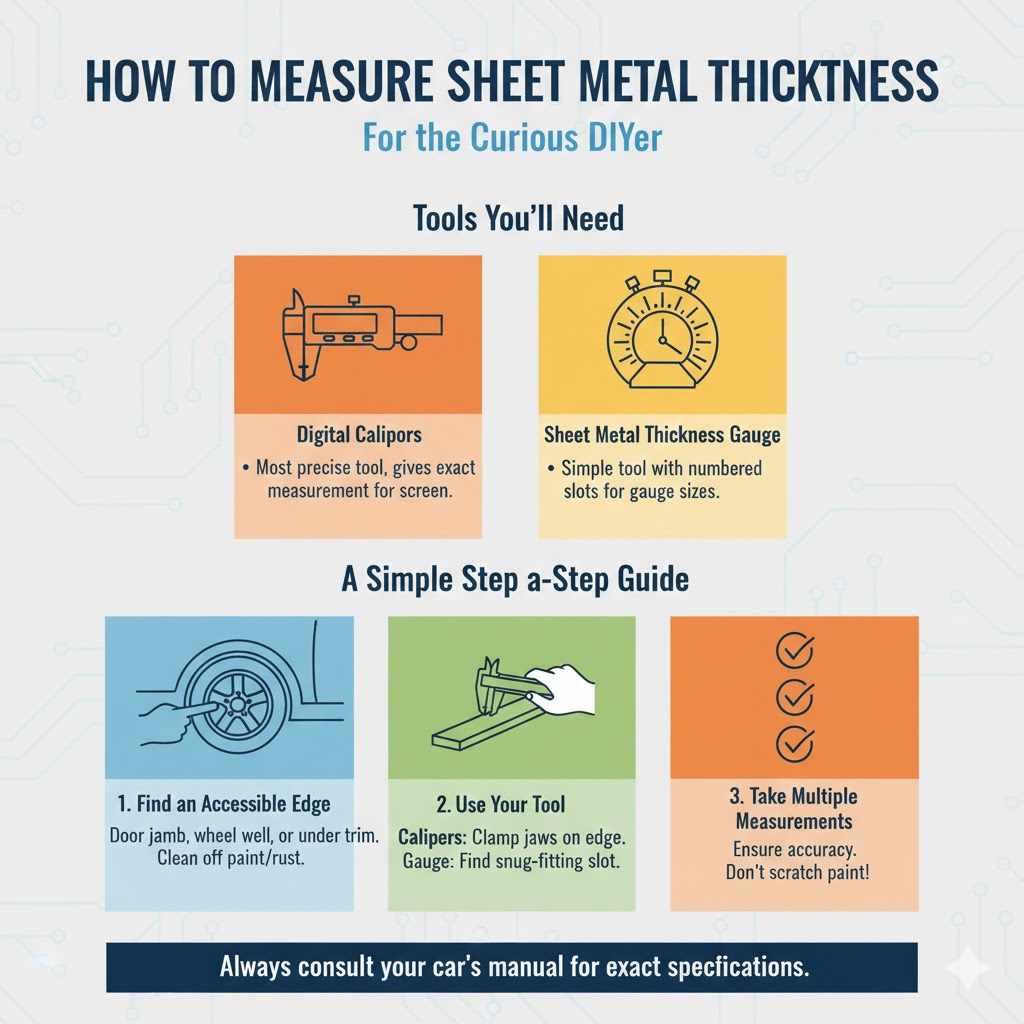
Here are the tools you would use:
- Digital Calipers: This is the most precise tool. It has two small jaws that you clamp onto the edge of the metal. The digital screen gives you a very accurate reading in millimeters or inches. The challenge is finding a clean, accessible edge of a panel to measure.
- Sheet Metal Thickness Gauge: This is a simpler, wheel-shaped tool with notches of different sizes around the edge. You slide the notches over the metal until you find the one that fits perfectly. Each notch is labeled with the corresponding gauge number. For a more detailed look at how these gauges work, you can check out this helpful steel gauge chart and explanation.
A Simple Step-by-Step Guide:
- Find an Accessible Edge: Look for a spot where the metal edge is exposed. Good places to check are the lip inside a wheel well, the edge of a door jamb, or an area where a piece of trim has been removed. Be very careful not to scratch your paint.
- Clean the Area: Make sure the spot you’re measuring is free of paint, primer, rust, or sealant. You want to measure only the metal itself.
-
Use Your Tool:
- With Calipers: Gently close the jaws on the metal edge. Don’t press too hard. Read the measurement on the screen.
- With a Gauge Tool: Try fitting different slots over the metal edge until you find a snug fit. The number on that slot is your gauge.
- Take Multiple Measurements: It’s always a good idea to measure in a few different spots to ensure you have an accurate reading.
If you’re patching a rust hole in the middle of a panel, finding an edge might be impossible. In that case, your best bet is to look up the factory specifications for your car’s year and model online or assume it falls within the standard 20-22 gauge range for most body panels.
Frequently Asked Questions (FAQ)
1. Is thicker sheet metal always safer in a car crash?
Not anymore. While it was true for very old cars, modern car safety is about engineering, not just thickness. Today’s cars use thinner, high-strength steel to create crumple zones that absorb and redirect crash energy away from the passenger cabin. A well-engineered car with thinner, advanced steel is much safer than an old car with thick, soft steel.
2. Why do modern cars feel so much lighter or “flimsier” than older cars?
This feeling comes from the use of lighter materials like high-strength steel and aluminum. The doors may feel lighter and the panels might flex more when you push on them, but this is by design. The underlying structure of the car is incredibly strong and rigid, providing better protection than ever before.
3. Can I use a magnet to tell if a panel is steel or aluminum?
Yes, this is a great and easy trick! A standard refrigerator magnet will stick firmly to a steel panel but will not stick to an aluminum panel at all. This is a common way body shop technicians quickly identify materials before starting a repair.
4. What gauge steel should I use for a rust repair patch?
The best practice is to use a patch panel made of the same gauge steel as the original panel. If you can’t measure the original, a 20-gauge or 22-gauge cold-rolled steel sheet is a safe and common choice for most non-structural body repairs like fenders or door skins. For floors or rocker panels, you might need a thicker 18-gauge steel.
5. How much does sheet metal thickness really affect a car’s weight?
It has a huge effect. The body of a car is one of its heaviest components. Even a tiny reduction in thickness across all the large panels—like the roof, doors, and hood—can add up to a weight savings of 50 to 100 pounds or more. This directly improves fuel economy and performance.
6. Are luxury cars made with thicker sheet metal?
Not necessarily thicker, but often with more advanced or varied materials. A luxury car might use aluminum for its outer panels to save weight and improve balance. They also invest heavily in sound-deadening materials applied to the inside of the panels, which can make them feel more solid and substantial, even if the metal itself isn’t any thicker.
7. Does thinner sheet metal dent more easily?
It can, but it depends on the type of steel. Thinner, mild steel will dent more easily than a thicker piece. However, the high-strength steels used in modern cars are very resilient and can resist small impacts surprisingly well despite being thinner. This is often referred to as “dent resistance.”
Conclusion: More Than Just a Metal Shell
So, how thick is car sheet metal? As we’ve learned, the answer is usually less than a millimeter. But that tiny measurement tells a big story about safety, efficiency, and incredible engineering.
The next time you close your car door or wash your hood, you can appreciate the complex balance that went into designing that simple panel. It’s not just a thin piece of steel; it’s a lightweight, high-strength component designed to protect you, save you money on gas, and make your car perform at its best.
Understanding these basics gives you confidence as a car owner. You’re better equipped to talk to a mechanic about body repairs, appreciate the technology in your vehicle, and even tackle your own DIY projects. Your car is no longer a mystery—it’s a marvel of smart, practical design, right down to its metal skin.