How to Check If Car AC Is Working Properly: Genius Guide
To check if your car AC is working properly, start the engine, turn the AC to its coldest setting and highest fan speed, and feel for cold air from the vents. If the air is cold and the fan blows strongly, your AC is likely functioning well. If not, simple checks can often pinpoint the issue.
Car AC acting up can turn a comfortable drive into a sticky situation, especially on a hot day. You might wonder, “Is my car AC really not working, or am I just not feeling it?” It’s a common worry, and thankfully, checking your car’s air conditioning doesn’t require a mechanic’s degree. You can easily tell if it’s blowing cool or just warm air with a few simple steps right in your driveway.
This guide is designed to demystify your car’s AC system. We’ll walk through how to perform basic checks yourself, helping you understand what’s happening. By the end, you’ll know if your AC is giving you the cold shoulder for a simple reason or if it might need a professional’s attention. Let’s get your cool comfort back!
Why Your Car’s AC Needs a Regular Check
Your car’s air conditioning system is more than just a luxury; it’s essential for comfort and even safety. On sweltering days, a properly working AC keeps you alert and prevents heat-related distractions. Over time, components can wear out, refrigerant levels can dip, or minor issues can escalate if left unchecked. Regular basic checks can help you catch small problems before they become big, expensive repairs.
Think of it like checking your home’s thermostat – you want to make sure it’s set correctly and responsive. Your car’s AC works similarly, with various parts needing to coordinate. Understanding these basic checks ensures you’re not caught off guard by a failing system when you need it most. It’s about peace of mind and smart vehicle ownership.

When Did You Last Notice Your Car AC Working Well?
Take a moment to recall the last time you truly felt that blast of refreshing cold air from your car’s vents. Was it last week? Last summer? Sometimes we get used to lukewarm air, mistaking it as “normal” for our car. If it’s been a while since you’ve experienced truly cold air, it’s definitely time for a check-up.
A well-functioning AC system should provide noticeably cold air within a minute or two of turning it on, even on a warm day. If it takes ages to cool down, or if the air only ever feels slightly cool, something might be amiss. This simple self-assessment is the first step to ensuring your comfort and the longevity of your car’s AC components.
The Genius Guide: How to Check If Your Car AC Is Working Properly
Let’s dive into the practical steps you can take to check your car’s AC. These are beginner-friendly and don’t require special tools. We’ll cover everything from visual cues to the feel of the air.
Step 1: Prepare Your Vehicle for the Test
Before you start the engine, ensure your car is in a safe and suitable location. A level surface is ideal. If possible, perform this test on a moderately warm day. An AC system struggles to demonstrate its full cooling power in very cool weather, though you can still check for airflow and basic functionality.
- Park Safely: Find a level spot, preferably in your driveway or a quiet street.
- Windows Up: Ensure all car windows and doors are closed. This creates a closed environment for the AC to work efficiently.
- Initial Setting: Set your car’s climate control system to the AUTO mode if it has one, or manually set the temperature to the lowest possible setting (LO or 60-65°F / 15-18°C) and the fan speed to its highest setting.
Step 2: Start the Engine and Turn On the AC
With your vehicle ready, it’s time to power up the AC. This is where you’ll start to feel the results of your check.
- Start the Engine: Turn your car’s ignition key to the “ON” position and let the engine run.
- Engage AC: Press the “AC” button. You should hear the compressor engage – often a subtle click or a slight change in engine sound. On some cars, the AC is engaged automatically when set to defrost or if the temperature is set quite low in AUTO mode.
- Direct Airflow: Point the air vents directly towards you so you can easily feel the air temperature.
Step 3: Feel the Air Coming from the Vents
This is the most critical part of the test. After a minute or two, you should feel a significant difference in the air temperature.
- The Cold Air Test: Place your hand directly in front of a vent and feel the air. It should be noticeably cold, and ideally, it should get colder the longer the AC runs. Compare the air from different vents if you have multiple.
- Check Fan Strength: Ensure the fan is blowing air with good force. If the fan is weak, it might indicate a problem with the blower motor or a clogged cabin air filter.
- Listen for Unusual Noises: While the AC is running, listen for any strange sounds like grinding, hissing, or rattling. These can be indicators of mechanical issues within the AC system.
Step 4: Inspect the AC Compressor Clutch
The AC compressor is the heart of your AC system. You can often see if it’s engaging correctly.
- Locate the Compressor: This is usually mounted on the engine and driven by a belt. It has a pulley on the front.
- Observe the Pulley: With the engine running and the AC on, look at the center of the compressor pulley. A small disc inside the pulley should be visibly spinning with the pulley. When you turn the AC off, this center disc should stop spinning while the outer part of the pulley continues to rotate. If the center disc never engages, the compressor isn’t kicking in, which could be due to electrical issues or low refrigerant.
Safety Note: Be extremely careful around a running engine. Keep hands, hair, and clothing away from moving belts and fans. If you’re not comfortable, skip this step or have a knowledgeable friend assist you.
Step 5: Check for Leaks and Condensation
A properly working AC system will produce condensation, which is a good sign. You can also look for other visual indicators.
- Water Dripping: After the AC has been running for a while (10-15 minutes), you should see a small amount of condensation dripping from under your car, usually on the passenger side. This is normal water vapor that has condensed from the air. No dripping might mean the system isn’t cooling enough or the evaporator drain is clogged.
- Look for Oily Residue: Inspect visible AC lines and connections for any signs of oily residue. Refrigerant often contains oil, and an oily spot can indicate a refrigerant leak.
Step 6: Evaluate the Temperature Drop
A simple way to quantify if your AC is working well is to measure the temperature difference between the outside air and the air coming from the vents.
How to do it: First, check the outside temperature using your car’s thermometer if available, or a phone app. Then, set your AC to the coldest setting and fan speed on high, with the recirculation mode on. After about 5-10 minutes, use a thermometer (a simple cooking thermometer or a digital meat thermometer will work) to measure the temperature of the air coming from a vent.
A good rule of thumb is that the air from the vent should be about 20-40°F (11-22°C) colder than the ambient outside temperature. For example, if it’s 90°F (32°C) outside, you should expect air coming from the vents to be between 50°F and 70°F (10°C and 21°C).
Common Car AC Problems and What They Mean
Even with a perfect check, sometimes AC systems encounter issues. Knowing what common problems look like can help you diagnose further or speak more clearly with a mechanic.
| Symptom | Possible Cause(s) | What It Means |
|---|---|---|
| Warm Air Blowing | Low refrigerant, Faulty compressor, Clogged cabin air filter, Blend door actuator failure | The system isn’t cooling effectively. Could be a simple filter clog or a more serious refrigerant or mechanical issue. |
| Weak Airflow | Clogged cabin air filter, Blower motor issues, Blocked vents | The fan isn’t pushing air properly. The cabin filter is the most common culprit for this. |
| Strange Noises (Grinding, Hissing) | Worn AC compressor bearings, Refrigerant leak, Issues with belt tensioner | Mechanical problems within the system. Hissing can also be a sign of a leak. |
| AC Only Blows Cold When Driving Fast | Low refrigerant, Faulty radiator fan, or condenser fan issue | The system relies on airflow over the condenser to dissipate heat. If it only works at speed, it suggests a problem with the vehicle’s cooling fans. |
| Musty or Moldy Smell | Mold and mildew growth in the evaporator core or ductwork | This is common and usually means it’s time for a cabin air filter change and potentially an AC system cleaning. |
Simple Fixes You Can Try Yourself
Before calling a professional, there are a few things you might be able to fix yourself, saving you time and money.
- Replace the Cabin Air Filter: This is probably the easiest and most common DIY AC fix. A dirty, clogged cabin air filter restricts airflow, making your AC feel weak and work harder. You can usually find your filter’s location in your car’s owner’s manual (often behind the glove box). New filters are inexpensive and easy to swap out. For more on how this works, see the Federal Trade Commission’s advice on avoiding car repair scams, which often starts with understanding basic maintenance like filter changes.
- Check Fuses and Relays: Your AC system has fuses and relays that can blow or fail. Consult your owner’s manual to locate the fuse box(es) and identify the fuses/relays related to the AC system. Visually inspect them for any signs of damage. If a fuse is blown, replace it with one of the exact same amperage rating.
- Defrost Cycle Test: Sometimes, simply running the AC in different modes can help clear minor issues. Run the AC on the defrost setting for a few minutes. This mode often engages the AC compressor and can help dehumidify the system.
When to Call a Professional Mechanic
While DIY checks are empowering, it’s important to know your limits. If the basic troubleshooting steps don’t resolve the issue, or if you encounter any of the following, it’s time to schedule a visit to a qualified mechanic.
- Refrigerant Concerns: Adding refrigerant yourself can be risky if you don’t know what you’re doing. Overcharging can damage the system, and using the wrong type of refrigerant is harmful and illegal. A mechanic has the proper tools and knowledge for safe and effective refrigerant handling, including leak detection. Reputable sources like the U.S. Environmental Protection Agency (EPA) emphasize the importance of proper refrigerant management.
- Suspected Compressor Failure: If you hear loud grinding noises, if the AC compressor clutch isn’t engaging (as described earlier), or if the system is completely blowing hot air despite other checks, the compressor itself might be the problem. This is a complex and expensive part that requires expert diagnosis and replacement.
- Persistent Leaks: If you’ve noticed oily residue or suspect a leak but can’t pinpoint it, a mechanic has specialized equipment, like UV dye kits and electronic leak detectors, to find and repair even small leaks.
- Electrical Issues: Problems with the AC wiring, control modules, or sensors are best left to professionals who can safely diagnose and repair complex electrical problems.
- Weak Cooling Despite All Checks: If you’ve done all the basic checks and the AC still blows only slightly cool air, there might be a deeper issue within the system’s thermodynamics or component performance that requires specialized diagnostic tools and expertise.
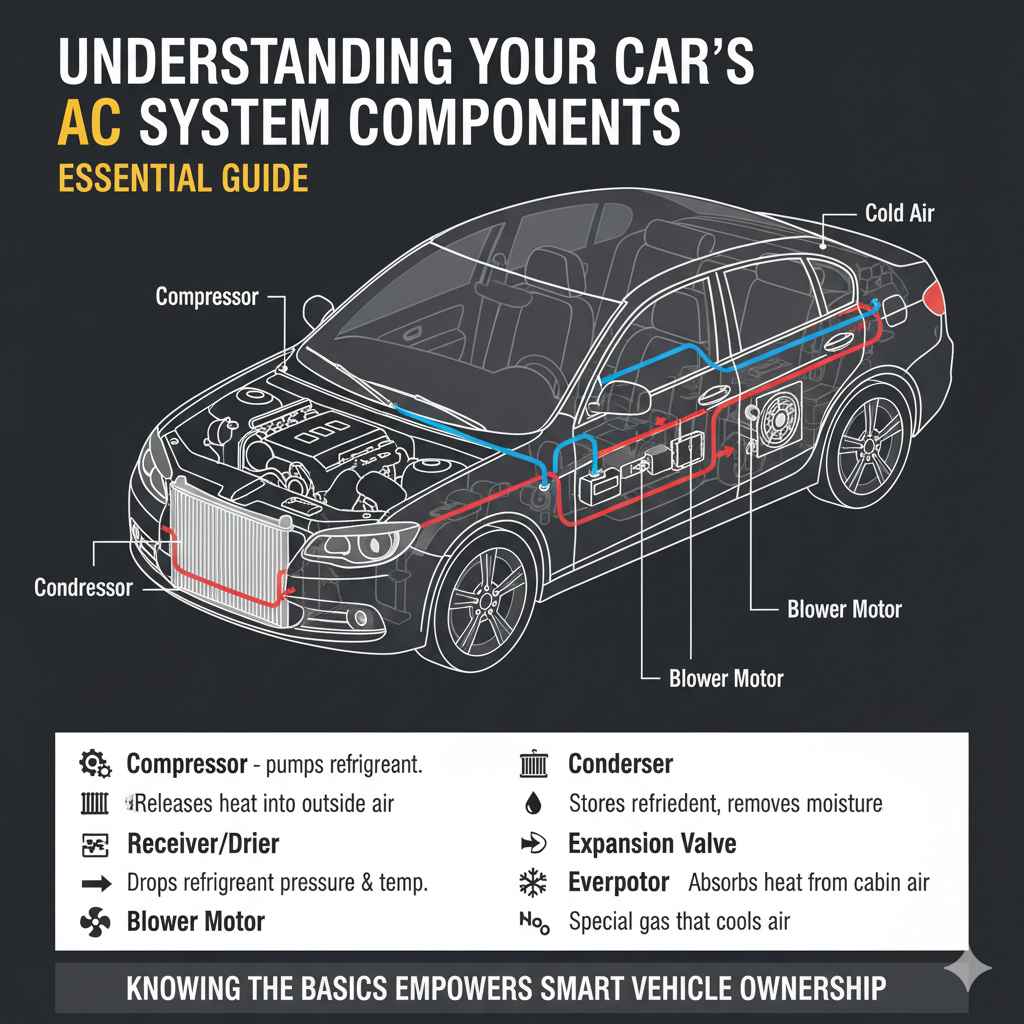
Understanding Your Car’s AC System Components
Knowing the basic parts of your car’s AC system can help you understand what’s happening when it works, or doesn’t. Think of it as a team working together to cool your car.
- Compressor: This is the “heart” of the system. It pumps the refrigerant, which is the chemical that cools the air. It’s driven by a belt connected to the engine.
- Condenser: Located at the front of the car, usually in front of the radiator, it releases heat from the refrigerant into the outside air. This is why good airflow over the front grille is important.
- Receiver/Drier or Accumulator: This component stores the refrigerant and removes moisture from it. It’s crucial for keeping the system clean.
- Expansion Valve or Orifice Tube: This narrows the path for the refrigerant, causing its pressure and temperature to drop dramatically before it enters the evaporator.
- Evaporator: Located inside the dashboard, this component absorbs heat from the cabin air as the refrigerant flows through it, thus cooling the air. It’s also where condensation occurs.
- Blower Motor: This fan pushes air through the evaporator and out through your car’s vents.
- Refrigerant: This is the special gas (like R134a or R1234yf) that circulates through the system, absorbing heat from inside the cabin and releasing it outside.
Frequently Asked Questions About Car AC
Q1: How long should it take for my car AC to start blowing cold air?
A: On a warm day, you should feel noticeably cold air from the vents within 1 to 2 minutes of starting the engine and turning on the AC to its coldest setting and highest fan speed.
Q2: Can I just add more refrigerant if my AC isn’t cold?
A: While low refrigerant is a common cause, simply adding more without finding and fixing the leak can be inefficient and potentially harmful to the system. It’s best to have a mechanic check for leaks and recharge the system properly.
Q3: My car AC smells bad. What should I do?
A: A musty or moldy smell often indicates mold and mildew growth in the AC system’s ductwork or evaporator. Replacing the cabin air filter is a good first step. You can also purchase AC evaporator cleaners that spray into the system to help combat odors.
Q4: Is it bad to use the AC on short trips?
A: Not necessarily. Modern AC systems are designed to be used frequently. In fact, running the AC occasionally can help keep the seals and components lubricated, potentially preventing issues.
Q5: What is the difference between recirculate and fresh air mode on my AC?
A: Recirculate mode cools the air already inside your car, making it more efficient on hot days. Fresh air mode brings in outside air, which is good for ventilation and defogging but less efficient for rapid cooling in extreme heat.
Q6: My car AC feels weaker than it used to. What could be the cause?
A: This is often due to a clogged cabin air filter, as it restricts airflow. Other causes can include low refrigerant levels or a weakening compressor.
Conclusion
Keeping your car’s AC in top shape doesn’t have to be a mystery. By following these straightforward steps, you can confidently check if your car AC is working properly. Remember to start with the simple things: a quick look, a feel of the air, and a listen for unusual noises. Often, a clogged cabin air filter or a blown fuse is the culprit, and these are easy fixes you can handle today.
If your AC is blowing cold and strong, celebrate that win! You’ve ensured a comfortable drive and potentially saved yourself a trip to the mechanic. If these simple checks reveal an issue that you can’t resolve yourself, don’t worry. You’ve done a great job narrowing down the possibilities. Knowing when to seek professional help is just as important as knowing how to do it yourself. A trip to a trusted mechanic will ensure your cooling system is expertly diagnosed and repaired, getting you back to enjoying cool, comfortable rides all year round. Happy driving!