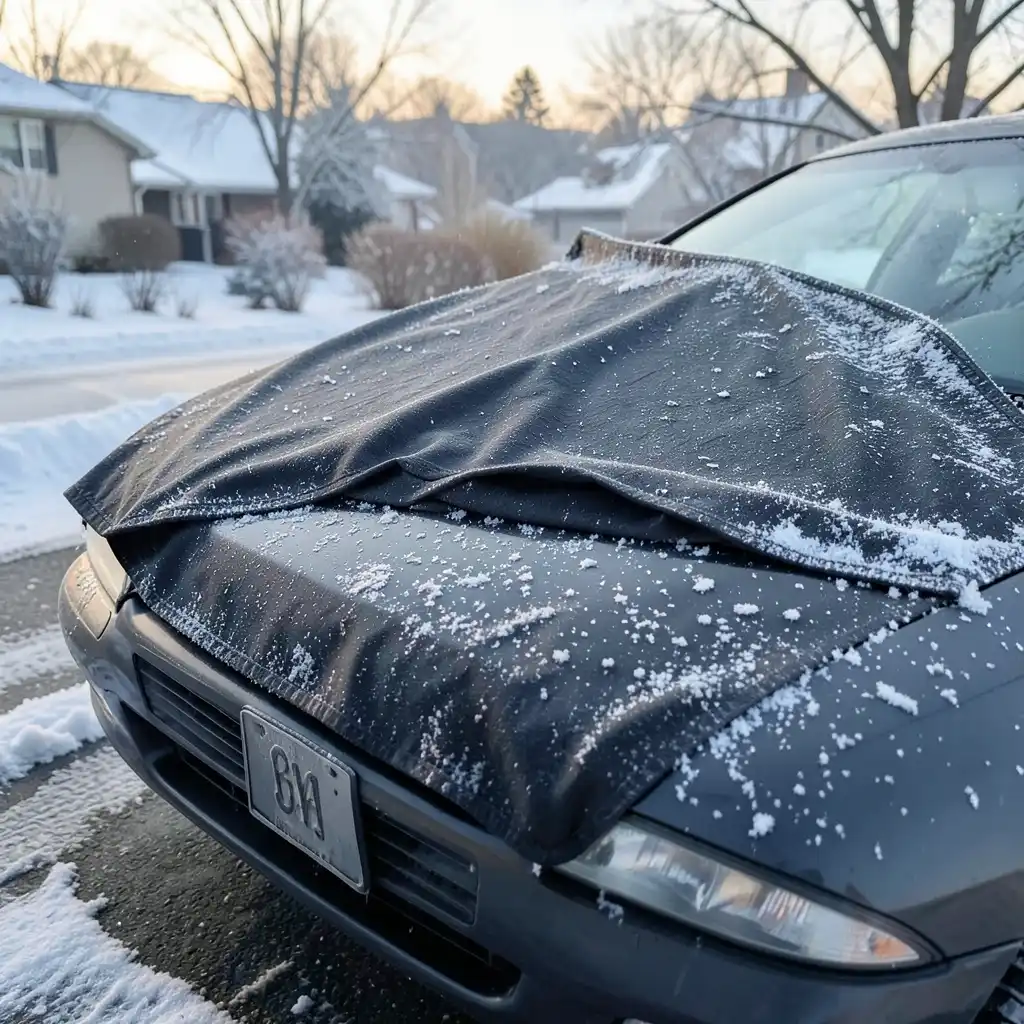
Windshield Frost Cover Guide: Sizes, Fit and Top Picks
Choose a windshield frost cover by windshield width first, then add 6–12 inches of side overlap if the shape allows it; compact cars usually fit medium covers, SUVs and trucks usually need large or XL. Too small leaves glass exposed and lets edges lift in wind. This guide maps windshield size, vehicle class, parking conditions, and cover style so you can choose the right fit fast.
Quick picks by fit and need
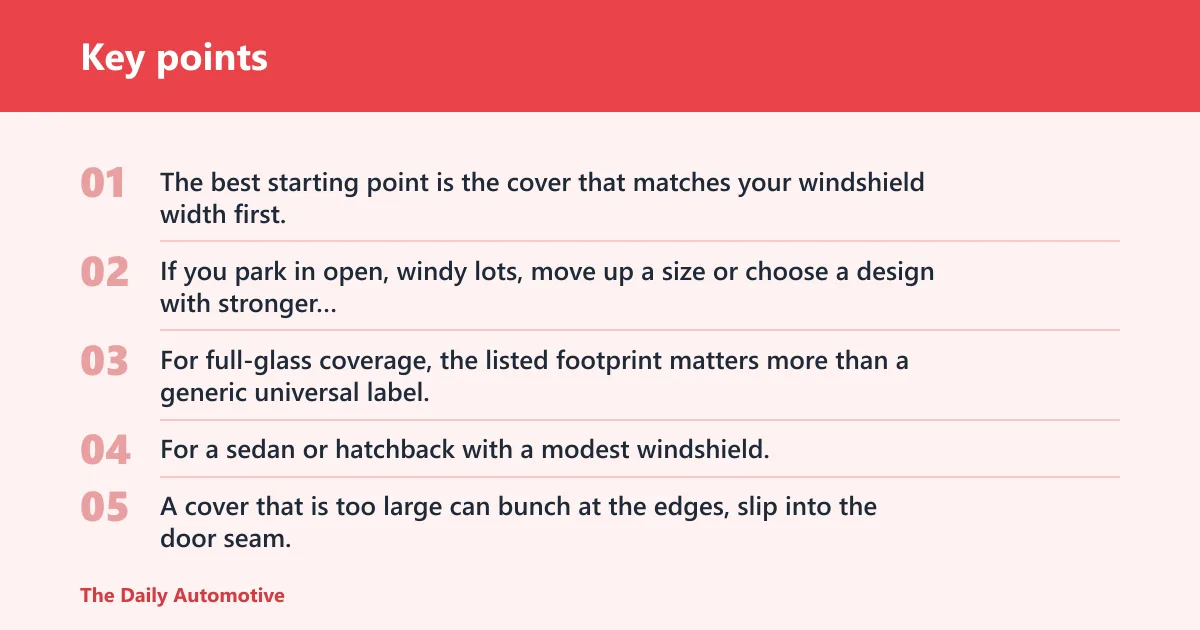


The best starting point is the cover that matches your windshield width first, then the parking conditions second. If you park in open, windy lots, move up a size or choose a design with stronger retention. For full-glass coverage, the listed footprint matters more than a generic universal label.
| Best for | Key spec from listing | Fit note | One honest drawback |
|---|---|---|---|
| Standard sedans and compact cars | FrostGuard Standard, 60 inches wide by 41 inches long | Urban Transit lists compact cars up to 63 inches for Standard | May leave less room for tall glass or oversized mirrors |
| Mid-size crossovers and larger sedans | EcoNour measures 69 inches by 42 inches | Fits many vehicles that need more width than a standard cover | Check mirror placement if your windshield sits low under a short roofline |
| SUVs and trucks | FrostGuard X-Large, 68 inches wide by 41 inches long | Urban Transit lists SUVs and trucks from 67 inches to 75 inches for Extra-Large | Large mirrors can still interfere with edge coverage |
| Windy parking and public lots | CAT Windshield Snow Cover measures 78 inches by 43 inches | Longer edges can help keep corners planted in exposed spaces | Extra overhang can be awkward around doors and mirrors |
| Year-round use | Tecoom lists a size of 68.5 inches by 47 inches | Broader height can help with frost, rain, and sun coverage | Confirm that the added height does not block door seals or mirrors |
Best for standard sedans and compact cars
For a sedan or hatchback with a modest windshield, Standard sizing is often the safer first choice. A cover that is too large can bunch at the edges, slip into the door seam, or block the mirror area. For many compact cars, a snug fit is easier to secure than a loose one.
FrostGuard Standard is listed at 60 inches by 41 inches, and Urban Transit says compact cars up to 63 inches can fit Standard. That gives a narrow band that works when your windshield is close to the listed footprint. If your car has a taller glass area, check whether the top edge still reaches the roofline.
Best for SUVs and trucks
Extra-Large sizing usually makes more sense when the windshield is wider, taller, or set high off the hood. Urban Transit places SUVs and trucks from 67 inches to 75 inches in the Extra-Large band, which is why many owners should start there rather than hoping a universal cover will stretch far enough.
FrostGuard X-Large is listed at 68 inches by 41 inches, while Eamefia uses a 75 inches by 45 inches footprint. That size spread matters. A truck with large mirrors or a tall windshield may need the larger footprint, while a smaller SUV may do better with the narrower X-Large if the goal is less excess fabric.
Best for windy parking and public lots
If the car sits in an open lot, retention matters as much as width. Anti-theft straps, mirror hooks, and magnetic edges help the cover stay planted when gusts hit the side. Public parking also makes removal resistance useful, since a loose cover is easier to pull off quickly.
Look for side mirror flaps, door anchors, or a magnetic edge system if your parking spot gets strong crosswinds. A magnetic edge can improve hold on oversized covers, but it can make installation slower and less forgiving around uneven panel gaps. For city parking, simpler strap routing may be easier to use every day.
What size windshield cover should you buy?
Buy by windshield width first, not by vehicle label. Standard often fits compact cars, while XL is the better starting point for many SUVs and trucks. If you are between sizes, choose the larger cover when the windshield is tall, the mirrors are wide, or the parking spot is exposed to wind.
Universal fit can be real, but only after you confirm the listed dimensions against your glass. A universal label does not change the fact that the cover must reach edge to edge and still anchor without blocking mirrors or door seams. The same model can work on several vehicles and still miss on one with a steep windshield angle.
Why windshield width matters first
Width decides whether the cover reaches the side edges before frost forms there. If the fabric stops short, the exposed strip can freeze first and defeat the point of the cover. A proper width also gives the strap or flap system enough material to stay in place.
Height matters too, but width usually decides the main fit failure. Too little width means exposed glass. Too much width may create loose folds that catch wind or pinch in the door. The best fit has coverage without excess slack at the corners.
When to size up
Size up when the windshield is tall, the side mirrors are oversized, the parking spot is windy, or the vehicle is an oversized SUV or truck. Urban Transit’s note to size up when between sizes is the right approach here. Extra coverage is safer than trying to stretch a short cover over a large glass area.
Suppose a driver measures a 66-inch windshield and parks in an open apartment lot. A Standard cover may fit on paper, but the corners can lift before dawn. An Extra-Large choice is more likely to stay planted and fully cover the glass.
How do you measure your windshield?
Measure the windshield width from edge to edge at the widest point, then check height for full coverage before you buy. Compare both numbers with the product listing, not just the “universal fit” claim. That is the simplest way to avoid a cover that leaves the top strip or the lower corners exposed.
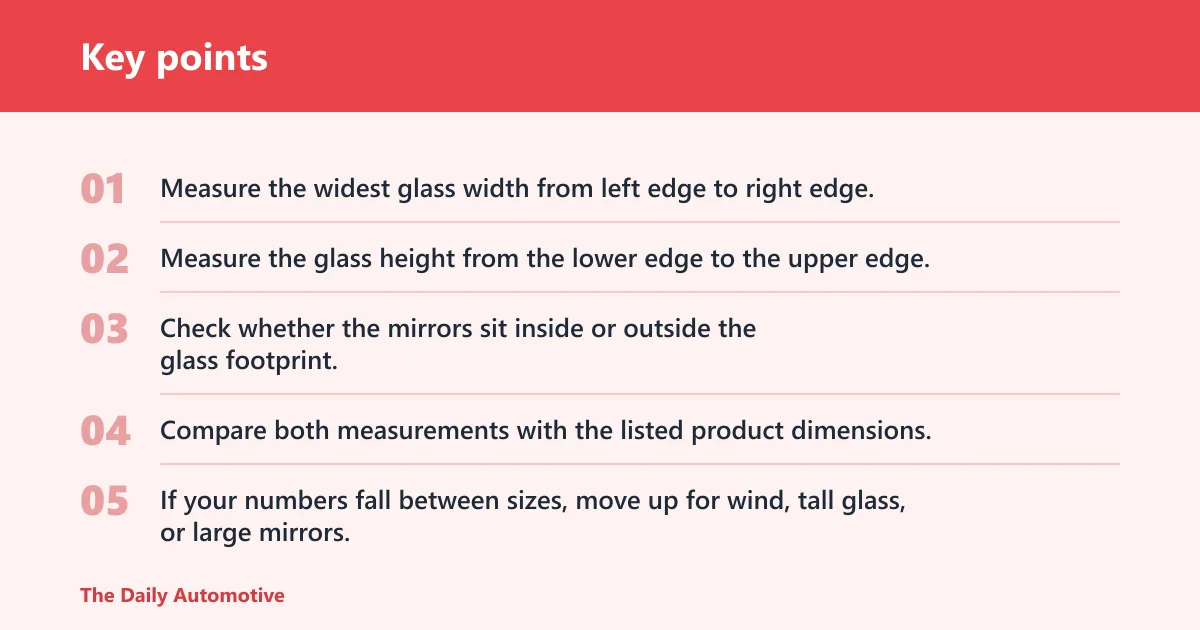
- Measure the widest glass width from left edge to right edge.
- Measure the glass height from the lower edge to the upper edge.
- Check whether the mirrors sit inside or outside the glass footprint.
- Compare both measurements with the listed product dimensions.
- If your numbers fall between sizes, move up for wind, tall glass, or large mirrors.
Measure width at the widest point
The widest point is the number that decides whether the cover reaches both edges. Do not measure only the center line if the windshield tapers near the roof. A taper can make a supposedly “wide enough” cover short on one side.
A common first-timer mistake is measuring the hood line and ignoring the top corners. That can lead to a cover that leaves a slim strip of glass exposed near the A-pillars, where frost often grabs first.
Measure height for full coverage
Height matters because the cover must reach high enough to shield the upper glass, yet still sit cleanly below the mirrors and door line. Products such as Tecoom at 68.5 inches by 47 inches and Eamefia at 75 inches by 45 inches show how much height can vary across listings.
If your roofline is short and the windshield is steep, a taller cover can bunch at the top edge. That is not always a deal-breaker, but it is a sign to check mirror clearance and door-seal placement before buying.
Compare measurements to listed dimensions
Read the listing dimensions literally. EcoNour is listed at 69 inches by 42 inches, CAT at 78 inches by 43 inches, and FrostGuard Plus at 68 inches by 41 inches. Those numbers tell you more than a generic vehicle class tag does.
If the listed width matches your windshield with a little extra room, the cover is more likely to sit flat. If the listed height is short, you may still get partial coverage, but the top corners and wiper area may remain exposed.
What keeps a cover from blowing off?
Straps, mirror flaps, hooks, and magnetic edges are the main retention tools. They help a windshield frost cover stay on overnight, especially in exposed parking. The best setup depends on where the car sits and how much wind pressure the cover will face.
Anti-theft straps and door anchors
Anti-theft straps help secure the cover in public lots and reduce removal risk. Many designs run the straps through the doors or around the side of the vehicle. That extra attachment point matters when someone might tug the cover or when wind tries to lift a corner.
Door anchors can also create pinch points. If a strap runs through the door seal, close the door gently and make sure the seal still seats properly. Follow the vehicle manual if any accessory interferes with weather stripping or door closure.
Side mirror flaps and hook points
Side mirror flaps add coverage and retention at the corners. They can tuck into the doors or hook around the mirrors, which helps resist wind displacement. They also help cover one of the most common weak points on a wide windshield: the outer edge near the mirror housing.
This feature is especially helpful on larger vehicles, where the mirrors sit farther out from the glass. It can also help on short rooflines, where the cover has less bodywork to grip.
Magnetic edge systems and wind tradeoffs
Magnetic edge systems can improve wind resistance on oversized options. They can be useful in gusty parking, but they may slow down installation because each edge needs to line up with the body panel. That tradeoff matters if you remove the cover every morning.
Magnets can also be awkward on vehicles with unusual panel shapes or tight gaps. If your parking is only mildly windy, a simpler strap-and-flap design may be easier to live with.
What is the difference between Standard and XL windshield covers?
Standard usually sits around the lower width band and suits compact cars or smaller sedans. XL is wider and often better for SUVs, trucks, and vans. The difference is not only the label size; it is whether the cover reaches the glass edges without pulling tight or leaving corners exposed.
When Standard is the safer bet
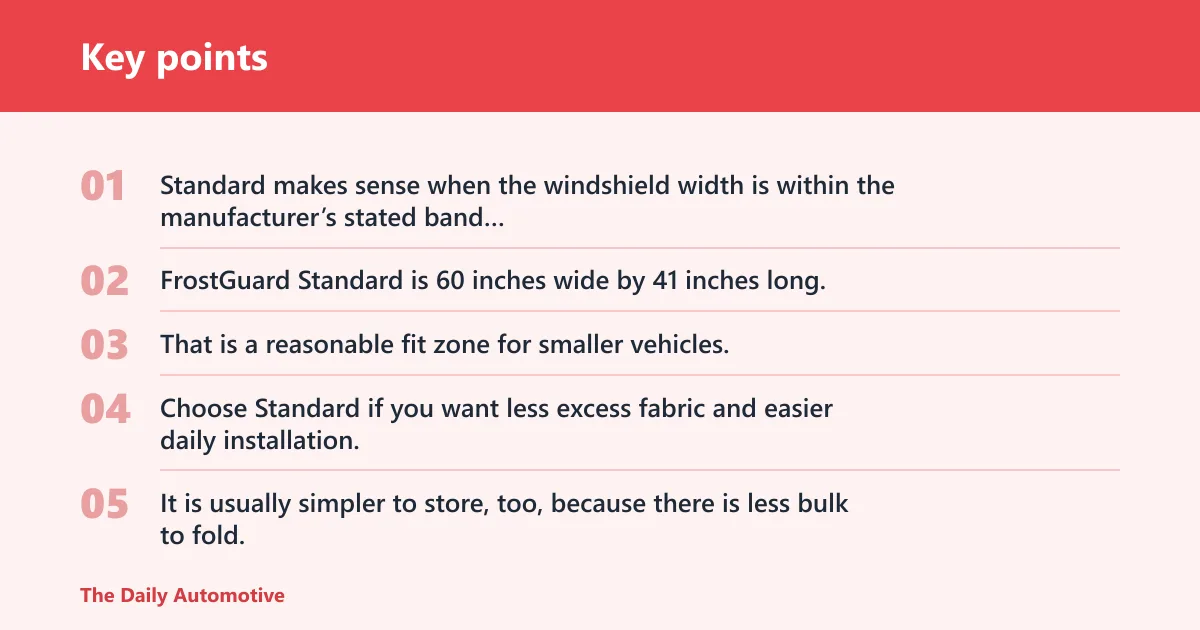
Standard makes sense when the windshield width is within the manufacturer’s stated band and the mirrors are not oversized. FrostGuard Standard is 60 inches wide by 41 inches long, and Urban Transit lists compact cars up to 63 inches for Standard. That is a reasonable fit zone for smaller vehicles.
Choose Standard if you want less excess fabric and easier daily installation. It is usually simpler to store, too, because there is less bulk to fold.
When XL is the better choice
XL is the better starting point for wider glass, taller windshields, and vehicles that sit high off the ground. FrostGuard X-Large is 68 inches wide by 41 inches long, while Urban Transit places SUVs and trucks from 67 inches to 75 inches in Extra-Large. That alignment makes XL the cleaner choice for many larger vehicles.
Say your SUV has a 70-inch windshield and large mirror housings. A Standard cover may reach the glass but fail at the corners, while an XL cover has a better chance of sitting flat and staying put.
How to choose the right cover
Start with dimensions, then decide how much retention and material durability you need. For wet snow and repeated folding, 600D Oxford fabric is often described as a heavy-duty choice, and some models pair it with a PU coating for added water resistance. PEVA outer layers are commonly used on multi-layer covers intended for broader weather use.
Material cues: 600D Oxford, PU coating, PEVA outer layer
600D Oxford fabric is common on higher-duty covers because listings tie it to durability and water resistance. If a model adds PU coating, that usually signals a stronger moisture barrier. A PEVA outer layer on a multi-layer design suggests a cover built for all-season use rather than a one-season stopgap.
Material alone does not guarantee fit. A tough cover that is too short still leaves glass exposed. A softer, well-sized cover can work better than a heavier one that rides up in the wind.
Security and storage features
Anti-theft straps matter most in public lots. Mirror flaps help with retention and coverage. Magnetic edges help in wind but can complicate setup. A storage pouch or case is useful because it keeps the cover folded for trunk or glove-box storage and helps with seasonal organization.
Those storage details sound minor until the first thaw. A compact pouch makes it easier to keep the cover clean and ready, rather than stuffing it loose into the cargo area.
Winter use versus year-round use
If the cover is only for winter mornings, focus on width, height, and retention. If you want sun and rain protection too, look for broader coverage and moisture-resistant materials such as PEVA layers or PU-coated fabric. The more seasons you expect it to handle, the more important storage durability becomes.
Will a universal windshield cover fit your SUV or truck? Sometimes yes, but only if the measurements line up and the mirror placement does not break the fit. For larger vehicles, universal fit should be treated as a starting claim, not a guarantee.
Frequently asked questions
What size windshield frost cover should I buy?
Buy the size that matches your windshield width first, then check height for full coverage. Standard often suits compact cars and smaller sedans, while XL is a better starting point for many SUVs and trucks. If your measurements fall between sizes, size up when the parking spot is windy or the mirrors are large.
How do I measure my windshield for a cover?
Measure the glass width at its widest point from edge to edge, then measure height for full coverage. Compare both numbers to the listed product dimensions before buying. If the cover barely matches width but has extra height, it may still work, provided the mirrors and door seals are clear.
Will a universal windshield cover fit my SUV or truck?
It may fit, but only if the listed dimensions match your windshield and the cover clears the mirrors. Universal fit is a useful shopping term, not a substitute for measurement. For SUVs and trucks, look for larger width bands and retention features that help the cover stay in place.
Are windshield frost covers worth it for winter mornings?
For drivers who scrape often, yes. A properly sized cover blocks frost, ice, and snow before overnight parking, so you start with a clear windshield instead of a frozen one. The value is highest for commuters, apartment parkers, and anyone who cannot keep the car in a garage.
What features keep a windshield cover from blowing off?
Anti-theft straps, mirror flaps, hook points, and magnetic edges are the main retention features. In public lots or windy parking, a cover that anchors at both the mirrors and the doors is less likely to shift overnight. If the wind is persistent, look for a design with multiple hold points.
Can a windshield frost cover also protect against sun and rain?
Some can, especially multi-layer models with PEVA outer layers or PU-coated fabric. Those materials can help with moisture resistance and broader weather use. Just check that the size still fits your windshield, because a cover that works for rain protection still has to stay flat through winter wind.
Products related to this article
Sponsored / affiliate links. As an Amazon Associate I earn from qualifying purchases. I may earn additional commission from eligible campaigns.
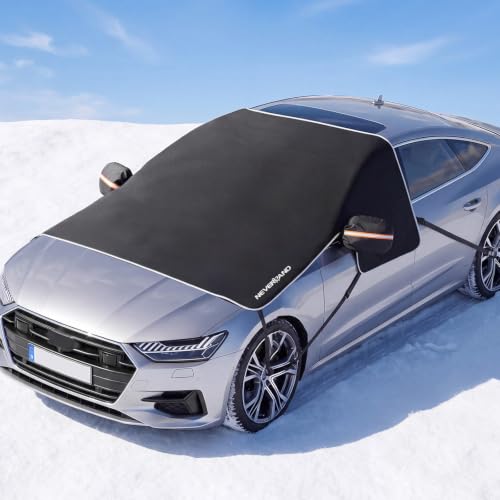 NEVERLAND Car Windshield Cover for Ice and Snow - Universal Windshield Snow Cover for Winter Frost Hail Guard with Side Window and Rearview Mirror Protector, Suitable for Most Cars, SUVs & Trucks
 Automost Windshield Cover for Ice and Snow Heavy Duty 600D Oxford Fabric Magnetic Windshield Protector for Car SUV Truck Windproof Waterproof Frost Cover with Side Mirror Covers (Large (74"x43"))