How To Clean Car AC Air Filter: Safe Reuse or Replace
The error means the article contains vague, unsupported, or misleading troubleshooting guidance.
You can clean a cabin air filter only if it is a reusable, washable type, and only with the method the vehicle maker allows. Most paper or activated-carbon filters are usually meant to be replaced rather than washed. Cleaning the wrong filter can damage the media, spread dust into the HVAC box, and leave odors or weak airflow. This guide shows how to inspect, clean, or replace the filter safely without damaging the HVAC system.
What you’ll need


- Owner’s manual
- Gloves
- Flashlight
- Vacuum with a soft brush attachment
- Clean, dry workspace
- Replacement cabin air filter, if the old one is not washable
- Trim tool or screwdriver only if your vehicle’s filter cover uses one
How to tell whether your car AC air filter can be cleaned
Start by identifying the filter media. Paper cabin filters are common and are usually replaced rather than washed. Gauze and foam filters are other common media, and only some reusable versions can be cleaned safely.
Reusable versus disposable cabin filters
A washable reusable filter should be labeled as such and usually has a frame and media built for service. A standard paper cabin air filter is a wear item. It keeps airflow steady inside the vehicle, then gradually loads up with dirt and debris.
Do not treat every filter as washable. The cabin air filter works as a barrier between car passengers and outside contaminants, while the 3 Essential Car Filters and How to Change Them blocks dust, debris, pollen, and insects from entering the engine assembly. They are different parts with different jobs.
When replacement is the safer choice
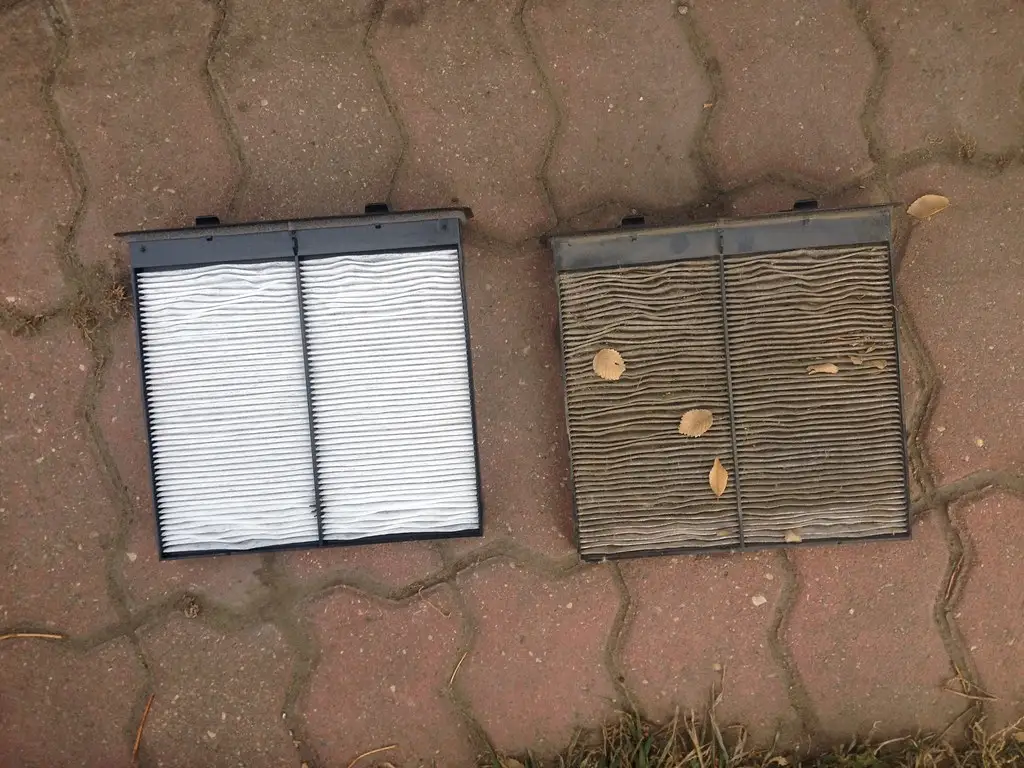
Replace the filter if it is wet, moldy, collapsed, torn, oil-soaked, or heavily loaded with debris. Those conditions can push contaminants back into the HVAC system. If the media is damaged or the frame is warped, cleaning is not a repair.
For example, if a filter has dark dust across the face and a damp corner after a storm, replacement is the safer choice because moisture and collapsed fibers can lead to odor and poor sealing.
| Filter type | Can it usually be cleaned? | Best choice |
|---|---|---|
| Paper cabin air filter | No | Replace |
| Gauze filter | Sometimes, if built as reusable | Clean only if the maker allows it |
| Foam filter | Sometimes, if built as reusable | Clean only if the maker allows it |
Where is the cabin air filter located in my car?
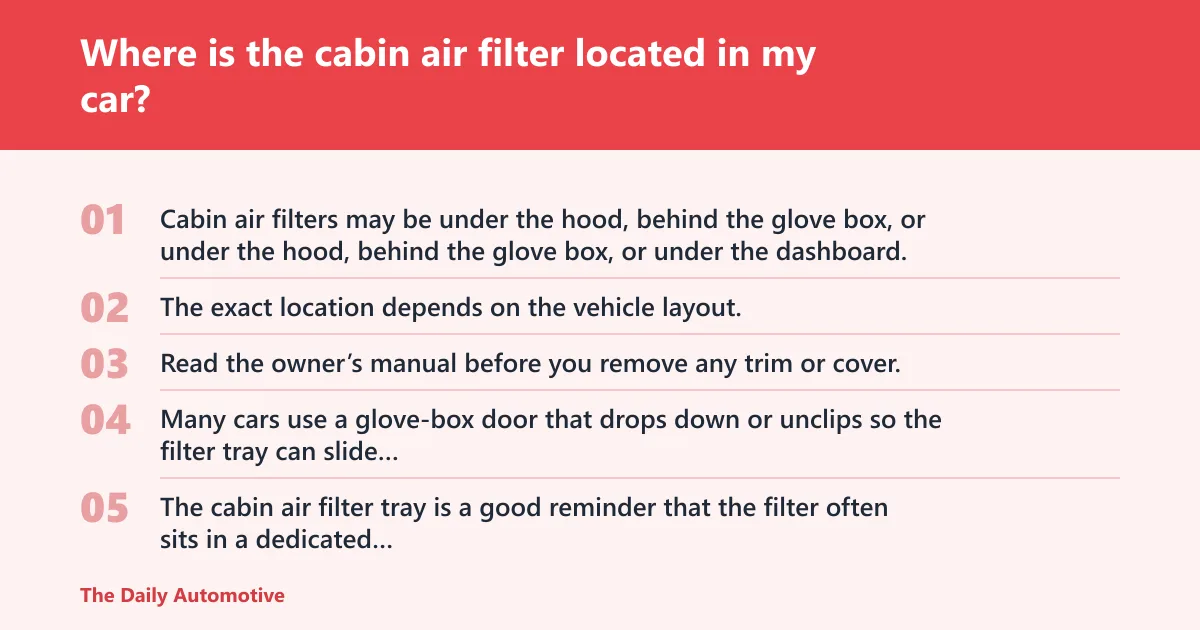
Cabin air filters may be under the hood, behind the glove box, or under the dashboard. The exact location depends on the vehicle layout, and access can range from a quick glove-box drop-down to a more awkward under-dash removal. Read the owner’s manual before you remove any trim or cover.
Behind the glove box
This is one of the easiest layouts. Many cars use a glove-box door that drops down or unclips so the filter tray can slide out. The cabin air filter tray is a good reminder that the filter often sits in a dedicated housing rather than loose in the dash.
Under the dashboard
Under-dash layouts usually take more time because the cover may be tucked above the passenger footwell. Use a flashlight and avoid forcing clips. If the cover resists, stop and check for a hidden fastener.
Under the hood
Some vehicles place the cabin filter near the cowl at the base of the windshield. These are often easier to spot, but water channels, rubber seals, and plastic cowl panels make careful reassembly important. A poor seal can let debris back in.
Easy-access versus difficult-access layouts
Easy-access filters can be checked in minutes. Harder layouts may require moving a panel, lowering the glove box, or removing a cover with clips. If the manual shows an involved path and the filter has not been changed in years, a shop may make more sense than forcing the housing.
5-minute inspection flow: clean, replace, or inspect the HVAC system
Use a quick inspection flow before any cleaning. In a few minutes, you can often tell whether the filter is reusable, needs replacement, or may point to an HVAC issue such as odor, moisture, or restricted ducting.
- Confirm the filter location in the owner’s manual.
- Remove the access cover without bending the tray or clips.
- Check the filter media type: paper, gauze, or foam.
- Look for dirt load, tears, warping, wet spots, and mold.
- Check for stale or musty odor coming from the housing.
- Decide whether to clean reusable media, replace disposable media, or inspect ducts and housing if the filter looks fine but the symptom remains.
Suppose a crossover SUV has a filter that looks dusty but dry, and the media is labeled reusable. A gentle vacuum may be enough. If the next filter still leaves the vents weak, the blower housing or cabin intake may need inspection instead of more filter cleaning.
How to remove and clean a washable cabin air filter
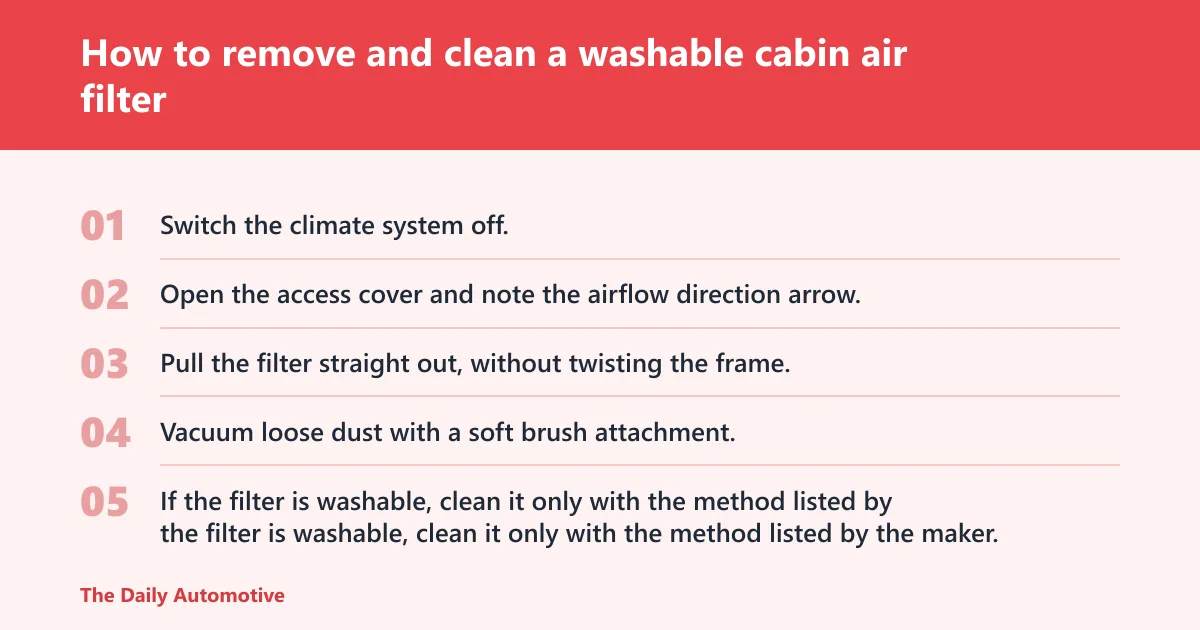
Remove the filter straight out so the frame does not bend. Clean only filters that are marked washable or reusable. For a reusable gauze or foam filter, use low-pressure air or a gentle vacuum from the clean side first, then follow the maker’s cleaning and drying directions if water cleaning is allowed.
- Switch the climate system off.
- Open the access cover and note the airflow direction arrow.
- Pull the filter straight out, without twisting the frame.
- Vacuum loose dust with a soft brush attachment.
- If the filter is washable, clean it only with the method listed by the maker.
- Dry it fully before reinstalling.
- Reinstall it with the airflow arrow in the same direction as the old filter.
If that didn’t work, try this next
- Inspect the housing for leaves, standing water, or broken seals.
- Check the blower speed at each setting to see whether airflow changes normally.
- Look for blocked ducts or a damaged cabin filter tray.
Do not reinstall a damp filter. Moisture can feed odor and can load the HVAC box with debris. Do not use compressed air at high pressure on thin paper media, because it can open tears that are hard to see.
What happens if the cabin air filter is clogged?
A clogged cabin air filter can reduce airflow, slow vent response, and make the HVAC system work harder than needed. It can also cause dust, odor, and uneven output from different vents. In severe cases, airflow falls enough that the cabin takes longer to cool or clear fog.
Strain on the HVAC blower
When airflow is restricted, the blower must push against more resistance. That does not mean every weak vent is a bad filter, but a filter packed with dirt and debris is a common place to start. If the filter is already new, look farther upstream.
Can a dirty air filter affect AC performance?
Yes. A dirty cabin filter can make the AC feel weaker because the system moves less air through the vents. It does not change refrigerant charge, but it can make cooling feel sluggish. If airflow improves after replacement, the filter was part of the problem.
Clean, replace, or pay for labor: time and cost comparison
Cleaning a reusable filter is usually the lowest-cost option if the media is designed for it. Replacing a standard cabin filter is often faster than cleaning and drying. Shop labor makes sense when the housing is hard to reach, the tray is damaged, or odor and water intrusion point beyond the filter itself.
| Option | Typical time | Typical cost pattern | Best for |
|---|---|---|---|
| Clean reusable media | 10 to 20 minutes plus dry time | Lowest parts cost | Reusable gauze or foam filters |
| Replace standard cabin filter | 5 to 15 minutes | Parts cost only | Most paper cabin filters |
| Shop labor | Variable | Parts plus labor | Difficult access or HVAC inspection |
Check the owner’s manual for the replacement interval and filter location. The manual usually lists the service point there, not in a generic schedule.
Prevention
Inspect the cabin filter at the same time you check the glove-box area or cowl panel for leaves and water. That simple habit helps keep the filter from loading up early and reduces repeat odor complaints.
Common mistakes
The biggest errors are washing a non-washable paper filter, reinstalling a damp filter, and ignoring signs of water intrusion. Another common mistake is confusing the cabin air filter with the engine air filter or oil filter. Those parts do different jobs and sit in different places.
- Washing a paper cabin filter instead of replacing it
- Reinstalling a filter that is still damp
- Forcing a bent frame back into the tray
- Skipping the airflow arrow on reinstall
- Ignoring a musty smell after a new filter is fitted
- Trying to clean a collapsed, torn, or moldy filter
Ignoring a recurring odor or water intrusion is a sign to inspect ducts, seals, and the housing. If the new filter still leaves the cabin smelling stale, the filter is probably not the only issue.
Frequently asked questions
How do I clean a car AC air filter?
Clean only a reusable cabin filter. Remove it, vacuum loose debris with a soft brush attachment, and use the maker’s approved method if water cleaning is allowed. Dry it fully before reinstalling. A standard paper cabin filter should be replaced instead of washed.
Can you clean a cabin air filter instead of replacing it?
Yes, but only if the filter is labeled reusable or washable. Most paper cabin filters are not meant to be washed. Replace any filter that is wet, moldy, torn, or heavily clogged, since cleaning will not restore damaged media or a warped frame.
Where is the cabin air filter located in my car?
It is usually behind the glove box, under the dashboard, or under the hood near the cowl area. The owner’s manual is the best place to confirm the exact location before you remove panels or covers. Layout varies a lot by vehicle.
What tools do I need to remove a car air filter?
For a cabin filter, a flashlight, gloves, and sometimes a small screwdriver or trim tool are enough. For inspection, a vacuum with a soft brush attachment helps. If the cover uses clips or a hidden fastener, the manual will usually note it.
How often should I replace the cabin air filter?
Follow the owner’s manual first, since service intervals vary by vehicle and driving conditions. Dusty roads, heavy pollen, and frequent city driving can shorten the interval. If airflow drops or the filter is visibly loaded, replace it sooner.
What happens if the cabin air filter is clogged?
Airflow through the vents drops, the HVAC blower works harder, and cooling can feel slower. A clogged filter can also cause dust or odor to linger in the cabin. If the symptom remains after replacement, inspect the housing, intake path, and ducts.
Is an engine air filter the same as a cabin air filter?
No. The engine air filter keeps dust, debris, pollen, and insects from entering the engine assembly. The cabin air filter works as a barrier between passengers and outside air contaminants. They are usually in different locations and should not be cleaned or replaced the same way.
Can a dirty air filter affect AC performance?
Yes. A dirty cabin air filter can reduce airflow enough to make the AC feel weaker or slower to respond. If a new filter does not fix the issue, the next step is to inspect the blower, seals, or HVAC housing rather than keep replacing filters.
Products related to this article
Sponsored / affiliate links. As an Amazon Associate I earn from qualifying purchases. I may earn additional commission from eligible campaigns.