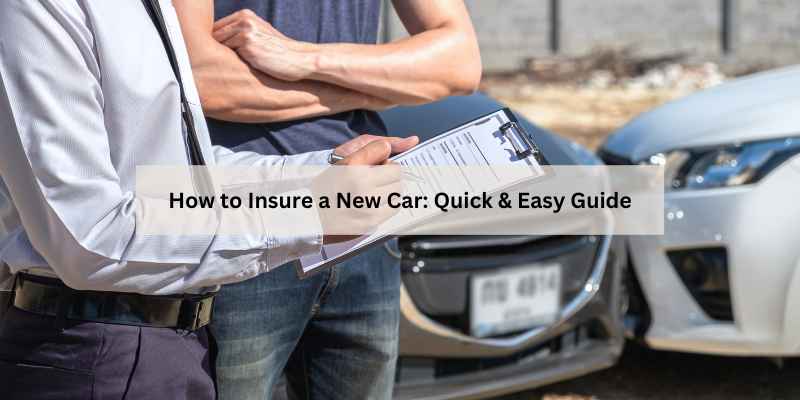
How to Insure a New Car: The Complete 2026 Guide
You just signed the paperwork. The finance manager shakes your hand, slides the keys across the desk, and says, “You’re all set.” Then you walk outside, sit in the driver’s seat, and a cold thought hits you: Am I actually covered to drive this thing home?
That moment confuses more people than almost any other part of buying a car. The dealership wants you to buy their policy on the spot. Your current insurer has rules about grace periods. And if you’re financing through a credit union, there’s a third set of requirements entirely. Get it wrong, and you could drive off with zero protection or pay hundreds more than you should.

Valardoh
Valardoh Premium Car Registration and Insurance Card…
- 【HIGH QUALITY】: made of premium PU leather and durable vinyl PVC, strong and firm enough for your long-term use.
- 【SAFE PROTECTION】: this insurance card holder keeps your document free from tearing, bending or being ruined by moisture.
- 【TIME SAVER】: clear inner pouches design helps you identify the correct document quickly with one glance.
This guide walks you through the entire process as a timeline: what to prepare before you buy, what to do during the 60-90 second window in the finance office, and how to handle your old policy after the trade-in. You’ll also see the real math on gap insurance, what coverage you actually need, and the exact numbers you should expect to pay. No fluff, just the steps.
Once you have your insurance cards sorted, keeping them organized in the glovebox makes a difference. A premium car document holder like the Valardoh model keeps your registration, insurance card, and driver’s license in clear pouches so you can find them fast during a traffic stop or after an accident. It’s a small purchase that saves you from digging through a pile of receipts and napkins.
Before You Buy: The 3 Things to Prepare
Walk into the dealership with three things ready. Doing this takes ten minutes and saves you from making rushed decisions under pressure.
1. Your Current Policy Details
Pull up your existing policy and write down your insurer’s phone number, your policy number, and the date your current coverage renews. You’ll need these to add the new car quickly. If you have a new car insurance guide saved, this is the moment to reference it.
2. The VIN
Ask the dealer for the vehicle identification number before you go to the finance office. You can get it from the window sticker or the driver’s side dashboard. With the VIN in hand, you can call your insurer and get an exact quote for that specific car while you’re still negotiating the price. No guesswork.
3. Your Budget for Insurance
Know what the car will cost to insure before you commit to the payment. A $400 monthly car payment looks fine until insurance adds another $200 on top. Call your agent, give them the VIN, and ask for the premium with your current coverages. Then ask what it costs with higher liability limits. The difference is usually small, and the protection is worth it.
The Grace Period: How Long You’re Actually Covered
Here’s the part most people misunderstand. If you already have an auto insurance policy, most insurers automatically extend coverage to a newly purchased car. This is called the grace period or automatic coverage extension. It typically lasts 14 to 30 days, depending on your insurer and state.
During that window, you have the same coverage on the new car that you carry on your oldest vehicle. If you have liability-only on a 2026 sedan, that’s all the protection your brand new car gets. Collision and comprehensive do not automatically apply unless you already have them on another vehicle.
Why the Grace Period Varies by State and Insurer
Some states mandate a minimum grace period. California requires 30 days. New York gives you 30 days as well. Other states leave it entirely up to the insurer, and some companies only offer 7 days. The worst-case scenario: you buy a car on a Friday, and your insurer’s grace period is 7 days, but you don’t call until the following Saturday. That’s a lapse.
Do not rely on the grace period as your plan. Call your insurer within 24 hours of purchasing the car. The grace period is a safety net, not a strategy.
Step-by-Step: How to Add a New Car to Your Existing Policy
Adding a car to an existing policy takes about 15 minutes on the phone. Here’s the exact process.
- Call your insurer or log in to your account. Have your policy number and the new car’s VIN ready.
- Tell them the effective date. You want coverage to start the moment you take ownership. If you’re buying today, say today. If you’re picking the car up tomorrow, set it for tomorrow.
- Confirm the coverage levels. The agent will likely mirror your existing coverages. Verify that includes collision and comprehensive if the car is financed or leased. Your lender requires it.
- Ask about the multi-policy discount. If you have home or renters insurance with the same company, adding the car might qualify you for a discount. Ask explicitly.
- Get proof of insurance. Ask for a digital copy emailed to you immediately. Most insurers also have a mobile app that updates within minutes. You’ll need this to drive off the lot.
- Pay the premium difference. Your insurer will bill you for the prorated amount. This might be a separate charge or added to your next renewal.
Pro tip: Do this before you go to the dealership, not after. If you already know the VIN, add the car to your policy the night before you pick it up. That way, the finance office never has a chance to sell you their overpriced policy.
What to Do If You’re Switching Insurers Instead
Switching insurers for a new car is common, but it requires coordination. You cannot cancel your old policy until the new one is active. Here’s the order:
- Get a quote from the new insurer using the VIN.
- Set the effective date for the new policy to match the day you take delivery.
- Complete the application and pay the first premium before you pick up the car.
- Receive your new insurance cards or digital proof.
- Only after the new policy is active, cancel the old one. Ask for a refund of any unused premium.
The risk here is a gap between cancellation and the new policy’s start. Double-check the effective date on the new policy before you cancel anything. A lapse in coverage, even for one day, can raise your rates for years.
At the Dealership: What to Say in the Finance Office
The finance and insurance office is where dealerships make their real profit. The person across the desk will present you with a binder of add-ons, including their own insurance product. You have about 60 to 90 seconds to make a decision, and they’re trained to make you feel like you’re being irresponsible if you hesitate.
Here’s what you say: “I already have coverage arranged through my insurer. I just need to show you proof of insurance so we can complete the sale.”
That’s it. You don’t need to explain, apologize, or listen to their pitch. If they push, repeat yourself calmly. If they claim your insurer won’t cover the car, politely disagree and hand them your insurance card.
The dealership’s insurance product is almost always more expensive than what you can get on your own. They’re not doing you a favor; they’re selling a product with a high commission. You can buy a policy online in less time than it takes to listen to their presentation.
One exception: if you have a poor driving record and no current insurer will take you, the dealership’s high-risk policy might be your only option. That’s a last resort, not a first choice.
The 4 Coverages Every New Car Needs (and 2 You Should Skip)
New car insurance is not the place to cut corners. Here’s what you need and what you can skip.
Must-Have Coverages
- Liability insurance. This pays for damage you cause to others. State minimums are almost always too low. A serious accident can easily exceed a $25,000 limit. Get at least $100,000 per person and $300,000 per accident. The cost difference between minimum and decent limits is often less than $15 a month.
- Collision coverage. This pays to repair or replace your car after an accident, regardless of fault. If you finance or lease, your lender requires it. Even if you pay cash, skip this only if you can afford to replace the car tomorrow.
- Comprehensive coverage. This covers non-collision damage: theft, vandalism, hail, fire, and hitting a deer. It’s usually cheap, often $100 to $200 a year, and it protects your investment from things you can’t control.
- Uninsured motorist coverage. About 1 in 8 drivers on the road has no insurance. If one of them hits you, this coverage pays your medical bills and car repairs. It’s inexpensive and worth carrying at the same limits as your liability coverage.
Coverages You Can Skip
- Rental reimbursement. This pays for a rental car while yours is in the shop. If you have a second car in the household, you don’t need it. If you don’t, the $20 to $30 per year might be worth it, but it’s not essential.
- Roadside assistance. Most new cars come with roadside assistance from the manufacturer for the first few years. Check your owner’s manual before you pay your insurer for a service you already have.
Gap Insurance: The Real Math on When It’s Worth It
Gap insurance covers the difference between what you owe on your loan and what the car is worth if it’s totaled. Here’s the concrete math.
You buy a car for $35,000 with a $5,000 down payment, financing $30,000. The moment you drive off the lot, the car depreciates roughly 20%. It’s now worth about $28,000. If you total it a month later, your standard collision coverage pays the replacement cost minus your deductible, which is about $27,000. But you still owe $29,500 on the loan. That $2,500 gap is your problem unless you have gap insurance.
Gap insurance costs anywhere from $200 to $600 as a one-time fee at the dealership, or $5 to $10 per month added to your auto policy. If you put less than 20% down or financed for more than 60 months, gap insurance is a smart buy. If you put 20% or more down, or you’re leasing, check your lease agreement first, as many leases include gap coverage already.
The dealership will try to sell you gap insurance for $800 or more. You can usually add it to your existing auto policy for a fraction of that cost. Ask your insurer first.
How Much Does It Cost to Insure a New Car? (Real Numbers)
Insurance rates vary wildly based on your location, driving record, credit score, and the car itself. But you need a baseline, so here are real 2026 averages from national rate data.
| Vehicle Type | Average Annual Premium (Full Coverage) | Monthly Cost |
|---|---|---|
| Compact Sedan (e.g., Honda Civic) | $1,650 | $138 |
| Mid-Size SUV (e.g., Toyota RAV4) | $1,850 | $154 |
| Luxury Sedan (e.g., BMW 3 Series) | $2,400 | $200 |
| Electric Vehicle (e.g., Tesla Model 3) | $2,900 | $242 |
| Sports Car (e.g., Ford Mustang GT) | $3,100 | $258 |
These numbers assume a 35-year-old driver with a clean record and good credit. If you’re under 25, have a ticket on your record, or live in a high-cost state like Michigan or Louisiana, expect to pay 50% to 100% more. If you bundle with home insurance and have a clean record for five years, you might pay 20% less.
How to Save Money Without Dropping Coverage
You don’t have to accept the first quote. Here are five ways to lower your premium without reducing your protection.
- Raise your deductibles. Moving your collision and comprehensive deductible from $500 to $1,000 can cut your premium by 10% to 15%. Only do this if you have that $1,000 in an emergency fund.
- Ask about every discount. Multi-policy, multi-car, anti-theft device, good student, defensive driving course, and paperless billing discounts all exist. Ask your agent to list every discount you qualify for.
- Shop around at renewal. Insurance companies change their pricing models constantly. The cheapest insurer for you this year might not be next year. Get quotes from three companies every six months.
- Choose a car with lower insurance costs. Before you buy, check insurance rates for the specific model. A Honda CR-V costs far less to insure than a Jeep Wrangler. Safety ratings, theft rates, and repair costs all factor into your premium.
- Pay in full. Many insurers charge a monthly installment fee of $3 to $10. Paying your premium in full every six months avoids those fees.
What to Do With Your Old Car’s Insurance Policy
Trading in your old car creates a paperwork problem that trips up a lot of people. You need to cancel the old policy, but you also need to avoid a lapse in coverage.
If you’re trading in the old car, call your insurer after the deal is done and tell them the old car is sold. They’ll remove it from your policy and adjust your premium. The effective date is the day you signed the trade-in paperwork. You’ll get a refund for the unused portion of your premium.
If you’re keeping the old car as a second vehicle, just add the new car to your existing policy. Both cars stay covered under the same policy, and you’ll get a multi-car discount.
If you’re selling the old car privately, keep the insurance active until the buyer takes possession. Once the title is signed over, cancel the coverage. Do not cancel before the title transfer is complete. If the buyer crashes the car while it’s still registered in your name, you could be held liable.
One more scenario: you’re gifting a car to a family member or adding a second car you already own. The process is the same as adding a new car. Call your insurer, give them the VIN, and confirm the effective date. You don’t need to go through a dealership at all.
Frequently Asked Questions
How long do I have to insure a new car after buying it?
Most insurers give you 14 to 30 days of automatic coverage if you already have an active policy. But this is not guaranteed. Some states mandate a minimum, while others leave it to the insurer. Call your insurer within 24 hours of purchase to be safe. Do not drive the car without confirming coverage.
Can I drive a new car off the lot without insurance?
Legally, you need at least state minimum liability insurance to drive any vehicle on public roads. If you have an existing policy, the grace period likely covers you. If you don’t have a policy, you cannot legally drive the car off the lot. The dealership will require proof of insurance before you leave.
Is gap insurance worth it on a new car?
It depends on your down payment and loan terms. If you put less than 20% down or financed for 72 months or longer, yes, gap insurance is worth it. If you put 20% or more down, the gap between your loan balance and the car’s value is small enough that you can skip it.
Does my credit score affect my car insurance rate?
Yes, in most states. Insurers use a credit-based insurance score to predict the likelihood of a claim. A poor score can raise your premium by 50% or more. The exceptions are California, Hawaii, and Massachusetts, where using credit scores for insurance pricing is prohibited.
What happens if I total a financed car without gap insurance?
Your collision coverage pays the actual cash value of the car, minus your deductible. If that amount is less than your loan balance, you owe the difference out of pocket. This is called being upside down on your loan. You’ll still have to make payments on a car you no longer own.
The Bottom Line
Insuring a new car comes down to doing three things in the right order. Prepare your current policy details and the VIN before you walk into the dealership. Add the car to your policy before you drive it off the lot. And handle your old car’s policy the same day you sign the paperwork.
Here’s what to remember:
- Call your insurer within 24 hours of buying the car, even if a grace period exists.
- Get at least $100,000/$300,000 liability limits, not the state minimum.
- Collision and comprehensive are required if you finance or lease.
- Say no to the dealership’s insurance product unless you have no other option.
- Buy gap insurance from your auto insurer, not the dealership, if you put less than 20% down.
- Cancel your old car’s policy only after the title is transferred.
- Shop for quotes every six months; loyalty doesn’t pay in insurance.
Follow these steps, and you’ll never face a coverage gap or overpay at the finance desk. The process is manageable if you handle it in the right order.
Products related to this article
Sponsored / affiliate links. As an Amazon Associate I earn from qualifying purchases. I may earn additional commission from eligible campaigns.