Walker Products ABS Sensor Review: Worth the Money Today?
Walker Products ABS sensors are a smart buy if you need an OE-style fit and a lower-cost repair, but only when the connector, lead length, and mounting style match the original part exactly. A wrong sensor can keep the ABS lamp on, shut traction control down, and turn one repair into two. I’d compare Walker with OEM and other aftermarket parts on fit, corrosion resistance, code recovery, and comeback risk.
Verdict: is Walker Products a good ABS sensor brand?
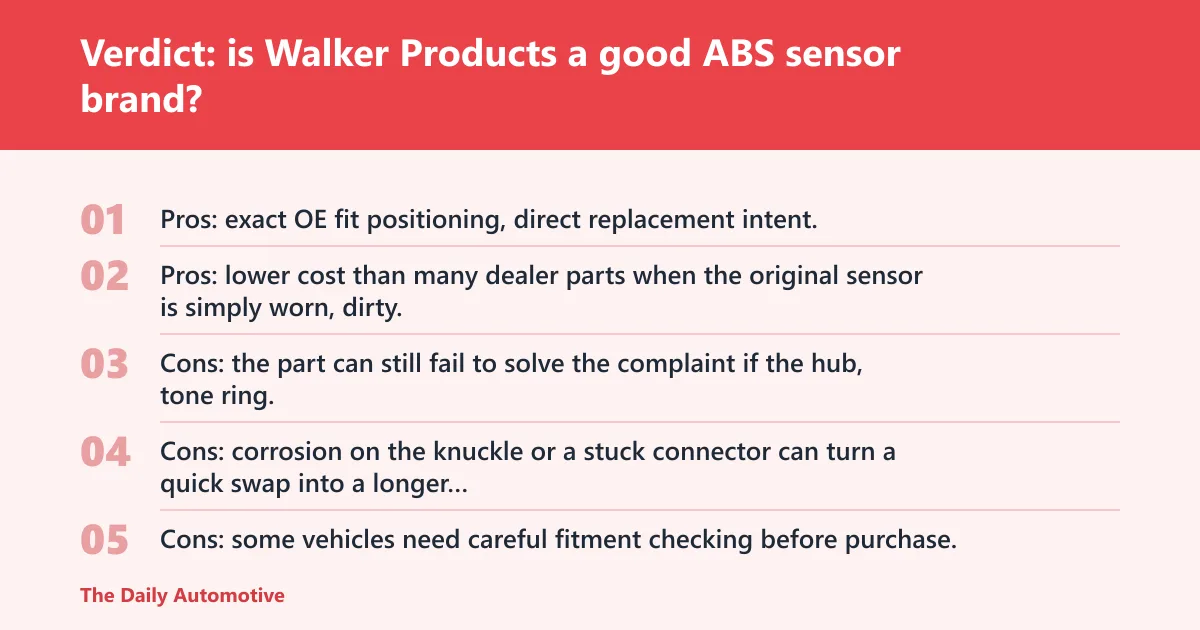

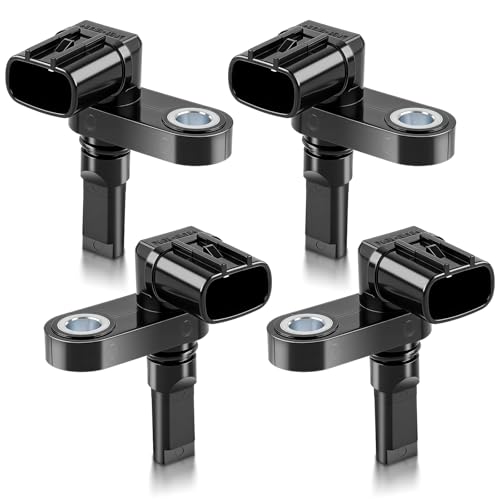
Walker Products is a good ABS sensor brand when the job calls for a direct replacement with exact OE fit and the original connector layout lines up cleanly. The brand’s own claim of stainless steel and high-temperature plastics helps here, especially on trucks and winter cars where rust and heat punish cheap parts.
The catch is diagnosis. If the fault is a hub bearing, damaged tone ring, or broken wiring, a new sensor will not fix it. Walker looks strongest as a fit-first replacement, not as a cure for every ABS lamp or traction control warning.
Pros and cons
- Pros: exact OE fit positioning, direct replacement intent, stainless steel and high-temperature plastics, and over 75 years of sensor manufacturing experience.
- Pros: lower cost than many dealer parts when the original sensor is simply worn, dirty, or electrically open.
- Cons: the part can still fail to solve the complaint if the hub, tone ring, or wiring is the real fault.
- Cons: corrosion on the knuckle or a stuck connector can turn a quick swap into a longer repair.
- Cons: some vehicles need careful fitment checking before purchase, especially for lead length and connector shape.
📊 Walker says it has over 75 years of experience in sensor manufacturing. Source: Anti-lock Brake System (ABS) Sensors.
Who is Walker Products ABS sensor for?
Walker Products ABS sensors fit the buyer who wants an OE-style replacement without paying dealer money, and who is willing to verify the exact part match before ordering. It is also a solid choice for daily drivers with a clear wheel-speed sensor fault, where the original connector and mounting style are easy to match.
It is a weaker choice for a vehicle with repeated corrosion problems, odd fitment history, or a diagnosis that still points to the hub assembly or wiring. In those cases, an OEM sensor or a higher-tier aftermarket part can be worth the extra spend.
Best-fit buyer profiles
- DIY shoppers replacing a failed wheel speed sensor on a common late-model car, crossover, or light truck.
- Owners who need exact OE fit and do not want to modify brackets, clips, or connectors.
- Drivers dealing with an ABS warning light and a code that clearly points at one corner.
When to choose OEM or a higher-tier aftermarket part instead
- When the original part sits in heavy salt, road spray, or brake dust and the old sensor was fused into the knuckle.
- When the vehicle has had repeated ABS faults after prior repairs.
- When connector seals, wiring route, or lead length have to be exact because the factory layout is tight.
How the sensor, hub, and module work together
An ABS wheel speed sensor sits at each wheel, measures individual wheel rotation speed, and sends that signal to the ABS control module. The module compares the wheel signals, then pulses brake pressure to help prevent wheel lockup during hard braking. On some vehicles, the ABS control module can also communicate with the ECU.
That simple chain is why diagnosis matters. The sensor may be innocent. A cracked tone ring, loose hub bearing, or damaged wiring can create the same warning light and the same complaint.
ABS wheel speed sensor basics
Most buyers use “ABS sensor” and “wheel speed sensor” to mean the same part. On the repair side, that usually works. The important point is the function: the sensor is reading wheel rotation, not brake pad wear or hydraulic pressure.
ABS control module logic
The ABS control module uses the sensor inputs to spot a wheel that is slowing faster than the others. It then modulates brake pressure to keep the tire rolling. That is how steering control stays usable on a panic stop, especially on split-traction pavement.
Why a hub or wiring fault can mimic a bad sensor
A bad wire, broken connector terminal, rust around the sensor bore, or a worn hub bearing can distort the signal. The scan tool may still show a wheel-speed fault. That is why parts-swapping without testing often wastes time and money.
What should you look for before buying a Walker ABS sensor?
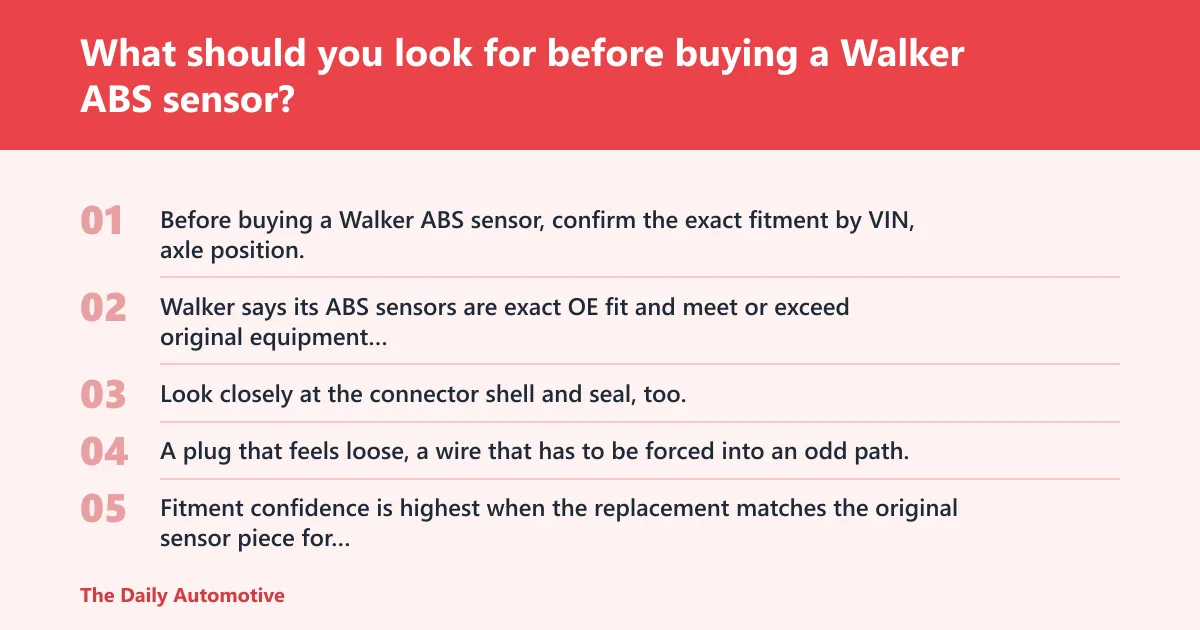
Before buying a Walker ABS sensor, confirm the exact fitment by VIN, axle position, connector shape, lead length, and mounting style. Walker says its ABS sensors are exact OE fit and meet or exceed original equipment specifications, but that promise only helps if the part matches the car that is actually in the bay.
Look closely at the connector shell and seal, too. A plug that feels loose, a wire that has to be forced into an odd path, or a mounting ear that does not sit flat can create a comeback even when the sensor itself is fine.
Fitment confidence and vehicle match
Fitment confidence is highest when the replacement matches the original sensor piece for piece. That includes front left versus front right, wiring style, and whether the sensor mounts at the knuckle or as part of a hub assembly.
Connector shape, lead length, and mounting style
These three details matter more than buyers expect. A connector that is the right color can still be wrong. A lead that is a little short can pull tight on full lock or suspension travel, and a mount that does not seat fully can affect the air gap.
Corrosion resistance and sealing cues
Walker’s stainless steel and high-temperature plastics are the kind of materials that make sense in this job. They do not erase rust from the vehicle, but they give the replacement part a better chance of surviving heat, spray, and winter grime than a very cheap sensor body.
Can a Walker ABS sensor fix the warning light and traction control fault?
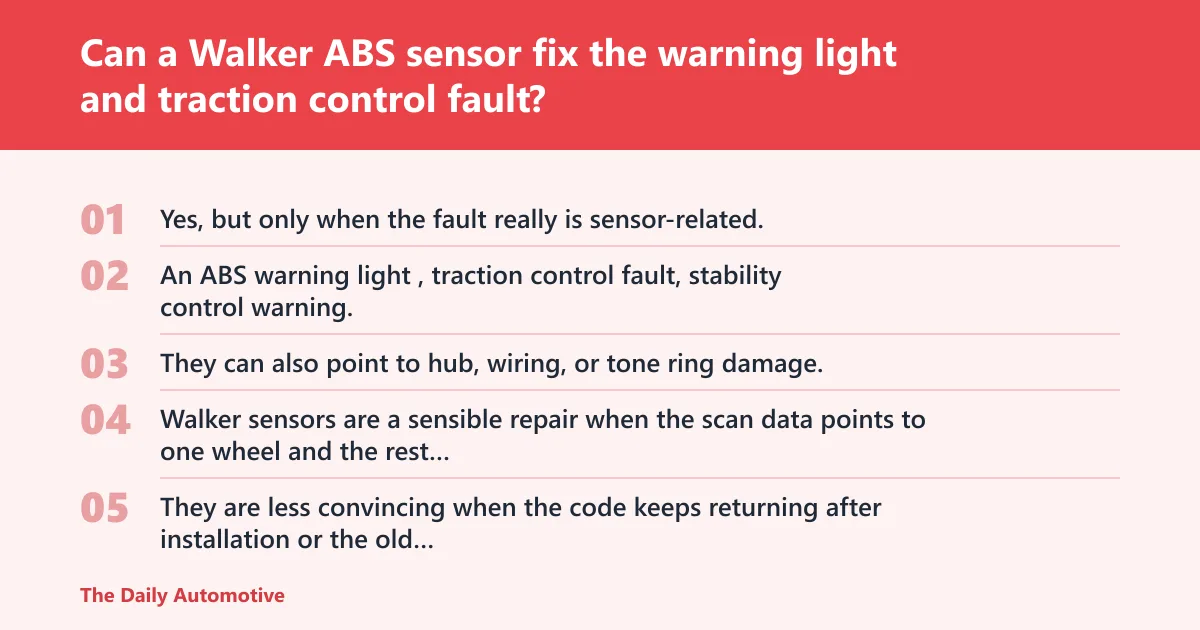
Yes, but only when the fault really is sensor-related. An ABS warning light, traction control fault, stability control warning, pulsating brake pedal, or longer stopping distances can all fit a wheel-speed sensor problem. They can also point to hub, wiring, or tone ring damage, so the code and signal data matter.
Walker sensors are a sensible repair when the scan data points to one wheel and the rest of the system looks healthy. They are less convincing when the code keeps returning after installation or the old sensor was not the actual failure.
Which symptoms point to the sensor
A single-wheel code, an intermittent warning light, or a speed signal that drops out over bumps often points toward the sensor or its connector. If the symptom changes when the wiring is moved, that also leans toward wiring.
Which symptoms usually point to hub, tone ring, or wiring trouble
If the code follows wheel bearing noise, rough hub play, or visible rust damage around the reluctor, the sensor may be only the messenger. Broken wires, water intrusion, and poor connector tension are common reasons for repeat faults after a sensor swap.
Codes that fit a wheel-speed sensor failure
Walker lists C0035 as Left Front Wheel Speed Circuit Malfunction, and C0196 as Yaw Rate Circuit Malfunction. Other wheel-speed related codes can include C0040, C0041, C0045, C0050, C0051, C0277, C0278, C0279, and C0280. Those codes point the diagnosis toward the corner named by the scan tool, but they do not prove the sensor is guilty by itself.
Walker ABS sensor verdict by real-world install factors
| Vehicle or fault scenario | Fitment confidence | Corrosion-risk notes | Diagnosis confidence | Likely install pain points | Sensor-related or hub/wiring-related? |
|---|---|---|---|---|---|
| Clear single-wheel code on a late-model sedan | High if connector and lead match | Moderate; surface rust at the mount is common | High if scan data matches one corner | Clip removal, routing the wiring cleanly | Often sensor-related |
| Rust-belt truck with fused sensor and crusted knuckle | Medium; verify mount style closely | High; rust can attack the bore and connector seal | Medium; hub damage is common here | Rusted fasteners, broken old sensor, cleanup time | Often hub/wiring-related |
| ABS light with traction control fault after wheel bearing noise | Medium | Moderate to high | Low until bearing play is checked | Hub removal, tone ring inspection | Often hub-related |
| Intermittent code that changes when wiring is moved | High if part number matches | Low to moderate | High for wiring diagnosis, not sensor certainty | Tracing wiring, connector terminal checks | Often wiring-related |
| Yaw rate fault, C0196, with stability control warning | Depends on vehicle and module location | Usually low at the sensor body, higher at connectors | Low for wheel sensor replacement alone | Scan-tool diagnosis, relearn or calibration steps | Often module, calibration, or wiring-related |
What tools do you need to diagnose and install it?
You need a scan tool that can read ABS codes, basic hand tools, and a way to clean rust from the mounting area. A jack, stands, wire brush, pick, and torque wrench are standard. On some jobs, a scan-tool relearn or code clear is needed after the repair.
The scan tool is the key item. Without live wheel-speed data, a buyer can spend money on the wrong corner and never know why the light came back.
Scan tool and code checks
Start by reading the ABS and traction control codes, then look at live wheel-speed data during a slow road test. If one wheel drops out, spikes, or reads dead while the others stay normal, that wheel becomes the focus.
Basic hand tools and rust cleanup
Expect broken clips, stubborn fasteners, and rust packed around the sensor bore. Clean metal helps the new sensor sit at the right height and keeps the seal from fighting corrosion.
When a relearn or code clear is needed
Some vehicles clear the fault after a normal drive cycle. Others need a scan-tool command. If the module stores a hard fault or the ABS light returns right away, the underlying problem probably was not solved.
How do I know if my ABS sensor is bad?
A bad ABS sensor may show up as an ABS warning light, a code tied to one wheel, and live data that drops out or reads erratically. Longer stopping distances under heavy braking can happen too. The symptom pattern matters more than the lamp by itself.
If the scan data is clean, the sensor may not be the problem. Check the hub, tone ring, wiring, and connector before ordering another part.
Is an ABS sensor the same as a wheel speed sensor?
In most repair conversations, yes. ABS sensor and wheel speed sensor are used as interchangeable terms for the part that reads wheel rotation and sends the signal to the ABS control module. The job name changes; the function does not.
The only caution is system layout. Some vehicles combine functions differently, so the exact location and connector style still need to match the car.
What ABS fault codes can point to a bad sensor?
Codes such as C0035, C0040, C0041, C0045, C0050, C0051, C0277, C0278, C0279, and C0280 can all point toward wheel-speed circuit trouble. C0196 points to a yaw rate circuit malfunction, which is a different sensor and a different diagnosis path.
Codes tell you where to start, not what to replace. A circuit fault can come from the sensor, the connector, the wire, or the hub signal source.
Will a Walker ABS sensor restore traction control and ABS light issues?
It can, if the failed part is the wheel speed sensor and the rest of the circuit checks out. When the warning light is caused by a bad connector, rusted hub, damaged tone ring, or lost calibration, the new sensor may not restore the system by itself.
That is why the repair should follow code confirmation and live-data checks. Parts replacement without diagnosis is the fastest way to buy a repeat visit.
How do I choose the right ABS sensor replacement for my car?
Choose the replacement by VIN, wheel position, connector shape, lead length, and mounting style before price enters the discussion. Confirm whether the original part is a wheel speed sensor at the knuckle, a hub-integrated unit, or another design. Then compare OEM, Walker, Bosch, ACDelco, and economy aftermarket options on fit and comeback risk.
If the vehicle lives in salt, the connector is buried, or the original part was seized in place, paying more for stronger sealing or better OE-matching detail can save labor later. If the match is clean and the diagnosis is solid, Walker is often the sensible middle ground.
Frequently asked questions
Is Walker Products a good ABS sensor brand?
Walker Products is a good ABS sensor brand for buyers who want an OE-style replacement with exact fit claims and sensible material choices. It is strongest when the diagnosis is already clear and the original sensor layout is easy to match. If the car has a deeper wiring or hub issue, no sensor brand can fix that alone.
What does a Walker ABS sensor fit?
A Walker ABS sensor fits vehicles that match its exact connector, lead length, and mounting style. That can include many domestic and import applications, but the real check is vehicle-specific fitment, not broad model family names. A close visual match is not enough when the wiring or bracket differs.
How do I know if my ABS sensor is bad?
Use the scan tool first. A bad sensor usually produces a wheel-specific ABS code, an ABS warning light, and erratic or missing wheel-speed data on live readings. If the code stays on one corner and the wiring checks out, the sensor becomes a much stronger suspect.
Is an ABS sensor the same as a wheel speed sensor?
Most of the time, yes. The terms are commonly used for the same part that reads wheel rotation and sends the signal to the ABS control module. The system name changes from one manual to another, but the basic function is the same.
What ABS fault codes can point to a bad sensor?
C0035, C0040, C0041, C0045, C0050, C0051, C0277, C0278, C0279, and C0280 can point toward wheel-speed circuit faults. C0196 points to a yaw rate circuit malfunction. These codes identify the area to inspect, but they do not rule out hub, wiring, or connector trouble.
What tools do I need to diagnose an ABS sensor?
A scan tool with ABS access is the main tool. Add a jack and stands, basic hand tools, a wire brush, picks for clips, and a torque wrench. On some vehicles, you will also need a scan-tool clear function or relearn command after the repair is complete.
Products related to this article
Sponsored / affiliate links. As an Amazon Associate I earn from qualifying purchases. I may earn additional commission from eligible campaigns.