IndyCar vs F1: Which Series Should You Watch?
You flip on the TV Saturday morning. A pack of open-wheel cars screams down a street course, wheels touching at 190 mph. Sunday, another race, different cars, different tracks. Both look similar at a glance — open wheels, wings, helmets. But the two series are worlds apart in almost every way that matters.
This guide breaks down the real differences between IndyCar and Formula 1, from the hardware to the driver experience to the economics. You’ll walk away knowing which series offers better racing, which is more accessible to follow, and which one deserves your Sunday afternoon.

Bburago
Bburago 1:24 2023 Race Oracle RB19 Model…
- Oracle Red Bull Die-Cast Race Vehicle in 1/24 scale
- Die-Cast Metal Body with Plastic Parts
- Driver with helmet included
If you’re a fan looking to bring a piece of the action home, the Bburago 1:24 Red Bull RB19 model with Verstappen’s helmet is a great desk companion while you study the differences.
IndyCar vs F1: The Quick Answer
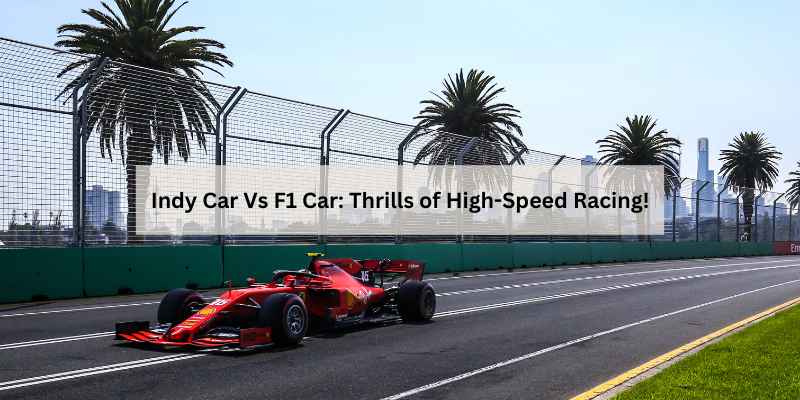
F1 is the pinnacle of engineering. Every team builds a custom chassis, develops its own hybrid power unit, and spends hundreds of millions chasing tenths of a second. IndyCar is a spec series. Every car uses the same Dallara chassis, the same aeroscreen, and one of two engine suppliers. That changes everything about how the racing plays out.
On a road course, an F1 car is roughly 10-15 seconds per lap faster than an IndyCar. At a track like COTA, F1 pole sits around 1:32, while IndyCar’s best is around 1:46. But on an oval, IndyCar hits 235+ mph, while F1 tops out around 230 mph at Monza. The gap shrinks dramatically.
Here’s the trade-off: F1’s tech is dazzling, but the racing can be processional. IndyCar’s spec parts keep the field tight, leading to more lead changes and closer finishes. Which is better? Depends on what you value.
The Cars: Chassis, Engines, and Hybrid Tech
F1’s Custom Chassis vs IndyCar’s Spec Parts
F1 teams design their own chassis from scratch. The result is a car that’s a bespoke engineering masterpiece — but it also means the gap between the best and worst teams is enormous. Red Bull and Mercedes fight for wins while Haas and Williams struggle to score points. The cost cap (around $135 million per year) has tightened things, but the top teams still spend every dollar better.
IndyCar is the opposite. Every team buys the same Dallara DW12 chassis. The aeroscreen is mandatory, and the aero kit is largely identical across the grid. That doesn’t mean the cars are identical — teams tune suspension, dampers, and setup — but the differences are measured in hundredths of a second, not seconds.
The result? In IndyCar, a driver like Scott Dixon can win in a midfield team’s car. In F1, even a generational talent like Fernando Alonso needs a top-three car to win. That’s not a knock on F1; it’s just the reality of a constructor series.
Horsepower and Power Units Compared
F1’s current hybrid power unit combines a 1.6-liter V6 turbo with an MGU-K and MGU-H. Total output is around 1,000 horsepower, with the electric motor contributing about 160 hp. The energy recovery system is complex, harvesting heat from the turbo and kinetic energy from braking.
IndyCar’s engine is simpler: a 2.2-liter twin-turbo V6 producing around 550-700 hp, depending on the track and boost level. In 2026, IndyCar added a hybrid unit that gives an extra 60 hp for overtaking, but the system is far less sophisticated than F1’s. The push-to-pass system — which gives drivers an extra 60 hp for a limited time — is a manual button, not a strategic energy management tool.
The power-to-weight ratio tells the story. An F1 car weighs about 1,760 pounds with driver and makes 1,000 hp. An IndyCar weighs around 1,650 pounds and makes 700 hp. That’s a significant gap in acceleration and top-end speed on road courses.
On-Track Performance: Speed, Downforce, and Tires
Top Speed vs Cornering Grip
F1 cars generate massive downforce — around 1,600 pounds at 150 mph. That lets them corner at speeds that feel physically impossible. At Silverstone’s Copse corner, F1 cars take it flat-out at 180 mph. IndyCar’s downforce is lower, maybe 1,200 pounds, so drivers have to brake earlier and carry less speed through high-speed corners.
But on ovals, IndyCar is king. The low-downforce superspeedway package lets cars hit 235 mph at Indianapolis. F1’s top speed record is 231 mph, set by Valtteri Bottas at Monza in 2026, but that was with a tow and DRS. Without those, F1 tops out around 220 mph on most tracks.
The cornering difference is stark. An F1 car pulls 5-6 G in high-speed corners; an IndyCar pulls 4-5 G. That sounds small, but it’s a massive gap in driver workload and tire stress.
Tire Compounds and Fuel Strategy
F1 uses Pirelli tires with five dry compounds, from hard (C1) to soft (C5). Each race weekend, Pirelli selects three compounds, and teams must use two different ones during the race. The tires degrade quickly, so pit strategy is a chess match. Fuel is also limited to 110 kg per race, so drivers manage fuel every lap.
IndyCar uses Firestone tires with only two dry compounds — primary and alternate. The alternate (red) is softer and faster but wears out quickly. There’s no mandatory tire change rule, so teams can run the whole race on one set if they want. Fuel strategy is simpler: no refueling, but drivers still save fuel to avoid a late-race splash-and-dash.
The tire difference changes the racing. In F1, tire degradation forces pit stops, creating strategy windows. In IndyCar, the alternate tire gives a speed boost for overtaking, but the durability gap is smaller. That’s why IndyCar races often have fewer pit stops and more on-track action.
Race Weekend: Qualifying and Race Formats
F1’s qualifying is a three-part knockout. Q1 (18 minutes) eliminates five cars, Q2 (15 minutes) eliminates five more, and Q3 (12 minutes) decides the top 10. Each session uses the softest tire, and drivers can only do a limited number of laps. The system rewards raw one-lap pace.
IndyCar’s qualifying depends on the track. Road and street courses use a similar knockout format, but ovals use a two-lap average system. That’s unique — drivers do two timed laps, and the average determines their starting spot. It rewards consistency over a single hot lap.
Race length also differs. F1 races are capped at 190 miles or two hours, whichever comes first. IndyCar races vary wildly — the Indy 500 is 500 miles, while road races are typically 200-300 miles. That means fuel strategy plays a bigger role in IndyCar, especially at Indianapolis, where fuel windows create constant strategy shifts.
The points system is another difference. F1 gives points to the top 10 (25 for a win, down to 1 for 10th). IndyCar gives points to the top 15 (50 for a win, down to 15 for 15th). IndyCar also awards a bonus point for pole position and for leading a lap. That keeps the championship tighter and rewards consistency.
The Driving Experience: G-Forces and Driver Workload
Drivers in both series are elite athletes, but the physical demands differ. F1 cars generate higher cornering G-forces — up to 6G in high-speed corners. That pulls on the neck and core constantly. Drivers train specifically for that, and even then, a 90-minute race leaves them exhausted.
IndyCar drivers face different challenges. On ovals, they experience sustained lateral G-forces for laps at a time, but the forces are lower — around 4G. The bigger issue is heat. Cockpit temperatures can reach 140°F, especially at street courses like St. Petersburg or Detroit. Drivers lose several pounds of sweat during a race.
Steering effort is also different. F1 cars have power steering, but the hydraulic assist is tuned to still give feedback. At low speed, the steering feels heavy, but at speed, it’s precise and light. IndyCar also has power steering, but the assist is less refined. Drivers say the car feels more mechanical, with more vibration and kickback through the wheel.
The aeroscreen — IndyCar’s cockpit protection — adds weight and changes the center of gravity. Drivers say it makes the car feel more stable but also adds drag and reduces top speed slightly. F1’s halo is lighter and less intrusive, but the cockpit is still tight.
The Business of Racing: Budgets and Salaries
Money separates these series more than any other factor. F1 teams operate on budgets of $135 million to $400 million per year. The top teams employ over 1,000 people. Driver salaries reflect that — Lewis Hamilton’s contract was reportedly $55 million per year, and Max Verstappen earns around $50 million.
IndyCar is a bargain by comparison. A top team like Penske or Ganassi spends maybe $20-30 million per year. Driver salaries top out around $5-10 million for stars like Scott Dixon or Josef Newgarden. Most drivers earn less than $1 million. The cost cap in F1 has helped, but IndyCar’s spec parts keep costs low enough for smaller teams to compete.
That economics gap affects the racing. In F1, the top three teams dominate because they can out-develop everyone. In IndyCar, the spec chassis levels the playing field, so a good driver in a midfield car can win. That’s why IndyCar has more race winners per season.
For a new fan, the financial side matters if you’re choosing which series to follow. F1’s drama is partly about the engineering war — who will bring the best upgrade package? IndyCar’s drama is purely on track — who will out-brake whom into Turn 1?
Which Series is Better to Watch? (The Spectacle Factor)
Let’s be honest: IndyCar produces better racing on most weekends. The spec parts and lower downforce mean cars can follow closely without losing grip. The push-to-pass system gives drivers a tool to attack. Ovals create pack racing with cars inches apart. The result is more lead changes, more passes for position, and more unpredictable finishes.
F1’s problem is aero wash. The complex front wings and floor designs create dirty air that disrupts the car behind, making it hard to follow through corners. DRS helps on straights, but it’s an artificial aid. The 2026 regulations improved following, but the gap between top and bottom teams still limits on-track battles.
That said, F1’s spectacle is bigger. The cars are faster, the tracks are more varied (Monaco, Singapore, Suzuka), and the drama off track — team orders, contract battles, technical controversies — is unmatched. F1 also has a massive global audience, so the atmosphere at races is electric.
For a new fan, I’d say this: if you want wheel-to-wheel action every lap, watch IndyCar. If you want engineering brilliance and a soap opera, watch F1. Both are worth your time, but they scratch different itches.
The Future: 2026 Rules and the Hybrid Era
F1’s 2026 engine regulations will shake things up. The new power units will use 50% electrical power, with a more powerful MGU-K and a simpler MGU-H — actually, they’re dropping the MGU-H entirely. That’s a big deal because it simplifies the hybrid system and increases the electric boost. The goal is to attract new manufacturers like Audi and Ford.
IndyCar’s hybrid is already here. The 2026 season introduced a spec hybrid unit from Chevrolet and Honda that adds 60 hp. The system is less complex than F1’s, but it changes the racing by giving drivers more torque out of corners. The push-to-pass system now works alongside the hybrid, so drivers have more tools for overtaking.
The performance gap will narrow slightly. F1’s 2026 cars will be more powerful but also heavier, so lap times might not drop much. IndyCar’s hybrid will add a small performance boost, but the chassis remains the same. The real difference won’t be speed — it’ll be strategy. F1’s energy management will get more complex, while IndyCar’s hybrid will stay simple and driver-focused.
One thing to watch: F1’s new rules could create more parity if the engine formula pushes teams toward similar designs. But the top teams will still out-develop the rest. IndyCar’s spec formula guarantees parity, so the racing will stay close regardless.
Final Verdict: Which is Right for You?
Pick IndyCar if you want:
- Close, unpredictable racing with more passing
- Oval tracks and the spectacle of the Indy 500
- Drivers who can win in any car
- A more affordable series to follow (fewer paywalls)
Pick F1 if you want:
- The fastest, most technically advanced cars on earth
- Engineering battles and development wars
- Global glamour, famous drivers, and big-money drama
- Historic circuits like Monaco and Silverstone
Most fans end up watching both. Start with IndyCar this weekend — the racing is more accessible. Then catch an F1 race to see what the future of motorsport looks like. You’ll quickly understand why both series have loyal followings.
And if you’re looking to decorate your desk while you catch up on races, the Bburago 1:24 Red Bull RB19 model is a solid pick — it’s die-cast, pre-assembled, and comes with a Verstappen figure.
What are the main differences between an IndyCar and an F1 car?
The biggest difference is the chassis. F1 cars are custom-built by each team, while IndyCars are spec Dallara chassis. F1 has a more powerful hybrid engine (around 1,000 hp vs 700 hp), more downforce, and better cornering grip. IndyCar is faster on ovals due to low-downforce setups.
Which series has faster cars, IndyCar or F1?
On road courses, F1 is significantly faster — about 10-15 seconds per lap. On ovals, IndyCar is faster, hitting 235 mph at Indianapolis. F1’s top speed is around 230 mph at Monza, but that’s with a tow and DRS.
Is IndyCar harder to drive than F1?
Different challenges. F1 cars have higher G-forces and more complex energy management. IndyCar drivers deal with more heat (up to 140°F in the cockpit) and the mental strain of oval racing at 230 mph. Both are extremely demanding.
Why does IndyCar have better racing than F1?
IndyCar’s spec parts and lower downforce allow cars to follow closely, and the push-to-pass system aids overtaking. F1’s aero wash makes it hard to follow, and DRS is a limited aid. IndyCar also has more parity between teams.
Which series is more expensive to run?
F1 is far more expensive. Top teams spend $200-400 million per year, while IndyCar teams spend $20-30 million. Driver salaries reflect that gap — F1’s top drivers earn $50 million, while IndyCar’s top earn $5-10 million.
Common Mistakes to Avoid When Choosing a Series
- Assuming faster cars mean better racing — they don’t. F1’s speed comes at the cost of dirty air.
- Ignoring ovals. If you’ve never watched an oval race, you’re missing the best wheel-to-wheel action in motorsport.
- Thinking you have to pick one. Both series are accessible on streaming, and each offers something unique. Watch both for a few weeks and see which hooks you.
For more car care tips, check out this guide on car washes and this family car safety guide.
Products related to this article
Sponsored / affiliate links. As an Amazon Associate I earn from qualifying purchases. I may earn additional commission from eligible campaigns.