Is Carmax a Christian Company? Unveiling the Truth Today
CarMax does not present itself as a Christian company in public materials, and there is no clear public corporate faith claim or Christian ownership link in its standard investor and brand sources. If you buy on a faith assumption, you can end up backing a business that never made that claim. The safer move is to verify company faith claims through ownership records, official statements, and public filings before you buy.
Is CarMax a Christian company?
No public evidence shows CarMax identifying itself as a Christian company. Its brand materials point to a used-car retail business, not a religious mission, and that matters because a company label like this needs direct proof from official sources, not inference from customer service language or broad values statements.
A Christian company claim can rest on an explicit religious mission, governance tied to a faith organization, or public statements that appear to center Christian belief. Without that, the word “Christian” is an assumption, not a verified corporate identity.
Why the label needs proof, not assumption
People often mix up three different things. An executive may be Christian. Employees may be Christian. Customers may be Christian. None of that proves the corporation itself is Christian. Corporate identity comes from the company’s own public records, leadership structure, and official statements.
That distinction matters for readers who want a faith-based buying standard. A business can sell to everyone, use neutral language, and still have owners or leaders with private religious beliefs. Those private beliefs do not become corporate beliefs unless the company says so in public, checkable materials.
What a Christian company means
In business terms, “Christian company” usually means a company that openly grounds its mission, governance, or public conduct in Christian belief. That can appear in a statement of faith, a religious founder’s governing documents, Christian ministry partnerships, or company policies written from an explicitly religious standpoint.
It does not mean the company has to sell religious goods. It also does not mean every worker or customer shares the same faith. The key question is whether the company itself publicly claims a Christian identity and acts on it in a way that can be verified.
Personal faith versus corporate identity
A leader’s personal faith is not the same as a company’s identity. A chief executive may attend church, support ministries, or speak about faith in a personal capacity, yet the business can still be run as a broad-market retailer with no religious claim at all.
For readers trying to make a conscience-based purchase, that difference is central. Personal religion belongs to the person. Corporate religion, if it exists, should show up in public governance, mission language, giving patterns, or formal policy.
Who owns CarMax?
CarMax is a publicly traded U.S. company, so it is not a privately held family firm with a hidden religious ownership structure. That matters because public companies answer to shareholders and disclose governance details through investor materials and filings, which makes sweeping claims about faith ownership easier to check and harder to fake.
Public ownership does not prove a company is secular by itself. It does mean a reader should look for a formal, public religious claim before assuming one. If that claim is absent from investor documents, brand materials, and leadership bios, the Christian-company label is not supported.
Public company ownership and board control
For a public company, board oversight and executive control are part of the evidence trail. If a company were operating as a Christian business, that identity would usually appear in governance documents, leadership disclosures, or public mission statements. Absent that, the company should be treated as commercially neutral.
Customers should also separate ownership from influence. A shareholder can be religious. A board member can be religious. Those facts do not turn the company into a Christian company unless the corporation itself adopts and states that identity.
Does CarMax have a faith-based mission statement?
A company’s public mission and values materials should generally be read as business language unless they explicitly invoke Christianity. Service, integrity, respect, and customer focus are common corporate values. By themselves, they do not prove religious orientation, and they are too broad to support a Christian-company claim.
If a faith-based mission statement existed, it would typically name Christian belief, Scripture, ministry, or an explicit religious purpose. Without that, the mission statement can show how the company wants to be seen as a retailer, but it cannot establish a Christian identity.
What a mission statement can and cannot prove
A mission statement can prove intent, priorities, and public branding. It can show that a company wants to be trusted, convenient, or customer-centered. It cannot prove Christian affiliation unless it directly says so. Generic values language is evidence of marketing posture, not religion.
That is where many forum discussions go off track. They treat “honesty” or “service” as if those words are religious code. They are not. A cultural value is not the same as a faith claim.
CarMax company facts
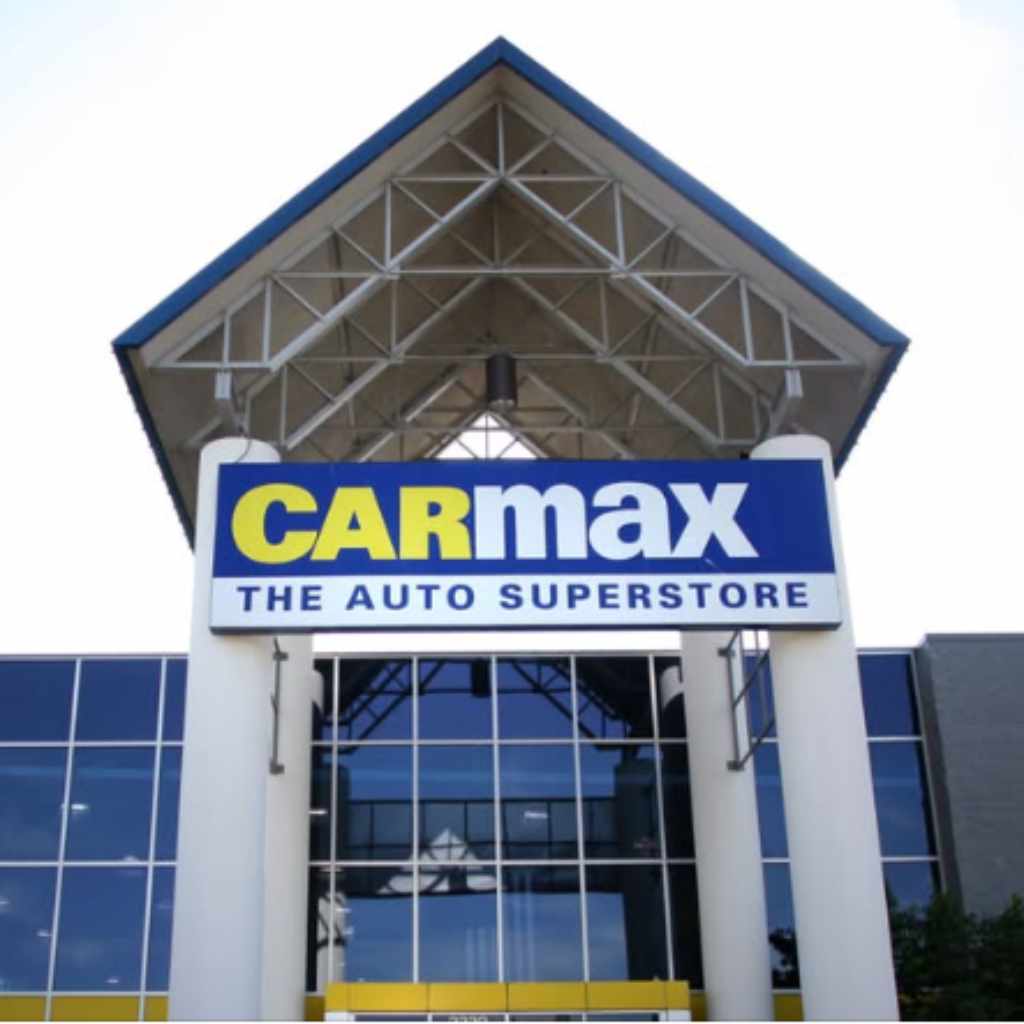
CarMax is best understood as a major used-car retailer with a national consumer brand. That business model tells shoppers what the company sells and how it reaches customers. It does not, by itself, indicate religious identity, Christian governance, or a faith-based mission.
Because CarMax serves shoppers across the country, a neutral public brand is exactly what a reader should expect unless the company states otherwise. Broad consumer reach is common in retail stores that sell everyday goods and services. It is not evidence for or against Christianity.
Customer-facing business model
Customer-facing business models usually focus on price, selection, financing, service, and convenience. Those details can tell you how a company operates. They cannot tell you what religion the company follows, if any.
Say your search starts with a used SUV and a financing offer. That tells you the company is selling transportation, not that it has a faith identity. The product category stays the same whether the company is religious, secular, or silent on religion.
Leadership bios and public disclosures
Executive biographies can be useful, but only for limited purposes. They may list career history, governance roles, or public service. They do not prove corporate faith unless they explicitly describe a company-wide Christian mission or religious governance structure.
Public filings are more useful than bios for this question because they show ownership, board structure, and risk disclosures. If religion matters to the company’s identity, that sort of material is where readers should expect to see it.
CarMax evidence matrix
This matrix separates evidence that would support a Christian-company claim from evidence that only sounds religious on the surface. It is meant to keep theology, branding, and governance in the right columns.
| Claim to verify | Best source type | What evidence would count | What evidence would not count |
|---|---|---|---|
| CarMax ownership | SEC filings, annual report, proxy statement | Clear ownership and governance details, including board control and any stated religious ownership structure | Forum posts, rumor, or a list of “Christian companies” without filings |
| Mission statement | Official company website, investor materials | Explicit Christian language, faith mission, or religious purpose in the company’s own words | Generic terms like integrity, service, respect, or customer focus |
| Executive bios | Leadership page, proxy statement, official interviews | A stated role in a Christian mission organization or a company-wide faith policy tied to leadership | An executive’s private church attendance or personal belief |
| Donations and charitable giving | CSR report, foundation records, tax filings, press releases | Regular gifts to Christian ministries, churches, or faith-based charities, paired with stated religious intent | General community donations with no religious purpose |
| Employee policies | Employee handbook, code of conduct, anti-discrimination policy | Policies that expressly apply Christian standards or faith-based hiring and conduct rules | Neutral workplace rules that apply to all employees |
What counts as real evidence
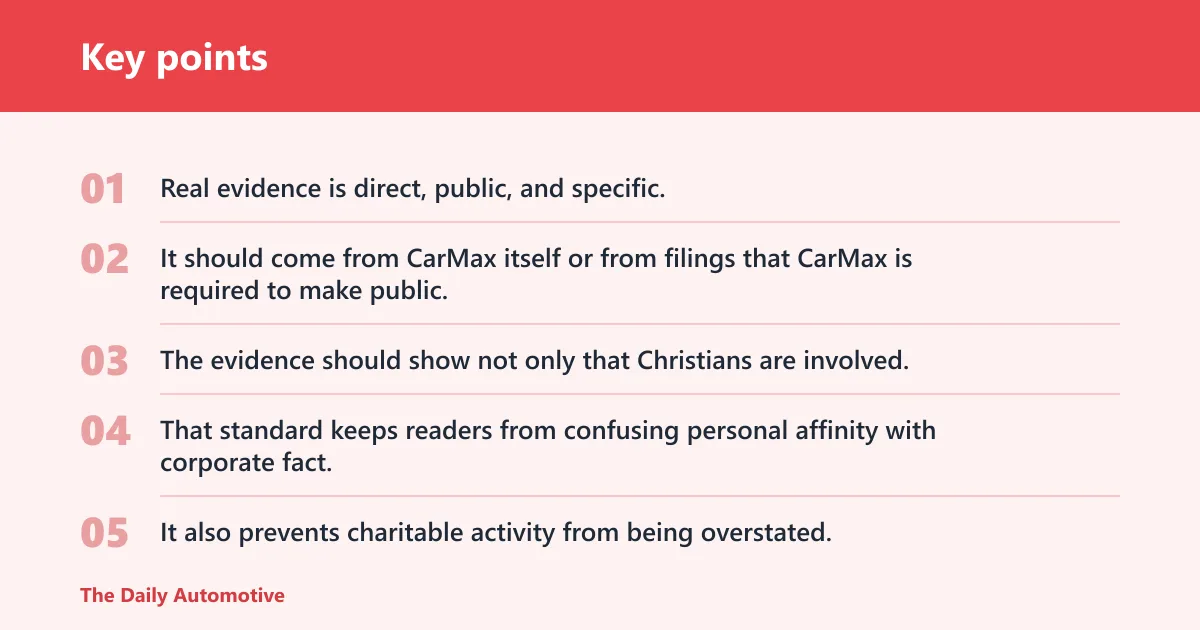
Real evidence is direct, public, and specific. It should come from CarMax itself or from filings that CarMax is required to make public. The evidence should show not only that Christians are involved, but that the company’s own identity or governance is tied to Christianity.
That standard keeps readers from confusing personal affinity with corporate fact. It also prevents charitable activity from being overstated. A donation to a local food bank does not prove Christian identity unless the company says the gift is part of a Christian mission.
What would not count?
What would not count is a social media rumor, a sales pitch from a third party, or a page that lists companies assumed to be Christian without documentation. It also would not count to say a company is Christian because it uses polite language or because some employees are believers.
Suppose a retailer posts a holiday greeting and donates to a community shelter. That may be kind. It is still not proof of Christian governance. The claim needs more than a warm tone.
What Christians should consider before buying
Christians often weigh company beliefs before buying, especially when a purchase feels morally loaded. That is reasonable. But a careful decision starts with facts. Verify the company’s public identity, compare it with your own standards, then decide whether the purchase fits your conscience.
Buying a product does not automatically mean endorsing every belief a company may hold. It may simply mean you need the product. At the same time, if a company openly backs positions that conflict with your convictions, that can matter for your decision.
Prayer, discernment, and practical steps
- Check official ownership and filing records.
- Read the company mission, values, and leadership bios.
- Look for direct evidence of Christian mission, not just generic ethics language.
- Review donations, sponsorships, and employee policies.
- Pray, then decide according to conscience and need.
A common first-timer mistake is stopping at the mission statement. Another is assuming a business is Christian because the price is fair or the service is good. Those things can be true without any faith claim at all.
Does CarMax support Christian causes?
There is no clear public evidence here that CarMax presents itself as a supporter of Christian causes in a way that proves Christian affiliation. If the company made such support central to its identity, readers should expect to see it in official giving records, sponsorship announcements, or corporate statements.
Support for community causes is not the same as support for Christian causes. A company can donate broadly, back local programs, or sponsor civic events without expressing any religious allegiance. That is why the burden of proof stays on the public record.
What would count as real evidence?
Real evidence would include direct gifts to churches or Christian ministries, sponsorships of explicitly Christian programs, or a corporate statement saying those gifts reflect the company’s faith commitments. Repeated, documented patterns matter more than one-off community donations.
Those records should also show intent. A matching check to a church-run shelter may be charitable, but it is not automatically proof of Christian corporate identity unless the company frames it that way in public.
Frequently asked questions
What company beliefs should Christians consider before buying?
Christians often consider ownership, leadership statements, donations, employee policies, and public stances that affect conscience. The key is to separate personal preference from documented company behavior. A product can be useful even if the company is neutral, but a direct conflict with your convictions may change the decision.
Can a business be Christian?
Yes, but only if the business openly and verifiably grounds its mission, governance, or public witness in Christian belief. That requires more than religious owners or moral language. It usually appears in official statements, leadership structure, or giving patterns tied to Christian purpose.
Products related to this article
Sponsored / affiliate links. As an Amazon Associate I earn from qualifying purchases. I may earn additional commission from eligible campaigns.