License Plate Lookup Service Review: Is It Worth It?
License Plate Lookup Service is worth paying for when you need a quick identity check on a used car, especially if the listing is sparse, the plate is your only lead, or the seller story feels incomplete. It can reveal a VIN, title risk, mileage clues, and recall leads, but it should never replace a physical VIN check on the car.
When a plate lookup beats a VIN search
Yes, for the right job. A license plate lookup works best as a reverse search by plate number when you need to confirm what vehicle a plate belongs to, check title risk, and spot registration or mileage gaps before you commit. It becomes less useful if you already have a verified VIN and a complete history report.
When the report earns its keep
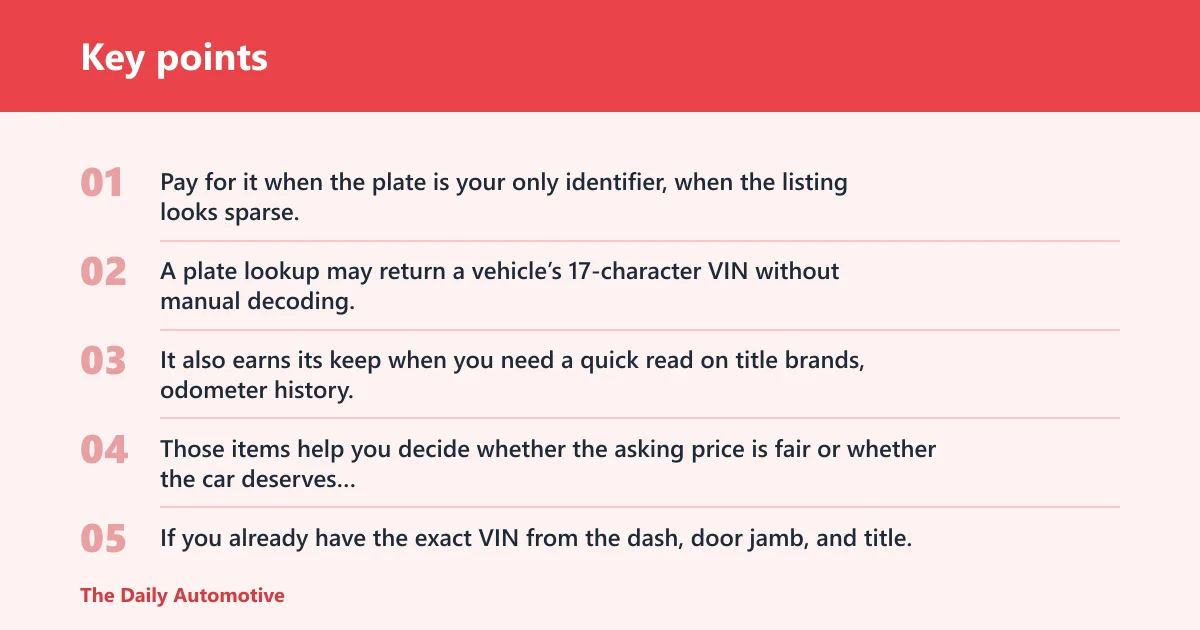
Pay for it when the plate is your only identifier, when the listing looks sparse, or when the seller’s paperwork does not line up cleanly. A plate lookup may return a vehicle’s 17-character VIN without manual decoding, and that can turn a vague listing into something you can verify against the car and its paperwork.
It also earns its keep when you need a quick read on title brands, odometer history, theft or salvage flags, and market value context. Those items help you decide whether the asking price is fair or whether the car deserves a harder pass.
When a VIN lookup is enough
If you already have the exact VIN from the dash, door jamb, and title, a VIN lookup is usually the cleaner choice. It identifies the specific vehicle directly, while a plate search still depends on issuing state, registration changes, and record coverage.
Picture a shopper comparing two private-sale sedans. One already has a legible VIN on the dashboard and matching title paperwork. The other only has a plate photo from the listing. The first car can go straight to VIN-based research; the second may justify the plate lookup because it may reveal the VIN and expose a mismatch before the buyer travels across town.
Plate lookup decision matrix
| Buying scenario | Worth paying for? | What it can confirm | What it cannot confirm | Next verification step |
|---|---|---|---|---|
| Clean private-sale car | Usually no, unless the listing is sparse or the paperwork looks off | Plate-to-VIN match, basic title clues, mileage trail, recall lead | It cannot prove the car’s condition or fill every record gap | Check the VIN on the car and run a full VIN history report |
| Suspiciously cheap used car | Yes | Title brands, salvage or junk signals, accident history, odometer issues, market value context | It cannot guarantee that every damage event appears | Inspect the VIN on the vehicle and compare the title to the report |
| No-VIN online listing | Yes | May resolve the VIN and identify the vehicle record set | It cannot make a missing or wrong VIN acceptable by itself | Ask for a photo of the VIN plate and verify it on the car |
| Out-of-state car | Yes, often | Registration and title clues from the issuing state, possible VIN match, record trail | It cannot fill every gap created by cross-state record changes | Match the physical VIN to the title and registration documents |
| Temp-tag vehicle | Yes, if the plate is temporary or newly issued | May still help with VIN resolution and early title clues | It may fail when the plate is too new or not yet tied to full records | Wait for the permanent VIN-based record set and inspect the car in person |
| Seller-provided plate only | Yes, as a first filter | Vehicle identity clues, title risk, mileage, recalls, price context | It cannot replace the seller’s title documents or the car’s VIN plate | Verify the VIN on the vehicle before any deposit or handshake deal |
What does a plate lookup report show?
A plate lookup report can show enough vehicle history to help you decide whether the car needs a deeper look. Common results include VIN resolution when available, title information, odometer readings, accident and damage signals, theft and salvage checks, recalls, market value, ownership costs, and sometimes photos.
VIN resolution when available
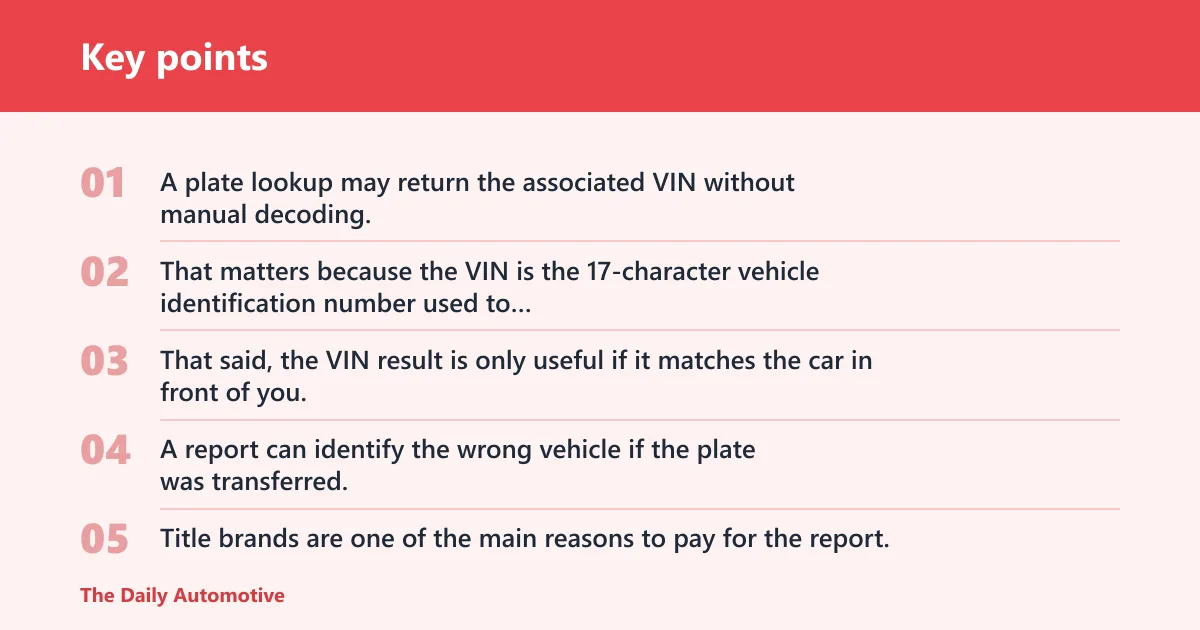
A plate lookup may return the associated VIN without manual decoding, and some services automatically search that VIN when available. That matters because the VIN is the 17-character vehicle identification number used to help verify the car and match the paperwork.
That said, the VIN result is only useful if it matches the car in front of you. A report can identify the wrong vehicle if the plate was transferred, the registration changed, or the records lag behind the current plate assignment.
Title brands and registration clues
Title brands are one of the main reasons to pay for the report. Watch for salvage, junk, rebuilt, flood, lemon, hail, and fire. Those labels can change how you value the car and how difficult it may be to insure or register later.
NMVTIS is a U.S. Department of Justice database that is commonly reported to track titles, odometer readings, theft records, and salvage or junk reports. A plate lookup often pulls from that kind of record chain, which is why state and registration history matter so much.
Accident, damage, and total loss signals
Look for collision events, total loss signals, insurance entries, police records, auction notes, and repair-related entries. Those clues can show that the car has had a harder life than the seller admits, even if the body panels look clean on the lot.
Do not treat the absence of an accident entry as proof that the car was never damaged. Not every repair, scrape, or body-shop visit becomes a formal record, and some events never reach the databases that feed the report.
Odometer readings and rollback checks
Odometer history can be one of the most useful parts of a plate lookup. Mileage readings over time can reveal a rollback risk, a jump that makes no sense, or a gap where the car appears to have disappeared from the record chain.
Where inspection mileage is available, it can add another check against fraud. A clean mileage trail does not prove the odometer is honest, but a mismatch is a strong reason to slow down.
Open recalls and market value context
Open recalls should still be verified through official manufacturer or NHTSA recall tools, even if they appear in the report. The report gives you a lead; the manufacturer tool gives you the final check.
Market value context helps you compare the report against the seller’s asking price. If the car carries a salvage brand or a rough mileage trail, that value context can support a lower offer or help you walk away.
What can it miss?
A plate lookup is useful, but it is not complete. Results vary by issuing jurisdiction, registration changes, and record availability, so a clean report does not mean a clean car. The report can miss recent transfers, skipped registrations, and damage that never became a formal record.
State and jurisdiction gaps
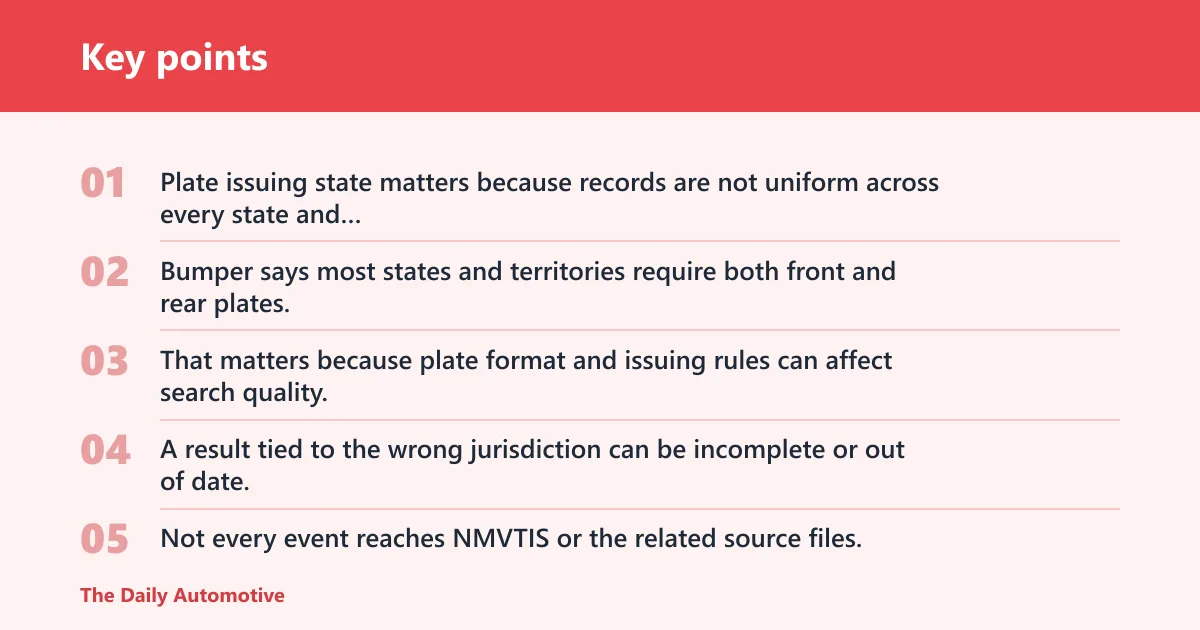
Plate issuing state matters because records are not uniform across every state and territory. Bumper says most states and territories require both front and rear plates, while Alabama, Alaska, Arizona, Arkansas, Delaware, Florida, and Georgia are among the states that only require rear plates.
That matters because plate format and issuing rules can affect search quality, especially when a car crosses state lines or the plate was recently changed. A result tied to the wrong jurisdiction can be incomplete or out of date.
Records that never reach the database
Not every event reaches NMVTIS or the related source files. A minor collision, an unreported repair, or a private transaction without a clean title trail may never surface. That is why a plate lookup should be read as evidence, not a verdict.
Suppose a truck had a bumper replacement after a parking-lot hit, but the repair never triggered an insurance claim. The report may still look quiet. The physical inspection, the title, and the VIN all still matter.
Why the physical VIN still matters
The car’s VIN plate, door sticker, and title must agree. A plate lookup can point you toward the right vehicle, but it cannot prove that the plate still belongs to the car sitting in front of you. That check has to happen on the vehicle itself.
A common first-timer mistake is trusting a plate search and skipping the dash VIN. That is risky on a car with fresh tags, a swapped plate, or paperwork that seems loosely copied.
Pros and cons
Pros
- It can reveal the VIN when available.
- It can surface title brands, accident clues, odometer readings, theft and salvage checks, recalls, and market value context.
- It helps you screen a car before you spend time on a full VIN report.
- It can support negotiation when the price does not fit the history.
Cons
- Results depend on records, state, and jurisdiction.
- It typically does not show owner names, addresses, or similar personal data because DPPA limits that kind of output.
- It can miss recent plate transfers, temporary tags, or records that never reached the database.
- Free previews are limited, so meaningful detail may sit behind a paywall.
How is it different from a VIN lookup?
A plate lookup typically starts with the plate number and the issuing state. A VIN lookup starts with the 17-character vehicle identification number, which is the cleaner way to verify the exact vehicle and compare it with the title, door sticker, and dash plate.
Plate number versus 17-character VIN
The plate is a registration clue. The VIN is the vehicle’s core identity. A plate search can sometimes resolve the VIN, and VinCheck.info says the associated VIN is automatically searched when available, but that still depends on the quality of the records behind the plate.
Why the issuing state matters
State matters because plate records are not equally visible everywhere. The same source says license plate data is sourced from federal agencies and state-level DMV agencies, which means coverage can shift when a car moves, the registration changes, or the plate is transferred.
That is why a plate search is best treated as a bridge to the VIN, not a replacement for it. If the plate and the VIN disagree, trust the physical vehicle paperwork over the search result and stop until the mismatch is explained.
How to confirm the plate matches the vehicle and paperwork
- Compare the plate number in the listing with the plate on the car.
- Find the 17-character VIN on the dash and door jamb.
- Match that VIN to the title, registration, and bill of sale.
- Check that the report history lines up with the make, model, trim, and year shown on the car.
- Use the VIN report for title, odometer, and recall verification before you pay.
Who it’s for
This service is best for private-sale shoppers, buyers facing a no-VIN listing, and anyone comparing an out-of-state car with weak paperwork. It is also useful when the seller provides only a plate number and a promise.
It is a poor fit for buyers who already have a verified VIN and a full history report, or for anyone hoping to use the report to identify, contact, or trace a vehicle owner. DPPA limits personal data, and that is the right boundary for consumer use.
Best fit for private-sale shoppers
Private sales carry more paperwork risk because you are relying on the seller’s documents and the car in front of you. A plate lookup gives you a fast first pass on identity, title risk, mileage, and recalls before you travel farther or hand over cash.
Best fit for no-VIN or out-of-state listings
A no-VIN listing is exactly where a plate lookup can help most, because it may reveal the VIN and expose a mismatch early. Out-of-state cars can also benefit because registration history and title branding may be clearer after a plate-based search than they appear in the ad.
Poor fit for buyers with a verified VIN
If the VIN already matches the car and the paperwork, the extra plate search may add little. In that case, a VIN history report and a physical inspection are usually the better use of time and money.
Frequently asked questions
Is License Plate Lookup Service worth it for buying a used car?
Yes, when you need a fast screen for identity, title problems, mileage clues, or a missing VIN. It is less useful if you already have a verified VIN and a full history report. Treat it as an early filter, then confirm the vehicle’s VIN on the car itself.
Can a license plate lookup find the VIN?
Often, yes. A plate lookup may return a vehicle’s 17-character VIN without manual decoding, and some services automatically search the associated VIN when available. That result still has to match the dash VIN, the door sticker, and the title before you trust it.
What information does a license plate lookup report show?
It can show VIN resolution, title information, accidents and damage signals, odometer readings, theft and salvage checks, recalls, market value, ownership costs, and sometimes photos. Exact results vary by jurisdiction and available records, so a report may be fuller on one car than another.
Does a plate lookup show accidents, title brands, or odometer issues?
It often does, but not every issue will appear. Look for accident history, total loss signals, salvage or rebuilt brands, and mileage readings that do not line up. Missing data does not prove a clean history, so use the report as one part of the check.
How is a license plate lookup different from a VIN lookup?
A plate lookup starts with the license number and issuing state, while a VIN lookup starts with the 17-character vehicle identification number. The VIN is the stronger identifier because it points to the exact vehicle, while the plate can change with registration, transfers, or state moves.
Are license plate lookup results privacy-safe and legal?
Yes, when used as a vehicle-history tool rather than an owner-tracing tool. DPPA limits owner names, addresses, and similar personal details, so a consumer report should stay vehicle-only. That boundary is part of why the report is useful for buying and not for chasing a previous owner.
Products related to this article
Sponsored / affiliate links. As an Amazon Associate I earn from qualifying purchases. I may earn additional commission from eligible campaigns.