What Do Car Rental Reviews Really Tell You?
Car rental reviews are useful when you read for patterns, not averages: three or more mentions of surprise fees, deposit holds, or long counter lines is commonly treated as a warning sign. Miss those clues, and you can end up paying more, waiting longer, or fighting charges after drop-off. This guide shows how to read reviews for fee risk, deposit trouble, and pickup or return friction before you book.
Pain points patterns not averages
Reviews can point to likely pain points such as extra charges, slow handoffs, weak communication, and cars that arrive dirtier or less maintained than promised. They cannot prove every experience will repeat, but they do help you judge whether a company has a pattern worth avoiding.
What reviews can predict
Reviews are most useful when they point to repeated process problems. If travelers keep mentioning surprise fees, deposit deductions, or a quote that does not match the final bill, that is a risk signal you should verify in the terms before paying. The same applies to long queues, poor handoffs, and complaints that staff gave inconsistent answers.
What reviews cannot prove
A single bad story can be real and still not reflect the normal experience. The stronger signal comes from repetition across recent reviews, especially when the same complaint appears on more than one platform. Less than five recent posts describing the same fee or damage claim.
Why the best rating is not always the safest choice
Overall ratings are only a quick snapshot, not the full story. A company can hold a decent average while still collecting repeated complaints about deposits, add-ons, or return-day friction. A higher score can also hide uneven service, where smooth airport pickups sit beside a trail of charge disputes.
Picture a traveler booking the cheapest midsize car at an airport desk. The score looks fine, but recent reviews keep mentioning an extra “admin” fee and a deposit hold that stays pending for weeks. That pattern matters more than a shiny average.
Read star ratings with context
Star ratings help you sort options fast, but they can hide how the company behaves under pressure. A four-star average may still include a recurring complaint about final bills, while a lower score can sometimes reflect one crowded holiday week rather than a steady service problem.
Why average scores can hide recurring problems
High averages often flatten the details that matter most. If many reviewers praise the car itself but mention billing surprises, that gap tells you the fleet and the front desk may not perform equally well. You need both the score and the text.
How review text changes the meaning of a rating
Read the wording around the rating, not the number alone. “Great car, hidden fees” means something very different from “slow pickup, but fair billing.” The first points to cost risk; the second points to time friction. Those are not the same booking problem.
When a lower score is less concerning than repeated complaints
A lower score after a holiday rush may be less alarming than a mostly positive page with the same complaint repeated again and again. Old praise can also mislead if the recent reviews describe worse service, new fees, or a change in return rules.
Which review signals matter most?
The strongest signals are the ones tied to money, time, and proof. Prioritize vehicle condition, customer service, pickup and drop-off behavior, and unexpected charges. Those themes tell you whether the company is likely to hand over a clean car, explain terms clearly, and bill the same way it quoted.
Vehicle condition: cleanliness, maintenance, and damage notes
Vehicle condition matters most when reviews mention cleanliness, maintenance, damage documentation, or a car that did not match the booking description. If travelers say the car had warning lights, worn tires, or pre-existing scratches that were not logged, that is a sign to inspect the car closely and photograph everything.
Customer service: helpfulness, communication, and complaint handling
Customer service reviews should be read for staff helpfulness, communication quality, and how the company handles complaints or dispute follow-up. A polite counter agent is useful, but the bigger question is whether the company answers billing problems and damage disputes with clear, timely responses.
Pickup and drop-off: queues, delays, after-hours return, and handoff speed
Pickup and drop-off reviews tell you whether the counter is fast or chaotic. Look for line length, handoff speed, return friction, and after-hours handling. These details matter more at airports and during busy weekends, when delays can turn a simple booking into a missed connection.
Unexpected charges: deposits, add-ons, and final bill surprises
Unexpected charges are a major warning sign. Reviews that mention deposit deductions, extra fees, fine-print charges, or a final bill that does not match the quote should push you to read the contract line by line. Hidden additional charges can greatly increase the final price.
Review audit checklist
Use this table as a quick audit before you pay. It is not a guarantee, but it helps you turn vague praise or complaints into a booking decision.
| Review signal | What it may mean | Risk level | What to verify in the booking terms before purchasing |
|---|---|---|---|
| “Hidden fees,” “extra charge,” “final bill was higher” | Possible add-ons, location fees, or billing gaps between quote and invoice | High | Fee list, taxes, surcharges, one-way fees, late return charges, fuel policy |
| “Deposit held for weeks,” “card blocked,” “refund delayed” | Security deposit hold or slow release after return | High | Deposit amount, payment card rules, release timing, damage claim process |
| “Long line,” “waited an hour,” “slow checkout” | Counter congestion or staffing gaps | Medium | Pickup hours, airport desk location, after-hours process, digital check-in options |
| “Car was dirty,” “tire light on,” “old damage not noted” | Poor maintenance or weak damage documentation | High | Inspection policy, damage form, photo requirements, vehicle swap rules |
| “Agent was rude,” “no help with issue,” “ignored complaint” | Weak support and poor dispute follow-up | Medium | Complaint channel, escalation steps, response timing, manager contact method |
| “After-hours return was confusing” | Return friction and possible dispute over time, fuel, or condition | Medium | Drop box rules, photo instructions, fuel policy, timestamp requirements |
| “Cross-border not allowed,” “extra driver fee,” “insurance denied” | Terms that restrict where and how you can drive | High | Cross-border rules, additional driver conditions, coverage exclusions, age limits |
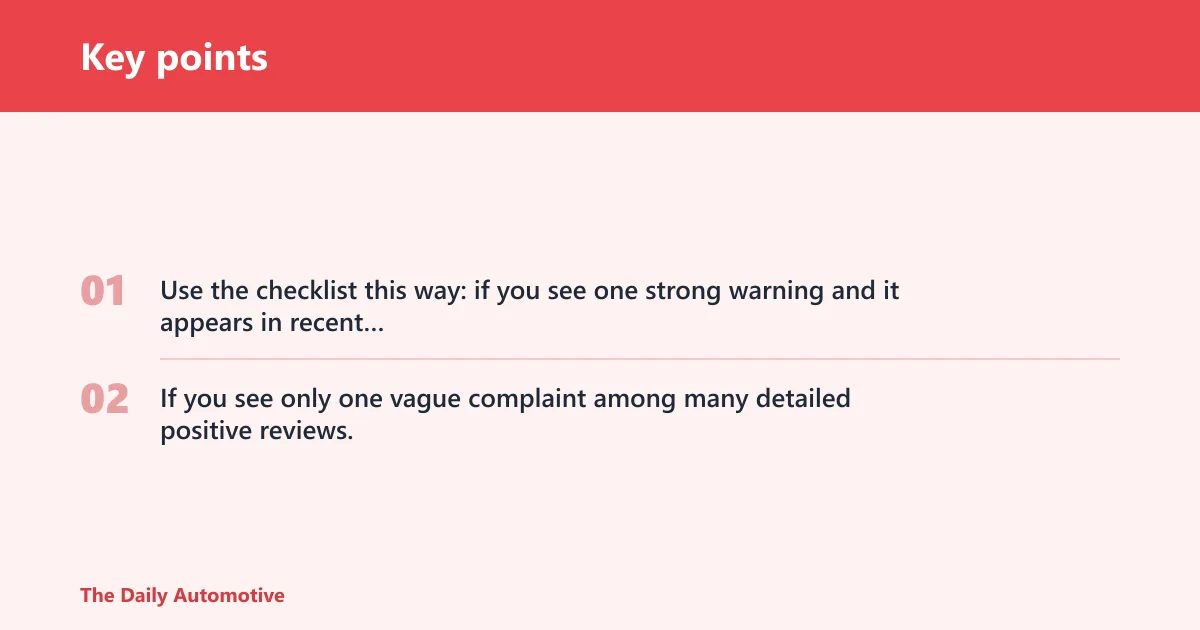
Use the checklist this way: if you see one strong warning and it appears in recent reviews across different sites, pause. If you see only one vague complaint among many detailed positive reviews, verify the terms and then decide whether the risk is tolerable for your trip type.
How recent should reviews be?
Recent reviews matter most for current service conditions. A company can improve or deteriorate fast, especially at airport locations with changing staffing and seasonal demand. Old praise may reflect a different team, different rules, or a quieter travel period.
Why the last few months matter most
The last few months carry the most weight because policies, staffing, and pricing can change. A review from last year may say little about today’s counter process or billing behavior. If the latest reports mention new fees or stricter deposit rules, treat that as current evidence.
How seasonality changes airport and holiday rental behavior
Review context matters because peak-season experiences may differ. A company that works smoothly in February may struggle during summer airport peaks or holiday weekends. If the recent complaints cluster around busy dates, the problem may be congestion, not a permanent service flaw.
How many reviews you need before a pattern is believable
Review volume and pattern recognition matter more than outlier praise. Many reviews with the same complaint are stronger evidence than one polished five-star note. Repeated wording, repeated fee disputes, and repeated pickup delays all deserve attention, especially when they appear on multiple dates.
Suppose an airport branch has about 18 recent reviews, and around 6 mention slow returns plus another 5 mention deposit delays; that can suggest a higher-risk branch. That is enough to treat the branch as a higher-risk choice, even if the average score still looks respectable.
How do you spot fake or weak reviews?
Fake or weak reviews often sound generic, arrive in a sudden burst, or repeat the same wording across many posts. Strong reviews usually include specific details about the desk, the car, the fee, or the return process. Compare patterns across platforms instead of trusting one page.
Signs of review spam and sudden rating spikes
A sudden wave of short praise with little detail can be a warning sign, especially if it appears after a cluster of complaints. The same goes for many near-identical five-star posts written around the same time. A real travel experience usually has at least one concrete detail.
Why repeated wording and vague praise are weak signals
“Great service,” “amazing staff,” and “best rental ever” are not useless, but they carry less weight than comments about line length, fuel level, or a deposit hold. Weak reviews praise the brand without naming a process. Strong reviews describe what happened and when.
How to compare Google, Maps, and Trustpilot for consistency
Independent review platforms can add credibility, especially Google Business Profile, Google Maps, and Trustpilot, when you compare patterns across sites. If the same billing complaint appears on more than one platform, treat it as more credible than a single isolated post. If the praise looks heavy on one site and thin elsewhere, ask why.
What to verify before booking
Before you pay, read the rental contract and insurance terms. That is where coverage exclusions, cross-border rules, additional driver conditions, fuel rules, and deposit language usually live. Reviews tell you where to look; the contract tells you what you are agreeing to.
Rental contract and insurance terms to read first
Consumers should read the rental contract and insurance terms before signing. Check coverage exclusions, cross-border rules, extra-driver conditions, mileage limits, fuel policy, and any clause that allows admin or processing charges. If a review mentions a fee, confirm whether the term appears in writing.
Photos to take at pickup and return
Take photos of the car at pickup and return to protect yourself. Include timestamped evidence of the fuel gauge, odometer, and any existing damage, including wheels, bumpers, mirrors, and windscreen chips. Those photos are your best proof if the company disputes condition or fuel level later.
Questions to ask if reviews mention hidden fees or damage claims
Ask whether the quote includes all mandatory fees, what deposit is required, how long the deposit can remain held, and what counts as chargeable damage. Security deposits can be kept for up to 28 working days, so confirm how release timing works before you hand over your card.
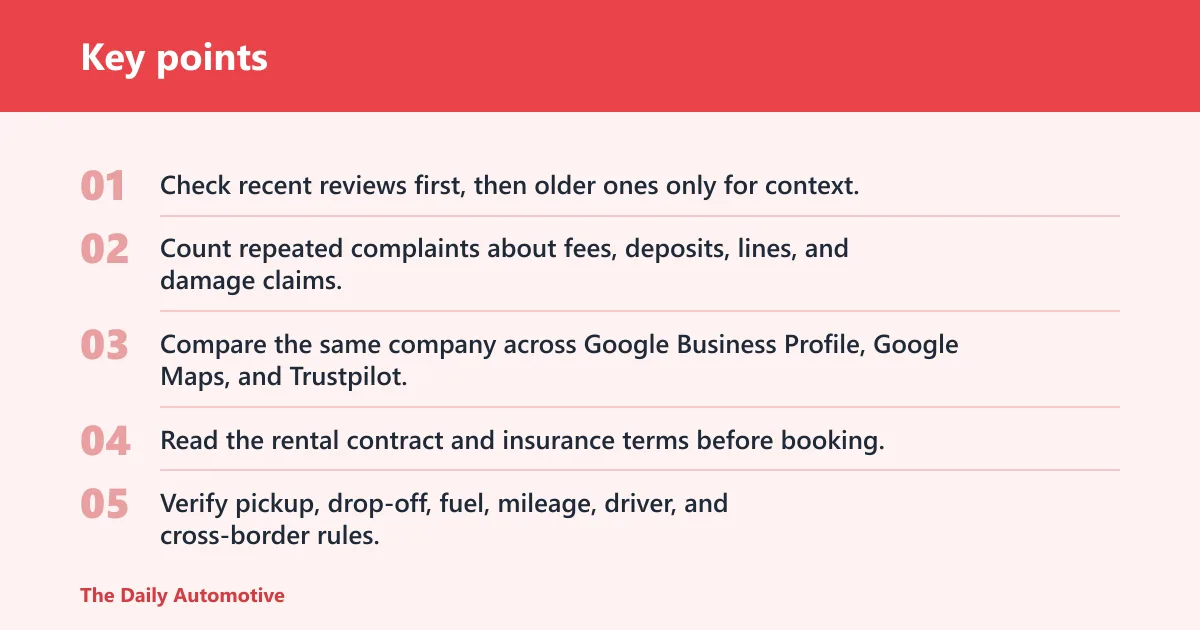
- Check recent reviews first, then older ones only for context.
- Count repeated complaints about fees, deposits, lines, and damage claims.
- Compare the same company across Google Business Profile, Google Maps, and Trustpilot.
- Read the rental contract and insurance terms before booking.
- Verify pickup, drop-off, fuel, mileage, driver, and cross-border rules.
- Take timestamped photos at pickup and return.
- Decide whether the risk is acceptable for your trip type.
What should you look for in car rental reviews before booking?
Focus on the themes that affect total trip cost and day-of-trip friction: fees, deposits, car condition, customer service, and pickup speed. The best review set is recent, specific, and consistent across platforms. That combination is far more useful than a high average score alone.
Trip type matters too. Airport rentals face queue risk and higher turnover. Road-trip rentals need better maintenance and mileage clarity. One-way rentals deserve extra attention on return rules and drop-off fees. Under-25 rentals should be checked for age surcharges and stricter coverage terms.
How do I tell if car rental reviews are trustworthy?
Trustworthy reviews are specific, recent, and consistent across more than one platform. They name a fee, a delay, a car condition issue, or a clear service interaction. If several reviewers mention the same problem in the last few months, the signal is stronger than a single glowing or angry post.
What do negative car rental reviews usually mean?
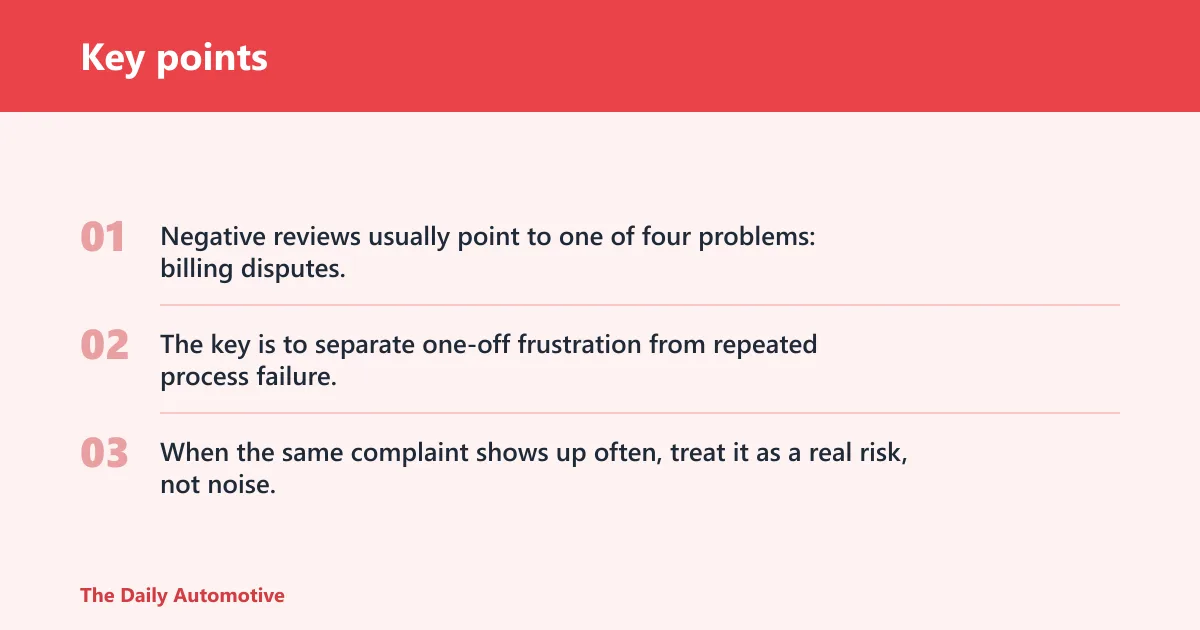
Negative reviews usually point to one of four problems: billing disputes, slow pickup or return, poor vehicle condition, or weak customer support. The key is to separate one-off frustration from repeated process failure. When the same complaint shows up often, treat it as a real risk, not noise.
Should I choose the cheapest rental company with the best reviews?
Only if the total terms are clean. The cheapest rate can become the most expensive choice once you add hidden charges, a large deposit, extra-driver fees, or strict return rules. Compare the final bill risk, not the headline price alone, before you book.
Frequently asked questions
How do I get good car rental reviews from other travelers?
Ask for details that matter: final bill, deposit timing, line length, vehicle condition, and whether the quote matched the charge. A useful review names the location, the date range, and the problem or success clearly. Specifics make the review useful to the next traveler.
Do car rental ratings actually predict hidden fees or bad service?
Sometimes, but only when the pattern repeats in the text. Star ratings are a fast snapshot, not the full story. Repeated mentions of surprise fees, deposit deductions, or poor handoff process are far more predictive than a high average score with vague praise.
Which review sites are best for car rental company reviews?
Use independent platforms such as Google Business Profile, Google Maps, and Trustpilot, then compare the patterns between them. A single site can be skewed by timing or reviewer habits. Consistent complaints across multiple platforms carry more weight than one isolated page.
How recent should car rental reviews be before I trust them?
Prefer reviews from the last few months, especially for airport locations and seasonal travel. Old praise can miss new fees, a staffing change, or updated deposit rules. If the latest reviews describe the same issue repeatedly, that matters more than older five-star comments.
How can I spot fake car rental reviews?
Look for generic praise, repeated wording, and sudden spikes in five-star posts with little detail. Real reviews usually mention the desk, the car, the fee, or the return process. Comparing several platforms also helps, because fake or weak reviews often fail to line up.
What questions should I ask after reading rental car reviews?
Ask whether the quote includes all mandatory charges, what deposit is required, how damage is documented, and whether the company allows your planned route or additional driver. If reviews mention problems, ask the counter how those issues are handled before you pay.
Products related to this article
Sponsored / affiliate links. As an Amazon Associate I earn from qualifying purchases. I may earn additional commission from eligible campaigns.