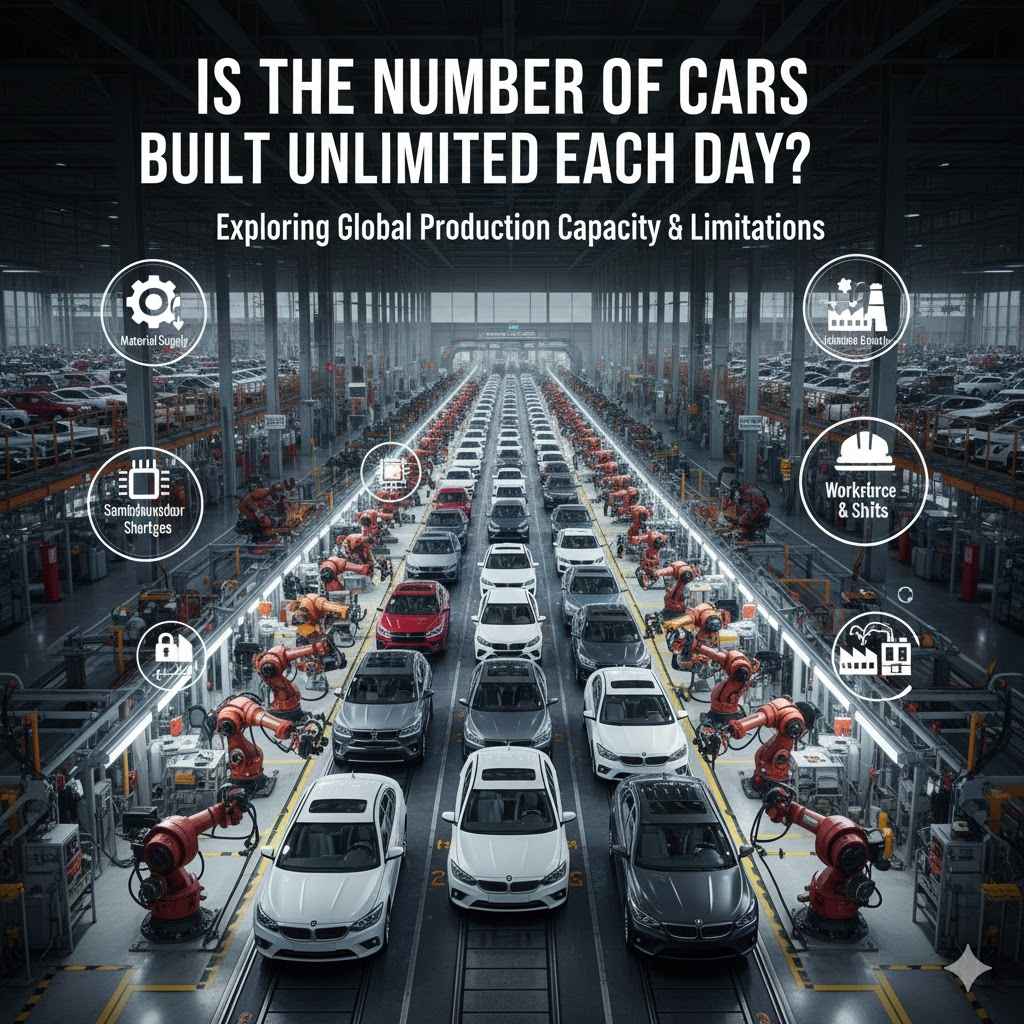
Is The Number Of Cars Built Unlimited Each Day
Many people wonder about production limits, asking “Is the number of cars built unlimited each day?”. It’s a common question, especially when thinking about how many vehicles are on the road. It can seem like a lot, and figuring out if there’s a set limit can be a bit tricky.
Don’t worry, though! We’ll break down this topic in a super simple, step-by-step way. Get ready to understand car manufacturing like never before.
We’ll explore what influences how many cars get made and what the real picture looks like.
Understanding Car Production Limits
This section explores the core question: Is the number of cars built unlimited each day? We will look at the factors that actually control how many vehicles roll off assembly lines. It’s not a simple yes or no answer.
Many elements work together to determine daily output. We will explain these in easy terms.
Factors Influencing Daily Car Production
Several key things affect how many cars a factory can build in a single day. These aren’t random; they are carefully managed. Think of it like a recipe where every ingredient has a specific role.
Assembly Line Speed and Capacity
The assembly line itself has a certain speed it can operate at. This speed is set by how fast workers can perform their tasks and how quickly the machinery can move parts along. Factories are designed with a maximum capacity.
This is the most cars they can physically produce in a given time. Pushing beyond this limit is often impossible without serious changes.
For example, a line might be set to build one car every 60 seconds. If the factory operates for 8 hours, that’s 480 cars. However, this doesn’t account for breaks, maintenance, or unexpected stops.
So, the theoretical maximum is different from the actual achievable number.
Worker Availability and Shifts
The number of people working on the line is critical. If there aren’t enough workers, the line slows down or stops. Car plants often run multiple shifts to maximize production.
The availability of skilled labor directly impacts how many cars can be built. If a shift has to be canceled due to unforeseen circumstances, daily production numbers will drop.
Companies invest heavily in training their workforce. This ensures they can handle the specific tasks required for each model. High absenteeism or labor disputes can significantly disrupt production schedules.
Component Supply Chain
Cars are made of thousands of parts. These parts come from many different suppliers. If even one crucial part is delayed, the entire production can halt.
This is known as a supply chain disruption. The reliable delivery of everything from engines to tiny screws is essential.
Modern car manufacturing relies on just-in-time delivery. This means parts arrive right when they are needed. While efficient, it makes factories very vulnerable to problems elsewhere in the supply chain.
A shortage of microchips, for instance, can stop car production worldwide.
Machine and Equipment Uptime
The robots and machines on an assembly line are vital. They perform tasks like welding, painting, and fitting parts. If a machine breaks down, that section of the line stops.
Factories have maintenance teams to fix issues quickly. However, complex machinery can take time to repair.
Regular maintenance schedules are put in place to prevent breakdowns. But accidents or wear and tear can still cause unexpected downtime. The amount of time machines are operational directly affects how many cars are built.
Model Complexity and Production Changes
Different car models have different assembly requirements. Some are more complex than others. Building a highly customizable luxury car takes longer than a basic compact model.
When factories switch between different models, it often requires retooling and adjustments. This can temporarily reduce the number of cars produced.
For instance, switching from producing sedans to SUVs on the same line can take days. This downtime means fewer cars are built during that transition period. Automakers try to plan these changes carefully to minimize impact.
Quality Control and Testing
Every car must pass strict quality checks. This includes inspections on the assembly line and final testing. If a car fails a quality test, it might need to be sent back for repairs.
This takes time and resources. It also means that car doesn’t count towards the daily production total until it’s fixed.
Thorough testing ensures safety and customer satisfaction. But it also adds a layer of potential delay. A batch of cars failing a specific test could significantly lower the day’s output.
The Concept of Production Capacity
Production capacity is the maximum output a factory can achieve under normal operating conditions. It’s not an unlimited number. It’s a calculated figure based on available resources.
Think of it as the ceiling for how many cars can be made.
Defining Production Capacity
Production capacity refers to the maximum output that can be achieved by a production facility within a given period. It considers factors like available machinery, labor, and operational hours. Factories are engineered to operate efficiently up to this capacity.
Going beyond it is usually not feasible without expanding infrastructure.
For example, a factory might have a theoretical maximum capacity of 1,000 cars per day. However, due to factors like planned maintenance, shift changes, and supply chain fluctuations, the actual daily output might be closer to 900 cars. This is known as effective capacity.
Types of Capacity
There are different ways to look at capacity. Theoretical capacity is the absolute maximum possible output if everything ran perfectly, with no downtime. Practical or effective capacity is the maximum output achievable under realistic conditions, including normal breaks and minor interruptions.
Then there’s actual output, which is the real number of units produced on any given day, influenced by daily events.
Understanding these distinctions helps explain why a factory doesn’t always hit its theoretical maximum. A plant might have a theoretical capacity of 1,200 vehicles per day. But its practical capacity might be around 1,000 due to scheduled maintenance and shift rotations.
Actual output on a given Tuesday might be 950 if a key part shipment was delayed.
Capacity Planning and Management
Car manufacturers carefully plan their capacity. They need to meet market demand without overproducing, which wastes money. Capacity planning involves forecasting future sales and ensuring the factory can build enough cars.
It also means planning for maintenance and upgrades.
Automakers also manage capacity by adjusting their production schedules. They might decide to build more of a popular model and fewer of a less popular one. This flexibility is key to staying competitive.
It allows them to respond to changing customer preferences and market conditions.
Is the Number of Cars Built Unlimited Each Day? Answering the Core Question
So, to directly answer: Is the number of cars built unlimited each day? No, it is absolutely not unlimited. Every car factory has a set limit on how many vehicles it can produce daily.
This limit is determined by the factory’s design and resources.
The idea of unlimited production is a misconception. It ignores the practical realities of manufacturing. The question arises because we see so many cars.
But those cars are the result of immense, organized effort within specific constraints.
Production Limits in Practice
Car factories operate within strict parameters. These parameters define their daily production limits. These limits are not arbitrary; they are based on engineering, labor, and supply chain realities.
Setting Daily Production Targets
Each car factory sets daily production targets. These targets are based on the factory’s maximum capacity and the current demand for its vehicles. They are ambitious but achievable numbers.
Achieving these targets consistently requires smooth operations across all departments.
For instance, a plant might be tasked with producing 1,000 cars today. This target is carefully calculated. It factors in the speed of the assembly line, the number of workers on duty, and the availability of all necessary parts.
It’s a daily goal, not an open-ended instruction.
What Happens When Limits Are Reached
When a factory reaches its daily production limit, it doesn’t just keep going. Production either slows down or stops for the day. The assembly line might pause.
Workers might be directed to other tasks or sent home early if production is unexpectedly halted. This ensures the factory operates within its design parameters and avoids costly errors or equipment strain.
If a factory has a daily limit of 1,000 cars and they build the 1,000th car, the line stops for the day. Any further assembly would require specific planning for overtime or the next production cycle. This controlled stop prevents exceeding operational limits and maintains product quality.
Impact of Global Events on Production
Global events can significantly impact production limits. Think about the chip shortage or unexpected natural disasters. These events can force factories to reduce their output far below their normal capacity.
This demonstrates that even the planned limits are subject to external pressures.
During the global semiconductor shortage, many car manufacturers had to drastically cut back production. Some plants were forced to close for extended periods. This dramatically reduced the number of cars built each day across the industry, proving that production is never truly unlimited.
Real-World Scenarios and Statistics
Looking at real-world examples helps illustrate the concept of production limits. Car manufacturers often share data about their output. These numbers reflect the constraints they operate under.
Example 1 A Major Automaker’s Output
Consider a large automotive company like Toyota. In a typical year, Toyota produces millions of vehicles globally. However, on any given day, their individual factories have specific output numbers.
For example, a single Toyota plant might be designed to produce around 1,000 to 1,500 vehicles per day, depending on the models being built there and operational efficiency. This is a significant number, but it’s still a defined limit.
The company’s global output is the sum of many such factories, each with its own capacity. If one plant experiences a temporary shutdown due to a localized issue, it impacts the overall global count, but the individual plant’s limit remains a key factor.
Example 2 Electric Vehicle Production
Newer companies like Tesla also face production limits. Tesla’s Gigafactories are state-of-the-art. Yet, they still operate within defined capacities.
For instance, a Gigafactory aiming to produce 500,000 cars per year has a daily target. If the factory runs 365 days a year, that’s roughly 1,370 cars per day. This target can fluctuate based on ramp-up phases, new model introductions, and supply chain availability.
Tesla has famously worked to increase its “production hell” during new model launches. This effort highlights the struggle to scale up production within physical and logistical constraints, rather than having an unlimited ability to produce.
Statistics on Global Vehicle Production
In 2023, the global production of automobiles was estimated to be around 80 million vehicles. This vast number comes from thousands of factories worldwide. However, this figure represents the total over an entire year, averaged out.
It doesn’t imply that 80 million cars can be made in a single day.
The average daily production across all global plants, therefore, is a fraction of this annual total. It’s still a massive number, but it’s finite. For instance, if we consider roughly 250 working days in a year for many plants, the global daily average would be around 320,000 cars.
This average is distributed across all operating factories, each with its own limitations.
Is the Number of Cars Built Unlimited Each Day? – The Constraints Explained
The core of the question is about constraints. Manufacturing is inherently constrained by physical and logistical realities. These constraints define the maximum number of cars that can be produced.
Physical Space and Layout
A car factory is a physical building. It has a fixed size and layout. The assembly lines, robotic arms, storage areas, and testing zones all take up space.
The factory’s footprint dictates how many workstations can be set up and how many cars can be in production simultaneously. Expanding a factory is a major undertaking, not something done daily.
Imagine a highway with only a few lanes. You can only fit so many cars on it at once. A factory is similar; its physical dimensions limit the flow of production.
More space could mean more assembly lines or more room for staging parts, thereby increasing potential output.
Energy and Utilities
Car manufacturing is an energy-intensive process. Welding, painting, and running robotic arms require significant electricity. Factories also need water, compressed air, and other utilities.
There are limits to the amount of energy and utilities that can be supplied to a site. Exceeding these limits can cause brownouts or shutdowns.
The sheer power required to run an entire assembly line at maximum speed is immense. Utility providers work with factories to ensure sufficient supply, but there are still practical limits to what the local infrastructure can provide and what the factory’s internal systems can handle.
Waste Management and Environmental Regulations
Factories produce waste, including scrap metal, paint fumes, and packaging materials. They must comply with environmental regulations regarding waste disposal and emissions. Processing and disposing of waste take time and resources.
Exceeding production targets can lead to excessive waste, which can overwhelm disposal systems or violate environmental permits.
Compliance with regulations is not optional. Factories must have systems in place to manage their environmental impact. This includes capturing emissions and treating wastewater, all of which are processes that operate at a certain rate, indirectly limiting how much can be produced.
Economic Factors and Demand
Ultimately, car production is driven by demand and economic viability. Manufacturers don’t build cars just to build them; they build them to sell them. If demand is low, production will be reduced, even if the factory has the capacity to build more.
Conversely, if demand is very high, factories may run at or near their maximum capacity.
Automakers constantly monitor market trends and consumer preferences. They adjust their production schedules based on sales forecasts and economic conditions. Building too many cars that don’t sell leads to costly inventory storage and potential losses.
This economic reality is a powerful constraint on daily production.
Frequently Asked Questions
Question: Can a car factory make any car model at any time?
Answer: Not exactly. While modern factories are often flexible, switching between significantly different models can require retooling the assembly line. This takes time and can temporarily reduce daily production numbers.
Question: What happens if a factory has too many parts delivered one day?
Answer: Factories use “just-in-time” inventory systems. If too many parts arrive, they might have to refuse the delivery or pay storage fees. This is because they have limited space to store components and can only process what’s needed for the current production run.
Question: Does building cars on weekends affect the daily limit?
Answer: If a factory is set up for weekend production, it extends the working days. However, the daily limit for each day remains the same. Running on weekends simply means more days are used to reach the total production target for a longer period.
Question: How does a car company decide its daily production number?
Answer: The daily production number is decided by combining the factory’s maximum physical and operational capacity with current sales demand, availability of parts, and the workforce schedule. It’s a strategic decision to balance efficiency and market needs.
Question: Are there any exceptions to production limits?
Answer: While there are always physical and logistical limits, companies might invest in temporary measures like overtime or extra shifts to temporarily increase output. However, these are usually short-term solutions and do not change the fundamental, sustainable daily capacity of the factory.
Summary
No, the number of cars built each day is not unlimited. Every car factory operates within strict daily production limits. These limits are set by the factory’s physical size, machinery, available workforce, and supply chain efficiency.
It’s a carefully managed process, not an endless capability.