Best for Car Engine Gaskets: Top Kits for Optimal Performance
The best gasket kit is the OE-equivalent set that matches your exact engine code. Choose a full head-gasket set for top-end work, a lower set for reseal jobs, and MLS with the right surface finish for high-cylinder-pressure builds. Choose wrong, and you can do the same job twice after coolant loss, combustion leaks, oil mixing, or warped heads. This guide compares head gasket sets, full engine gasket kits, sealers, and fitment checks by failure mode, build level, and total project cost.
Match gasket kits to your specific engine and repair needs
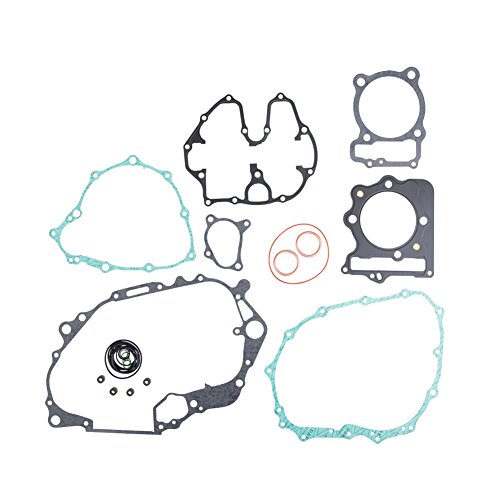


Top pick: an OE-equivalent full engine gasket set matched to your engine code is the safest all-around buy for most repair shoppers. It covers common leak points around the valve covers, intake, front cover, and head sealing without pushing you into parts you do not need.
That is the right starting point for a daily driver, a high-mileage reseal, or a mild top-end repair. If the job is a boosted build or a high-compression engine, move to MLS head gaskets and verify surface finish before ordering.
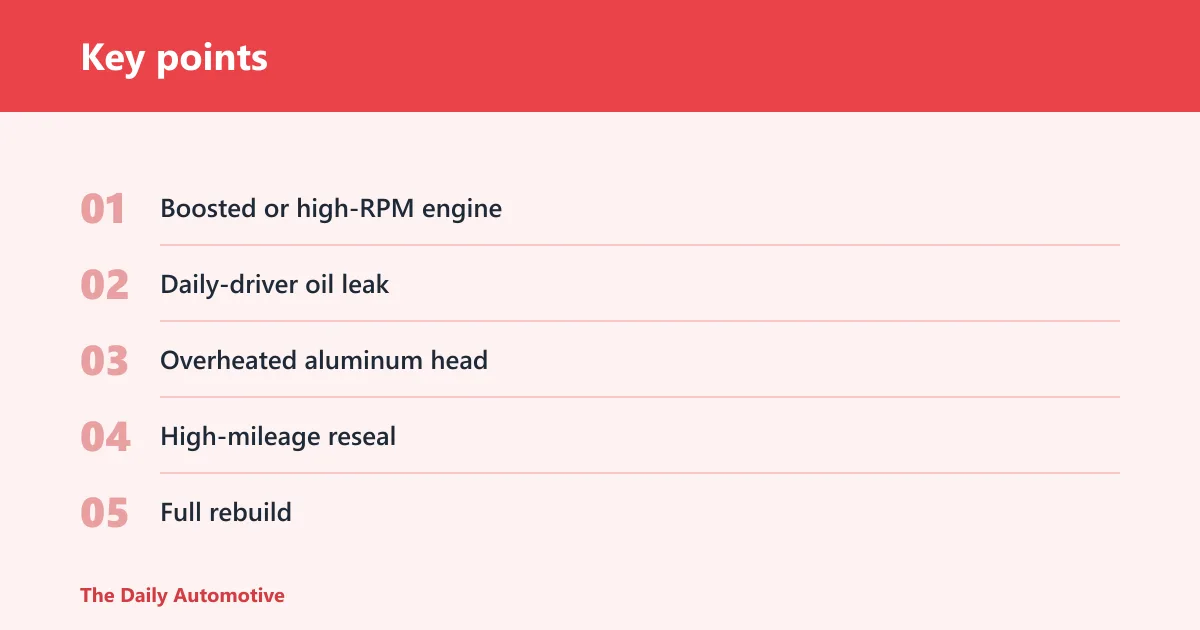
Quick picks by need
- Boosted or high-RPM engine: MLS head gasket kit with exact engine-family fitment and verified deck flatness.
- Daily-driver oil leak: full engine gasket set that includes valve cover gaskets and the relevant intake or front-cover seals.
- Overheated aluminum head: head gasket set only after flatness is checked; machine work may be needed before MLS goes back on.
- High-mileage reseal: OEM-grade gasket set when you want factory-equivalent sealing and broad coverage of age-related leaks.
- Full rebuild: complete engine gasket set plus the engine-specific hardware and seals required by the platform.
Best fit by repair type
For a common leak repair, the best kit is often the one that solves the most seepage points in one order. A valve cover gasket matters more than many shoppers expect, because oil leaks often start there before they spread to plugs, exhaust smell, or smoke on a hot manifold.
For a combustion seal issue, start with the cylinder-head sealing surface and the exact engine family. A kit with the wrong gasket thickness, bore pattern, or coolant passage layout can fail even when the part name sounds close enough.
Say your 5.3L GM truck has oil wetness around the valve covers and front of the engine, but no coolant loss. A full engine gasket set is usually the cleaner buy than a head gasket set, because the repair scope is sealing-related rather than combustion-related.
A turbocharged 4-cylinder that starts pushing coolant after repeated high-boost pulls may need fitment-verified MLS construction. That is not a “sealant and hope” problem. It needs fitment-verified MLS construction, checked deck flatness, and a look at bolt reuse before any gasket goes on.
MLS head gasket kits
MLS head gaskets are commonly used for higher cylinder pressure, higher RPM, and heavy combustion loads. The multi-layer steel construction is built for demanding engines, but it only works well when the block and head surfaces are flat and properly prepared.
What MLS construction does well
MLS designs help maintain combustion sealing where pressure spikes are part of normal operation. That makes them common on boosted or high-compression engines, and it is why performance gasket lines often include MLS head designs for demanding builds.
TheSmallTools describes performance gaskets as being evaluated for temperature resistance and sealing effectiveness, and it identifies Fel-Pro’s performance head gasket as multi-layered steel. That lines up with the general rule: the higher the cylinder pressure, the more important the surface finish and clamp load become.
Where flatness and finish matter
MLS gaskets need a clean, flat, properly prepared surface. If the head is warped, the block deck is rough, or the finish is outside what the gasket expects, the seal can fail quickly even if the part itself is correct.
That is why MLS is not the automatic answer for every blown head gasket. If the engine has a warped aluminum head, a porous block, or repeated gasket failure from an unresolved machine issue, surface correction comes before parts shopping.
A common first-timer mistake is ordering an MLS gasket because it sounds stronger, then installing it on a head that still needs machining. That usually saves nothing. It can create a repeat failure that costs more than the original repair.
Best-fit engines and stress levels
Performance gaskets are designed to withstand high boost, high RPM, and extreme cylinder pressures. Domestic Gaskets lists a 7 Layers Head Gasket Set for 04-09 GM V8 6.0L LS applications, and it also shows a head gasket set for 14-20 Chevrolet Silverado 1500, Tahoe, GMC Yukon, and Sierra 5.3L. It offers a 0.037-inch thick head gasket set for 04-10 Chevrolet GMC 6.6 Duramax.
Those examples point to the same buying rule: match the gasket not only to the engine family, but also to the stress level and intended use. A diesel, a boosted LS, and a mild commuter engine do not ask the same thing from the seal.
When MLS is the wrong choice
MLS is not the best answer when the sealing surface is damaged and you are not planning machine work. It is also the wrong buy if the engine family requires a different thickness or a very specific head bolt strategy that the kit does not cover.
For a stock, low-stress engine with no performance goal, a well-matched OEM-grade gasket set often makes more sense. It is usually the more practical route for long-term reliability when the engine is not being pushed into boosted or high-RPM territory.
Full engine gasket set
A full engine gasket set is the right buy when the repair scope goes beyond the head. It typically includes multiple engine sealing components, and many kits bundle valve cover, crank seal, intake gasket, and related pieces for a broader reseal or rebuild.
What a full set includes
Full sets vary by engine family and vehicle fitment, so the contents are never universal. The useful part is coverage: one order can address oil leaks, intake seepage, timing-cover sealing, and top-end work without piecing together parts from different boxes.
O&J Performance lists intake manifold seals in its gasket selection, and it includes exhaust and header rings among its gasket types. That is a reminder that a “kit” can mean several very different sealing pieces, not only a head gasket.
When a full set beats piecemeal buying
Choose a full engine gasket set when the engine is already apart for a rebuild, when multiple leak paths are present, or when age has made several seals brittle at once. It is usually the cleaner value when labor is the expensive part of the job.
It is often overkill for a single external oil seep. In that case, buying only the needed lower or upper seals keeps parts cost and install time in check.
Cost and labor tradeoffs
Total project cost is bigger than the gasket price. Add coolant, oil, filter, sealant where specified, fresh hardware if the platform uses torque-to-yield bolts, and machine work if the head or deck is out of spec.
For a head job, the machine shop bill can easily matter as much as the gasket set itself. That is why the cheapest part on the screen is not the cheapest repair.
The same source lists 1,649 head gasket set products, 316 timing belt kit products, 333 timing chain kit products, and 3,410 piston set products. That volume is useful only if you still filter by engine code, model year, and exact application before you buy.
Fitment checks before ordering
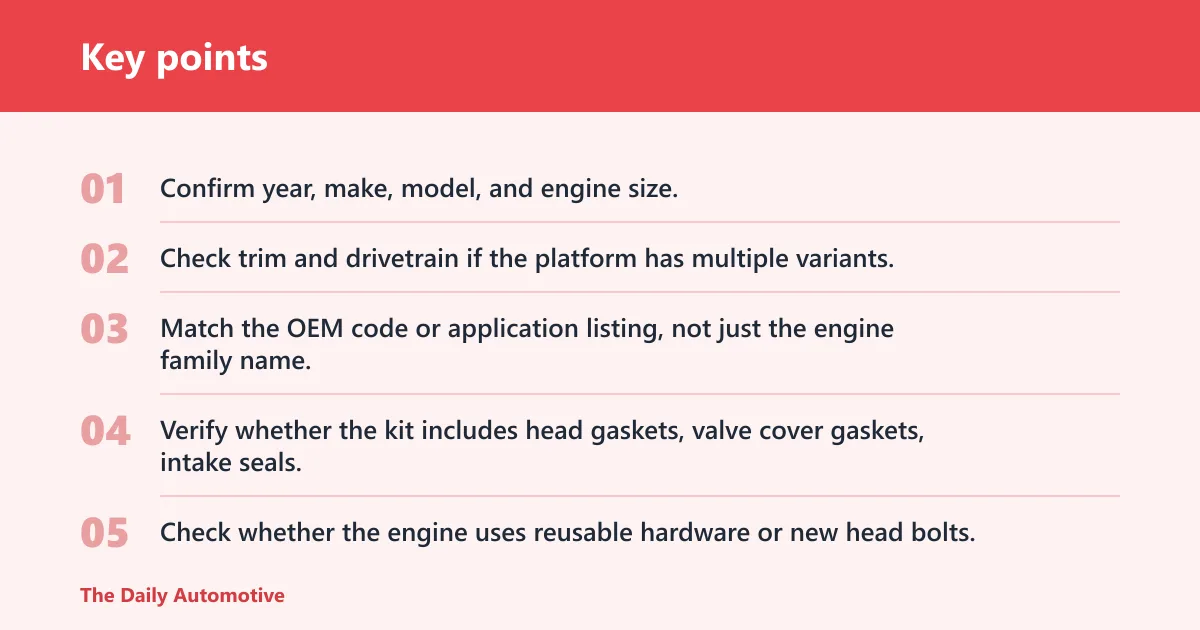
- Confirm year, make, model, and engine size.
- Check trim and drivetrain if the platform has multiple variants.
- Match the OEM code or application listing, not just the engine family name.
- Verify whether the kit includes head gaskets, valve cover gaskets, intake seals, crank seals, and any exhaust rings you need.
- Check whether the engine uses reusable hardware or new head bolts.
OEM-grade gasket set
OEM-grade gasket sets are the safer buy when you want factory-equivalent sealing and exact fitment over performance extras. They are common in rebuild kits and are often the least complicated answer for engines that need long-term reliability, not a change in operating envelope.
Factory-equivalent sealing
OEM-grade does not mean premium in the marketing sense. It means the gasket layout, port shape, and sealing approach are intended to match the engine’s original requirements as closely as possible.
That matters on engines with tight tolerances or specific coolant and oil passage geometry. A near-match can still leak if a passage is off by design, not by quality.
When OEM-grade is the safer buy
Choose OEM-grade when the engine is stock, the repair is maintenance-driven, or you want the least guesswork on fitment. It is especially useful when the vehicle has had previous repairs and the current issue is a straightforward reseal rather than a performance upgrade.
Motor Review includes a FEL-PRO 260-1880 engine gasket set for Chevrolet Silverado 1500 applications. That kind of catalog fitment shows why the exact vehicle listing matters more than a general part family name.
Durability versus performance intent
OEM-grade is not the best answer for sustained boost or extreme cylinder pressure. For that, MLS construction and the correct prep work matter more than factory-equivalent comfort.
For a stock commuter engine, though, chasing a racing-style gasket can create more risk than value. The right seal is the one that matches the stress level, not the one with the loudest label.
Engine gasket decision matrix
This matrix matches failure mode to gasket choice, fitment checks, and cost drivers. Use it to narrow the kit before you shop by brand or price.
| Failure mode | Engine type | Recommended gasket material | Must-check fitment fields | Install risk | Total project cost range |
|---|---|---|---|---|---|
| Boost-related blow-by | Turbo or supercharged V6/V8 | MLS head gasket | Year, make, model, engine code, head bolt type | High; surface prep is critical | High; gasket, fluids, hardware, possible machining |
| Repeated coolant loss after overheating | Aluminum-head commuter engine | MLS if flatness is verified; otherwise repair the surface first | Year, engine size, trim, head casting, OEM code | High; warped head risk | High; machine work can dominate the bill |
| Daily-driver oil leak at valve covers | High-mileage gasoline engine | Valve cover gasket within a full or upper set | Engine family, model year, upper/lower set coverage | Medium | Low to medium; parts plus fluids |
| Intake manifold seepage | V6 or V8 with age-related seals | OEM-grade intake and upper sealing set | Intake style, engine code, emissions package | Medium | Low to medium |
| High-mileage reseal during maintenance | Stock street engine | OEM-grade gasket set | Year, make, model, engine size, trim | Medium | Medium; broader parts coverage |
| Full rebuild after teardown | Any platform undergoing overhaul | Full engine gasket set | Engine family, bore size, head version, accessory layout | High; many parts to verify | High; kit, seals, fluids, hardware, labor |
| Minor coolant seep with no teardown planned | Any engine with a small external leak | Temporary head gasket sealer only as an interim step | Cooling-system capacity, leak location, heater-core risk | High; clogging risk | Low upfront, but risky if it worsens cooling issues |
| Boosted LS build | GM LS-based high-performance engine | MLS head gasket | Engine code, deck finish, bore size, bolt strategy | High | High; machining and hardware matter |
| High-RPM naturally aspirated build | Performance four-cylinder or V8 | MLS or application-specific performance set | Compression ratio, head casting, gasket thickness | High | High; tuning and prep often add cost |
| Porous block or damaged deck surface | Any engine with repeated failure | Repair the surface first; gasket choice comes second | Block integrity, flatness, casting condition | Very high if ignored | Very high; machine work may be unavoidable |
How do you choose the right kit?
Choose the kit by failure mode first, not brand. If the problem is combustion sealing under pressure, MLS is usually the right lane. If the problem is age-related oil seepage, a full or OEM-grade set is often the better buy. If the head or deck is not flat, no kit fixes that by itself.
Match gasket material to cylinder pressure
High boost, high RPM, and extreme cylinder pressure call for MLS construction or an application-specific performance seal. The material has to survive the load, not merely fit the hole pattern.
For a stock engine with mild use, a composite-style or OEM-equivalent gasket can be the better fit because the job is about proper sealing at factory stress levels, not endurance under racing conditions.
Check surface prep before buying
If the engine has overheated, inspect the head and block for flatness before you order parts. That step can change the whole purchase from a simple kit to a machine-shop job plus a different gasket choice.
MLS gaskets are less forgiving of poor prep than many shoppers expect. They reward precision. They do not erase it.
Decide between head kit and full set
Buy a head gasket kit when the only top-end task is combustion sealing and the surrounding seals are still serviceable. Buy a full engine gasket set when the engine is already apart, when oil leaks are spread across several areas, or when the labor overlap makes it smart to renew everything at once.
Budget for machine work and fluids
A gasket purchase should always be paired with the rest of the repair bill. Add coolant, oil, filter, RTV only where the service manual calls for it, and any required bolts or seals. If the head needs resurfacing, that cost belongs in the plan before you click buy.
Use sealer only as a temporary stopgap
Head gasket sealer is an interim option for very limited situations, not a real repair for a blown gasket. It can clog heater cores, radiators, and coolant passages, and it may make overheating worse. If the leak is severe or combustion gases are entering the cooling system, the engine needs mechanical repair.
Can it stop a minor seep in a pinch? Sometimes. Should it be treated as a fix? No.
Frequently asked questions
What is the best engine gasket kit for my car?
The best gasket kit is the one that matches your exact engine code and repair scope. For top-end work, choose a head gasket kit; for broader reseal work, choose a full engine gasket set; for stock reliability, OEM-grade is often the safest path. Fitment comes before brand.
How do I choose between MLS and composite head gaskets?
Choose MLS for high boost, high RPM, and extreme cylinder pressure, but only if the block and head surfaces are flat and properly prepared. Composite-style gaskets are generally more suited to lower-stress applications and factory-style sealing needs. If the surface is damaged, fix the surface first.
Which gasket kit is best for boosted or high-RPM engines?
MLS head gasket kits are the usual choice for boosted or high-RPM engines because they handle high cylinder pressure better than standard sealing setups. The important part is not only the gasket material, but also head flatness, deck finish, and the correct hardware for the platform.
Do I need a full engine gasket set or just a head gasket set?
Use a head gasket set when the repair is centered on combustion sealing and the other seals are still serviceable. Use a full engine gasket set when you are doing a rebuild, a complete reseal, or a job that already reaches the intake, valve covers, crank seals, or front cover.
What should I check to make sure a gasket kit fits my vehicle?
Check year, make, model, engine size, trim, and the OEM code or application listing before you order. Many engines share a family name but differ in ports, thickness, bolt pattern, or accessory layout. That mismatch is a common cause of repeat leaks and returns.
Can a head gasket sealer fix a blown head gasket temporarily?
Only in very limited, low-severity situations, and even then it is a stopgap. It does not replace mechanical repair. It can also clog heater cores, radiators, and coolant passages, which may create worse overheating problems than the original leak.
Products related to this article
Sponsored / affiliate links. As an Amazon Associate I earn from qualifying purchases. I may earn additional commission from eligible campaigns.