Best Windshield Washer Fluid: What Actually Keeps Your Glass Clean
It happens to everyone. You’re cruising down the highway behind a semi, and suddenly your windshield is a brown smear of road grime and dead bugs. You hit the washer button. A thin blue liquid sprays out, the wipers drag it across the glass, and you’re left looking through a streaky, smeared haze that’s somehow worse than before.
That moment isn’t just annoying. It’s a visibility problem, and it’s exactly why the fluid in your reservoir matters more than you think. Most people grab whatever blue bottle is cheapest at the gas station without realizing that the chemistry inside determines whether you get a clear view or a smeared one. This article walks you through what’s actually in washer fluid, how to match it to your climate, and which types genuinely perform. You’ll learn how to dilute concentrates properly, why methanol is a double-edged sword, and how to diagnose a clogged line versus a dead pump.

Prime Guard
Prime Guard +32°F Power Blast Blue Windshield…
- Powerful Cleaning Performance: Effectively removes road grime, bugs, dirt, film, and light frost to maintain clear windshield visi…
- Streak-Free Formula: Engineered to leave no streaks or residue for a crystal-clear finish every time
- +32°F Summer Blend: Ideal for warm-weather driving conditions while maintaining optimal cleaning power
For warm-weather driving, a solid all-season option like the Prime Guard +32°F Power Blast handles the basics well. It’s a ready-to-use summer blend that cuts through light frost, bugs, and road film without leaving residue. If you live somewhere that never sees single-digit temperatures, this kind of fluid is a dependable, no-fuss choice that you can pour straight in and forget about.
What’s Actually in the Bottle?
Washer fluid is mostly water. The rest is a mix of solvents, surfactants, and a few specialty additives that do the heavy lifting. The solvent is usually methanol or ethanol, and it serves one critical purpose: lowering the freeze point. Plain water freezes at 32°F. A standard winter blend with 30-40% methanol stays liquid down to about -20°F. That’s the difference between spraying your windshield and blowing a fuse because the lines are frozen solid.
Surfactants are the cleaning agents. They reduce the surface tension of water, which lets the fluid spread evenly across the glass instead of beading up. Without them, you’d get a patchy, half-cleaned windshield. Most formulas also include a small amount of polymer or glycol ether. These help the fluid cling to the glass just long enough for the wiper blade to do its job, then evaporate cleanly without leaving a film.
Here’s where it gets interesting. Cheap fluids use more methanol and fewer surfactants. They freeze fine, but they clean poorly. Premium fluids flip that ratio. They use better surfactants and add things like water repellents or anti-corrosion agents that protect your paint and wiper blades. You can usually tell the difference by the price tag, but you can also tell by how the fluid feels. Rub a drop between your fingers. A good fluid feels slick, almost like soap. A cheap one feels like colored water.
How to Choose: Match the Fluid to Your Climate
Winter and Deep Freeze
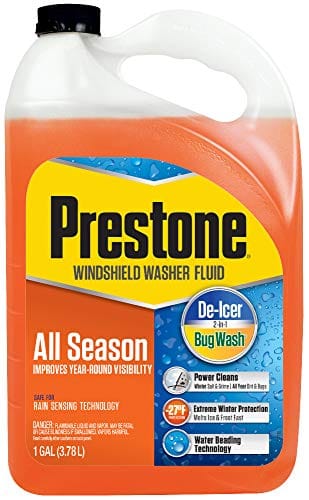
If you live in a place where temperatures drop below 10°F, you need a dedicated winter blend. Look for a freeze point rating of -20°F or lower. Prestone De-Icer is a solid example. It uses a higher methanol concentration and adds a de-icer that helps melt light frost on contact. This matters because a standard all-season fluid will freeze in the lines, crack the reservoir, or blow a fuse when you try to use it.
One thing to watch: winter blends often have a slightly different smell and can be harsher on your paint if you spill them. Rinse spills off quickly. Also, don’t mix a winter blend with a leftover summer blend in the reservoir. The diluted mixture might have a higher freeze point than you expect. If you’re switching seasons, drain the reservoir first or run it dry before refilling.
Summer and Bug Season
Bugs are a different problem. They’re mostly protein and chitin, which doesn’t dissolve in plain water. You need a fluid with strong enzymes or alkaline builders that break down organic matter. Rain-X 2-in-1 All Season is a popular pick here because it combines bug-cutting surfactants with a water-repellent treatment. The repellent makes rain bead up and roll off at speed, which is genuinely useful in a downpour.
Summer blends like the Prime Guard +32°F Power Blast focus on cleaning power over freeze protection. They use more surfactant and less methanol, which makes them better at cutting through road film and bug splatter. They’re also less aggressive on your vehicle’s paint and rubber seals than a high-methanol winter blend. If you live in a mild climate, this is the sweet spot.
Year-Round Commuters
For most people, an all-season fluid rated to 0°F or -10°F is the right call. It handles the majority of winter days, cleans bugs well enough, and doesn’t require seasonal swaps. The trade-off is that it’s not exceptional at anything. In a hard freeze, it might leave a thin layer of ice on the glass. In peak bug season, you might need to spray twice. But for the average commuter who just wants a clear windshield, it’s the most practical option.
If you want the water-repellent benefit without buying a separate product, Rain-X makes an all-season version that includes the treatment. It costs a bit more, but the beading effect is noticeable, especially at highway speeds. Just be aware that the repellent can cause wiper chatter on some glass. It’s a minor annoyance, not a functional problem.
Concentrates vs. Ready-to-Use: The Cost Breakdown
Concentrates save money but cost you time and attention. A typical concentrate like Aqua Charge Ultra Concentrate comes in a small bottle that makes several gallons when diluted. The math is simple: one gallon of ready-to-use fluid costs around $3-4. A concentrate that makes four gallons might cost $10-12. You’re saving roughly 30-50% per gallon, but you have to mix it yourself and get the ratios right.
Here’s how to dilute properly. Most concentrates are 10:1 or 20:1. That means one part concentrate to ten or twenty parts water. For a 1-gallon jug, that’s about 6.4 ounces of concentrate for a 20:1 mix. Use distilled water, not tap water. Tap water contains minerals that can leave streaks and, over time, clog the tiny jets in your spray nozzles.
The freeze point depends entirely on the dilution ratio. If you mix a winter concentrate at 10:1, you might get -20°F protection. If you dilute it too much, say 20:1, the freeze point might only be 10°F. That’s a dangerous mistake in a cold climate. Always check the label for the specific freeze point at each ratio. When in doubt, mix it stronger than you think you need. A slightly stronger mix won’t hurt anything.
Ready-to-use fluids are the opposite. They’re pre-mixed at the factory, so the freeze point is guaranteed. You pour it in and forget it. The extra cost is the price of convenience. For most people, that’s worth it. Unless you’re going through several gallons a year, the savings from a concentrate probably aren’t worth the hassle of mixing and storing.
Common Mistakes (And How to Avoid Them)
The most common mistake is using plain water in summer. It’s free, but it does a terrible job. Water doesn’t remove bugs or road film, and it leaves mineral deposits that etch into the glass over time. If you run your reservoir dry and fill it with water from a hose, you’re setting yourself up for streaks and potential nozzle clogs.
The second mistake is mixing incompatible fluids. Different brands use different surfactant packages. Mixing them can create a cloudy, gel-like substance that clogs your reservoir filter and pump. It’s rare, but it happens. If you’re switching brands, drain the reservoir first. It takes five minutes and saves you a potential repair bill.
The third mistake is ignoring the freeze point rating. A fluid rated to 32°F is fine for a mild winter, but it’s useless in a Minnesota January. Check the label every time you buy. The rating is printed on the front, usually in big letters. Don’t assume a blue liquid is winter-rated. Some summer blends freeze at 20°F, which is well above what you need.
DIY Fluid: Why It Fails in Winter
Homemade washer fluid recipes are all over the internet. Most involve water, dish soap, and rubbing alcohol. The idea is that the alcohol lowers the freeze point. In theory, that works. In practice, it’s a mess.
Dish soap leaves a film. It’s designed to cling to dishes, not to rinse cleanly off glass. That film causes streaking and can actually attract dirt. Rubbing alcohol, which is typically 70% isopropyl, will lower the freeze point, but you need a lot of it. A 50/50 mix of water and 70% alcohol freezes at about -20°F. That’s a lot of alcohol to buy and mix, and it’s not much cheaper than just buying a gallon of winter fluid.
There’s also a legal issue in some cold states. Several states, including Vermont and New Hampshire, have regulations about the methanol content of windshield washer fluid. They restrict it because methanol is toxic and poses a risk to children and pets if ingested. Homemade fluids aren’t tested or regulated, so you have no idea what you’re actually putting in your car. If you’re in a cold climate, just buy a proper winter blend. It’s not worth the risk.
Storage Tips to Prevent Degradation
Washer fluid doesn’t expire in the traditional sense, but it can degrade. The surfactants can separate from the water over time, especially if the bottle is exposed to extreme heat or freezing temperatures. The solvents can evaporate if the cap isn’t sealed properly, which raises the freeze point.
Store your fluid in a cool, dry place. A garage shelf is perfect. Avoid leaving bottles in the trunk during summer. Interior temperatures can exceed 140°F, which accelerates separation. If you open a bottle and the liquid looks cloudy or has a layer of film on top, shake it vigorously. If it doesn’t re-mix, throw it out.
For concentrates, the shelf life is longer, but the same rules apply. Keep the cap tight and store it out of direct sunlight. A concentrate that’s been sitting for two years is probably fine, but check the color and smell before using it. If it smells sour or looks like it’s separated permanently, buy a fresh bottle.
Diagnosing a Clogged Line vs. a Bad Pump
If you press the washer button and nothing comes out, you have two likely culprits: a clogged line or a dead pump. Here’s how to tell the difference without tearing apart your car.
First, listen. When you press the button, you should hear a faint whirring or buzzing sound from under the hood. That’s the pump motor. If you hear it, the pump is working. The problem is likely a clogged nozzle or a frozen line. If you don’t hear anything, the pump is either dead, the fuse is blown, or the relay is faulty.
If the pump is running but nothing sprays, check the nozzles first. They’re tiny brass or plastic jets on the hood. They clog with mineral deposits and debris. Use a pin or a small needle to gently clear the opening. If that doesn’t work, check the line. The rubber hose that runs from the reservoir to the nozzles can kink or get blocked. Disconnect it at the nozzle end and have someone press the button. If fluid comes out of the hose, the line is clear and the nozzle is the problem.
If the pump is silent, check the fuse. It’s usually in the interior fuse box, labeled ‘washer’ or ‘wiper’. If the fuse is fine, the pump itself is likely dead. A new pump costs $15-30 and takes about twenty minutes to replace on most cars. It’s a simple job. You just need a socket set and a screwdriver.
Comparing the Main Types
| Type | Freeze Point | Best For | Key Additives | Trade-Off |
|---|---|---|---|---|
| Summer Blend | 32°F to 20°F | Warm climates, bug season | High surfactant load, enzymes | Freezes in winter |
| Winter Blend | -20°F to -30°F | Deep freeze, ice, frost | High methanol, de-icers | Harsher on paint, strong smell |
| All-Season | 0°F to -10°F | Mild winters, year-round commutes | Balanced surfactants and solvents | Not exceptional at either extreme |
| Concentrate | Varies by dilution | Bulk users, cost savings | Same as liquid, but concentrated | Requires precise mixing |
| Eco-Friendly | 20°F to 0°F | Environmentally conscious drivers | Plant-based solvents, low VOC | Higher cost, less effective in extreme cold |
Environmental Impact: Methanol vs. Alternatives
Methanol is the standard solvent in most washer fluids. It’s cheap and effective, but it’s toxic. If you spill it on the ground, it can contaminate groundwater. If you pour it down a drain, it’s a problem for wastewater treatment. Most states don’t regulate it heavily, but some do, and the trend is toward stricter limits.
Eco-friendly alternatives like Nextzett Kristall Klar use ethanol or plant-based glycols instead of methanol. These are less toxic and biodegrade more readily. The trade-off is cost and performance. Ethanol is more expensive, so the fluid costs more. It also has a slightly higher freeze point, which means it’s not ideal for extreme cold. A good eco-friendly fluid might be rated to 0°F, while a methanol-based one goes to -30°F.
If you’re concerned about the environment, look for fluids labeled ‘low VOC’ or ‘plant-based’. They’re a legitimate option for most of the country. If you live in a place where it hits -20°F regularly, you might need to stick with methanol for the winter months. It’s a practical trade-off, not a moral failure.
Frequently Asked Questions
Can I mix different colors?
You can, but it’s not recommended. The color is just dye, so mixing blue and green won’t cause a chemical reaction. The problem is the formula. Different brands use different surfactant packages and solvents. Mixing them can cause the surfactants to precipitate out of solution, creating a cloudy gunk that clogs your reservoir and pump. If you need to top off, use the same brand you already have. If you’re switching brands, drain the reservoir first.
Does it expire?
Not in a strict sense, but it does degrade. The solvents can evaporate over time, especially if the bottle isn’t sealed. The surfactants can separate, reducing cleaning power. A bottle that’s been sitting in a hot garage for three years might still work, but it won’t perform like new. Check the color and smell. If it looks cloudy or smells off, buy a fresh bottle.
Can I use water instead?
In an emergency, yes. In the long term, no. Water doesn’t clean bugs or road film, it leaves mineral deposits that streak and etch glass, and it freezes in winter. If you’re stuck and need to clear a dirty windshield, water is better than nothing. But you should replace it with proper fluid as soon as possible. Running water in your system for a few days won’t damage anything, but weeks of it will leave scale in the lines and nozzles.
Final Thoughts and Recommendations
- Match the fluid to your climate. Summer blends freeze, winter blends smell, and all-season fluids are the safe middle ground.
- Check the freeze point rating on the label every time. Don’t assume a blue liquid is winter-rated.
- Use distilled water if you’re diluting a concentrate. Tap water leaves streaks and clogs nozzles.
- Don’t mix brands. Drain the reservoir before switching to avoid gelling.
- Store fluid in a cool, dry place. Heat degrades the surfactants and evaporates the solvents.
- If the pump whirs but nothing sprays, check the nozzles and lines before buying a new pump.
- Eco-friendly fluids work well in mild climates but may not handle extreme cold. Know your local temperatures.
For most drivers, a quality all-season fluid like the Rain-X 2-in-1 is the right call. It cleans well, repels water, and handles mild winter temperatures. If you live in a deep-freeze zone, step up to a dedicated winter blend. If you’re in a warm climate and hate bugs, a summer blend with strong enzymes is your best bet. And if you want to save a few bucks and don’t mind mixing, a concentrate is a solid option. Just read the dilution chart carefully.
The right fluid is a small investment that pays off every time you hit the washer button. It’s not glamorous, but a clear windshield is a safety feature. Take two minutes to check what’s in your reservoir and make the switch if it’s not up to the job. You’ll notice the difference on the very next drive.
Products related to this article
Sponsored / affiliate links. As an Amazon Associate I earn from qualifying purchases. I may earn additional commission from eligible campaigns.