Oil for Car: Top 5 Choices for a Smooth Engine
Mobil 1 Advanced Full Synthetic Motor Oil 5W-30 is a strong default for many gasoline engines that call for 5W-30 because it fits common daily-driver specs and is formulated for sludge control, LSPI resistance, and timing-chain wear protection.
Quick picks by driving need
Start with the engine’s stress pattern, then look at brand. If your manual allows more than one viscosity, pick the grade that matches short trips, hot running, and mileage needs.
| Need | Pick | Why it fits | Must-check spec |
|---|---|---|---|
| Best overall | Mobil 1 Advanced Full Synthetic Motor Oil 5W-30 | Broad daily-driver fit, longer mileage positioning, sludge and wear protection | API SP and the viscosity in the manual |
| Best value | Valvoline Advanced Full Synthetic SAE 5W-20 Motor Oil | Full synthetic with anti-wear additives, detergents, and temperature protection | API SP plus ILSAC GF-6A when the manual calls for it |
| Best premium | Liqui Moly 2041 Premium 5W-40 Synthetic Motor Oil | Strong fit for higher heat, fast low-temperature delivery, cleaning additives | Correct 5W-40 fitment in the owner’s manual |
| Best high-mileage | Valvoline High Mileage with MaxLife Technology SAE 5W-30 Synthetic Blend Motor Oil | Seal conditioning, leak reduction, oil consumption control | Use only when leak or consumption symptoms justify it |
| Best performance | Motul 109776 8100 X-Cess Gen2 5W-40 | Built for demanding driving and higher thermal load | 5W-40 approval in the manual or performance spec list |
| Best for hybrids | Valvoline Hybrid Vehicle Full Synthetic SAE 0W-20 Motor Oil | Hybrid-specific full synthetic with cold-start flow | 0W-20 called for by the vehicle maker |
📊 The Drive says its list was built by looking over more than 20 oils. Source: Thedrive.
Top pick for most drivers
Mobil 1 Advanced Full Synthetic Motor Oil 5W-30 is the best default for many gasoline cars that allow 5W-30 because it pairs common fitment with strong protection for the issues everyday engines face: sludge, low-speed pre-ignition risk, and timing-chain wear.
That matters more than a brand badge. A commuter that sits in traffic, runs short errands, and bakes in summer heat needs an oil that stays stable and keeps deposits down.
Say your compact sedan has a 5W-30 fill spec and spends most of its time on school runs and traffic. A full synthetic 5W-30 is usually the better call than a cheaper blend if the manual allows it, because repeated short trips leave more moisture and fuel dilution behind.
Quick picks by driving need
Best overall: Mobil 1 advanced full Synthetic 5W-30
This is the broadest match for drivers who want one oil that can handle commuting, stop-and-go heat, and longer mileage expectations without moving to a specialty formula.
Best value: Valvoline advanced full synthetic SAE 5W-20
Choose this when your manual calls for 5W-20 and you want a full synthetic with anti-wear additives, detergents, and protection across high and low temperatures.
Best high-mileage: Valvoline high mileage with maxLife technology SAE 5W-30
This is the right call when an engine shows seepage, seal hardening, or rising oil consumption, and the manual accepts 5W-30.
Best premium: Liqui Moly 2041 Premium 5W-40
Use this for engines that see higher heat, hard pulls, or a premium-performance spec that calls for a thicker hot viscosity.
Best for hybrids: Valvoline hybrid vehicle full synthetic SAE 0W-20
Hybrid powertrains often restart the engine frequently, so cold-start flow and quick circulation matter more than a thicker grade that may be unnecessary.
Best for performance cars: Motul 109776 8100 X-Cess Gen2 5W-40
Pick this when the engine is built for high load, higher temperature, or spirited driving and the manual permits 5W-40.
Engine oil decision matrix

This table turns common car scenarios into a clear oil choice. Match the stress pattern first, then confirm the exact viscosity and specification in the owner’s manual.
| Scenario | Best oil type | Viscosity | Must-check spec | Avoid this if |
|---|---|---|---|---|
| Late-model commuter with the manual listing 5W-30 | Full synthetic | 5W-30 | API SP | Do not buy a thicker grade just because it sounds stronger. |
| Small gasoline car that specifically calls for 5W-20 | Full synthetic | 5W-20 | ILSAC GF-6A | Avoid 5W-30 unless the manual allows it. |
| Hybrid with frequent engine stop-start operation | Hybrid-specific full synthetic | 0W-20 | API SP | Skip thicker oil unless the maker approves it. |
| High-mileage car with consumption or seepage | High-mileage synthetic blend or full synthetic | 5W-30 | API SP | Do not use high-mileage oil just because the odometer is high. |
| Turbo engine that sees heat and short shutdowns | Full synthetic | 5W-30 or 5W-40 | API SP | Avoid old-spec oil that lacks current LSPI protection. |
| Performance car with sustained high load | Premium synthetic | 5W-40 | Vehicle maker approval | Avoid thin oil if the engine is tuned or heavily loaded. |
| Cold climate and overnight parking outdoors | Full synthetic with fast low-temp flow | 0W-20 or 5W-20 | ILSAC GF-6A when required | Do not choose a thicker hot-grade only for winter use. |
| Older non-leaking daily driver on a normal commute | Standard full synthetic | 5W-20 or 5W-30 | API SP | Avoid high-mileage oil if the engine has no leak, seep, or consumption symptoms. |
A common mistake is topping up with whatever oil is on hand without checking whether it matches the engine’s required viscosity. A 90,000-mile engine with clean seals and no consumption issue may do better on the factory grade than on a high-mileage formula built for seal conditioning.
Which oil is best for your car?
The best oil is the one that matches your manual first and your driving pattern second. If the handbook lists a single grade, start there. If it lists more than one, choose the grade that fits climate, trip length, and engine load.
If your manual calls for 5W-20
Use 5W-20 and look for API SP, with ILSAC GF-6A for many current gasoline cars. Valvoline Advanced Full Synthetic SAE 5W-20 is the value pick here because it gives you full-synthetic protection, anti-wear additives, detergents, and temperature stability without moving away from the factory grade.
If your manual allows 5W-30
5W-30 is the common all-around choice for daily drivers because it offers wide compatibility and solid hot-running protection while still flowing well at startup. Mobil 1 Advanced Full Synthetic Motor Oil 5W-30 is the strongest default when you want one formula that can fit broad use, longer mileage expectations, and wear concerns.
If your engine needs 0W-20
Use 0W-20 when the maker specifies it, especially in hybrids and many late-model engines. The lower winter number helps with cold-start flow, which matters when the engine shuts off and restarts often. Valvoline Hybrid Vehicle Full Synthetic SAE 0W-20 is built for that pattern.
If you drive hard or see high heat
Move toward 5W-40 only when the manual allows it and the engine’s use case justifies it. Higher load, sustained heat, mountain driving, or track-adjacent use can call for a thicker hot viscosity and stronger high-temperature stability. Liqui Moly 2041 Premium 5W-40 and Motul 109776 8100 X-Cess Gen2 5W-40 fit that lane.
Mobil 1 advanced full Synthetic 5W-30 review
Mobil 1 Advanced Full Synthetic Motor Oil 5W-30 earns the best-overall label because it covers the widest range of everyday needs without forcing a compromise in most cars that already call for 5W-30. It is a full synthetic, it is positioned for longer mileage, and it adds protection against sludge, LSPI, and timing-chain wear.
Those are real failure modes, not marketing copy. Sludge can form in engines that see short trips and poor heat soak. LSPI matters in many turbocharged gasoline engines. Timing-chain wear becomes a concern when oil film strength and cleanliness break down over time.
Choose this over a cheaper oil when the car sees repeated stop-and-go traffic, short hops, frequent hot restarts, or a manual that allows extended service intervals under the right conditions. If the car is a basic commuter with light use and a tight budget, a spec-correct cheaper oil can still be enough.
Valvoline Advanced full Synthetic 5W-20 review
Valvoline Advanced Full Synthetic SAE 5W-20 Motor Oil is the value pick because it stays close to the factory viscosity for many smaller engines while adding full-synthetic protection, anti-wear additives, detergents, and high- and low-temperature coverage.
That makes it a sensible buy for drivers who want to stay within the manual without paying for a premium-performance formula they do not need. Detergents help keep deposits in suspension. Anti-wear additives matter most in engines that see cold starts, idle time, and frequent restarts.
Stick with 5W-20 when the owner’s manual calls for it. Do not move to 5W-30 just because a friend’s car uses it. The difference looks small on paper, but fitment depends on the engine’s bearing clearances, oil pump design, and calibration targets.
How do you choose the right oil spec?
Start with the manual, then confirm the current spec printed on the bottle. For many gasoline cars, API SP and ILSAC GF-6A are the key labels to look for. Viscosity matters, but the certification tells you whether the oil meets a modern engine’s protection targets.
API SP explained
API SP is the modern gasoline-engine service category. In plain terms, it signals current protection for wear, deposits, oxidation, and LSPI concerns in newer engines. If your car is a newer gasoline model, this is a strong baseline to seek.
ILSAC GF-6A explained
ILSAC GF-6A is a fuel-economy-oriented standard commonly used by many current gasoline cars. It fits common grades like 0W-20, 5W-20, and some 5W-30 applications. If your manual names GF-6A, do not ignore it and buy by viscosity alone.
What 5W-20, 5W-30, 5W-40, and 0W-20 mean
These grades describe cold-start flow and hot-running thickness. The first number with the W tells you how the oil flows in cold conditions; the second number describes how it holds up at operating temperature. Lower first numbers help winter starts. Higher second numbers help in hotter, harder use.
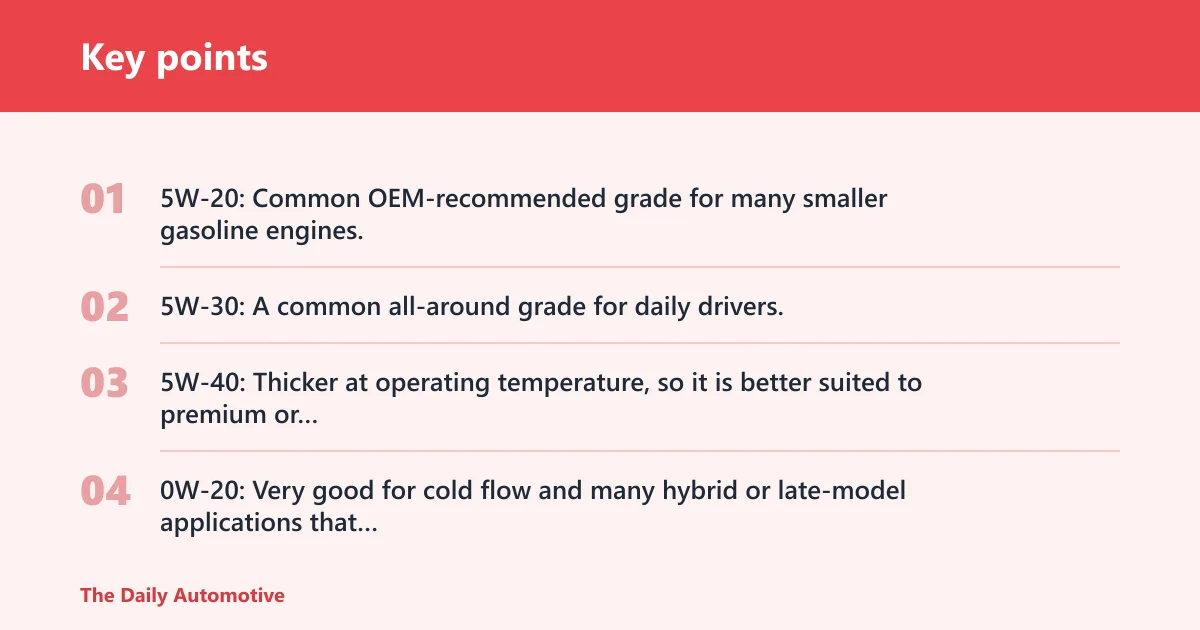
- 5W-20: Common OEM-recommended grade for many smaller gasoline engines. Good for cold starts and factory fuel-economy targets.
- 5W-30: A common all-around grade for daily drivers. Often the best middle ground when the manual allows it.
- 5W-40: Thicker at operating temperature, so it is better suited to premium or performance use when approved.
- 0W-20: Very good for cold flow and many hybrid or late-model applications that prioritize quick circulation.
Hot weather does not automatically mean thicker oil. Cold weather does not automatically mean the thinnest grade. Match the viscosity to the manual first, then choose within the allowed range based on climate and use.
Frequently asked questions
What is the best oil for my car engine?
The best oil is the one that matches the viscosity and certification in your owner’s manual, then fits your driving pattern. For many daily drivers that allow 5W-30, a full synthetic with API SP is a strong default. For hybrids and many late-model cars, 0W-20 may be the right fit.
Should I use synthetic or conventional oil?
Synthetic is usually the better choice when the manual allows it because it generally protects better and lasts longer than conventional oil. Conventional can still work in some older or low-stress engines, but current gasoline engines often benefit from the stronger oxidation control, cleaner operation, and better cold-start flow of synthetic oil.
What does 5W-30 mean for motor oil?
5W-30 means the oil flows like a 5-weight oil in cold conditions and like a 30-weight oil at operating temperature. The first number helps with startup flow, while the second number matters once the engine is hot. Use it only if the manual permits that grade.
Which oil is best for high-mileage cars?
High-mileage oil is best when the engine shows seal seepage, leaks, or rising oil use. Valvoline High Mileage with MaxLife Technology SAE 5W-30 Synthetic Blend Motor Oil fits that need because it adds seal conditioning and leak reduction. It is not the right choice for every older car.
How often should I change synthetic oil?
Follow the owner’s manual and the service schedule for your driving conditions. Severe use such as short trips, towing, or repeated heat cycles can shorten the interval. Some premium oils claim longer drain capability, but the vehicle maker’s interval and oil-life monitor, if equipped, should still guide the change.
Can I use high-mileage oil in any car?
No. High-mileage oil is designed for engines that have the kinds of symptoms it addresses, such as seepage, leaks, or oil consumption. If your engine is clean, dry, and within spec, the factory-recommended standard oil is usually the better fit. Use high-mileage oil for a reason, not by default.
Products related to this article
Sponsored / affiliate links. As an Amazon Associate I earn from qualifying purchases. I may earn additional commission from eligible campaigns.