Mold Cleaner for Cars: Top Picks for a Spotless Vehicle Interior
Pick a cleaner that matches the surface. Use enzyme or detergent sprays for fabric and carpet, low-moisture interior cleaners for vinyl and plastic, and a dedicated odor treatment if the smell stays after cleanup. Use the wrong product, and you can set stains, soak padding, discolor trim, or leave odors that return after the cabin heats up. This guide compares interior mold cleaners by surface type, odor control, drying time, and safety so you can buy the right one.
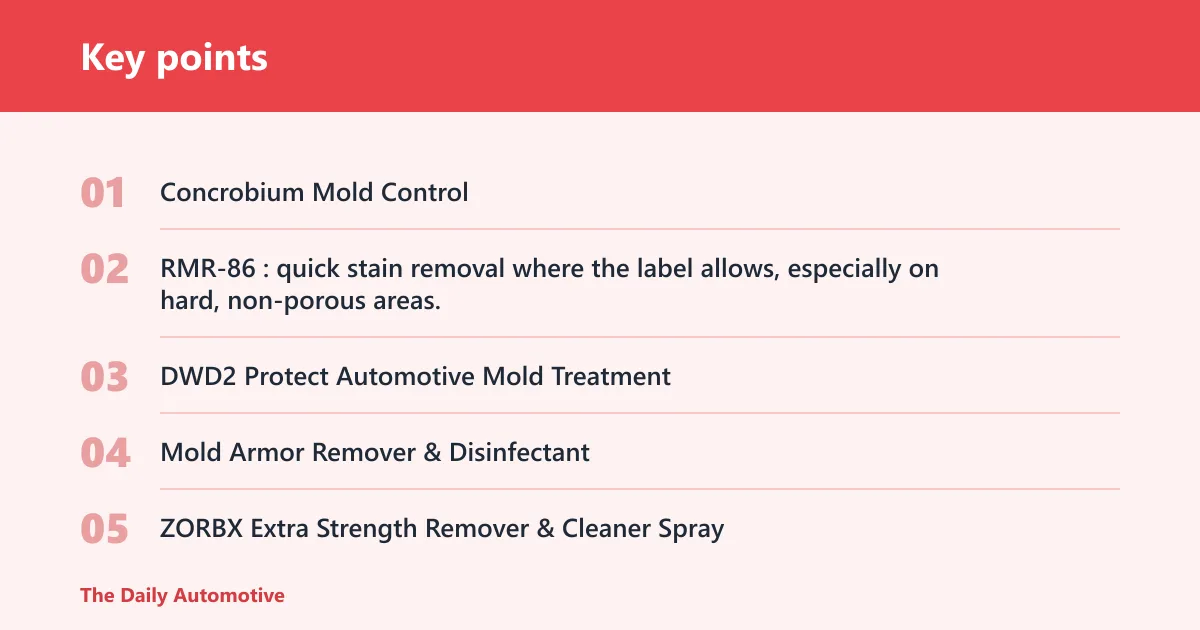
The top pick for most car owners is Concrobium Mold Control for odor-focused cleanup on hard and soft interior surfaces where you want a bleach-free, odorless, VOC-free option and a regrowth barrier claim, as long as you still control moisture and do not expect it to erase heavy stains.
Quick picks for different car mold situations

Quick picks
| Best for | Product | Key note | Important caution |
|---|---|---|---|
| Musty odor after cleanup | Concrobium Mold Control | Bleach-free, odorless, VOC-free; 32 oz spray and 14.1 oz aerosol | Not a stain-removal shortcut for heavy visible growth |
| Visible stains on non-carpeted hard surfaces | RMR-86 Instant Mold and Mildew Stain Remover | 30 oz spray, also seen as 32 oz spray; scrub-free stain focus | Not a blanket-safe choice for upholstery or headliners |
| Vent and HVAC odor | DWD2 Protect Automotive Mold Treatment | 14 oz fogger; automotive ventilation use; plant-based enzyme positioning | Fogging is not a substitute for cleaning clogged ducts or wet filters |
| Non-porous trim and seals | Mold Armor Remover & Disinfectant | 32 oz ready-to-use; claims 99.9% bacteria and viruses | Disinfectant claims depend on exact label dwell time |
| Mixed surfaces with spot testing | ZORBX Extra Strength Remover & Cleaner Spray | Multi-surface positioning, stain and odor removal | Spot test before broad use |
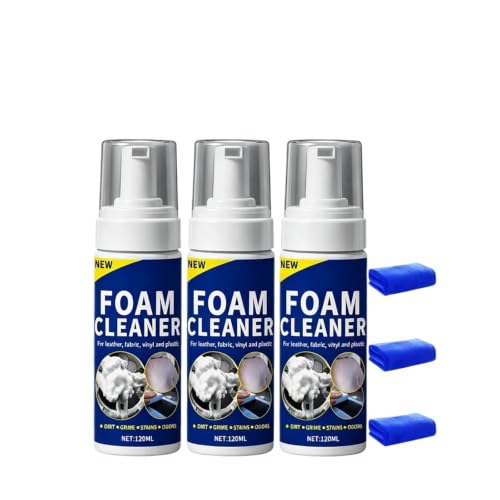
| Fabric and carpet | Chemical Guys Citrus Fabric & Carpet Cleaner | Foaming cleaner for automotive upholstery | Avoid over-wetting foam backing and headliner-adjacent areas |
What each product is best
- Concrobium Mold Control: odor control, light cleanup, and barrier treatment on compatible interior surfaces.
- RMR-86: quick stain removal where the label allows, especially on hard, non-porous areas.
- DWD2 Protect Automotive Mold Treatment: HVAC and vent odor treatment where airflow paths need attention.
- Mold Armor Remover & Disinfectant: non-porous interior surfaces that need cleaner-plus-disinfectant treatment.
- ZORBX Extra Strength Remover & Cleaner Spray: mixed-material situations that require spot testing first.
- Chemical Guys Citrus Fabric & Carpet Cleaner: seats, carpet, and other fabric-heavy areas that need foam and stain lifting.
Car mold cleaner decision matrix
Surface mold, mildew odor, and HVAC contamination are different jobs. A stained seat needs a fabric-safe cleaner. A vent smell needs duct treatment. A musty cabin with no visible growth may need odor control and drying, not a harsh stain remover.
| Scenario | Safest product type | Required drying time | Key failure risks |
|---|---|---|---|
| Musty odor only | Odor treatment or barrier spray, such as Concrobium Mold Control | Dry completely before closing the cabin; allow several hours with airflow | Masking odor without removing moisture; odor returns after heat builds |
| Visible upholstery stains | Fabric-safe cleaner, such as Chemical Guys Citrus Fabric & Carpet Cleaner | Until the foam and backing are dry; often overnight in humid conditions | Over-wetting padding, setting stains, wicking marks back to the surface |
| Non-porous trim and vents | Disinfectant/cleaner, such as Mold Armor Remover & Disinfectant | Follow label dwell time, then dry fully before reuse | Skipping dwell time; leaving residue in switchgear, vent vanes, or seams |
| Recurring HVAC odor | Fogger or vent-focused treatment, such as DWD2 Protect Automotive Mold Treatment | Vehicle and HVAC system should dry and air out before driving | Treating the smell while ignoring a wet cabin filter, condensate issue, or duct contamination |
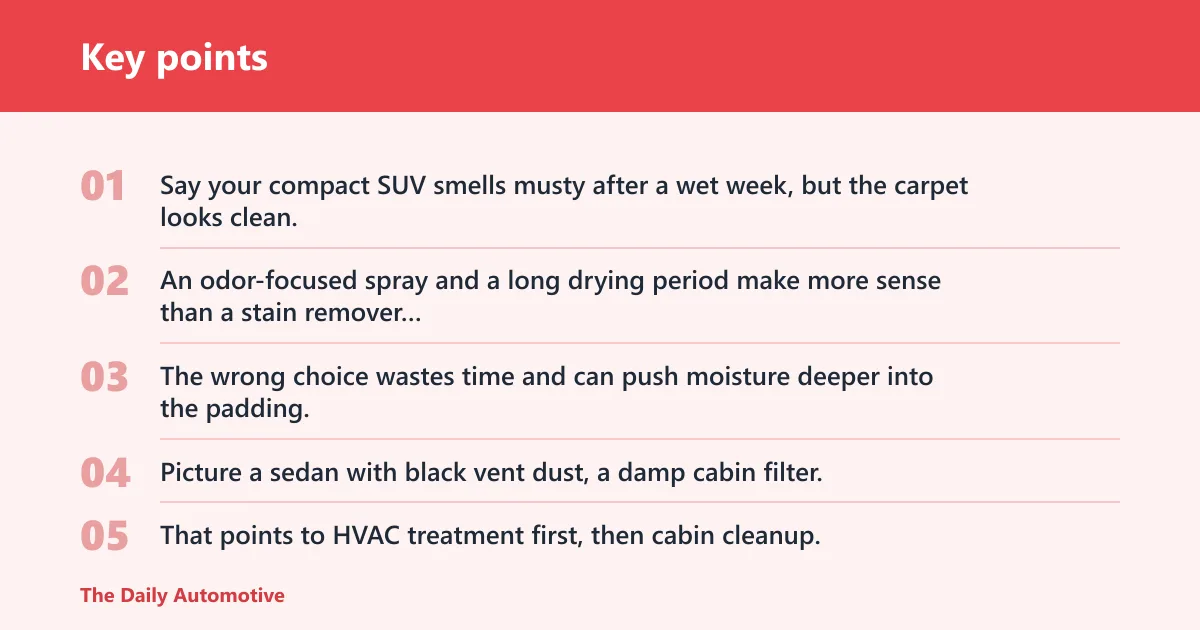
Say your compact SUV smells musty after a wet week, but the carpet looks clean. An odor-focused spray and a long drying period make more sense than a stain remover built to break up visible growth. The wrong choice wastes time and can push moisture deeper into the padding.
Picture a sedan with black vent dust, a damp cabin filter, and a smell that gets stronger when the fan runs. That points to HVAC treatment first, then cabin cleanup. A seat cleaner alone will not reach that problem.
Best for stain removal: RMR-86 instant mold and mildew stain remover
RMR-86 fits visible mold and mildew staining where the label supports use, especially on hard surfaces that can tolerate a stronger cleaner. It is sold as a 30 oz spray, and another roundup lists a 32 oz spray. Its selling point is fast stain removal, but that does not make it the default choice for seat fabric or carpet.
Where it fits
This type of product is for obvious staining that sits on the surface, not for hidden padding or delicate interiors. Use it only where the label allows, and assume less margin for error on porous materials. Automotive upholstery, headliners, and leather-adjacent surfaces deserve extra caution.
Surface limits to watch
RMR-86’s fast-action stain approach is not the same as broad interior safety. A stain remover can be too aggressive for dyed fabric, laminated trim, or stitched seats. If a label does not clearly support the surface, do not use it as a general cabin cleaner.
Why it is not the default fabric choice
Seats and carpet need material-specific protection from discoloration, residue, and over-wetting. A harsh stain remover can do more harm than the mold spot itself. For fabric and carpet, a dedicated upholstery cleaner is the safer first step.
Best for odor and barrier treatment: Concrobium Mold Control
Concrobium is the best overall fit when the goal is odor control plus light cleanup and a regrowth barrier, not stain stripping. It comes as a 32 oz spray and a 14.1 oz aerosol. The product is described as bleach-free, odorless, and VOC-free, with an invisible barrier claim against regrowth.
32 oz spray and 14.1 oz aerosol
The spray format is practical for broad interior use, while the 14.1 oz aerosol is the smaller format. Both suit light to moderate cleanup where a user wants minimal scent and no bleach-style residue. The tradeoff is that these claims do not replace drying or moisture control.
Bleach-free and VOC-free positioning
Bleach-free and VOC-free formulas are attractive in a confined cabin because they are generally less harsh on trim and less punishing to the nose. That still does not mean any product is automatically safe for every surface. Test spots matter, especially near dyed fabrics and delicate trim.
Invisible barrier claim and limits
The barrier claim should be treated as a helpful maintenance feature, not proof that mold cannot return. If the underlying leak, spill, or humidity problem remains, regrowth can still happen. The cleaner helps only after the source of moisture is corrected and the interior dries fully.
Best for vents and HVAC odor: DWD2 Protect Automotive Mold Treatment
DWD2 Protect Automotive Mold Treatment is positioned for car interiors, and its 14 oz fogger format makes it the most HVAC-focused option here. Fogger-style use suits vent paths and other hard-to-reach areas where odor lingers after visible surfaces have been cleaned.
Fogger-style use case
Foggers can help distribute treatment through ventilation passages, but they are not a substitute for removing the cause of the smell. If the cabin filter is wet, the evaporator case is dirty, or drainage is blocked, the odor will often come back. Fogging should be one step, not the whole repair.
What plant-based enzyme claims mean
Plant-based enzyme positioning suggests a cleaner designed to break down organic residue rather than attack it with a harsh solvent approach. That can be useful for odor control, but it does not guarantee complete cleanup of every source. Treat the claim as a formula description, not a performance guarantee.
Why airflow parts need careful application
Air ducts, vent fins, and HVAC housings are difficult to dry if too much liquid is introduced. That is why fogger use should follow the label closely. The goal is odor neutralization in hard-to-reach areas, not soaking the system.
Best for non-porous surfaces: Mold Armor Remover & Disinfectant
Mold Armor Remover & Disinfectant is a 32 oz ready-to-use product aimed at non-porous surfaces. It claims to kill 99.9% of bacteria and viruses, which makes it a better fit for hard cabin pieces than for seats, foam, or fabric that can trap moisture and residue.
Where disinfectant claims matter
Disinfectant claims only apply when the product sits on the surface for the exact label dwell time. That matters in a car because users often wipe too soon. If the contact time is shortened, the claimed kill rate does not apply.
Exact dwell time and label use
Follow the label exactly. Apply to the intended surface, keep it wet for the stated dwell time, and then dry the area fully. This is especially important on knobs, plastic panels, rubber seals, and other non-porous parts where residue is easy to leave behind.
Best surfaces inside the cabin
Hard trim, vinyl, rubber seals, and vent vanes are the strongest candidates here. Avoid treating fabric and foam as if they were hard surfaces. Porous materials need different products and more careful drying.
Best for spot testing and mixed surfaces: ZORBX Extra Strength Remover & Cleaner Spray
ZORBX Extra Strength Remover & Cleaner Spray is a multi-surface option for mixed-material cleanup, but it belongs in the spot-test-first category. That is the right approach for cabin materials that shift from plastic to fabric to stitched trim in a small area.
Why spot testing comes first
A single seat bolster can include dye, texture, stitching, and adhesive layers. A product that works on one material may discolor another. Test a hidden area, wait for it to dry, and look for residue, dulling, or color shift before broader use.
Multi-surface use limits
Multi-surface labeling does not mean universal safety. It means the formula is intended for more than one category of surface, but the user still has to verify compatibility. That is especially important around leather-adjacent trim, painted accents, and foam-backed upholstery.
Stain and odor tradeoffs
Products that claim both stain and odor removal often sit in the middle of the market: useful for moderate problems, but not the strongest choice for severe staining or deep HVAC contamination. They are best when the cabin needs one cleaner for several small areas, not a one-step cure.
Best for fabric and carpet: Chemical Guys citrus fabric & carpet Cleaner
Chemical Guys Citrus Fabric & Carpet Cleaner is the clearest fit for upholstery, carpet, and other fabric-heavy areas. Its foaming action helps lift soil from automotive fabric, and the citrus scent can help with immediate freshness after cleanup. That does not replace drying, though.
Foam cleaner use on upholstery
Foam is helpful because it can work on the top layer without flooding the backing right away. That matters in seats and floor mats where moisture can settle into padding. Still, use only enough product to clean the area, then extract or blot as needed.
Headliner caution
Headliners are among the most delicate surfaces in the cabin. Adhesive layers can fail if they are over-wet. Use the least moisture possible, and avoid aggressive scrubbing unless the label clearly supports the material.
Drying time and oversaturation risk
Fabric and carpet must dry fully before you close the cabin or run recirculation for long periods. Oversaturation can lead to wicking, odor return, and even new growth in the padding. If the carpet feels wet deep down, more drying time is needed.
The right cleaner depends on the surface first, then the symptom. For odor-only problems, choose an odor treatment or barrier product. For visible stain removal, choose a stain-focused cleaner that matches the material. For vents, choose an HVAC-focused approach. For non-porous trim, choose a cleaner or disinfectant with exact label directions.
Match cleaner to material
Use fabric cleaners on seats and carpet, low-moisture interior cleaners on vinyl and plastic, and only leather-appropriate products on leather if the label clearly says so. Do not assume a general mold spray is safe for leather car interiors. If leather is involved, the label has to say so plainly.
Compare drying time and residue
Drying time is not a side note. It is part of the product choice. A cleaner that leaves residue or requires long dwell time may be fine on hard trim but risky on seats, foam, and headliners. In a cabin, too much moisture is a failure point.
Check ventilation, PPE, and label directions
Work with the doors open, wear gloves and eye protection, and keep fresh air moving through the cabin. Use a mask if the label or the odor level calls for it. Do not mix products, and do not shorten dwell time on disinfectants.
When DIY is not enough
If the car has soaked carpet, wet padding, a musty evaporator case, or repeated regrowth after cleaning, the problem may be larger than a consumer spray can handle, and professional remediation or interior removal may be needed. Water intrusion from a sunroof drain, door seal, windshield leak, or flooded floor can require professional remediation and interior removal.
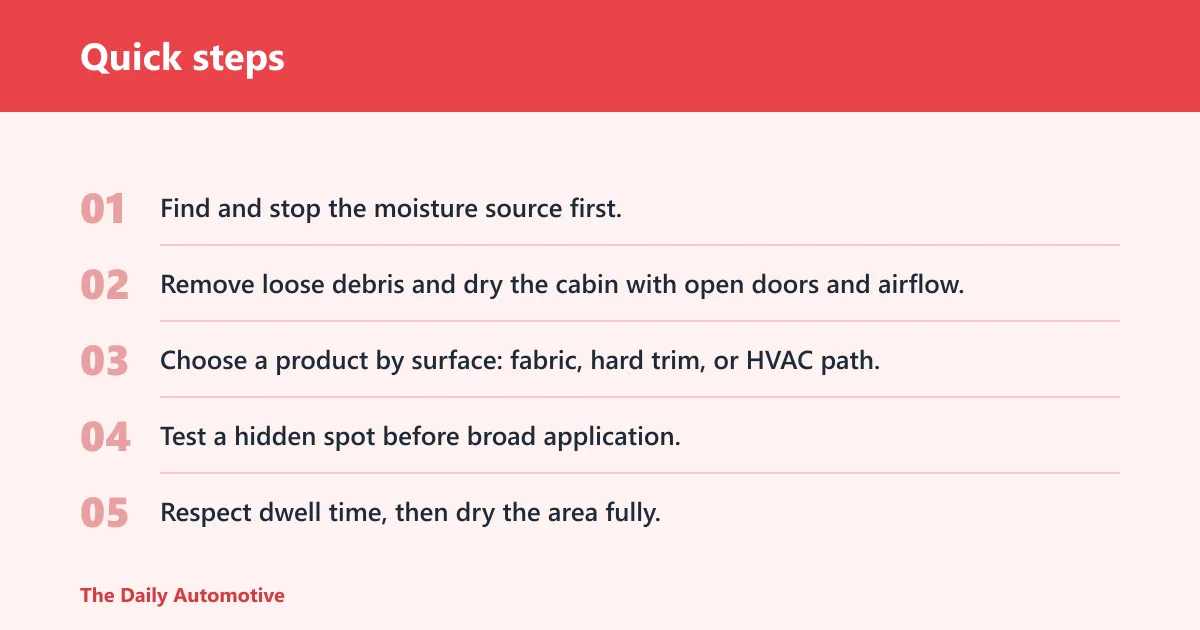
- Find and stop the moisture source first.
- Remove loose debris and dry the cabin with open doors and airflow.
- Choose a product by surface: fabric, hard trim, or HVAC path.
- Test a hidden spot before broad application.
- Respect dwell time, then dry the area fully.
- Recheck for odor or staining after the interior has dried.
A common first-timer mistake is treating a musty cabin like a stain problem. The smell may come back if the floor insulation is still damp or the HVAC case is dirty. Another common mistake is using a strong stain remover on a headliner, which can leave a bigger repair bill than the original mold spot.
Frequently asked questions
What is the best mold cleaner for car interiors?
For most interiors, Concrobium Mold Control is the safest broad pick because it is bleach-free, odorless, and VOC-free, with spray and aerosol formats. For visible stains, choose a stain-focused product instead. For vents, use an HVAC-specific treatment rather than a fabric cleaner.
Can I use mold remover on car seats and carpet?
Yes, but only with a product labeled for fabric or carpet. Use the least moisture possible and avoid over-wetting the padding below the surface. Strong stain removers are not automatically safe for upholstery, and they can discolor or leave residue if the label does not support that use.
What cleaner works best for musty car odors?
A dedicated odor treatment is usually the better choice when there is no visible stain. Concrobium is a strong fit for odor control, while DWD2 Protect can help when the smell is tied to vents or airflow parts. If the source remains wet, no odor product will hold for long.
Is there a mold remover safe for leather car interiors?
Only if the product label clearly supports leather use. Do not assume a general mold spray is leather-safe. Leather can discolor, dry out, or spot if the wrong cleaner is used. If the label is vague, choose a leather-specific interior cleaner rather than a mold remover.
Do car mold cleaners also kill mold spores?
Not all of them do, and “kill” claims are usually limited by label directions and surface type. Some products clean visible growth, some disinfect hard surfaces, and some only neutralize odor or help deter regrowth. Treat the label carefully and do not assume one product does every job.
How long should a car interior dry after mold cleaning?
Drying should continue until the surface and the backing are fully dry, which often takes several hours and can take overnight in humid weather. The right endpoint is no cool, damp feel and no trapped moisture smell. If the cabin still feels humid, keep drying.
Products related to this article
Sponsored / affiliate links. As an Amazon Associate I earn from qualifying purchases. I may earn additional commission from eligible campaigns.