P0012 Ford Escape Fix: Diagnose Before You Replace Parts
You’re driving your Escape and the check engine light pops on. The scan tool says P0012. A quick internet search tells you it’s the camshaft position timing over-retarded code. But what does that actually mean for your wallet?
This code is one of the most common on Ford Escapes, but it’s also one of the most misdiagnosed. Many shops will immediately quote you a timing chain replacement, which runs well over a thousand dollars. Sometimes that’s the right call. Often it isn’t. The real culprit is frequently a clogged VCT solenoid or degraded oil pressure, which you can fix for under $50 and an afternoon of work.

ANCEL
ANCEL AD310 Classic Enhanced Universal OBD II…
- CEL Doctor: The ANCEL AD310 is one of the best-selling OBD II scanners on the market and is recommended by Scotty Kilmer, a YouTub…
- Sturdy and Compact: Equipped with a 2.5 foot cable made of very thick, flexible insulation. It is important to have a sturdy scann…
- Accurate Fast and Easy to Use: The AD310 scanner can help you or your mechanic understand if your car is in good condition, provid…
This guide walks you through every real cause, the exact diagnostic steps in order, and what each fix costs. You’ll also learn why the 2.5L Duratec engine in older Escapes behaves differently than the 1.6L and 2.0L EcoBoost engines in newer models. Grab a code reader if you have one, and let’s get to work.
Before you start pulling parts, you need a way to read and clear the code as you work. A basic OBD-II scanner like the ANCEL AD310 is enough for this job. It reads P0012, shows live data, and clears the code after you finish the repair. No need for a $500 professional tool here.
What Does the P0012 Code Mean on a Ford Escape?
P0012 stands for “Camshaft Position A – Timing Over-Retarded (Bank 1).” That sounds technical, but here’s the plain version: your intake camshaft is rotating slower than the crankshaft expects it to. The engine’s computer (PCM) commanded the variable valve timing (VCT) system to advance the camshaft, but the camshaft didn’t move enough.
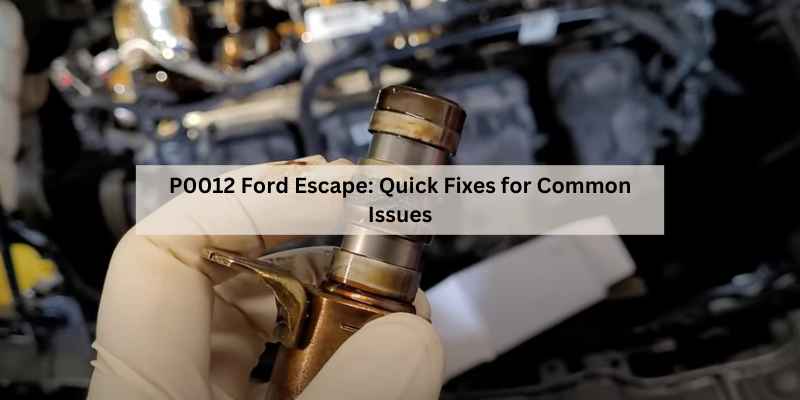
The system works using engine oil pressure. The VCT solenoid, sometimes called an oil control valve (OCV), directs pressurized oil into the camshaft phaser. That phaser then rotates the camshaft relative to the crank. If the oil can’t get there, or the phaser is stuck, the timing stays retarded. The PCM waits a set amount of time, sees no change, and sets the code.
On the 2.5L Duratec engine (found in 2026-2026 Escapes), the VCT solenoid sits on the front of the cylinder head, driver’s side. It’s a single unit with a metal screen on the oil inlet side. On the 1.6L and 2.0L EcoBoost engines (2026 and newer), the solenoids are on the front of the valve cover, and there are two of them: one for intake, one for exhaust. The P0012 code always refers to the intake side.
P0012 Symptoms: What You’ll Notice
Sometimes the code appears with no noticeable symptoms at all. The check engine light is the only clue. Other times, you’ll feel the engine struggling.
- Rough idle: The engine may shake or vibrate more than usual when stopped at a light.
- Reduced fuel economy: A drop of 2-3 miles per gallon is common because the engine can’t optimize valve overlap.
- Lack of power at low RPM: The car feels sluggish pulling away from a stop, especially when the engine is cold.
- Hesitation on acceleration: A stumble or flat spot when you press the gas pedal.
- Engine stall (rare): In severe cases, especially if the timing chain has jumped a tooth, the engine may stall at idle.
If you only have the light and no symptoms, you still need to address it. Ignoring P0012 can lead to the timing chain wearing out prematurely, and that’s a much bigger repair.
Root Causes: Why Your Escape is Over-Retarding
There are four main reasons this code sets. You need to rule them out in order of cost, not likelihood.
The VCT Solenoid and Oil Pressure Issue
This is the most common cause, and the cheapest to fix. The solenoid is a small valve that moves back and forth to direct oil. Over time, engine sludge and carbon particles clog the fine mesh screen on the solenoid’s oil inlet. When that screen clogs, oil flow drops, and the phaser can’t move.
Low engine oil level is another trigger. If your oil is a quart low, the pickup tube may suck air during hard cornering or acceleration, causing a momentary pressure drop. The PCM sees the camshaft not moving and logs the code. Always check the dipstick first.
Using the wrong oil viscosity also matters. Ford specifies 5W-20 for the Duratec and 5W-30 for most EcoBoost engines. If someone put 10W-40 in there, the oil is too thick when cold, and the VCT system won’t respond fast enough.
Timing Chain Stretch and Wear
This is the expensive one. The timing chain connects the crankshaft to the camshafts. Over 100,000 miles, the chain stretches slightly. A stretched chain means the camshaft timing is physically retarded relative to the crank, even if the VCT system is working perfectly.
The EcoBoost engines are more prone to this than the Duratec. The 1.6L EcoBoost, in particular, has a known issue with the timing chain tensioner failing. If you hear a rattle on cold start that lasts 2-3 seconds, that’s the tensioner bleeding down. That rattle is the chain slapping against the timing cover. If you hear that, the chain and tensioner are already worn.
Wiring and Connector Damage
This one gets missed a lot. The VCT solenoid has a small electrical connector (pigtail) that plugs into the wiring harness. Oil can wick up the wires and into the connector, causing corrosion. The connector pins can also spread apart, creating an intermittent connection.
On the EcoBoost engines, the wiring harness runs near the hot turbocharger. Heat cycling can make the insulation brittle, and the wires can crack or short. A simple continuity test with a multimeter will confirm this.
Diagnosing P0012: A Step-by-Step Approach
Don’t just throw parts at this. Follow these steps in order. You’ll likely stop at step 2 or 3 and save yourself a lot of money.
Checking Oil Level and Condition First
Park on level ground, wait 10 minutes after the engine has been off, and pull the dipstick. Wipe it, reinsert, and pull it again. The level should be between the MIN and MAX marks. If it’s low, top it off with the correct viscosity and clear the code. Drive for a day and see if it returns.
Also check the oil condition. Rub a drop between your fingers. If it feels gritty or smells strongly of fuel, the oil is contaminated. Change the oil and filter before doing anything else. Fresh oil with the correct viscosity solves a surprising number of P0012 cases.
Testing the VCT Solenoid (Resistance and Cleaning)
Locate the intake VCT solenoid. Unplug the electrical connector. Use a multimeter set to ohms to measure resistance between the two pins on the solenoid itself. You’re looking for a reading between 4 and 12 ohms. If it reads open (infinite) or shorted (near 0), the solenoid coil is dead, and you need a new one.
If the resistance is fine, the coil is good, but the valve may be mechanically stuck. Here’s the cleaning procedure:
- Remove the solenoid from the engine. It’s usually held by one or two 10mm bolts.
- Spray the outside with brake cleaner to remove loose oil.
- Look at the metal screen on the oil inlet port. If it’s dark brown or black, it’s clogged.
- Soak the solenoid in a small container of brake cleaner or carb cleaner for 15 minutes.
- Use an old toothbrush to gently scrub the screen and the valve body. Do not use a wire brush; you’ll damage the fine mesh.
- Rinse it again, and let it air dry completely.
- Reinstall the solenoid, plug it in, and clear the code.
This cleaning works about 50% of the time. If the code comes back within a week, replace the solenoid. A new one costs between $40 and $80 for a genuine Motorcraft part.
Mechanical Timing Check
If the solenoid is clean and the code persists, you need to verify the timing chain hasn’t stretched. This requires a scan tool that can read live data. Look at the Parameter Identification (PID) for “Camshaft Position Intake” or “VCT Desired vs. Actual.”
Start the engine and let it idle. The desired camshaft position should be around 0 degrees. The actual position should be within +/- 5 degrees of desired. Rev the engine to 2500 RPM. The desired position should advance to around 20-30 degrees. If the actual position lags significantly or stays at 0, the phaser is stuck or the chain is stretched.
A physical check is more definitive. Remove the valve cover. Rotate the crankshaft to top dead center on cylinder 1. Check the timing marks on the camshaft sprockets. If the marks don’t line up with the cylinder head surface, the chain has jumped a tooth. That means a full timing chain replacement.
How to Fix P0012 on a Ford Escape (DIY Guide)
Here’s where the money gets spent. Do the cheap fix first, then consider the expensive one.
Replacing the VCT Solenoid
This is a 30-minute job on any Escape. On the 2.5L Duratec, the solenoid is on the front of the head, easily accessible from above. On the EcoBoost engines, you may need to remove the engine cover and possibly the air intake tube to reach it.
- Disconnect the negative battery cable.
- Unplug the electrical connector from the solenoid. Squeeze the tab and pull straight up.
- Remove the mounting bolt(s). Keep track of the O-ring on the solenoid body; it must come off with the old unit.
- Install the new solenoid. Apply a thin coat of clean engine oil to the new O-ring to prevent it from rolling when you tighten the bolt.
- Torque the bolt to 89 lb-in (10 Nm). Do not overtighten; the aluminum housing strips easily.
- Reconnect the electrical connector and battery cable.
- Clear the code with your scanner.
One tip: buy a Motorcraft solenoid, not a cheap aftermarket one. The cheap ones often fail within 6 months because the internal valve tolerances aren’t precise. You’ll end up doing the job twice.
Replacing the Timing Chain (When Necessary)
If the chain is stretched, this is the only real fix. This is not a beginner job. It requires special tools to hold the camshafts in place and to set the correct tension. The parts kit (chain, tensioner, guides, and bolts) costs between $200 and $350 for aftermarket kits. Labor at a shop will add $800 to $1,200, depending on your area.
If you attempt this yourself, budget a full weekend. You’ll need to remove the valve cover, the crankshaft pulley, the front engine cover, and the oil pan. The timing cover on the EcoBoost engines is notoriously difficult to reseal without leaking. If you’re not confident, take it to a shop that specializes in Ford engines.
Repair Costs: Parts and Labor Breakdown
Here’s what you can expect to pay at each stage of the repair, excluding taxes.
| Repair | Parts Cost | Labor Cost (Shop) | DIY Difficulty |
|---|---|---|---|
| Oil change (correct viscosity) | $30 – $60 | $50 – $80 | Easy |
| VCT solenoid cleaning | $5 (brake cleaner) | $80 – $120 | Easy |
| VCT solenoid replacement | $40 – $80 | $100 – $150 | Easy |
| Wiring harness repair | $10 – $30 (connector) | $150 – $250 | Moderate |
| Timing chain kit replacement | $200 – $350 | $800 – $1,200 | Hard |
These prices are estimates. Check the current price on Amazon for the solenoid and chain kit for your specific model year. The labor rates vary widely by region, with coastal cities running higher.
Preventing P0012 in the Future
Once you fix the code, you want to keep it from coming back. The VCT system is entirely dependent on clean oil at the right pressure.
- Change oil every 5,000 miles, not the 10,000 miles the manual claims. This is the single best prevention for VCT issues.
- Use full synthetic oil. It resists breakdown and keeps the VCT screens cleaner than conventional oil.
- Check the oil level monthly. Low oil is the fastest way to kill a VCT solenoid.
- Listen for cold-start rattle. If you hear it, replace the timing chain tensioner before it damages the chain.
Frequently Asked Questions
Can I drive my Ford Escape with a P0012 code?
Short distances, yes. Long distances, no. If the engine is running rough or stalling, stop driving immediately. If it just has a light and runs fine, you can drive it to a parts store or your garage, but don’t take a road trip. The worst-case scenario is the timing chain jumps completely, which can bend valves and destroy the engine.
Will a P0012 code clear itself?
Sometimes, but only if the condition was temporary, like a one-time low oil pressure event. If the PCM sees the camshaft timing return to normal over several drive cycles, it may turn the light off. But the code will stay stored in memory. If the underlying cause is a clogged screen or stretched chain, the light will come back.
Is P0012 the same as P0011?
No. They are similar but opposite. P0011 means the camshaft timing is over-advanced, meaning it’s too far ahead of the crankshaft. P0012 means over-retarded, or too far behind. Both point to the same VCT system, but the diagnostic path is slightly different. For P0011, you often look for a stuck-open solenoid or a failing phaser.
How much oil pressure should the VCT system have?
At hot idle, engine oil pressure should be at least 10-15 psi. At 2026 RPM, it should be above 30 psi. If you suspect the oil pump is weak, you can test it with a manual gauge. Remove the oil pressure sending unit, thread in the gauge, and compare readings to the spec. If pressure is low, the pump may be worn or the pickup tube screen is clogged.
Do I need to relearn the camshaft after replacing the VCT solenoid?
Usually, no. The PCM learns the new solenoid’s response over the first few drive cycles. However, if you replaced the timing chain or phaser, you should perform a camshaft adaptation reset using a professional scan tool like Forscan. This clears the old learned values and lets the PCM start fresh. Skipping this step can cause a rough idle for a few days until the PCM re-learns.
The Bottom Line
P0012 on a Ford Escape is rarely a catastrophic failure. In most cases, it’s a maintenance issue that got ignored. Start with the cheapest fix, which is an oil change and a solenoid cleaning. Test the solenoid’s resistance before you buy a new one. Only move to the timing chain if the mechanical timing check points to it.
Here’s what to remember:
- Check oil level and condition before anything else.
- Clean the VCT solenoid screen before replacing the part.
- Test the solenoid coil resistance (4-12 ohms) to avoid buying a good part for nothing.
- Inspect the wiring connector for oil intrusion and damaged pins.
- Use a scan tool to compare desired vs. actual camshaft position.
- Listen for cold-start rattle, which points to a stretched chain.
- Replace the timing chain only if the mechanical marks are off.
You can fix this. Take your time, follow the steps in order, and you’ll save yourself a hefty repair bill. If you run into a wiring issue, check out this powertrain fault guide for related electrical troubleshooting tips. And if you’re also dealing with other Escape quirks, this transmission fluid guide covers a common maintenance task.
Products related to this article
Sponsored / affiliate links. As an Amazon Associate I earn from qualifying purchases. I may earn additional commission from eligible campaigns.