Pinstripe Decals for Cars: 3 Picks Reviewed and Buying
For most DIY trim work, the best pinstripe decals for cars are 3M Scotchcal-style vinyl, OEM-style pre-cut stripe kits, and removable low-tack tape, with the best pick depending on curve fit, durability, and how cleanly you want it to come off. Pick poorly and you get lifted edges, crooked runs, cracked vinyl on tight curves, or paint damage at removal. This guide compares three pinstripe tape types, where each fails, and which one fits clean styling, easy installation, and low removal risk.
Best pinstripe tape picks at a glance


Pinstripe tape is self-adhesive vinyl used to draw a clean accent line on body panels. The common widths buyers run into are about 1/4 inch, 1/2 inch, and 3/4 inch. Wider rolls create bolder stripes. Longer rolls reduce seam count, which matters on a hood, door, or trunk where one visible splice can spoil the look.
Quick rank by use case
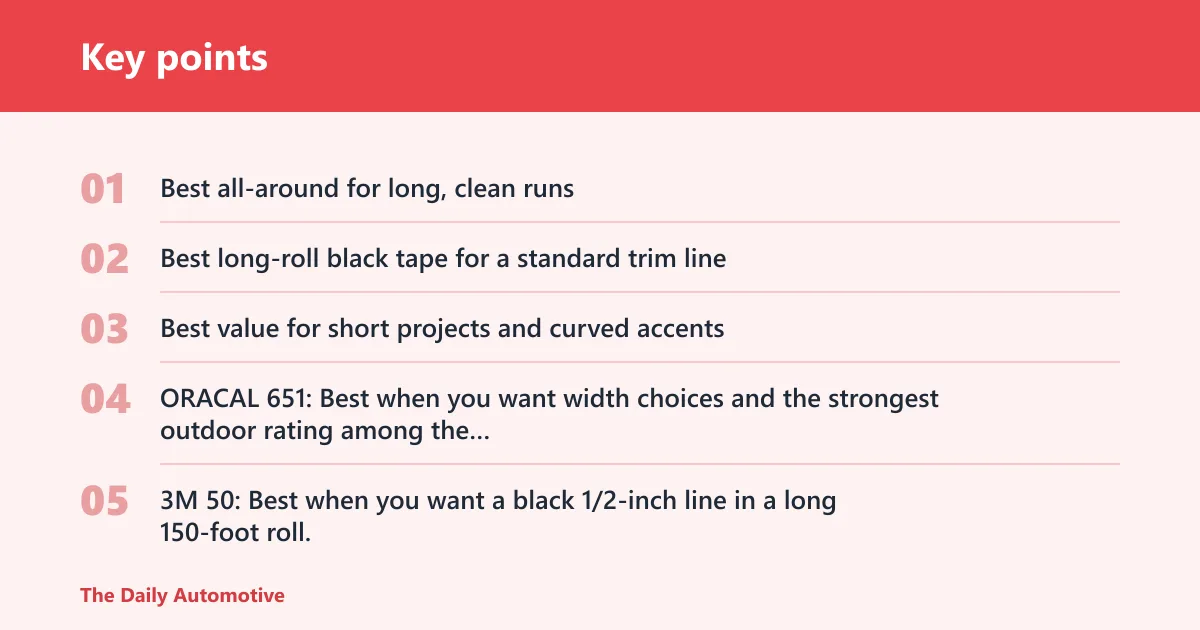
- Best all-around for long, clean runs: ORACAL 651 Vinyl Pinstriping.
- Best long-roll black tape for a standard trim line: 3M 50 Vinyl Pinstriping.
- Best value for short projects and curved accents: Spurtar Car Pinstripe Tape.
Where each pick fits best
- ORACAL 651: Best when you want width choices and the strongest outdoor rating among the three.
- 3M 50: Best when you want a black 1/2-inch line in a long 150-foot roll.
- Spurtar: Best when you want two 32-foot rolls for a small project or a lower-commitment install.
Where each pick falls short
- ORACAL 651: Less useful if you only need a short accent and do not want to pay for a long roll.
- 3M 50: Narrower width choice here, since the listed roll is 1/2 inch only.
- Spurtar: Shorter total length means more joins on larger vehicles.
Pinstripe tape comparison matrix
This matrix compares the three shortlisted tapes on the details that matter most: width, roll length, curve fit, removal risk, and a cost-per-foot view. For the cost column, the math uses Cherry Picks’ reported average price of about $10.77 as a neutral benchmark, so you can compare roll value without guessing at sticker prices.
| Pick | Width | Roll length | Curve conformity | Removal risk | Cost per foot | Best use case | Not recommended if |
|---|---|---|---|---|---|---|---|
| ORACAL 651 Vinyl Pinstriping | 1/4 inch, 1/2 inch, or 3/4 inch | 150 feet | High for gentle to moderate curves and contour surfaces | Low to moderate, depending on paint age and prep | About $0.072/ft at $10.77 benchmark | Long runs, clean contour work, wide width choice | Textured plastic, winter installs, full-length stripes on large panels if you need a softer, lower-commitment tape |
| 3M 50 Vinyl Pinstriping | 1/2 inch | 150 feet | Good on straight and mild curves | Low to moderate | About $0.072/ft at $10.77 benchmark | Standard black accent line on cars, trucks, SUVs, motorcycles, and boats | Textured plastic, tight 3D bends, winter installs, width changes beyond 1/2 inch |
| Spurtar Car Pinstripe Tape | Commonly sold as automotive pinstripe tape for flexible curve work | 2 rolls x 32 feet | Good for curves and small trim sections | Moderate, because shorter projects often invite more edge mistakes | About $0.168/ft at $10.77 benchmark | Short decorative stripes, small custom projects, first-time installs | Textured plastic, winter installs, full-length stripes that need one long uninterrupted run |
A common first-timer mistake is using a short, cheap roll on a hood line that needs one clean pass. The result is a visible seam near the fender, and that seam is often where wash water and wax begin to work under the edge.
Which width should you choose?
Choose width by visual scale, not by price alone. A 1/4-inch stripe looks subtle and suits smaller accents. A 1/2-inch line is the easiest middle ground for most cars. A 3/4-inch stripe reads bolder and is better when you want the line to stand out from a few feet away.
1/4 inch for subtle lines
This width is the safest choice when you want a light accent on a dark body color or a narrow line around a beltline. It also helps when the panel has short contours that would make a wider stripe look busy.
1/2 inch as the common middle ground
Most buyers end up here. It is wide enough to be seen without taking over the body side, and it is easy to place on doors, rocker areas, and hatch panels. The 3M 50 listing in this group is 1/2 inch wide, which makes it a practical default for many daily drivers.
3/4 inch for bolder stripes
This width works when you want the stripe to read as a styling element rather than a trim line. ORACAL 651 offers 3/4 inch, which matters if you want a larger visual impact without moving to a full decorative stripe kit.
Which tape lasts and comes off cleanly?
Outdoor life depends on the film, not just the word “vinyl.” ORACAL 651 is commonly described as having about five years of outdoor life, and 3M 50 is listed for indoor and outdoor use with UV resistance. Clean removal depends on both the product and the surface underneath it, so residue-free removal is never automatic.
Outdoor rating and UV resistance
UV resistance helps the color stay stable in sun, and weather resistance helps the adhesive hold through rain and wash cycles. Datanly also claims resistance to scratches, UV rays, water, and color loss, which makes it a useful short-roll option for buyers who care about finish stability on smaller jobs.
What affects residue risk
Removal risk rises when tape sits too long on aged paint, cheap repaint work, or a panel that saw heavy sun and heat. Freshly painted panels need extra caution. Even a residue-free product can leave adhesive marks if the surface was dirty at install or if the film had been baked on by weather.
Painted panels versus textured plastic
Pinstripe tape is best on clean, dry, non-porous surfaces. Textured plastic is a poor match because the adhesive cannot fully wet the surface and the edge can lift early. That is why textured cladding, rough wheel-arch trim, and grainy bumper inserts are bad places for most cosmetic pinstripe tape.
Can you use pinstripe tape on curves?
Yes, but only within limits. Pinstripe tape can follow gentle body lines, mirror caps, and sweeping fender edges. Tight 3D curves are different. Once the panel twists in more than one direction at the same time, the film starts to wrinkle or pull back at the edge.
Flat panels versus tight bends
Flat doors, smooth hoods, and mild quarter-panel sweeps are the easy cases. Tight bumper corners, deep character grooves, and wrapped edges around textured trim are where failure starts. If the line has to make a sharp turn while also climbing or dipping, expect more risk.
Why heat helps during install
A hair dryer softens the vinyl so it can settle into a curve and later loosen during removal. The goal is gentle warmth, not high heat. Too much heat can stretch the tape and make the stripe look thin or distorted near the bend.
When to avoid 3D curves and trim edges
Skip complex wraps on winter installs, because cold vinyl resists movement and grabs too quickly. Also avoid running pinstripe tape across textured plastic or across a sharp edge that gets hit by hands, cargo, or automatic car-wash brushes. Those are common failure zones.
How do you install pinstripe tape?
Installation is simple, but the details matter. Clean, dry, non-porous surfaces give the adhesive the best chance to hold. After placement, use firm pressure, a squeegee for smooth application, and give the stripe 24 hours before washing the vehicle. Heat helps on curves and during removal.
- Wash the area and remove wax, road film, and dust.
- Dry the panel fully. Moisture under the film can cause edge lift.
- Lay out the stripe before peeling the backing. Check alignment from both ends.
- Apply the tape slowly, keeping tension even so the line stays straight.
- Use a squeegee or firm finger pressure to press out air and seat the edge.
- Warm curved sections lightly with a hair dryer so the vinyl settles.
- Trim only after the stripe is aligned and flat.
- Wait 24 hours before washing.
Suppose your car has a black 1/2-inch accent line on a silver door and the stripe starts wandering after 18 inches. The fix is usually not more pressure alone. Stop, realign, and restart before the adhesive fully sets, because a crooked run is far more visible than a short break in the line.
Where each tape fits best
These tapes are not limited to cars. They can work on trucks, SUVs, motorcycles, boats, and bicycles if the surface is smooth and the shape is reasonable. For full-length stripes, a long roll matters more than a cheap price tag because seams and overlaps are where failure often begins.
Cars, trucks, and SUVs
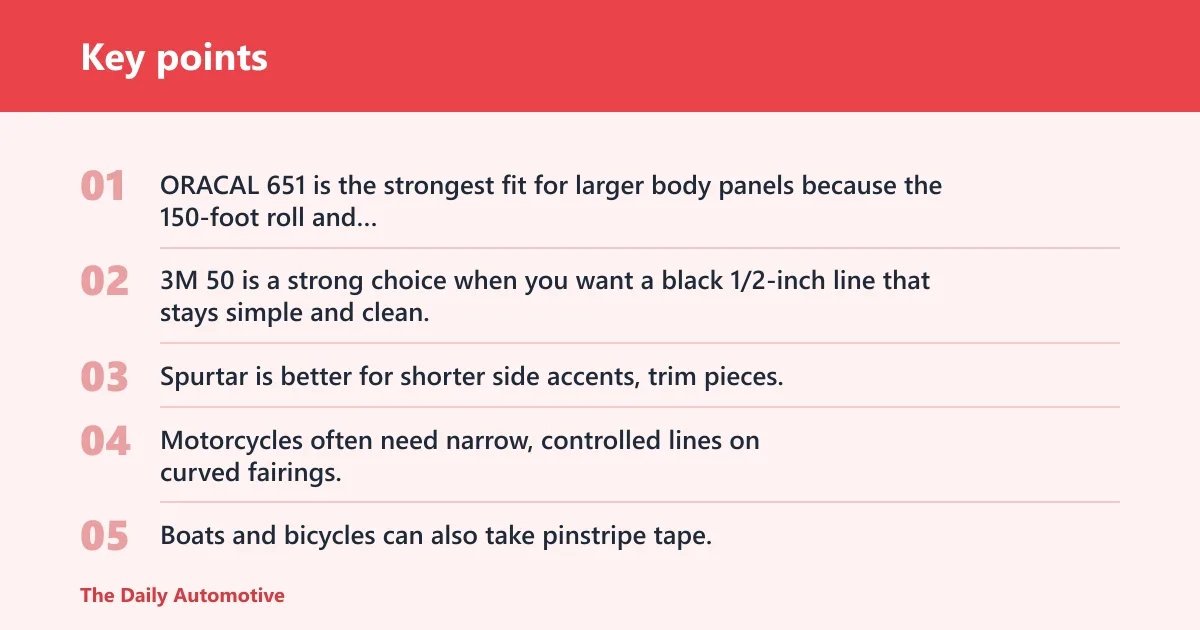
ORACAL 651 is the strongest fit for larger body panels because the 150-foot roll and width choices make planning easier. 3M 50 is a strong choice when you want a black 1/2-inch line that stays simple and clean. Spurtar is better for shorter side accents, trim pieces, or a first try on a smaller panel.
Motorcycles, boats, and bicycles
Motorcycles often need narrow, controlled lines on curved fairings, which makes 1/4-inch or 1/2-inch tape a smarter choice than a wide stripe. Boats and bicycles can also take pinstripe tape, but salt exposure and flexible plastics make surface prep even more important. Datanly’s UV and water resistance claim makes it a practical short-run option.
When a stripe kit is the wrong product
Do not mix up cosmetic pinstripe tape with larger decorative stripe kits. A stripe kit is usually wider, more graphic, and often intended for a bigger visual panel treatment. If you only want a slim accent line, a pinstripe roll is the better product. If you want a full hood-to-trunk styling band, the tape category may be too narrow.
Cherry Picks evaluated 306 automotive pinstriping tape products, analyzed 34,628 consumer satisfaction reviews, and listed 30 products. That market view matters because it shows how much clutter sits between a short accent roll and a genuinely useful long-run option. Cherry Picks also reported an average price of $10.77, with the highest at $24.49 and the lowest at $4.45.
That price spread is why cost per foot matters. A short two-roll pack can look cheap at checkout, yet end up more expensive per usable foot than a long 150-foot roll. For buyers planning one door line, that may not matter. For a full side stripe, it matters a lot.
Frequently asked questions
What is the best pinstripe decal tape for cars?
For most buyers, ORACAL 651 is the strongest all-around choice because it offers 1/4-inch, 1/2-inch, and 3/4-inch widths plus a five-year outdoor rating. Choose 3M 50 if you want a black 1/2-inch line in a 150-foot roll. Choose Spurtar for smaller jobs and lower commitment.
What width pinstripe tape should I use for my car?
Use 1/4 inch for a subtle accent, 1/2 inch for the usual middle ground, and 3/4 inch for a bolder line. If you are unsure, start with 1/2 inch. It works on a broad range of body styles without looking too thin or too loud.
Does pinstripe tape damage car paint when removed?
Not usually, but the answer depends on the product, paint condition, and how long the tape stayed on the car. Some tapes remove without residue on suitable paint, yet aged clear coat, poor prep, or baked-on sun exposure can change the result. Test a small section first if the paint is fragile.
Can I use pinstripe tape on curved body panels?
Yes, on gentle to moderate curves. ORACAL 651 is the best fit here because it is sold in widths that suit contour work. Tight 3D curves, sharp edges, and textured plastic are weak spots. Use mild heat, keep the line clean, and avoid forcing the film around severe bends.
How long does automotive pinstriping tape last outside?
It varies by film. ORACAL 651 is rated for five years outdoors, and some other automotive pinstriping tapes offer UV and weather resistance without the same exact rating. Sun, wash frequency, and surface prep all affect real life. A clean install on a smooth panel lasts better than a rushed one.
How do you install pinstripe decals on a car?
Clean and dry the panel first. Lay out the line, apply it slowly, press firmly with a squeegee or hand pressure, and use a hair dryer on curves. Wait 24 hours before washing. If the panel is textured or the weather is cold, wait for better conditions rather than forcing the install.
Can pinstripe tape be used on motorcycles and boats?
Yes. It works on motorcycles, boats, bicycles, trucks, SUVs, and cars when the surface is smooth and non-porous. For boats, UV and water resistance matter more. For motorcycles, curve handling matters more. In both cases, a shorter roll can be easier to place on smaller panels.
Products related to this article
Sponsored / affiliate links. As an Amazon Associate I earn from qualifying purchases. I may earn additional commission from eligible campaigns.