
Profit Margin Per Car For Top Manufacturers
Figuring out the Profit Margin Per Car for Top Manufacturers: 2026 Price Guide might seem a bit tricky at first. It’s a topic many people new to the car business find confusing. But don’t worry!
We’ll break it down into simple steps so you can easily grasp it. We’ll look at how much money car makers really make on each vehicle they sell. Get ready to learn about what drives these numbers and what you can expect.
This guide will help you make sense of it all.
Understanding Profit Margin Per Car For Top Manufacturers
This section explains what profit margin per car means for big car companies and why it’s important. We look at how car makers calculate this number. It helps us see how successful they are with each car they build and sell.
Understanding this can give you a good idea of the financial health of different brands. We will explore the basic ideas behind profit margins and why they matter to everyone involved in the car industry, from buyers to investors. This is key to knowing the real value behind the sticker price.
What Is Profit Margin Per Car
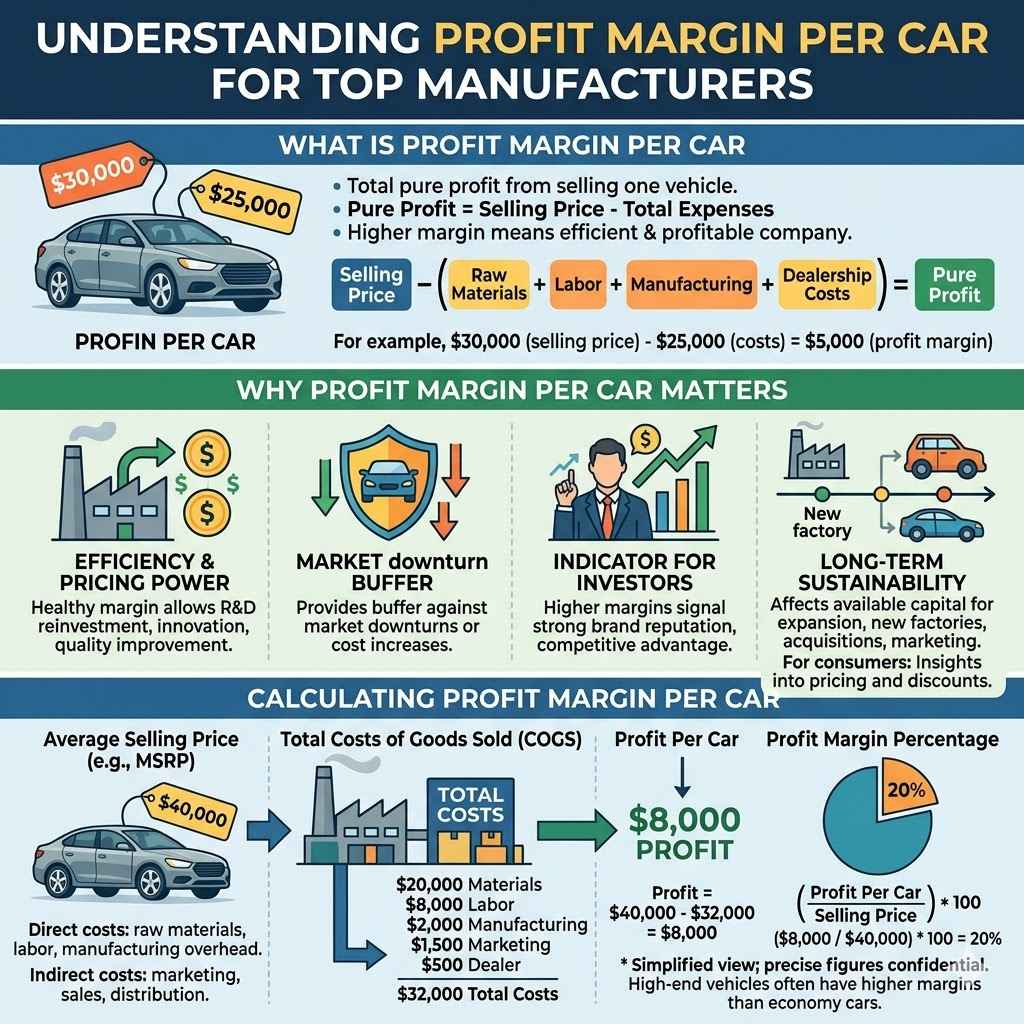
Profit margin per car is the amount of money a car manufacturer makes from selling one vehicle after covering all the costs associated with making and selling it. Think of it as the pure profit. It’s the selling price minus the total expenses.
These expenses include everything from the raw materials and labor to marketing and dealership costs. A higher profit margin means the company is more efficient and profitable. It is a key indicator of a company’s financial success.
For example, if a car sells for $30,000 and the total cost to produce and sell that car is $25,000, the profit margin per car is $5,000. This $5,000 is the profit the manufacturer pockets. It’s not just the factory cost; it includes many other expenses.
This number helps investors and analysts judge how well a company is doing. It also shows how competitive the company is in the market.
Knowing this helps consumers too. It can inform buying decisions when you see how much margin is built into a car’s price. It also influences pricing strategies and future model development.
Companies aim to increase this margin to boost overall profits and shareholder value. This is a fundamental concept in business.
Why Profit Margin Per Car Matters
The profit margin per car is a vital metric for several reasons. It directly reflects a manufacturer’s efficiency and pricing power. A healthy profit margin allows companies to reinvest in research and development, innovate new technologies, and improve vehicle quality.
It also provides a buffer against market downturns or unexpected cost increases. For investors, it’s a key indicator of a company’s financial health and potential for growth. Higher margins often signal a strong brand reputation and competitive advantage.
Moreover, a company’s ability to maintain or increase its profit margin per car influences its long-term sustainability. It dictates how much capital is available for expansion, new factories, or acquiring other companies. It also affects how much money can be spent on marketing and advertising to attract more buyers.
This creates a cycle where good profits lead to better products and marketing, which in turn leads to more sales and profits.
For consumers, understanding profit margins can offer insights into pricing. While not directly visible, it helps explain why some cars are priced higher than others, even if their features seem similar. It’s a piece of the puzzle that explains the automotive market’s dynamics.
It also helps understand why manufacturers sometimes offer discounts or incentives to move vehicles.
Calculating Profit Margin Per Car
Calculating the profit margin per car involves several steps. First, you need the average selling price of the car. This is often the Manufacturer’s Suggested Retail Price (MSRP) or the average transaction price after discounts.
Next, you determine the total cost of goods sold (COGS) for that car. This includes direct costs like raw materials, labor, and manufacturing overhead. It also includes indirect costs like marketing, sales, and distribution expenses.
The formula is essentially Profit Per Car = Selling Price – Total Costs. The profit margin percentage is then (Profit Per Car / Selling Price) 100. For example, if a car sells for $40,000 and the total costs are $32,000, the profit per car is $8,000.
The profit margin would be ($8,000 / $40,000) 100 = 20%.
It’s important to note that this is a simplified view. Manufacturers often use sophisticated accounting to allocate costs. Different models will have different margins.
High-end vehicles typically have higher profit margins than economy cars. This is due to factors like brand perception, advanced technology, and premium materials. Precise figures are usually kept confidential.
Profit Margin Per Car for Top Manufacturers: 2026 Price Guide Insights
This section offers a closer look at what the Profit Margin Per Car for Top Manufacturers: 2026 Price Guide reveals. We explore how different major car makers achieve their profit margins. You’ll find out what influences these numbers for brands like Toyota, Volkswagen, and General Motors.
We will also look at market trends that affect these margins in the coming years. This guide helps you see the financial landscape of the automotive giants.
Key Manufacturers And Their Profit Margins
When we talk about top manufacturers, we usually mean companies like Toyota, Volkswagen Group, General Motors, Stellantis, and Ford. These companies produce millions of vehicles globally. Their profit margins can vary significantly based on the brands they own, the types of vehicles they sell, and the markets they operate in.
Toyota, for instance, is often praised for its efficiency and strong profit margins, especially on its popular models like the Camry and RAV4. They focus on reliability and cost control. Volkswagen Group, with its wide range of brands from economy (Skoda) to luxury (Porsche, Audi), sees diverse profit margins across its portfolio.
Luxury brands generally command much higher margins.
General Motors and Stellantis (formed from the merger of Fiat Chrysler and PSA Group) often have strong profits from their truck and SUV segments in North America. These vehicles are high-margin products. Ford also relies heavily on its F-Series trucks for profitability.
Understanding these company-specific strategies is key to grasping their profit margin performance.
Factors Influencing Profit Margins
Several factors influence a car manufacturer’s profit margin per car. The type of vehicle is a big one; SUVs and trucks typically have higher margins than sedans and small cars. This is because consumers are often willing to pay more for larger, more powerful vehicles.
Luxury brands, by their nature, charge a premium for advanced features, brand prestige, and exclusive materials, leading to substantial profit margins.
Another key factor is manufacturing efficiency. Companies that can produce cars with fewer defects and less waste will have lower production costs, thus higher margins. Supply chain management also plays a crucial role.
Efficient sourcing of parts and materials, especially during times of shortages, can significantly impact profitability. Global economic conditions, currency exchange rates, and trade policies also affect costs and demand, influencing margins.
Furthermore, marketing and sales strategies are important. Effective advertising campaigns can build demand and brand loyalty, allowing for higher prices. The cost of incentives and discounts offered to consumers also directly eats into profits.
Finally, research and development costs for new technologies, like electric vehicles and autonomous driving, can be high and initially reduce margins, but they are investments for future profitability.
Market Trends Affecting Profitability
The automotive industry is undergoing rapid changes, which directly impact profit margins. The shift towards electric vehicles (EVs) presents both challenges and opportunities. While EVs require significant investment in battery technology and production, they also offer the potential for higher margins in the future due to simpler powertrains and less maintenance for consumers.
However, current EV production costs can be high, sometimes leading to lower initial margins compared to traditional gasoline cars.
The increasing demand for SUVs and crossovers globally continues to boost profit margins for manufacturers as these vehicles are highly profitable. Conversely, the declining popularity of sedans in many markets puts pressure on margins for those models. Geopolitical factors, such as trade wars, tariffs, and regional conflicts, can disrupt supply chains and increase costs, negatively affecting margins.
Consumer preferences are also evolving, with a growing interest in sustainability and advanced technology, pushing manufacturers to invest in these areas, which can impact short-term profitability.
The rise of subscription services and software-defined vehicles also introduces new revenue streams. While not directly part of the car’s initial sale profit margin, these services can contribute significantly to overall company profitability over the vehicle’s lifetime. The industry is also consolidating, with mergers and acquisitions potentially leading to economies of scale and improved margins for larger entities.
The ongoing semiconductor chip shortage, while easing, has highlighted the vulnerability of global supply chains and the need for resilience, which can influence future cost structures and margins.
Analyzing Profit Margin Per Car for Top Manufacturers: 2026 Price Guide
This section goes deeper into how we can analyze the Profit Margin Per Car for Top Manufacturers: 2026 Price Guide. We will look at specific examples and use data to illustrate our points. This helps you see how these numbers work in real life.
We also consider the future outlook for these margins. This detailed look will give you a clearer picture of the financial strategies of major car companies.
Case Study 1 Toyota’s Profitability
Toyota is renowned for its operational efficiency and strong financial performance, consistently achieving healthy profit margins. A significant factor in Toyota’s success is its Toyota Production System (TPS), which emphasizes lean manufacturing, waste reduction, and continuous improvement. This system allows them to control costs effectively without compromising quality.
For example, models like the Toyota RAV4 and Highlander are best-sellers and command strong prices. Their reliability reduces warranty costs, and their durable design appeals to a broad market. Toyota also benefits from its hybrid technology, which is popular and often carries a premium price.
Even with the high investment in hybrid development, the consistent demand and efficient production allow for robust profit margins.
Toyota’s strategy often involves offering well-equipped, reliable vehicles at competitive prices, but with excellent cost management. This allows them to achieve profit margins that are often the envy of their competitors. They focus on long-term value and customer loyalty, which translates into stable sales and profitability.
Case Study 2 Tesla’s High-Margin Strategy
Tesla is a prime example of a manufacturer with potentially very high profit margins on its electric vehicles, especially in its earlier years. Unlike traditional automakers, Tesla built its brand around cutting-edge technology and a direct-to-consumer sales model. This bypasses the traditional dealership network, eliminating significant sales and service costs that eat into margins for other companies.
Tesla’s ability to integrate software and hardware development allows for unique features and over-the-air updates, which can create ongoing revenue streams and enhance vehicle value. The premium pricing of models like the Model S and Model X, coupled with efficient battery production and simpler vehicle architecture (fewer moving parts compared to gasoline cars), contributes to their high margins.
However, Tesla’s margins can be sensitive to production ramp-ups, raw material costs for batteries, and competition. Despite these fluctuations, their innovative approach to manufacturing and sales has allowed them to set a benchmark for profitability in the EV sector. Their ability to directly control the customer experience from order to delivery is a key differentiator.
How Pricing Guides Reflect Profit Margins
Price guides, such as the hypothetical Profit Margin Per Car for Top Manufacturers: 2026 Price Guide, aim to offer an estimation of the financial performance behind vehicle sales. They do this by analyzing publicly available data. This includes manufacturer financial reports, average transaction prices, production costs (often estimated), and market analysis.
These guides don’t have access to the exact internal profit calculations of car companies. Instead, they use formulas and industry benchmarks to infer profit margins. They might look at the difference between a car’s MSRP and estimated production costs, adjusting for factors like marketing expenses and dealer markups.
A higher MSRP compared to estimated production costs generally suggests a higher potential profit margin.
For example, a luxury SUV from a premium brand might have an MSRP of $80,000. If the estimated total cost to produce and sell that vehicle is $55,000, the guide would calculate a potential profit of $25,000. This would translate to a profit margin of about 31.25%.
Conversely, an economy sedan with an MSRP of $25,000 and estimated costs of $21,000 would show a $4,000 profit, or a 16% margin. These guides are valuable for market comparison and trend analysis.
Future Outlook For Profit Margins In The Automotive Industry
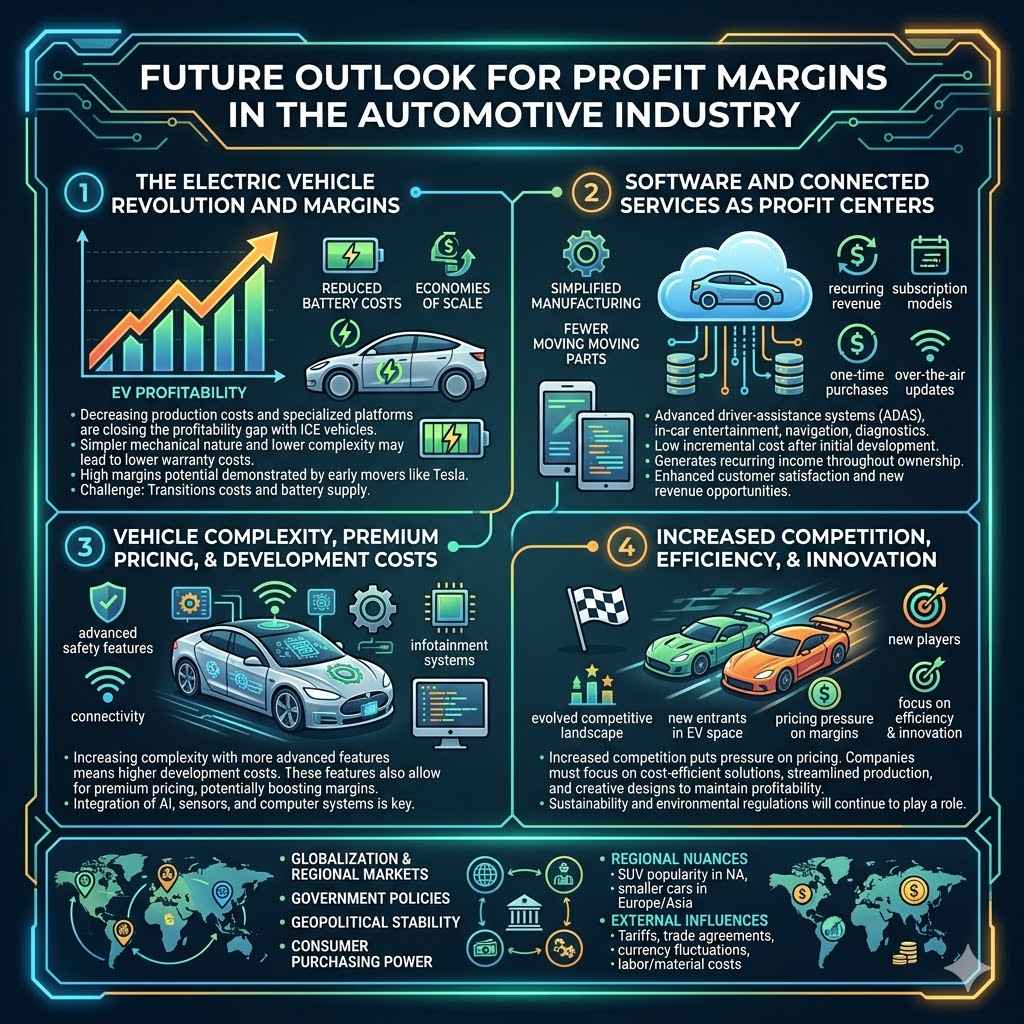
The future of profit margins for car manufacturers is tied to significant industry shifts. The ongoing transition to electric vehicles is a major driver. As battery costs decrease and production scales up, EVs are expected to become more profitable, closing the gap with internal combustion engine (ICE) vehicles.
Manufacturers are also exploring new revenue models, such as software subscriptions and connected car services, which can add recurring income and boost overall profitability beyond the initial sale of the car.
The increasing complexity of vehicles, with more advanced safety features, infotainment systems, and connectivity, means higher development costs. However, these features also allow for premium pricing. The competitive landscape is also evolving, with new players entering the market, particularly in the EV space.
This increased competition will likely put pressure on pricing and margins, forcing companies to focus even more on efficiency and innovation to maintain profitability.
Sustainability and environmental regulations will continue to play a significant role. Companies that can effectively meet these demands with cost-efficient solutions will gain a competitive edge. The global economic climate, geopolitical stability, and consumer purchasing power will also remain critical factors influencing demand and, consequently, profit margins.
Success will depend on adaptability and a keen understanding of evolving consumer needs and technological advancements.
The Electric Vehicle Revolution And Margins
The electric vehicle (EV) revolution is reshaping profit margins in the auto industry. Initially, EVs were often less profitable than their gasoline counterparts due to high battery costs and specialized production lines. However, as battery technology advances and economies of scale kick in, the cost of EV production is steadily decreasing.
This trend is projected to make EVs as profitable, if not more profitable, than traditional ICE vehicles in the coming years.
Manufacturers are investing heavily in EV platforms, which can be more cost-effective to produce than adapting existing ICE designs. The simpler mechanical nature of EVs, with fewer moving parts, also leads to lower manufacturing complexity and potentially lower warranty costs over the vehicle’s life. Furthermore, governments worldwide are offering incentives for EV adoption, which can boost sales volumes and indirectly support profitability.
Companies like Tesla have already demonstrated the potential for high margins in the EV space. As legacy automakers ramp up their EV offerings, they are also aiming to capture similar profitability. The challenge lies in managing the transition costs and ensuring consistent supply of critical components like batteries.
The ultimate profitability of EVs will also depend on consumer acceptance of charging infrastructure and driving range.
Software And Connected Services As Profit Centers
The automotive industry is increasingly moving beyond simply selling hardware. Software and connected services are emerging as significant profit centers for manufacturers. Think of features like advanced driver-assistance systems (ADAS), in-car entertainment, navigation updates, and vehicle diagnostics, which can be offered through subscription models or one-time purchases.
For example, a manufacturer might offer a premium navigation package or a subscription for enhanced autopilot features. These services often have very high-profit margins because the incremental cost of providing them after the initial development is relatively low. This allows companies to generate recurring revenue throughout the ownership of a vehicle, smoothing out the traditional cyclical nature of car sales.
Over-the-air (OTA) software updates are another key area. These can be used to fix bugs, improve performance, or even introduce new features after a car has been sold. This not only enhances customer satisfaction but also opens up opportunities for new revenue streams.
As vehicles become more like connected devices on wheels, the software and services embedded within them will play a crucial role in a manufacturer’s financial success.
The Role Of Globalization And Regional Markets
Globalization and regional market dynamics profoundly influence profit margins for car manufacturers. Operating in multiple countries means manufacturers can leverage economies of scale by producing large volumes of vehicles. However, they also face varying consumer preferences, regulatory environments, and economic conditions in each region.
For instance, SUVs are highly popular in North America, driving higher profit margins there, while smaller, fuel-efficient cars might dominate sales in Europe and Asia.
Tariffs and trade agreements between countries can significantly impact the cost of imported parts and finished vehicles, directly affecting profit margins. Manufacturers often set up production facilities in different regions to mitigate these costs and better serve local demand. Currency fluctuations also play a role; a strong local currency can make exports more expensive and reduce profitability when repatriating earnings.
The cost of labor and raw materials can also vary dramatically by region. Companies must carefully manage their global supply chains and manufacturing footprints to optimize costs. Understanding these regional nuances is critical for any manufacturer aiming to maximize its profit margin per car across its entire portfolio.
Each market presents unique opportunities and challenges that shape financial outcomes.
Frequently Asked Questions
Question: What is the primary goal of calculating profit margin per car
Answer: The primary goal is to understand how much money a car manufacturer makes from selling one vehicle after all expenses are covered. This helps assess profitability, efficiency, and financial health.
Question: Are SUVs and trucks more profitable than sedans
Answer: Yes, typically SUVs and trucks command higher profit margins because consumers are generally willing to pay more for them.
Question: How do electric vehicles (EVs) affect profit margins
Answer: Initially, EVs had lower margins due to high battery costs. However, as technology improves and production scales, they are expected to become more profitable, with some companies already seeing strong EV margins.
Question: Can dealerships affect a manufacturer’s profit margin
Answer: Dealerships are separate entities, but their sales volume and efficiency influence the overall profitability for the manufacturer. Manufacturers set wholesale prices, and dealer markups contribute to the retail price and customer cost.
Question: Is the profit margin per car for all manufacturers the same
Answer: No, profit margins vary significantly between manufacturers due to differences in branding, product mix, production efficiency, market focus, and cost management strategies.
Summary
This guide explored the Profit Margin Per Car for Top Manufacturers: 2026 Price Guide. We learned that profit margin per car is the profit made on each vehicle sold after all costs. Key factors like vehicle type, brand, and production efficiency influence this number.
The automotive industry is shifting towards EVs and software services, which will shape future profit margins. Understanding these dynamics provides valuable insight into the car market’s financial landscape.