How to Get Automotive Service Technician Certification
Get automotive service technician certification through the route your state or province accepts: approved school, apprenticeship, or exam-based trade qualification. Then complete the required work hours and pass the credential exam where required. Pick the wrong path and you can waste time, tuition, and eligibility to work legally or move ahead. This guide breaks down U.S. and Canadian routes by school, apprenticeship, exam, and region so you can choose the fastest valid option.
Credentials and core job responsibilities
Automotive service technician certification is the credential step that shows employers and regulators you have the training, supervised experience, and tested knowledge needed to work on cars and light trucks. It is not the same as a short course certificate, and in some places it is not the same as a license.
Certification vs license vs qualification
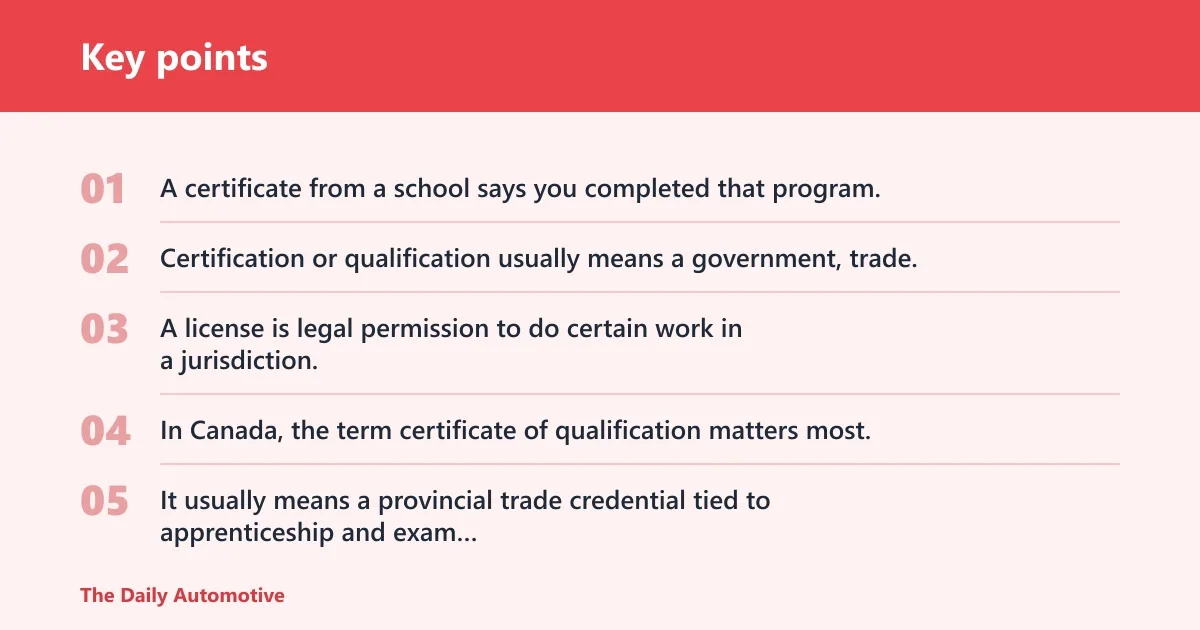
A certificate from a school says you completed that program. Certification or qualification usually means a government, trade, or independent body accepted your training and, in many cases, your exam result. A license is legal permission to do certain work in a jurisdiction, and not every technician role requires one.
In Canada, the term certificate of qualification matters most. It usually means a provincial trade credential tied to apprenticeship and exam requirements, not a generic classroom certificate. In the U.S., the term “certification” often also includes employer-recognized credentials such as ASE-style credentials, which can sit on top of work experience without replacing a government requirement.
What technicians do on the job
Automotive service technicians diagnose and repair cars and light trucks. Common work includes brake service, engine diagnostics, steering and suspension work, electrical troubleshooting, maintenance, and replacing worn parts. The job demands hands-on work, so any valid path should include real shop time, not theory alone.
Say your goal is a dealership service bay. A theory-only online course may help with basics, but it will not satisfy a province that requires supervised hours and a practical exam. Many applicants lose time right there.
📊 Automotive repair & maintenance employed 66.1% of the occupation. Source: Datausa.
Which path fits your situation?
Your best path depends on where you live, how fast you need to start working, and whether you already have shop access. In general, school-first works well for beginners, apprenticeship-first works well if you can get hired quickly, and hybrid routes fit people who want classroom theory plus paid shop time.
School-first path
Choose school-first if you want structure, instructor support, and a clearer route into diagnostics, tools, and shop routines. This path often suits new entrants, recent graduates, and career changers who need basic instruction before applying for work. It can also help if your local employers prefer graduates with a formal program on the résumé.
Apprenticeship-first path
Choose apprenticeship-first if your jurisdiction allows it and you can secure an employer sponsor or registered training position. You earn while you learn, but you still need supervised work hours and technical instruction. This route often gets paid work started sooner, yet it can slow down if you cannot find a sponsor or if your hours are not documented properly.
Hybrid path
Choose a hybrid path if your local system accepts both school and apprenticeship credit. Many learners use a short approved program to build theory, then move into shop work to finish the hands-on requirement. That can reduce confusion and make exam prep easier, especially where the trade exam expects both technical knowledge and proof of work experience.
Automotive certification pathway table

This table helps you compare the main routes before you enroll or sign an apprenticeship agreement. The right answer depends on jurisdiction, because U.S. Rules and Canadian provincial trade systems do not line up the same way.
| Path type | Who it suits | Likely prerequisites | Hands-on requirement | Exam requirement | Common mistakes to avoid |
|---|---|---|---|---|---|
| School-first program | New entrants who want structured training | High school completion or program entry minimums | Usually required through labs, shop blocks, or externships | Often required for trade qualification or employer certification | Choosing an unaccredited or locally unrecognized program |
| Apprenticeship-first | People who can get hired into a registered trade position | Employer sponsorship or registration, plus local entry rules | Required; supervised work hours are the core of the route | Usually required at the end of training or each level | Counting unsupervised hours or missing documentation |
| Hybrid school plus apprenticeship | Applicants who want classroom theory and paid shop time | Approved school entry and access to a shop employer | Required in both the classroom and workplace segments | Often required for provincial or state trade standing | Assuming school alone is enough in a hands-on trade |
| Exam-based trade qualification | Experienced workers with enough prior training or hours | Documented experience, prior training, or eligibility waiver rules | Usually already completed before the exam route opens | Central requirement; may include trade exam or certification exam | Applying before you meet minimum hours or proof standards |
| ASE-style professional credential | Working technicians building marketable proof of skill | Employer experience is often useful or expected | Helpful, but not a substitute for local trade hours | Yes, but it is independent from government licensing | Treating it like a license or a complete trade ticket |
| U.S. note | Routes vary by state, employer, and credential type | State rules may require school, work experience, or both | Hands-on training matters even when theory is online | Some states use exams; ASE can sit alongside employer needs | Assuming one national rule applies everywhere |
| Canadian note | Best for learners pursuing a provincial trade pathway | Apprenticeship registration and level requirements are common | Supervised hours are part of the trade structure | Certificate of qualification exams are common at the end | Confusing a course certificate with a provincial trade credential |
How do you get certified in the U.S.?

In the U.S., automotive service technician certification depends on state rules, employer expectations, and the credential you want. Some states and employers value formal school completion, some require documented work experience, and many use ASE-style credentials to verify skill after training.
State and local requirements
Start by checking whether your target state treats the job as a licensed trade, a certified occupation, or an employer-driven occupation. The biggest mistake is assuming a school diploma automatically makes you job-ready for every state or shop. Local rules can affect minimum age, training hours, or exam eligibility.
Training, hours, and exam steps
Most valid U.S. routes include approved instruction plus hands-on time. That can mean a trade school program, employer training, internship-style experience, or a combination. If an exam is part of the path, confirm what the test covers, whether practical skill is included, and whether you need proof of hours before you sit for it.
- Check the state rule for the credential you want.
- Confirm whether school, work experience, or both are required.
- Verify that the program is recognized by local employers or regulators.
- Collect records of shop hours, tasks, and supervision.
- Prepare for the required certification or trade exam.
Online theory can help with diagnostics, electrical fundamentals, and test prep. It should not be treated as a full substitute for shop time where hands-on training is required. If a program advertises only video lessons and no lab access, ask how it meets the local practical requirement.
Where ASE-style credentials fit
ASE-style credentials are generally independent professional certifications. They can improve employability and show that you passed a rigorous exam, but they are not the same as a government license or a provincial trade ticket. Many technicians stack ASE-style credentials after getting shop experience, and that combination can help with hiring and pay progression.
How do you get certified in Canada?
In Canada, the path typically centers on apprenticeship and a provincial trade credential. The exact path varies by province, but the key idea is the same: you need supervised workplace hours, technical instruction, and usually a provincial exam before you earn the certificate of qualification.
Apprenticeship structure
An apprenticeship pairs paid work with technical training. You normally need an employer sponsor or registered placement, and your hours must be tracked. Missing paperwork is a common failure point, especially for people who move between shops or assume informal training will count later.
Certificate of qualification
The certificate of qualification is the trade credential many Canadian technicians pursue. It is not a class completion paper. It usually follows structured training and an exam, and it can signal to employers that provincial trade standards for the occupation were met.
Suppose a worker completes shop duties for about six months but never logs the hours through the provincial system; those hours may not count. Those hours may not count toward the certificate of qualification. The paperwork matters as much as the wrench time.
Provincial exam and trade ticket notes
Some provinces use a trade exam as the final step, while others combine level-by-level requirements with a final certification test. Ask whether your province requires a trade ticket, whether it recognizes prior learning, and whether an out-of-province certificate transfers cleanly. Do not assume one provincial result automatically applies nationwide.
What should you check before you enroll?
Before you pay tuition or sign an apprenticeship agreement, verify recognition, hands-on time, and exam alignment. A program can sound strong and still miss the local credential rule you need. That can leave you with debt or hours that do not count.
Accreditation and local recognition
Ask whether the school or training provider is accepted by employers, unions, state agencies, or provincial trade authorities in the region where you plan to work. If you want the fastest valid route, local recognition matters more than marketing language. A nice brochure cannot replace a missing credential pathway.
Hands-on time and shop access
Confirm how many hours are in the lab, how much time is in an actual shop, and whether the program includes supervised work on real vehicles. A theory-heavy course may still be useful, but it should not be mistaken for a full certification path where practical training is mandatory.
Ask about employer placement and exam prep
Ask whether the program helps place graduates with employers, because apprenticeship and job placement can shorten the route to certification. Also ask which exam the program prepares you for, what pass rates it reports, and whether you will get practice tests, tool training, and records that prove hours completed.
What jobs and pay can this lead to?
Automotive service technician certification can open the door to entry roles in repair shops, dealerships, and parts stores. In the U.S., the occupation employed 782,128 people in 2024, paid an average yearly wage of $52,579, and had estimated 10-year job growth of 4.17%.
Typical employers and entry roles
Automotive repair & maintenance employed 66.1% of the occupation, car dealers employed 28%, and automotive parts, accessories, & tire stores employed 2.96%. Those settings point to the main entry markets: independent repair bays, dealership service departments, and retail parts counters with technical support work. If you want the broadest job base, start where those employers hire apprentices or trainees.
The wage data also helps with return on training cost. In a trade where shop access matters, a program that leads to recognized certification, documented hands-on hours, and faster entry into the largest employer group is usually better than a cheaper course that leaves you unable to qualify.
Frequently asked questions
How do I become a certified automotive technician?
Start by checking the credential rules where you live. Then choose a recognized route: approved school, apprenticeship, hybrid training, or an exam-based trade path. Finish the required hands-on hours, keep proof of supervision, and pass the required exam if your jurisdiction uses one.
How do I get auto mechanic certification?
Use the same route as automotive service technician certification, because the terms are often used interchangeably in hiring and training. The key is to match the credential to your state or province, not to an online advertisement. A course certificate alone usually is not enough.
Is there an automotive technician certification online?
Online options exist for theory, exam prep, and some certificate programs, but online-only study is often not the full answer. Many jurisdictions still require hands-on training, supervised hours, or workplace assessment. Before enrolling, confirm that the online portion fits the credential you actually need.
Do I need a license to work as an automotive technician?
Sometimes, but not always. Some places require a license, some require a trade qualification or certificate of qualification, and many employers mainly want recognized training plus experience. Check local rules first, because license, certification, and course completion are not the same thing.
How long does automotive technician certification take?
It depends on the route, the jurisdiction, and how quickly you can complete hours or pass an exam. A school program may take months, while an apprenticeship can take longer because it includes supervised work. Do not trust any fixed timeline without checking local requirements.
What jobs can I get with automotive service technician certification?
You can apply for entry roles in repair shops, dealerships, and parts stores, especially where employers want diagnostic and repair support. Certification can also help you move into higher-responsibility work after experience. The best first job is usually the one that counts toward local trade hours.
Products related to this article
Sponsored / affiliate links. As an Amazon Associate I earn from qualifying purchases. I may earn additional commission from eligible campaigns.