Radiator Fan Keeps Running After Car Is Off? Explained
It can be really confusing and a little worrying when you turn off your car, and the radiator fan keeps running. You might think something is broken, and for beginners, this can feel like a big problem. But often, it’s totally normal and not something to panic about.
This post will help you understand why this happens and what it means. We’ll break it down so it’s simple to follow, and you’ll know exactly what’s going on with your car. Let’s get started on figuring out the mystery of the Radiator Fan Keeps Running After Car Is Off?
Explained.
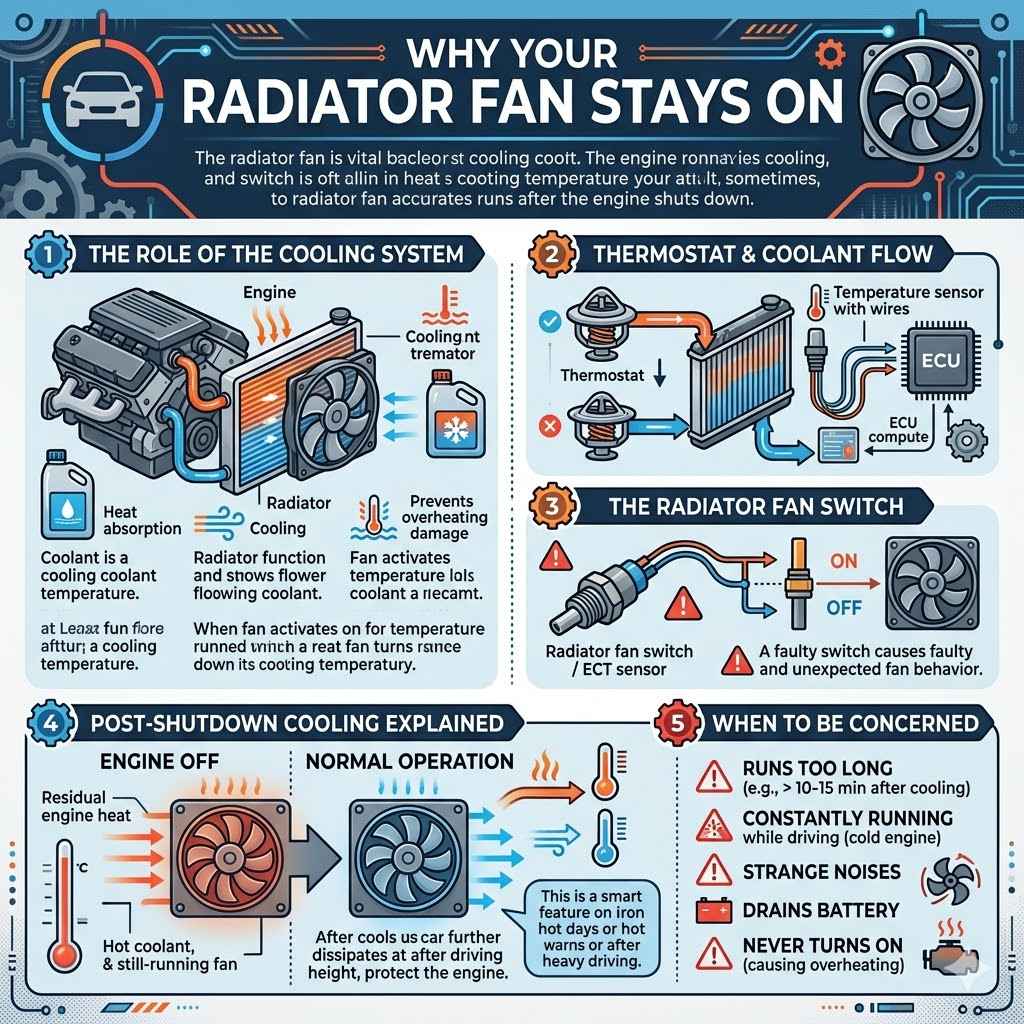
Why Your Radiator Fan Stays On
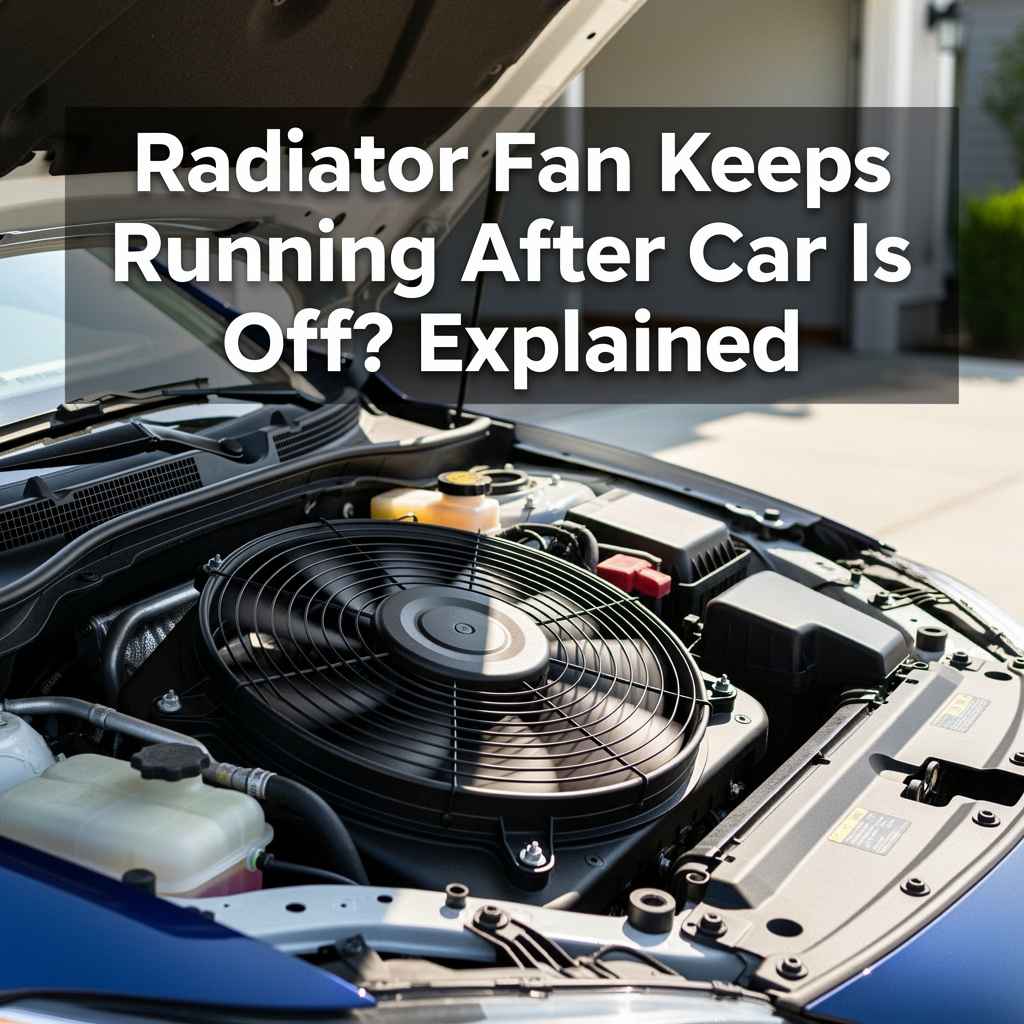
When your car’s engine heats up, the radiator fan plays a vital role in cooling it down. This fan is controlled by the engine’s computer and works to keep the engine from overheating. Normally, it switches off shortly after you turn the engine off, especially if the engine isn’t too hot.
However, sometimes it keeps spinning for a while. This can happen for a few reasons, and it’s usually a sign the car is doing its job to protect the engine.
The Role of the Cooling System
The cooling system in your car is like the engine’s thermostat. It uses coolant, a special liquid, to absorb heat from the engine and then carries that heat to the radiator. The radiator is like a heat exchanger.
Air passes through its fins, cooling the hot coolant inside. The radiator fan helps this process, especially when the car is moving slowly or stopped, as there isn’t enough natural airflow through the radiator.
The fan’s job is to pull air through the radiator. This makes the coolant cooler. When the coolant reaches a certain temperature, the fan is told to turn on.
When the temperature drops, it should turn off. This system is crucial for preventing engine damage. Overheating can cause serious and expensive problems.
Thermostat and Coolant Flow
The car’s thermostat is a small valve that controls how coolant flows. When the engine is cold, the thermostat stays closed. This keeps the coolant circulating within the engine block, helping it reach its optimal operating temperature faster.
Once the engine warms up, the thermostat opens. This allows coolant to flow to the radiator for cooling.
The temperature sensor in the engine is what tells the car’s computer when the coolant is hot enough to need extra cooling. This sensor sends a signal. The computer then decides if the fan needs to turn on.
If the sensor is working correctly, it provides accurate readings. This is key to the fan turning on and off at the right times.
The Radiator Fan Switch
The radiator fan switch, also known as the engine coolant temperature (ECT) sensor or fan switch, is a critical component. It monitors the coolant’s temperature. When the coolant reaches a specific high temperature, this switch sends a signal to turn on the electric radiator fan.
If this switch malfunctions, it might send the wrong signal, causing the fan to behave unexpectedly.
A faulty fan switch could fail to turn the fan off even when the engine is cool. Or, it might not turn it on at all, leading to overheating. For the Radiator Fan Keeps Running After Car Is Off?
Explained scenario, it’s important to check if this switch is sending signals to keep the fan running even when the engine is no longer hot.
Post-Shutdown Cooling Explained
Sometimes, the radiator fan continues to run for a short period after you switch off the engine. This is often a normal and even desirable function. When you stop driving, the engine’s heat doesn’t disappear instantly.
The engine block and the coolant are still very hot. This residual heat can continue to rise for a while after the engine is off.
To prevent the engine from overheating from this retained heat, the car’s computer might command the radiator fan to keep running. This helps dissipate the extra heat. It’s a way for the car to protect itself.
The fan will typically shut off once the engine temperature has dropped to a safe level. This post-shutdown cooling is a sign of a healthy system designed to safeguard your engine.
Normal Operation After Shutoff
It is quite common for electric radiator fans to run for a few minutes after you turn off your car, especially on hot days or after strenuous driving, like going uphill or towing. The engine’s temperature doesn’t immediately drop when the engine stops running. The hot coolant still circulating and the heat stored in the engine components can keep the temperature high.
The car’s cooling fan system is designed with this in mind. Sensors detect the high temperature and activate the fan to cool things down even with the engine off. This process is usually automated and controlled by the vehicle’s main computer, also known as the Engine Control Unit (ECU).
It’s a smart feature that helps maintain the engine’s integrity.
When to Be Concerned
While some post-shutdown fan operation is normal, you should pay attention if the fan runs for an unusually long time. If it continues to run for more than 10-15 minutes after the engine has cooled down, or if it makes strange noises, it might indicate a problem. Also, if the fan runs constantly while driving, even when the engine is cold, that’s a sign something is wrong.
Another indicator of an issue is if the fan doesn’t seem to turn on at all when the engine is hot. A fan that runs excessively might drain your car battery. A fan that never runs can lead to severe engine damage due to overheating.
So, while some continuous running is okay, prolonged or absent fan activity warrants investigation.
Potential Causes for the Fan’s Behavior
Several components can cause the radiator fan to keep running longer than expected or even constantly. Understanding these causes helps in diagnosing the problem correctly. The most common culprits involve the cooling system’s sensors, the fan’s relay, or even the car’s computer itself.
Addressing these issues promptly can prevent more serious damage.
Faulty Coolant Temperature Sensor
The coolant temperature sensor (CTS) is key to regulating the radiator fan. This sensor sends information about the coolant’s temperature to the car’s computer. If the CTS is faulty, it might send inaccurate readings.
For example, it could consistently report a high temperature, even when the coolant is actually cool.
This false high-temperature reading would trigger the car’s computer to keep the radiator fan running. This is because the computer believes the engine is overheating. Replacing a faulty CTS is usually a straightforward repair.
It involves removing the old sensor and installing a new one. This can often solve the issue of the fan running too long.
How a Bad Sensor Affects the Fan
When a coolant temperature sensor starts to fail, its resistance can change erratically. This change in resistance affects the voltage signal it sends to the ECU. The ECU interprets this signal as an engine temperature reading.
If the signal indicates a high temperature, the ECU will command the cooling fan to stay on.
This can happen even if the engine is cold or at normal operating temperature. It’s like the sensor is stuck in a “hot” mode. This constant signal to cool the engine can lead to the fan running continuously.
This is a common reason behind the Radiator Fan Keeps Running After Car Is Off? Explained mystery when the fan doesn’t seem to stop.
Testing the Coolant Temperature Sensor
Diagnosing a faulty CTS can be done with a multimeter and by comparing its readings to the manufacturer’s specifications. You can test the sensor by checking its resistance at different known temperatures. Often, a mechanic will use a diagnostic scanner to read the temperature data the ECU is receiving.
This can quickly reveal if the sensor is providing incorrect information.
If the scanner shows a significantly different temperature than what you might expect or what a manual thermometer reads, the sensor is likely the problem. Replacement is usually recommended if the sensor is found to be faulty. It’s a relatively inexpensive part and can save you from potential engine damage.
Cooling Fan Relay Issues
The cooling fan relay is an electrical switch that controls the flow of power to the radiator fan motor. When the car’s computer decides the fan needs to run, it sends a low-voltage signal to the relay. The relay then closes a circuit, allowing high-voltage power to flow from the battery to the fan motor, making it spin.
If the relay gets stuck in the “on” position, it will keep sending power to the fan, even after the car is turned off and the engine has cooled. This is a common mechanical or electrical failure that can cause the fan to run continuously. Replacing a stuck relay is a relatively simple fix.
Understanding Relay Function
A relay acts like an electrically operated switch. It allows a small current to control a larger current. In the case of the radiator fan, the car’s computer uses a small amount of power to activate the relay coil.
This activated coil then moves a switch mechanism, connecting the fan motor to the car’s main power source. This protects the computer from the high amperage draw of the fan motor.
When the computer stops sending the signal to the relay, the relay is supposed to open the circuit, cutting power to the fan. If the internal contacts of the relay become welded together due to age, heat, or electrical surges, it can remain closed. This keeps the fan running indefinitely.
Diagnosing a Stuck Relay
You can often test a cooling fan relay by listening for its click when the car is turned on and off. If you don’t hear it, it might be faulty. Another method is to swap it with an identical relay from a non-critical system (like the horn, if it’s the same type) to see if the problem follows the relay.
If the fan stops running with the swapped relay, then the original relay was indeed the issue.
Most relays are located in the fuse box under the hood. They are usually plug-and-play components. If a relay is suspected, replacement is often the easiest diagnostic step.
Mechanics can also use specialized tools to test the relay’s operation directly.
Low Coolant Level
While not as direct a cause for the fan continuing to run after the car is off, a low coolant level can indirectly lead to the cooling system working harder. If there isn’t enough coolant, the system can’t efficiently transfer heat away from the engine. This can cause the engine to run hotter than it should.
A hotter engine will definitely trigger the radiator fan to come on. If the coolant level is critically low, the temperature sensors might still detect high heat, prompting the fan to run. After the engine is shut off, the remaining heat can cause the temperature to spike again, keeping the fan engaged for longer periods.
So, ensuring your coolant is at the proper level is fundamental to a well-functioning cooling system.
The Importance of Coolant
Coolant, also known as antifreeze, is a mixture of water and chemicals that circulates through your engine to absorb heat. It has a much higher boiling point and lower freezing point than water. This allows it to effectively cool the engine under extreme temperatures and protect it from freezing in cold weather.
The coolant also contains additives that prevent corrosion and lubricate water pump seals. Without sufficient coolant, the engine’s ability to dissipate heat is severely compromised. This can lead to rapid overheating, even with a functioning radiator fan.
Regularly checking and maintaining the coolant level is a simple yet vital maintenance task.
Signs of Low Coolant
A common sign of low coolant is the temperature gauge on your dashboard rising into the red zone. You might also notice steam coming from under the hood. Sometimes, you’ll see a visible coolant leak on the ground beneath your car, often a colored puddle (green, orange, pink, or yellow, depending on the coolant type).
If the radiator fan runs for a very long time after you turn off the engine, it can also be a symptom of an engine that’s struggling to cool itself due to insufficient coolant.
It’s important to never open a hot radiator cap, as pressurized hot coolant can spray out and cause severe burns. Always let the engine cool down completely before checking the coolant level. Most cars have a translucent coolant reservoir, making it easy to see the level.
It should be between the “MIN” and “MAX” marks. If it’s below “MIN”, you need to add coolant.
Air Pockets in the Cooling System
Air pockets can form in the cooling system if it hasn’t been bled properly after maintenance, like a coolant flush or radiator replacement. Air doesn’t transfer heat as efficiently as liquid coolant. If air pockets get trapped around the temperature sensor, they can give it false readings.
This might trick the sensor into thinking the engine is hotter than it really is.
These trapped air bubbles can prevent proper circulation of coolant. This leads to hot spots within the engine. The temperature sensor in these hot spots will signal the computer to activate the fan.
Even after the engine is off, these pockets can retain heat, causing the fan to run longer. Removing air pockets, a process called “bleeding the system,” is crucial.
How Air Affects Temperature Readings
The engine temperature sensor is submerged in the coolant. Its job is to measure the temperature of the coolant passing by it. If an air bubble surrounds the sensor, it won’t be able to accurately measure the coolant’s temperature.
Air is a poor conductor of heat compared to liquid. So, the sensor might read a much lower temperature than the actual engine block temperature.
Conversely, a pocket of superheated steam or air trapped near the sensor can cause it to read a falsely high temperature. This is what leads to the radiator fan being activated unnecessarily or staying on for extended periods. Proper coolant level and circulation are key to accurate temperature readings.
Bleeding the Cooling System
Bleeding the cooling system involves removing trapped air. The process varies slightly depending on the car’s make and model. Often, it involves running the engine with the radiator cap off (or a special bleeding funnel attached) and turning the heater on to full blast.
This allows air to escape through the heater core and out of the system.
You might need to squeeze the radiator hoses or use a specific bleed screw located in the cooling system. The goal is to get the coolant to flow freely without any air bubbles. If you’re not comfortable doing this yourself, a mechanic can perform this service.
It’s an important step after any work on the cooling system.
Troubleshooting Steps for a Running Fan
If you’re dealing with the Radiator Fan Keeps Running After Car Is Off? Explained situation, there are several troubleshooting steps you can take. Starting with the simplest checks can save you time and money.
It’s always best to be safe when working on your car, so if you’re unsure, it’s better to seek professional help.
Checking the Coolant Level and Condition
The very first thing to check is your coolant level. Locate the coolant reservoir, usually a translucent plastic tank under the hood. Ensure the coolant level is between the MIN and MAX lines when the engine is cool.
Also, check the condition of the coolant. It should be clean and free of debris, oil, or rust.
If the coolant is low, you’ll need to find out why. Is there a leak? Did it simply evaporate over time?
If the coolant looks dirty or has oil in it, this could indicate a more serious problem like a blown head gasket. If the level is good and the condition is fine, you can move on to other checks.
Adding Coolant Properly
If your coolant level is low, you’ll need to add the correct type of coolant for your car. Check your owner’s manual for the specific type. Never use just plain water, as it can freeze in winter and cause corrosion.
Mix the coolant with distilled water in the ratio recommended by the manufacturer, usually 50/50.
Add the mixture to the coolant reservoir until it reaches the MAX line. It’s also a good idea to bleed the cooling system after adding coolant, especially if you suspect air pockets. This ensures the system is filled correctly and operates efficiently.
Top up the reservoir and then start the engine and let it run until it reaches operating temperature, checking the level again.
Inspecting Relays and Fuses
Your car’s cooling fan is controlled by a fuse and a relay, usually found in a fuse box under the hood. Consult your owner’s manual to locate the specific fuse and relay for the radiator fan. You can visually inspect the fuse for a break in the metal wire inside.
If it looks blown,
Testing the relay is a bit more involved. As mentioned, you can try swapping it with an identical relay from a less critical system. If the fan’s behavior changes with the swapped relay, you’ve likely found your culprit.
If not, the relay may be functioning correctly, and the issue lies elsewhere.
Fuse Box Locations
Most modern vehicles have at least two fuse boxes. One is typically located inside the passenger cabin, often under the dashboard or near the steering wheel. The other is usually found under the hood, near the battery or engine.
Your owner’s manual is the best resource for pinpointing the exact location of the fuse box that contains the radiator fan’s fuse and relay.
Inside the fuse box, there will often be a diagram or legend that identifies each fuse and relay by its function. This makes it easier to locate the specific components you need to inspect. Remember to always disconnect the battery or turn off the ignition before working on fuses and relays to avoid electrical shorts.
Checking Relay Functionality
To check a relay, you need to ensure it’s receiving a signal from the car’s computer and that it’s correctly powering the fan. A simple test involves listening for the “click” sound when the relay is activated. You can try to trigger the fan manually using a diagnostic tool that can send a signal to the ECU.
If the relay clicks, it’s likely receiving the signal.
If the relay clicks but the fan doesn’t run, the problem could be with the fan motor itself or the wiring between the relay and the fan. If the relay doesn’t click, it could be faulty, or the ECU might not be sending the signal to activate it. This points back to a potential issue with the temperature sensor or the ECU.
Testing the Radiator Fan Motor
If the fan isn’t running at all, or if you suspect it’s not powerful enough, you might need to test the fan motor directly. This typically involves bypassing the car’s computer and relay system. You would connect the fan motor directly to a 12-volt power source, like your car battery.
Be very careful when doing this, as incorrect wiring can damage the motor or cause a short circuit.
If the fan motor spins vigorously when directly powered, it’s likely not the motor itself that’s faulty. This would suggest the problem lies with the control system – the sensors, relays, or wiring. If the motor doesn’t spin or spins weakly, the fan motor itself may need to be replaced.
This can be a more involved repair, often requiring removal of the fan shroud.
Common Fan Motor Failures
Fan motors can fail due to wear and tear, electrical shorts, or damage to the motor’s internal components. Over time, the bearings inside the motor can wear out, causing it to become noisy or seize up completely. Electrical issues, such as a short circuit in the windings or a failing brush assembly, can also cause the motor to stop working or operate erratically.
If the fan motor has been exposed to excessive heat or moisture, it can also degrade. This is why checking for leaks and ensuring the cooling system is sealed properly is important. A failing fan motor can lead to overheating, especially in stop-and-go traffic or during hot weather.
When to Seek Professional Help
While some of these checks are manageable for a DIYer, electrical troubleshooting can be tricky. If you’re not comfortable with electrical systems or working with car components, it’s best to take your car to a qualified mechanic. They have specialized tools and knowledge to quickly diagnose and repair complex issues.
This is especially true if you suspect a problem with the car’s computer (ECU) or intricate wiring harnesses.
Mechanics can perform more advanced tests, like checking the fan’s power and ground circuits, inspecting the wiring for damage, and using diagnostic software to monitor the ECU’s commands. They can also confirm if the fan shroud is properly seated, as this is important for efficient cooling. Don’t hesitate to seek help if you’re unsure about any step.
Preventive Maintenance for the Cooling System
Keeping up with regular maintenance is the best way to prevent your radiator fan from acting up. A well-maintained cooling system is less likely to cause these kinds of issues. Simple checks and fluid changes can save you from unexpected repairs and keep your car running smoothly.
Regular Coolant Flushes
Over time, coolant can degrade. Its anti-corrosive properties diminish, and it can become contaminated with debris. Performing a coolant flush involves draining the old coolant and refilling the system with fresh coolant.
This helps maintain the coolant’s ability to transfer heat efficiently and protects the internal components of the cooling system from corrosion.
The frequency of coolant flushes varies by car manufacturer and the type of coolant used. Check your owner’s manual for the recommended schedule. Typically, it’s every 30,000 to 50,000 miles.
This simple maintenance task can extend the life of your cooling system components, including the radiator, water pump, and hoses.
Benefits of Fresh Coolant
Fresh coolant provides optimal protection against both overheating and freezing. It also contains additives that lubricate the water pump and prevent corrosion in the radiator and other metal parts. Old or contaminated coolant can become acidic, leading to internal corrosion and blockages.
These blockages can impede coolant flow, causing the engine to run hotter and forcing the fan to work overtime.
The color of the coolant can also be an indicator of its condition. If it’s murky, rusty, or has a slimy appearance, it’s time for a flush. A coolant flush is a relatively inexpensive procedure that can prevent much more costly repairs down the line, such as radiator replacement or water pump failure.
DIY vs. Professional Service
Many car owners can perform a coolant flush themselves with the right tools and knowledge. However, it can be a messy job, and proper disposal of old coolant is important for environmental reasons. If you’re not comfortable with the process or don’t have the necessary equipment, a professional mechanic can perform this service quickly and efficiently.
A professional service often includes a system pressure test to check for leaks and a thorough inspection of all cooling system components. They will also ensure the correct type and amount of coolant are used. For those new to car maintenance, a professional flush is often the safer and more reliable option.
Checking Hoses and Radiator
Inspect the radiator hoses regularly for any signs of wear, such as cracks, bulges, or softening. These hoses are under pressure and carry hot coolant. A ruptured hose can lead to a rapid loss of coolant and severe engine overheating.
Also, check the radiator itself for any leaks, damage to the fins, or corrosion.
The radiator cap is also a critical component. It maintains pressure in the cooling system, which raises the boiling point of the coolant. If the cap is faulty or doesn’t seal properly, the system won’t hold pressure, and the coolant may boil at a lower temperature, leading to overheating and increased fan activity.
Test the cap for its sealing ability and spring tension.
Signs of Hose and Radiator Problems
Visible cracks or a spongy feel in the hoses are clear signs they need to be replaced. Bulges in the hose indicate that the internal structure is weakening. If you see coolant leaks around the hose connections or on the radiator itself, it’s time for a repair or replacement.
A radiator that appears corroded or has damaged fins may not be able to dissipate heat effectively.
A common indication of a problem with the radiator or hoses is a persistent sweet smell of coolant around the car, which can mean a small leak. Also, if your temperature gauge frequently creeps higher than normal, especially during stop-and-go traffic, these components should be inspected.
Hose and Radiator Replacement
Replacing radiator hoses is usually a straightforward DIY job. You’ll need to drain the coolant, unclamp the old hoses, install the new ones, and then refill and bleed the cooling system. Radiator
If you discover a leak from the radiator itself, it might be possible to repair minor leaks with specialized sealant. However, significant damage or corrosion often necessitates replacement. Given the critical role of the radiator in cooling, any damage should be addressed promptly by either a DIYer or a professional.
When to Call a Mechanic
While understanding the basics of your car’s cooling system is empowering, there are times when professional expertise is essential. If you’ve tried basic troubleshooting and the problem persists, or if you’re uncomfortable performing certain checks, it’s time to consult a mechanic. They have the diagnostic tools and experience to pinpoint complex issues quickly and accurately.
Complex Electrical Issues
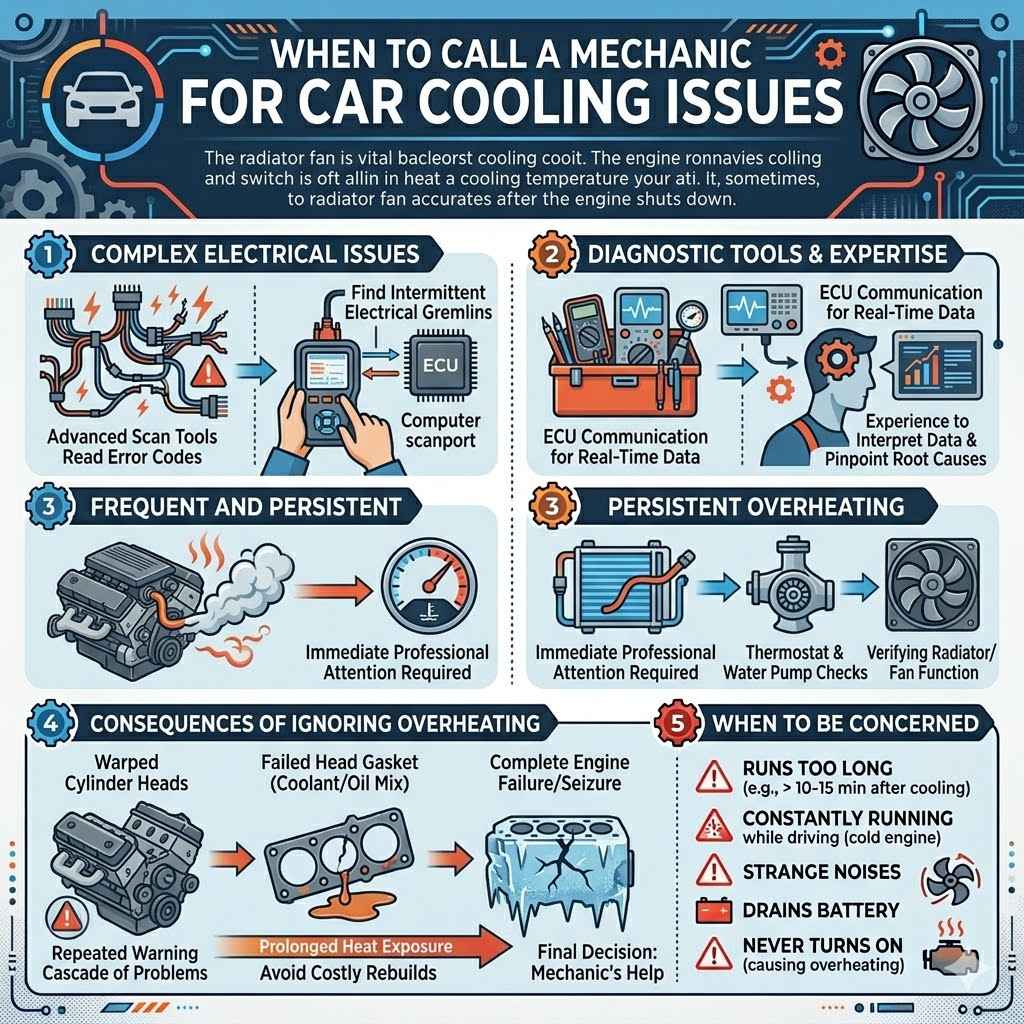
Modern cars rely heavily on sophisticated electrical systems. If the radiator fan issue seems related to wiring, control modules, or sensors that you can’t easily access or test, it’s best to leave it to a professional. Faulty wiring harnesses, damaged control modules, or intermittent electrical gremlins can be very difficult to diagnose without specialized equipment and knowledge.
A mechanic can use advanced scan tools to read error codes from the car’s computer, which can provide valuable clues about electrical problems. They can also perform voltage drop tests and continuity checks on the wiring to identify breaks or shorts. Attempting complex electrical repairs without the proper tools and expertise can lead to further damage or safety hazards.
Diagnostic Tools and Expertise
Mechanics use a variety of specialized tools to diagnose car problems. This includes advanced diagnostic scanners that can communicate with your car’s Engine Control Unit (ECU) and other control modules. They can read real-time data, such as engine temperature, sensor readings, and fan command signals, helping them identify discrepancies.
They also use multimeters, oscilloscopes, and other electrical testing equipment.
Beyond tools, mechanics possess the knowledge and experience to interpret the data they gather. They understand how different systems interact and can distinguish between symptoms and root causes. This expertise is invaluable when dealing with complex issues where a simple visual inspection isn’t enough.
Persistent Overheating
If your car continues to overheat despite your efforts to troubleshoot the fan issue, it’s a serious concern. Persistent overheating can cause significant damage to the engine. This can include warped cylinder heads, blown head gaskets, or even complete engine failure.
In such cases, immediate professional attention is required.
A mechanic will perform a thorough diagnosis of the entire cooling system. This includes pressure testing for leaks, checking the thermostat’s operation, inspecting the water pump, and verifying the functionality of the radiator and fan. They will work to identify the precise cause of the overheating and repair it effectively to prevent further damage.
Consequences of Ignoring Overheating
Ignoring engine overheating can lead to a cascade of problems. Initially, it might just be a warning light or a temperature gauge creeping up. However, prolonged exposure to excessive heat can warp metal engine components.
This warping can create new leaks and disrupt the precise seals required for proper engine operation. For instance, a warped cylinder head can cause the head gasket to fail.
A failed head gasket can allow coolant to leak into the combustion chambers or oil passages, leading to serious internal damage. In extreme cases, the engine can seize, rendering the vehicle inoperable and requiring a very costly rebuild or replacement. Therefore, addressing overheating promptly is critical.
Frequently Asked Questions
Question: Why does my car’s radiator fan keep running after I shut off the engine?
Answer: This is often normal, especially on hot days or after hard driving. Your car’s computer may keep the fan running to cool down residual heat from the engine and prevent overheating. It should shut off on its own after a short period.
Question: Is it bad if the radiator fan runs for a long time after the car is off?
Answer: It can be if it runs for more than 10-15 minutes after the engine has cooled. This might indicate a problem like a faulty temperature sensor or relay. If it makes unusual noises or runs constantly, it needs to be checked.
Question: Can a low coolant level cause the fan to run continuously?
Answer: Yes, indirectly. Low coolant means the engine can’t cool itself efficiently, leading to higher temperatures. This higher temperature will trigger the fan to run more often and for longer periods, even after the engine is shut off.
Question: How can I check if my radiator fan is working correctly?
Answer: You can check the coolant level and condition first. Then, try to locate the fan relay and fuse in your car’s fuse box and inspect them. If you suspect a problem, listen for the fan running when the engine gets hot.
Testing the fan motor directly with a 12V source is also possible but requires caution.
Question: Should I be worried if my car’s radiator fan never turns on?
Answer: Yes, absolutely. If your car’s radiator fan never turns on, even when the engine is hot, it’s a critical issue. This can quickly lead to severe engine overheating and damage.
You should have it inspected by a mechanic immediately.
Summary
When your radiator fan keeps running after the car is off, it’s usually a normal cooling process. This post explained why it happens, covering issues like sensor malfunctions, relay problems, and coolant levels. We also detailed troubleshooting steps and maintenance tips.
If the fan behaves abnormally, addressing it promptly protects your engine. Don’t hesitate to seek professional help if needed.