3 Best Electric Radiator Fans for Cars (2026): We Compared
The best electric radiator fan for cars is the one that fits your radiator, matches your charging system, and meets your cooling load. For most DIY swaps, the right choice is a slim dual-fan setup, a high-output single, or a factory-style direct-fit. Pick wrong and you can overload the alternator, block airflow, or still overheat in traffic. This guide compares three picks by fitment, amperage draw, and real-world use case.
Quick comparison
| Product | Badge | Best for | Price | ||
|---|---|---|---|---|---|
 |
VibeUp 16" Inch Universal Slim Pull Push Racing ElectricVibeUp | Our pick | 16-inch · 2100 RPM · Slim | $47.37
Price as of 23 Oct 2026
|
View |
 |
Standard Motor Products TS295T Radiator Cooling Fan SwitchStandard Motor Products | Also great | $27.11
Price as of 23 Oct 2026
|
View | |
 |
Flex-A-Lite Syclone Black S-Blade Reversible Electric Fan,Flex-a-lite | Upgrade pick | 16-inch · 2500 CFM · S-Blade | $176.20
Price as of 23 Oct 2026
|
View |
 |
Mopar 5137714AA Radiator Fan Motor/AssemblyMopar | Also great | $214.41
Price as of 23 Oct 2026
|
View | |
 |
Dual Electric Fan Relay Kit 40 AMP with Temperature SwitchZOZOMOTORS | Pair with it | 40 AMP · 12V · Dual Fan | $35.99
Price as of 23 Oct 2026
|
View |
The trade-off is plain: larger fans usually move more air, but they also need more space and may ask more of the 12V system. A smaller or slimmer fan can fit where a larger unit cannot, yet it may leave less cooling reserve in stop-and-go traffic or hot climates.
How we chose
The comparison focuses on fitment depth, electrical load risk, thermostat control, and cooling headroom. It also checks whether each option makes sense for a small car, truck, classic car, or performance build.
CFM matters, but it does not tell the whole story. Wiring gauge, relay quality, alternator headroom, shroud space, and hood clearance can decide whether a fan works in the real engine bay.
We also weigh installation flexibility. Puller and pusher layouts, reversible blades, and included mounting hardware help, but they do not fix a bad fit or an undersized charging system.
VibeUp 16-inch fan: best for flexible universal swaps
This 16-inch VibeUp fan suits DIY owners who want a slim universal unit with reversible blades and a mounting kit. The 16-inch size gives it a better chance of supporting larger radiators and warmer use cases than a small fan, while the slim profile helps in tighter bays where depth still matters.
The upside is flexibility. Reversible blades allow puller or pusher use, and the included mount kit cuts down the parts hunt for a basic swap. That matters when you are trying to fit a universal fan around radiator tanks, hoses, and nearby accessories.
The drawback is the same one that follows most universal fans: fit is not guaranteed. A 16-inch fan can still run into hood clearance, pulleys, belts, or shroud limits, so you still need to measure before buying.
Flex-A-Lite Syclone 16-inch fan: best for higher airflow
This is the pick for buyers who care most about airflow and are willing to pay for it. Based on the published specs, it moves 2500 CFM and uses eight curved blades, which puts it in a different class from lower-output budget fans and makes it a better match for larger radiators or hotter-duty use.
It also makes sense as a primary or auxiliary fan when space allows. The reversible design gives you puller or pusher flexibility, and the quieter operation claim points to a more refined motor and blade design than basic universal units.
The drawback is price. At $176.20, it costs far more than basic universal options, and the larger output still means little if your radiator depth, shroud, or wiring cannot support it.
ZOZOMOTORS dual relay kit: best for wiring control
This kit is for the electrical side of the job, not the fan itself. If you are adding dual fans or replacing a weak relay setup, the 40 AMP rating, temperature switch, waterproof relay box, and fused layout make it a practical support piece for a 12V cooling system.
It helps reduce guesswork when you need automatic control. The included color-coded wires and diagram are useful for a first-time install, especially if you want both fans to come on under the same temperature trigger.
The drawback is that a relay kit does not solve a poor fan choice. If the fan is too large for the radiator, or the engine bay is too tight, better wiring will not fix the physical mismatch.
16-inch electric radiator fan: best for larger radiators

A 16-inch fan is the better fit when the radiator opening is large enough and the engine bay has the depth to accept it. One sourced 16-inch kit lists up to 1000 CFM and uses a 16.05-inch diameter, while another 16-inch option is marketed at 3000+ CFM. That spread is why you should compare the whole package, not just the diameter.
The value of a 16-inch fan shows up most in performance builds, trucks, and hot climates. It can move more air across a bigger core, and one listed kit uses a thermostat that turns on at 180°F and off at 165°F, which is a common pattern for traffic and idle control.
But that same size can create installation problems. A 16-inch fan can interfere with shrouds, hoses, pulleys, belts, or hood clearance, and the current draw may outpace weak wiring or a marginal alternator.
Why it fits performance builds and hot climates
Choose a 16-inch fan when the car idles in traffic, sees summer heat, or carries more thermal load than stock. The larger diameter can help move more air across a wider core, which matters when the radiator has room but the engine bay still needs a controlled puller or pusher layout.
Say your classic car has a wide radiator and overheats after ten minutes in stop-and-go traffic. A 16-inch fan with a thermostat switch can bring the temperature down at idle more effectively than a small slim fan, as long as the mounting depth and wiring are both in range.
When to avoid a 16-inch fan
Avoid this size if the core support is shallow, the fan sits close to belts, or the hood brace cuts into available depth. It is also a poor choice when the alternator and wiring are already near their limit, because a larger fan can add load without a usable gain in real cooling.
12-inch slim radiator fan: best for tight engine bays
A 12-inch slim fan is the safer choice when space is the main problem. The BLACKHORSE-RACING slim fan is 12 inches, is described as a pull-type radiator fan, lists up to 800 CFM, and draws up to 7.5 amps. That makes it easier to package in smaller bays where depth matters more than peak airflow.
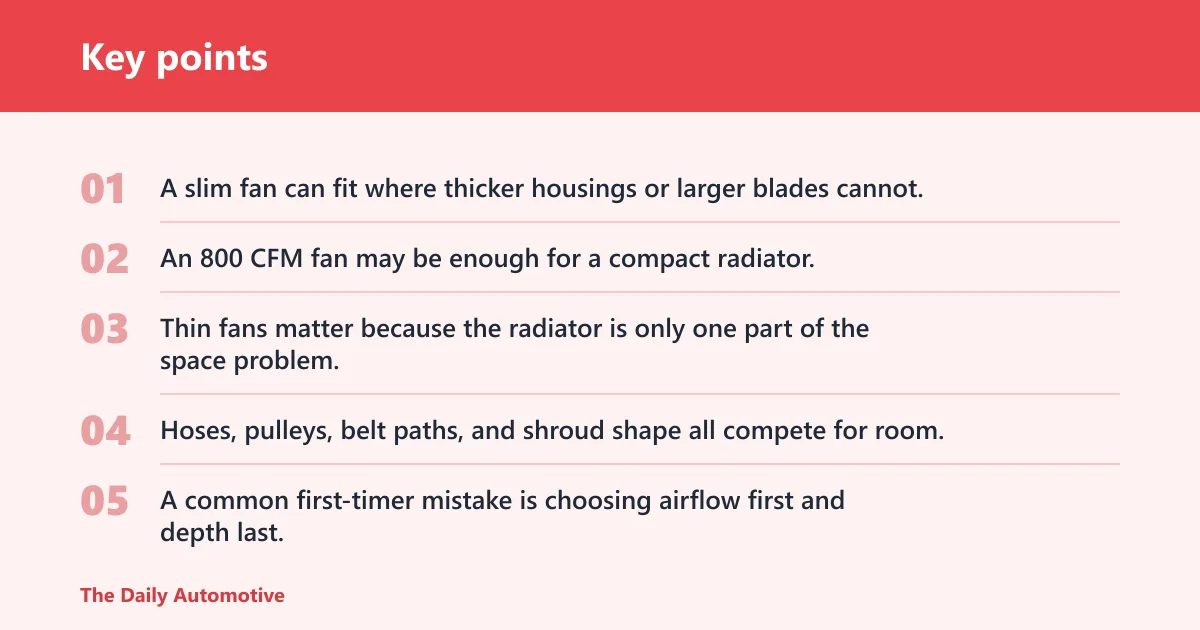
Its biggest advantage is physical clearance. A slim fan can fit where thicker housings or larger blades cannot, especially on smaller radiators or in older cars with cramped accessory layouts.
The drawback is obvious: less airflow. An 800 CFM fan may be enough for a compact radiator, but it will not match the cooling reserve of a larger unit on a big core or a heat-heavy setup.
Why slim profile matters
Thin fans matter because the radiator is only one part of the space problem. Hoses, pulleys, belt paths, and shroud shape all compete for room, and a slimmer housing can be the difference between a clean install and a fan that rubs or sits too close to moving parts.
A common first-timer mistake is choosing airflow first and depth last. Picture a small car with a short radiator support: a thick 16-inch unit may seem stronger on paper, but a 12-inch slim fan can be the one that actually fits and runs safely.
When to avoid a 12-inch fan
Avoid a 12-inch fan if the radiator is large, the car sees long idle periods, or the cooling system already struggles in summer traffic. It is also the wrong choice if you need a puller setup across a bigger core and cannot afford to give up cooling headroom.
Thermostat kit: best for automatic control
A thermostat kit is worth it when you want the fan to turn on and off by temperature instead of by a manual switch. Common behavior is 180°F turn-on and 165°F turn-off, which helps avoid unnecessary cycling and gives the fan a clear job during idle, traffic, and after a hot shutdown.
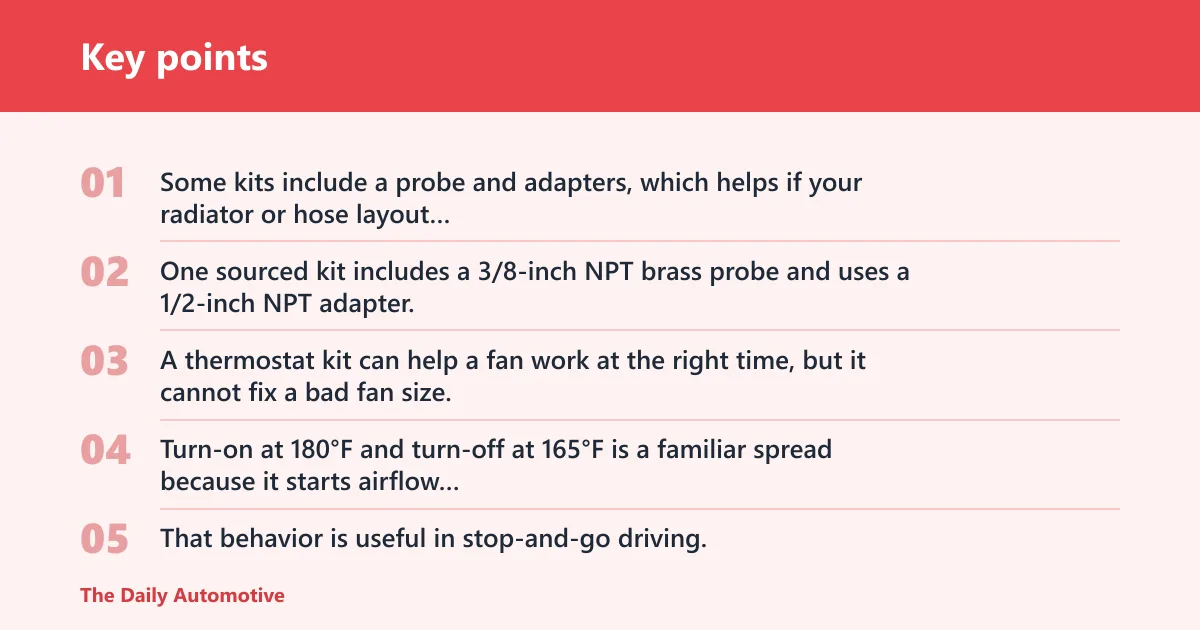
Some kits include a probe and adapters, which helps if your radiator or hose layout needs a specific mounting point. One sourced kit includes a 3/8-inch NPT brass probe and uses a 1/2-inch NPT adapter, which shows how much the details matter when you are matching parts to the cooling system.
The drawback is control, not complexity. A thermostat kit can help a fan work at the right time, but it cannot fix a bad fan size, weak wiring, or poor airflow path.
Common turn-on and turn-off points
Turn-on at 180°F and turn-off at 165°F is a familiar spread because it starts airflow before heat soars and then lets the system settle before the fan cycles again. That behavior is useful in stop-and-go driving, where repeated short bursts are often better than waiting for the gauge to climb first.
For highway use, the fan may cycle less often because ram air is doing more of the work. In hot-weather idle conditions, though, the thermostat becomes more important because the car loses that natural airflow and depends on the fan and relay path to stay stable.
When to avoid a thermostat kit
Avoid a thermostat kit if you already have factory control that is working correctly, or if your fan is meant to run on a simple manual circuit for a special build. It is also a poor fix for overheating caused by a clogged radiator, a weak water pump, or a fan that simply does not fit well.
Radiator fan decision matrix
This plain-text matrix scores each pick on the issues that actually decide a swap: fitment depth, electrical load risk, thermostat quality, and cooling headroom. Higher scores mean a better result for that category, not a universal win.
| Pick | Fitment depth | Electrical load risk | Thermostat quality | Cooling headroom | When to avoid it |
|---|---|---|---|---|---|
| VibeUp 16-inch fan | 3/5 | 3/5 | 2/5 | 4/5 | Skip it if the bay is shallow or the radiator opening is tight. |
| Flex-A-Lite Syclone 16-inch fan | 3/5 | 3/5 | 2/5 | 5/5 | Skip it if budget, wiring margin, or clearance is limited. |
| ZOZOMOTORS dual relay kit | 5/5 | 4/5 | 4/5 | 1/5 | Skip it if you need a fan, not a control kit. |
Choose VibeUp if… / Choose Flex-A-Lite if…
Choose the VibeUp 16-inch fan if you want a lower-cost universal fan with reversible blades, a mounting kit, and a slim body that may suit a sedan, truck, or RV swap. It is the better fit when you need a broad-use option and can confirm the diameter and depth before ordering.
Choose the Flex-A-Lite Syclone if your priority is airflow and you are willing to spend more for it. It makes the most sense for larger radiators, performance builds, and hot-weather use where a 2500 CFM rating is more useful than a bargain price.
Choose the ZOZOMOTORS relay kit if your current wiring is weak, your dual fans need a proper trigger, or you are building a fresh 12V control path. It is the sensible add-on when the electrical side needs to be as clean as the fan choice.
Which one should you buy?
Pick the 16-inch fan if your radiator is large enough, your bay has clearance, and you want more cooling reserve for traffic or hot climates. If the build is performance-focused, that is usually the safest place to start.
Pick the 12-inch slim fan if the engine bay is tight, the radiator is smaller, or belts and hoses leave little room for depth. That choice is about fit first and airflow second.
Pick the thermostat kit if you want automatic control and a cleaner on-off pattern. It is especially useful when you want the fan to react to temperature instead of a switch in the cabin.
If you are uncertain, measure the radiator core, check the shroud depth, and confirm wiring capacity before buying anything. A universal fan is only as universal as the space around it.
Frequently asked questions
What is the best electric radiator fan for my car?
The best fan is the one that fits your radiator, leaves clearance for belts and hoses, and stays within your 12V electrical limits. A larger fan can help more, but only if the bay has room and the wiring can support the current draw without stress.
Should I choose a 12-inch or 16-inch electric radiator fan?
Choose 16 inches for larger radiators, hotter use, and more cooling reserve. Choose 12 inches when the bay is tight or the radiator is smaller. The better fan is the one that fits without forcing the shroud, hood, or accessory layout out of place.
Do I need a thermostat kit with an electric radiator fan?
You do not always need one, but it is a strong choice for most DIY swaps. A thermostat kit automates on-off control, often around 180°F on and 165°F off, which helps the fan run when needed and stay off when airflow is already enough.
Should I use a puller or pusher electric radiator fan?
A puller fan draws air through the radiator and is favored for many installs. A pusher fan pushes air through the radiator from the front side. Use the layout your bay can support, and make sure the blades, shroud, and mounting points match that direction.
Will a universal electric radiator fan fit my vehicle?
Not automatically. Universal fans often need custom brackets, adaptation, or a different shroud arrangement, and they can still clash with pulleys, belts, hoses, or hood clearance. Measure the radiator core and available depth before you order.
How much current does an electric radiator fan draw?
It depends on the fan size and motor design. One 12-inch slim fan in the sourced specs draws up to 7.5 amps, while higher-output fans can demand much more. That is why wiring, relay quality, and alternator headroom matter as much as airflow.
Products related to this article
Sponsored / affiliate links. As an Amazon Associate I earn from qualifying purchases. I may earn additional commission from eligible campaigns.