Rental Reimbursement vs Loaner Car Coverage
Rental reimbursement pays for a rental after a covered claim. Loaner car access depends on a dealer or repair shop. For most drivers, rental reimbursement is the better protection for your budget. Skip the comparison and you can end up paying daily transportation costs, or sitting through a repair delay with no backup. Here’s how each option works, what it costs, and when it matters most.
| Factor | Rental Reimbursement | Loaner Car Coverage | Winner |
|---|---|---|---|
| Who pays | Your auto insurer pays up to the policy limit for a rental car tied to a covered claim. | The dealer, repair shop, or manufacturer usually provides the car as a service benefit, not as an insurance payment. | Rental Reimbursement |
| Availability | Often available as an optional add-on through major insurers, with rules that vary by company and state. | Depends on shop policy, inventory, and the kind of repair appointment you have. | Rental Reimbursement |
| Predictability | Policy terms set the daily cap, total cap, and claim trigger. | Availability and duration can change if the shop runs out of loaners or needs the vehicle back. | Rental Reimbursement |
| Budget control | Usually the stronger choice when you want a clear reimbursement path for repair-time transportation. | Can be cheap or free if offered, but it is not guaranteed and may not match your needs. | Rental Reimbursement |
| Best fit | Drivers who need dependable transportation after a covered loss. | Drivers who already know their dealer or shop will provide a usable loaner. | Rental Reimbursement |
How rental reimbursement coverage works and what it pays
Rental reimbursement coverage pays for a rental car while your vehicle is being repaired after a covered claim. It is usually an optional add-on to an auto policy, and major insurers commonly offer it. Enterprise describes it as low-cost and notes that you can add it at any time, not only at renewal.
What the coverage pays
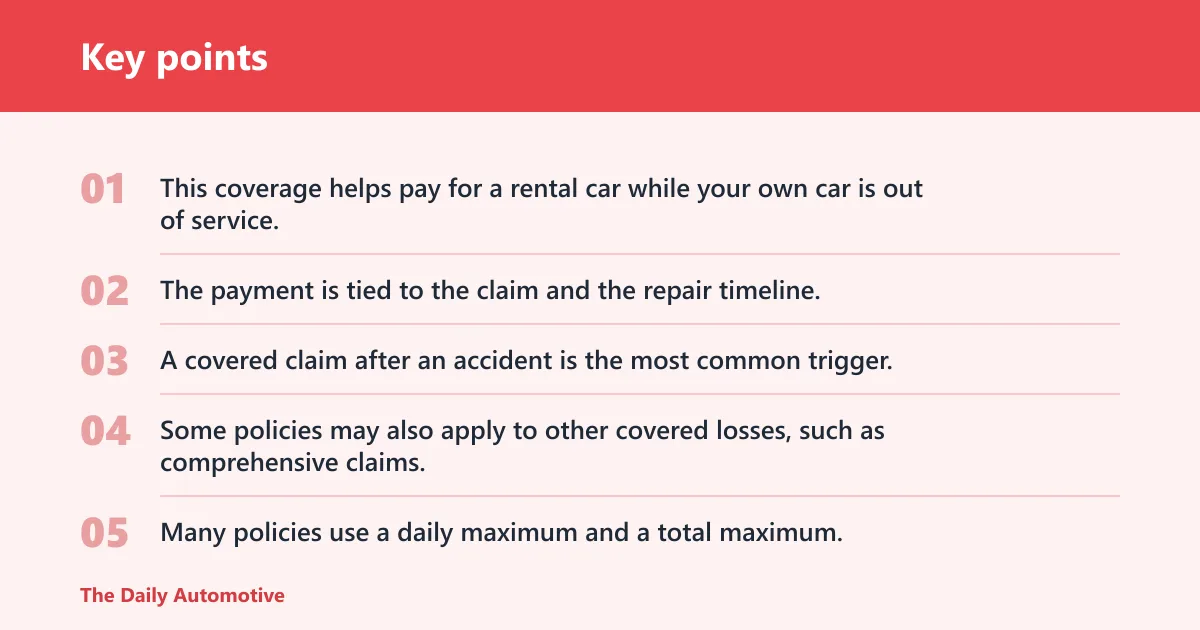
This coverage helps pay for a rental car while your own car is out of service. The payment is tied to the claim and the repair timeline, so a longer repair can raise the bill, but only up to the policy’s limits.
When a claim can trigger payment
A covered claim after an accident is the most common trigger, but the policy language controls the details. Some policies may also apply to other covered losses, such as comprehensive claims, while noncovered mechanical breakdowns are usually outside the benefit.
How daily and total limits work
Many policies use a daily maximum and a total maximum. If the rental costs more than the daily cap, or if repairs take longer than the total cap allows, you pay the difference.
How does a loaner car differ?
A loaner car usually comes from a repair shop, dealer, or manufacturer program rather than from your auto policy. It is generally a service benefit rather than insurance coverage, so availability, duration, and vehicle type depend on the provider’s own rules and inventory.
Who provides the vehicle
With a loaner, the shop or dealer controls the handoff. That can make the process easy, but it also depends on whether they have a car available when your repair begins.
Why a loaner is not insurance coverage
Loaner access does not create a reimbursement right under your policy. If the provider has no car, or if its rules do not fit your repair timeline, there may be no backup at all.
Who insures the vehicle during use
That part depends on the provider’s program and the rental agreement. You need to ask who carries insurance on the loaner, what your own policy covers, and whether any deductible or damage responsibility applies before you drive away.
Rental reimbursement comparison table
| Scenario | Rental Reimbursement | Loaner Car Coverage | Who provides the vehicle | Who pays | When coverage applies | Common exclusions | Most likely out-of-pocket cost | Winner |
|---|---|---|---|---|---|---|---|---|
| Accident repair | Usually the cleaner match if the claim is approved and repairs start. | May exist if the shop offers one, but it is not guaranteed. | Rental agency or insurer-arranged rental | Your insurer, up to policy limits | After an approved covered claim | Claim denial, policy limits, repair delays beyond the cap | Any amount above the daily or total limit | Rental Reimbursement |
| Warranty repair | Often unavailable unless the policy also covers that loss. | Common at some dealers for covered warranty work. | Dealer or manufacturer | Dealer or manufacturer program | While warranty work is being completed | No loaner stock, limited tiers of service, short duration | Possible fuel, mileage, or upgrade charges | Loaner Car Coverage |
| Dealership repair | Can apply only if the repair also opens a covered claim under your policy. | More likely if the dealer includes a courtesy vehicle. | Dealer | Dealer or you, depending on program terms | During dealer service, if offered | No vehicle available, short loaner window, eligibility rules | Fuel or added-day charges if the return date slips | Loaner Car Coverage |
| Body shop repair | Often useful when the shop repair follows a covered claim. | Less common unless the shop has a courtesy fleet. | Rental agency or shop loaner | Insurer or you, depending on the arrangement | When a covered repair is underway | Noncovered damage, delayed parts, unrelated mechanical work | The part of the bill above the policy limit | Rental Reimbursement |
| Insurer-approved claim | Built for this case if the policy includes the option. | Not tied to the claim itself. | Rental agency | Your insurer up to the limit | When the claim is accepted and repair time starts | Denied claims, noncovered repairs, excess rental days | Extra days and upgraded classes | Rental Reimbursement |
| Daily commute need | Strong if you need predictable transport every workday. | Can work if the loaner is immediate and reliable. | Either a rental agency or a dealer | Insurer or provider, depending on the path | When you need a vehicle during repairs | Last-minute shortages, pickup timing, vehicle class mismatch | Gas, insurance, or rental days beyond the limit | Rental Reimbursement |
| Family car replacement | Usually better because you can choose a vehicle that fits the family’s routine. | May not fit a car seat, cargo need, or schedule. | Rental agency or provider loaner | Your insurer or the provider | While the car is being repaired | Small loaner, short duration, no child-seat setup | Upgrade charges or extra rental days | Rental Reimbursement |
| Limited-policy-day cases | Works, but only for the days or dollars the policy allows. | Sometimes better if the provider offers a longer courtesy period. | Rental agency or loaner fleet | Insurer until the cap ends | Until the policy’s day limit or dollar limit is reached | Long repairs, parts delays, claim disputes | The full cost after the cap ends | Loaner Car Coverage |
Accident repair
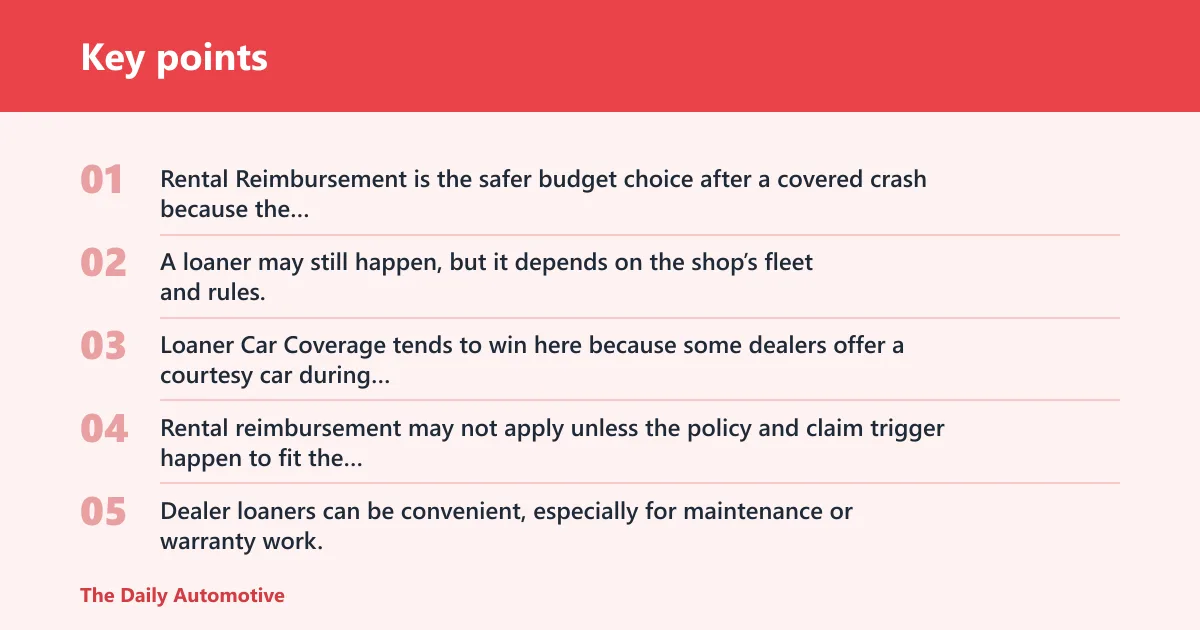
Rental Reimbursement is the safer budget choice after a covered crash because the insurer pays under policy terms. A loaner may still happen, but it depends on the shop’s fleet and rules, so it cannot be counted on the same way.
Warranty repair
Loaner Car Coverage tends to win here because some dealers offer a courtesy car during warranty work. Rental reimbursement may not apply unless the policy and claim trigger happen to fit the repair, which is uncommon for a plain warranty visit.
Dealership repair
Dealer loaners can be convenient, especially for maintenance or warranty work, but they are a courtesy, not a policy promise. If the dealer has no loaner available, you need another plan.
Body shop repair
Rental Reimbursement is usually the more dependable choice when a body shop is handling a covered claim. The policy can pay while repairs move forward, though the benefit still stops at the day or dollar cap in your contract.
Insurer-approved claim
When the insurer approves the claim, rental reimbursement does what drivers expect: it pays for temporary transportation while the repair is underway. That is the clearest case for buying the add-on.
Daily commute need
Drivers who need to get to work every day are often better protected by rental reimbursement. A loaner might help, but only if the provider has one on hand and keeps it available for the whole repair window.
Family car replacement
Families often need a vehicle that fits school runs, groceries, and child seats. A rental gives more flexibility than a loaner that might be smaller, older, or limited to a short courtesy period.
Limited-policy-day cases
If your policy has a short day cap, loaner access can sometimes stretch farther than reimbursement. The tradeoff is uncertainty: a loaner is only useful if the provider actually has one when you need it.
Does rental reimbursement cover the full bill?
No. Rental reimbursement usually covers only part of the bill, because the policy sets a daily cap and a total cap. If the repair runs long, or if the rental rate is above the limit, the remaining balance becomes your cost.
What happens when repairs run long
Long repairs are where the math matters most. Parts delays, adjuster timing, or body shop backlogs can stretch the rental period beyond what the policy pays, even when the claim itself is approved.
Common out-of-pocket gaps
The most common gaps are a higher daily rental rate, extra days beyond the cap, fuel, fees, and any upgrade beyond the covered class. If your insurer allows only a modest amount per day, a midsize rental at a busy counter can still leave you paying the difference.
Is rental reimbursement worth it?
It is often worth it if you cannot easily borrow a second car. Commuters, parents, and leased drivers usually need predictable transportation, and rental reimbursement is more dependable than hoping a dealer or body shop has a loaner on the right day.
If you can borrow a second car
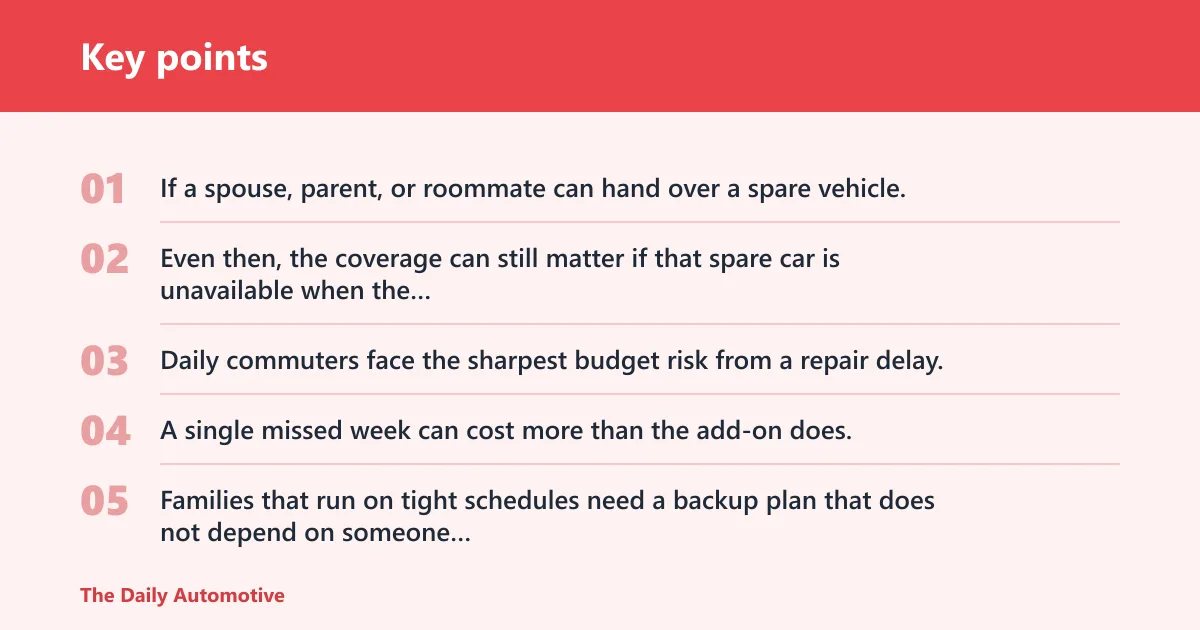
If a spouse, parent, or roommate can hand over a spare vehicle, the add-on may feel less urgent. Even then, the coverage can still matter if that spare car is unavailable when the repair starts.
If you commute every day
Daily commuters face the sharpest budget risk from a repair delay. A single missed week can cost more than the add-on does, especially when your policy can pay only part of the rental bill.
If your household cannot share one car
Families that run on tight schedules need a backup plan that does not depend on someone else’s calendar. Rental reimbursement is usually the more flexible option because it lets you rent the class of vehicle you actually need, within policy limits.
Can you add rental reimbursement mid-policy?
Sometimes yes, but not always under every insurer and state rule. The same source says the coverage can be added at any time, but you should still confirm whether your insurer allows a mid-term change, how soon it takes effect, and whether any claim timing rules apply.
What to confirm before you change coverage
Ask about the daily limit, the total limit, and whether the benefit applies only after a covered claim is approved. Also ask whether the policy pays for the rental immediately or only once repairs begin.
How to ask your insurer
- Ask if rental reimbursement is available on your policy.
- Confirm the daily cap and total cap.
- Ask which claims trigger payment.
- Check whether you can add the coverage mid-term.
- Ask how claim approval and repair start dates affect reimbursement.
Verdict: Rental reimbursement or loaner car Coverage?
Choose Rental Reimbursement if you need dependable transportation after an approved accident repair or other covered claim, especially for a daily commute or family car replacement when you want a clear reimbursement path and can avoid sitting through repair delays with no backup.
Choose Loaner Car Coverage if you already know your dealer or repair shop will provide a usable loaner during warranty work or dealership repair, and you want the courtesy car that the dealer or manufacturer may offer for that specific service visit.
Frequently asked questions
What is rental reimbursement in car insurance?
Rental reimbursement is optional auto coverage that can pay for a rental car while your covered vehicle is being repaired. It usually sits as an add-on to your policy, and the insurer only pays within the limits and claim rules written into the contract.
What is the difference between rental reimbursement and a loaner car?
Rental reimbursement is an insurance benefit that pays under policy terms. A loaner car comes from a dealer, shop, or manufacturer program, so it depends on their inventory and rules, not on your auto policy.
Does rental reimbursement cover a rental car after an accident?
When a covered claim is approved and repairs are underway, rental reimbursement typically pays only up to the policy’s daily and total limits. The insurer pays only up to the policy’s daily and total limits, so a long repair can still leave you with part of the bill.
How does loaner car coverage work if my car is in the shop?
It usually works as a courtesy arrangement from the shop or dealer. If a loaner is available, you may get one for the repair period, but the provider decides the duration, vehicle type, and any conditions tied to the handoff.
Is rental reimbursement worth it if I can borrow a car?
It can still be worth it if the borrowed car is not always available or if your household depends on strict timing. The add-on is most useful when you need a predictable backup for commuting, children, or work travel.
Can I add rental reimbursement coverage at any time?
Often yes, but you should confirm with your insurer because mid-policy changes can vary by company and state. Before you add it, verify the effective date, claim rules, and the daily and total limits on the policy.
Products related to this article
Sponsored / affiliate links. As an Amazon Associate I earn from qualifying purchases. I may earn additional commission from eligible campaigns.
 Half Car Cover SUV,Top Cover with Red Reflective Strip, Hail Protector Car Cover with Cotton Liner, Sunroof & Windshield Cover for Ice and Snow, All Weather Car Body Cover for Sun, Rain, Dust
 Half Car Cover Top with Red Reflective Strip, Snow Car Cover with Cotton Liner, Sunroof & Windshield Cover for Ice and Snow, All Weather Car Body Cover Fit for Compact Sedan