Gap Insurance vs Collision Coverage: What Matters Most
Collision coverage pays to fix or replace your car after a crash; gap insurance pays the loan or lease balance if the car is totaled and worth less than what you owe. Skip either one badly, and you can end up paying for repairs out of pocket or still making loan payments on a car that no longer exists. This guide shows when to carry collision, gap, both, or neither on financed, leased, and paid-off vehicles.
This guide is part of our Car insurance coverage guide series.
Gap insurance vs collision coverage: the core trade-off
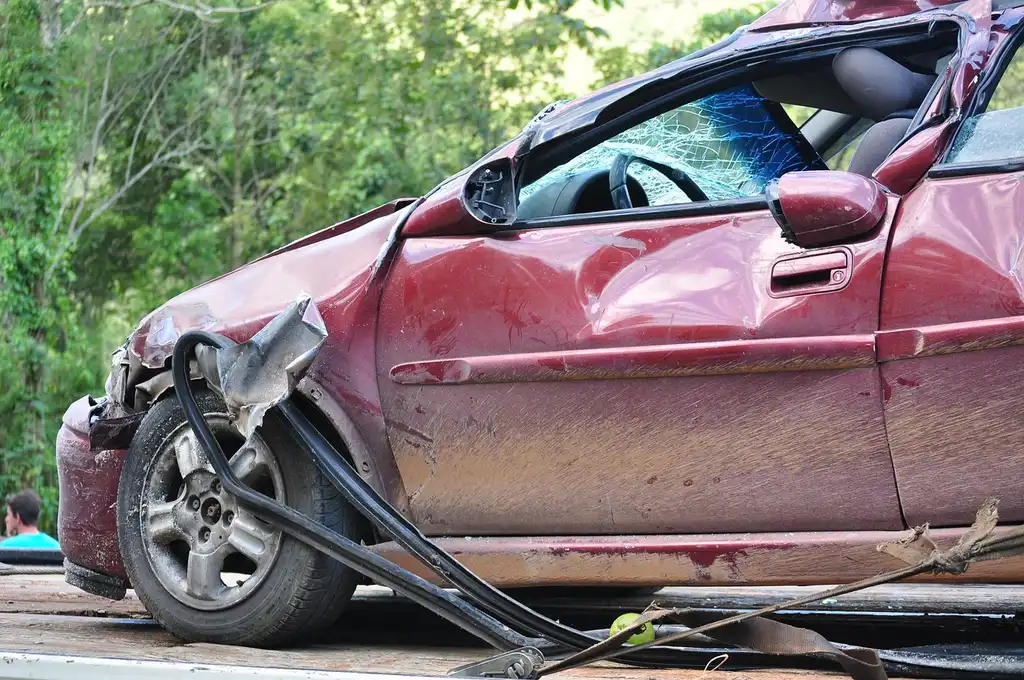
These coverages solve different problems. Collision coverage is repair protection for the car itself, while gap insurance is debt protection for the unpaid balance behind it. If the car is damaged but repairable, collision matters. If the car is totaled or stolen and the loan balance is higher than the car’s value, gap is the one that can stop the lender bill from landing on the driver.
| Decision factor | Gap Insurance | Collision Coverage | Winner |
|---|---|---|---|
| What it pays for | Loan or lease balance above actual cash value after a total loss | Damage to your vehicle after a crash | Collision Coverage |
| Trigger event | Total loss or theft | Crash damage, including hitting another vehicle or an object | Collision Coverage |
| Use on paid-off cars | Usually little value once no loan remains | Still useful if you want repair protection | Collision Coverage |
| Debt protection | Direct protection against a loan or lease shortfall | Does not pay off the loan balance | Gap Insurance |
| Cost logic | Usually cheaper than collision, but only useful when upside-down risk exists | Cost is driven by the car’s value and deductible choice | Depends |
What collision coverage pays for
Collision coverage helps pay for your vehicle’s damage after a crash. It can apply when you hit another vehicle or an object, and it is often mandatory for financed or leased cars. It does not pay health bills, and it does not cover hail or theft.
What gap insurance pays for
Gap insurance pays the difference between what standard auto insurance covers and the amount you owe. If a vehicle is worth $16,000 and the loan balance is $20,000, the gap is $4,000. That is debt protection, not repair coverage. (caranddriver.com)
Why they are not interchangeable
Collision coverage works on the car. Gap works on the balance sheet. A driver can have collision and still owe money after a total loss, because the insurer’s payout is tied to the vehicle’s actual cash value, not the full loan balance.
According to What Is GAP Insurance on a Car? — If a vehicle is worth $16,000 and the loan balance is $20,000, the gap is $4,000. (source)
How collision coverage works after a crash
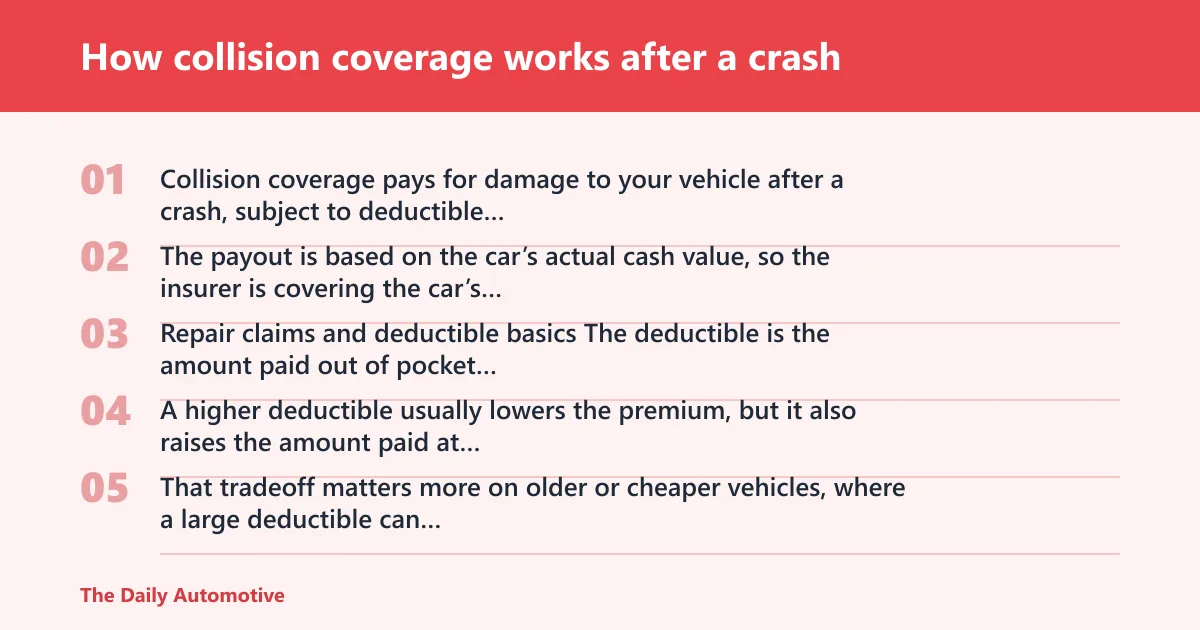
Collision coverage pays for damage to your vehicle after a crash, subject to deductible and policy limits. The payout is based on the car’s actual cash value, so the insurer is covering the car’s depreciated market value, not the original purchase price or the amount still owed.
Repair claims and deductible basics
The deductible is the amount paid out of pocket before collision coverage applies. A higher deductible usually lowers the premium, but it also raises the amount paid at claim time. That tradeoff matters more on older or cheaper vehicles, where a large deductible can eat into the value of the claim.
How actual cash value affects payout
Actual cash value, or ACV, is the vehicle’s depreciated market value. Standard auto policies use ACV for total-loss settlement, and gap calculations start there too. If the car has dropped in value quickly, the insurer’s check can be noticeably smaller than the remaining loan balance.
Why collision can still leave you owing money
Collision coverage does not make the loan disappear. If the car is totaled and the ACV payout is lower than the loan balance, the lender still expects the remaining balance to be paid. That is the common failure case for borrowers who carry collision alone.
How gap insurance works after a total loss
Gap insurance activates when a vehicle is totaled or stolen and the ACV payout falls short of the loan or lease balance. It does not cover repairs, and it does not help with routine crash damage. Its job is to close the gap between what the vehicle is worth and what you still owe.
When gap coverage activates
A total loss is the trigger event for gap insurance, though exact handling can vary by state and insurer. If the loss is not total, gap usually does nothing. That makes it a backup for severe losses, not a day-to-day repair policy.
Loan balance, lease balance, and ACV
Loan balance is the remaining amount owed on financing and can exceed ACV early in the term. That risk is sharper with leases, since some lease agreements require gap coverage. Buyers should read the contract language before signing, because the lease may spell out the required coverage stack.
What gap does not cover
Gap insurance does not pay for repairs. It also does not replace collision coverage. If the car is drivable after a crash, gap does nothing on its own. If the car is gone but there is no loan or lease balance left, gap has no role.
Do you need gap insurance if you already have collision coverage?
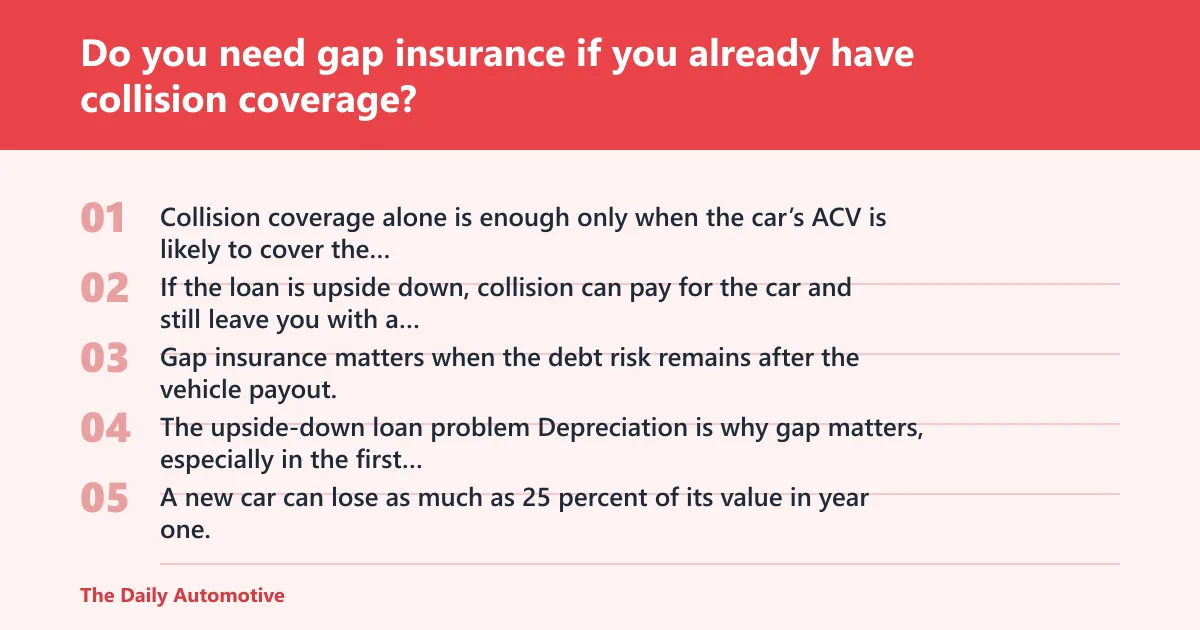
Collision coverage alone is enough only when the car’s ACV is likely to cover the balance you still owe after a total loss. If the loan is upside down, collision can pay for the car and still leave you with a lender bill. Gap insurance matters when the debt risk remains after the vehicle payout.
The upside-down loan problem
Depreciation is why gap matters, especially in the first year of ownership. A new car can lose as much as 25 percent of its value in year one. That drop can leave a borrower owing more than the car is worth, even when payments are made on time.
When collision alone is enough
Collision alone is usually enough when the borrower has built equity or made a large down payment. Used-car buyers with positive equity are often in this camp. In that case, the ACV payout may be enough to wipe out the loan, making gap coverage less useful.
When collision plus gap is the safer stack
If the loan balance can exceed the car’s value, the safer stack is collision plus gap. That is especially true on new cars, low-down-payment loans, and leases that require gap. Collision handles repair risk; gap handles the leftover debt if the vehicle is totaled.
When is gap insurance worth it on a financed or leased car?
Gap insurance is worth it when depreciation can outpace loan paydown. It is often most useful on new cars, long loan terms, and leases that call for it in the contract. The question is not whether the policy is cheap; it is whether the likely shortfall would be painful if the car were totaled.
New-car depreciation and low down payments
New vehicles lose value quickly, and a small down payment leaves less equity buffer. That is where gap tends to pay for itself. A borrower who rolls taxes, fees, or negative equity into the loan is even more exposed if the car is totaled early.
Lease terms that often call for gap
Some leases may require gap coverage, so it is worth checking the lease before signing. The vehicle belongs to the lessor until the contract ends, so a total loss can create a balance problem that standard insurance may not fully solve. Do not guess here; read the contract.
Long loan terms and slow equity building
Long loan terms slow the point at which the borrower reaches equity. That means the balance can stay above ACV for longer. Drivers with extended financing should treat gap as a debt-shield, not a luxury add-on.
Choose gap insurance if… / choose collision coverage if…
Choose gap insurance if your car loan or lease can exceed the car’s value after a total loss. Choose collision coverage if you need repair protection after a crash. Choose both when you are protecting the vehicle and the debt at the same time.
Choose gap insurance if your loan or lease can exceed the car’s value
- You made a low down payment on a new car.
- Your lease contract requires it.
- You rolled negative equity into the current loan.
- You have a long loan term and slow equity buildup.
Choose collision coverage if you need repair protection after a crash
- You still want help paying for damage to your own car.
- Your vehicle is financed or leased and the lender requires it.
- You would struggle to pay a repair bill out of pocket.
- The vehicle still has enough value that repair coverage matters more than debt protection.
Choose both if you are protecting the car and the debt
- The car is new and depreciating fast.
- The loan balance is still higher than ACV.
- The lease contract calls for gap.
- You want repair coverage plus shortfall protection after a total loss.
Decision matrix: five buyer scenarios and the right coverage stack
This matrix is built around the real choice point: are you protecting the vehicle, the loan, or both? The deductible note matters because collision pricing and out-of-pocket cost move together. Gap coverage is cheap in many cases, but it only matters when there is a balance risk to insure.
| Buyer scenario | Recommended coverage stack | Deductible logic | Leftover-risk outcome |
|---|---|---|---|
| New financed car | Collision + gap | Pick a deductible you can actually pay on short notice | Repair risk plus loan shortfall are both covered |
| Leased car | Collision + gap if the lease requires it | Follow lease rules first, then compare deductible to monthly budget | Lower risk of owing money after a total loss |
| Paid-off car | Collision if repair protection matters; no gap | Choose a deductible based on the car’s current value | No loan deficit exists, so gap adds little value |
| Low-down-payment loan | Collision + gap | Do not chase a very high deductible just to lower premium | Still exposed if ACV falls below what is owed, but gap closes the shortfall |
| Used car with equity | Collision only, or neither if self-insuring makes sense | Set deductible against the car’s market value and repair tolerance | Loan shortfall risk is low because equity already exists |
auto insurance comprehensive vs collision coverage
Comprehensive and collision are different physical-damage coverages. Collision handles crash damage. Comprehensive often covers non-crash losses such as theft or hail, and collision coverage does not cover those kinds of losses. Gap insurance can still matter after a total loss from either type of event if the loan balance is higher than ACV.
collision coverage vs gap insurance
Collision coverage pays for the car’s damage after a crash. Gap insurance pays the leftover balance if the car is totaled and the insurer’s payout is lower than what you owe. One protects the vehicle; the other protects the debt tied to it.
gap insurance vs comprehensive
Gap insurance is not a substitute for comprehensive coverage, and comprehensive is not a substitute for gap. Comprehensive covers non-collision losses to the car, while gap addresses the loan or lease shortfall after a total loss. If the car is stolen and the loan is upside down, the two can work together, but they solve different problems.
Frequently asked questions
What is the difference between gap insurance and collision coverage?
Collision coverage pays for damage to your car after a crash. Gap insurance pays the difference between what standard auto insurance covers and what you still owe on the loan or lease if the car is totaled or stolen. One repairs the car; the other closes the debt gap.
Does gap insurance cover collision damage?
No. Gap insurance does not pay for repairs or crash damage. It only applies after a total loss or theft when the insurance payout is lower than the remaining loan or lease balance. For collision damage, the policy that matters is collision coverage.
Does collision coverage pay off a car loan?
No. Collision coverage can help pay to repair or replace the vehicle after a crash, but it does not pay off the loan balance. If the car is totaled and the ACV payout is less than what you owe, the remaining balance is still your responsibility unless gap coverage applies.
Do I need gap insurance if I already have full coverage?
Maybe. “Full coverage” often means collision and comprehensive, but it does not remove loan balance risk. If you owe more than the car is worth, gap can still matter. If the car has equity, or the loan is close to paid down, gap may be unnecessary.
When is gap insurance worth it on a financed or leased car?
Gap insurance can be worth considering when depreciation may outpace loan paydown, especially on a newer car, a low-down-payment loan, or a lease that calls for it. It becomes more valuable when the car’s actual cash value can fall below the balance you still owe.
Can you have collision coverage without gap insurance?
Yes. Many drivers carry collision without gap, especially on paid-off vehicles or loans with equity. The risk is that collision only pays the car’s value after a total loss, so if the loan balance is higher than that value, a shortfall can remain.
Products related to this article
Sponsored / affiliate links. As an Amazon Associate I earn from qualifying purchases. I may earn additional commission from eligible campaigns.