What Is APR for a Car? Loan Rate Explained Clearly
APR for a car loan is the annual cost of borrowing, including the interest rate plus most lender fees. Compare APR, not just the note rate, if you want the truest loan cost. Skip that step, and you can pick the wrong offer and pay more in interest and fees over the life of the loan. This guide explains APR, how it differs from the interest rate, what changes it, and how to compare offers.
What does APR mean on a car loan?
APR means Annual Percentage Rate. On an auto loan, it is the yearly cost of borrowing shown as a percentage, and it can include interest plus certain fees. Because a car loan is closed-end credit with fixed monthly payments, APR gives you a standard way to compare offers.
In the United States, APR disclosure is governed by the Truth in Lending Act, and the CFPB implements calculation and disclosure through Regulation Z. That matters because lenders must show the cost in a comparable form, not just a monthly payment that hides fees. (en.wikipedia.org)
For car shopping, APR matters because it ties the advertised rate to the real borrowing cost. A lender may advertise one number on a page and disclose a different number on the finance contract once fees are included.
APR vs. interest rate: what is the difference?
The interest rate is the base cost of borrowing before added fees. APR is broader: it is the annualized borrowing cost and may include certain lender fees that are part of the finance charge. The two numbers can be close, or they can differ by a noticeable amount.
Think of the interest rate as the price of the money itself. APR is the price of the money plus some of the costs tied to getting the loan. That is why APR is usually the better number when you want to compare one auto loan offer with another.
A dealer finance worksheet may show a note rate, while the contract’s APR is higher because of fees or a markup. If you compare only the note rate, you can miss the real cost stack.
What determines APR on a car loan?
APR on a car loan is shaped by risk and loan structure. Lenders look at credit score, loan term, down payment, loan-to-value ratio, the vehicle’s age, whether the car is new or used, and the lender type. Dealer markup can also push the rate above the lender’s base offer.
A stronger credit tier usually points to a lower APR because the borrower looks less risky. A larger down payment can reduce the amount financed and improve the lender’s view of the loan. Shorter terms often carry lower total interest, while longer terms usually increase total cost even if the payment looks easier.
New vehicles often qualify for better pricing than used vehicles because the collateral is easier for lenders to underwrite. Dealer-arranged financing can also include a reserve or markup, which means the rate you sign may be higher than the lender’s wholesale approval.
What determines apr on car loan
Several pricing inputs set the APR you see on a car loan. Credit score matters first, but lenders also weigh term length, down payment, vehicle age, and whether the deal is for a new or used car. The lender’s own pricing model and the dealership’s participation can change the final number.
Say your credit is strong but you choose a 72-month term on an older used sedan with little cash down. Even if the base rate starts low, the lender may price in more risk, and the longer payoff period can make the total interest much larger.
How do lenders calculate APR on an auto loan?
Lenders calculate APR by taking the interest rate and then folding in certain finance charges so the result reflects the yearly cost of credit. The exact method depends on jurisdiction and loan type, but the goal is the same: turn the full borrowing cost into one annual percentage.
That is why APR can be higher than the note rate. If the lender charges an origination fee or another qualifying prepaid finance charge, the cost of that fee gets spread over the loan, which raises the effective annual rate.
WalletHub describes APR as the estimated yearly cost of borrowing, expressed as a percentage. On auto loans, that estimate is tied to the actual structure of the contract, not just the advertised headline rate.
What fees can be included in car loan APR?
APR can include certain lender fees, such as origination fees and some processing or underwriting fees, when those charges count as finance charges. It can also include some prepaid finance charges. Not every fee works the same way, so the contract disclosures matter.
An origination fee is an up-front lender fee, and if it is included in the finance charge, it raises the effective borrowing cost. That fee may not change the interest rate itself, but it still changes the APR and the total amount paid.
Dealer add-ons can also change the real cost if they are rolled into the amount financed or required as a condition of the deal. A warranty, gap product, or service package may sit outside APR in a narrow legal sense, yet still increase what you owe overall.
What usually does not matter the same way is a fee that is not part of the credit charge. Still, if a fee is financed, it affects the loan balance and the total paid over time.
How APR changes your monthly payment and total cost
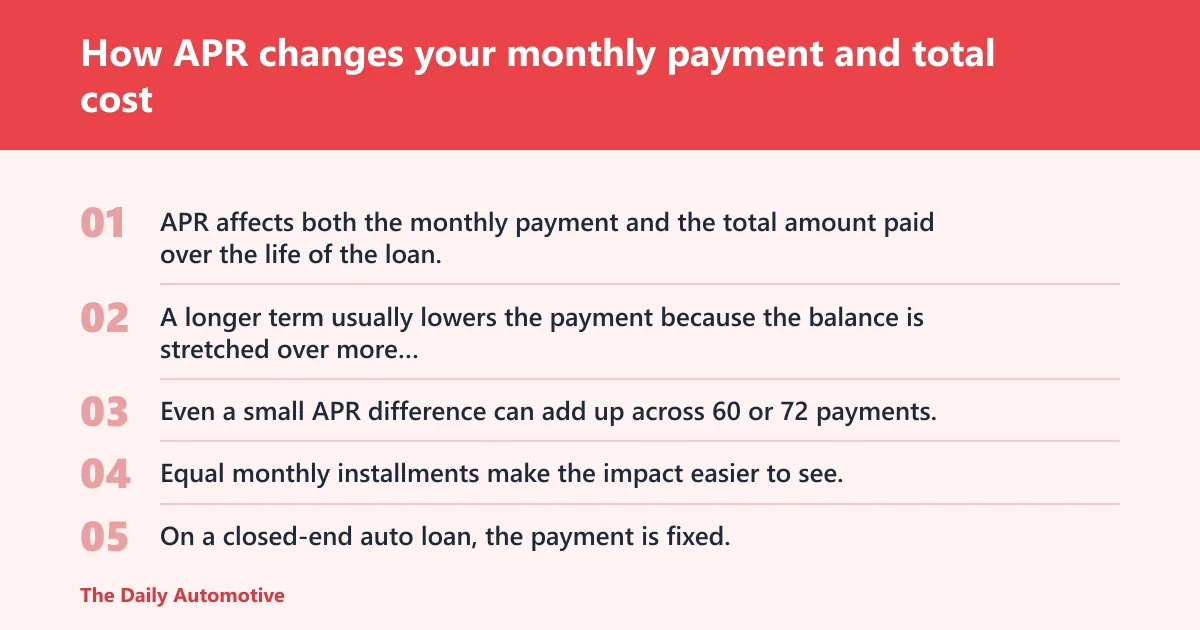
APR affects both the monthly payment and the total amount paid over the life of the loan. A longer term usually lowers the payment because the balance is stretched over more months, but it usually increases total interest. Even a small APR difference can add up across 60 or 72 payments.
Equal monthly installments make the impact easier to see. On a closed-end auto loan, the payment is fixed, so any increase in fees or rate changes how much principal gets retired each month. That is why total finance cost matters as much as the monthly bill.
Cost comparison: same car loan, different APRs and fees
Picture three similar auto loans: about $25,000 financed over roughly 60 months. The only difference is how fees change the effective borrowing cost. This example uses the same amount and term so you can see the cost stack more clearly.
| Loan | Rate structure | Monthly payment | Total paid over 60 months | Total finance cost |
|---|---|---|---|---|
| Loan A | Note rate only, no added fee | $483.14 | $28,988.40 | $3,988.40 |
| Loan B | Same note rate plus a $500 origination fee | $492.79 | $29,567.40 | $4,567.40 |
| Loan C | Same amount financed with a dealer markup that raises the APR | $489.83 | $29,389.80 | $4,389.80 |
In this table, the note-rate-only loan has the lowest cost. The origination fee raises the monthly payment and total finance cost even though the base rate stays the same. The dealer markup does the same thing by pushing the effective APR higher.
That is the key point: a loan can look similar on paper, yet the real cost changes once fees or markup are added. If you stop at the payment alone, you may miss hundreds of dollars in borrowing cost.
What is a typical APR for a car loan?
A typical APR for a car loan depends on credit tier, new versus used vehicle, lender type, and term length. There is no single number that fits every shopper, and current rates move with market conditions. The safer approach is to ask for the quoted APR in your own credit tier and loan structure.
Borrowers with stronger credit usually see lower APRs. Used vehicles, longer terms, and thinner down payments tend to push pricing higher. A lender’s posted range can be a rough starting point, but the contract offer is what matters.
If you are comparing offers, use your actual approval terms, not a generic average. Two shoppers can be looking at the same model and still get very different APRs because their credit files, terms, and vehicle details are different.
Is a lower APR always the better car loan?
No. A lower APR is not always the best deal if it comes with a lost rebate, a longer term, or required add-ons that raise the total cost. The cheapest loan on a monthly basis is not always the cheapest loan overall.
A manufacturer rebate can outweigh a slightly higher APR if the rebate reduces the amount financed by more than the added interest costs. The reverse can also happen. A low APR paired with a much longer term can still cost more across the full loan.
A common mistake is focusing only on the monthly car payment and overlooking that a higher APR can make the loan cost much more over time. A 72-month loan can look easier than a 48-month loan, but the extra months usually mean more interest and a higher total cost.
How to compare car loan offers the right way
Compare the APR, the note rate, the amount financed, the term, and the fee list together. APR is the baseline comparison tool, but the payment and total amount paid tell you whether the offer actually saves money. Lender disclosure rules exist so you can make that comparison.
- Ask for the note rate, APR, and a full fee breakdown.
- Check whether any origination fee, processing fee, or dealer reserve is included.
- Compare the same loan amount and same term across offers.
- Look at the monthly payment and the total paid over the full term.
- Confirm whether a rebate, add-on, or markup changes the actual deal.
Suppose one lender offers 6.5% APR with no fee and another offers 6.1% APR but adds $700 in charges. The lower APR may still cost more once the fee is financed. That is why the contract details matter more than the headline rate alone.
What is the difference between APR and interest rate on an auto loan?
The interest rate is the cost of borrowing before added fees. APR includes that interest plus certain finance charges when they count under the disclosure rules. If fees are present, APR will usually be higher than the note rate.
How do lenders calculate APR on an auto loan?
Lenders calculate APR by combining the interest rate with qualifying charges and expressing the result as a yearly percentage. On an auto loan, that makes the annual cost of borrowing easier to compare across offers, even when one lender includes fees that another does not.
Frequently asked questions
How do credit score and loan term affect car loan APR?
Credit score is a major rate-setting factor, and higher scores generally reduce APR because the borrower looks less risky. Loan term also matters: longer terms usually lower the monthly payment but increase total interest and can raise the overall cost of the loan.
what is current apr for car loans
Current APR for car loans changes with market conditions, lender policy, credit tier, vehicle type, and term length. There is no single number that fits every shopper. Ask for a personalized quote and compare the APR against the amount financed, the term, and any fees.
apr vs interest rate car loan
On a car loan, the interest rate is the base cost of borrowing. APR is the broader annual cost that can include certain fees. If you want the truest apples-to-apples comparison, focus on APR, then verify the fee list and the total amount paid.
what is apr on an auto loan
APR on an auto loan is the annualized borrowing cost expressed as a percentage. It is the number lenders must disclose under Truth in Lending rules so you can compare offers on a common basis, rather than relying on a headline rate that may leave out fees.
Products related to this article
Sponsored / affiliate links. As an Amazon Associate I earn from qualifying purchases. I may earn additional commission from eligible campaigns.