How Much Does Full Coverage Car Insurance Cost?
Full coverage car insurance often costs roughly $1,800 to $3,000 a year for many drivers. Younger drivers, high-risk ZIP codes, and newer cars can push it much higher. A quote more than about 20% above your profile norm deserves a second look. Overpaying adds hundreds a year, and thin coverage can leave you exposed after a crash. This article breaks down age, state, coverage limits, deductibles, and insurer differences so you can sanity-check a quote fast.
What full coverage usually includes
Full coverage usually means liability plus comprehensive and collision. In some states, a policy also includes or requires uninsured or underinsured motorist coverage, personal injury protection, or medical payments coverage. The label is shorthand, not a legal standard, so check the declarations page before you compare quotes.
Liability, comprehensive, and collision
Liability pays for damage or injury you cause to others. Comprehensive helps with theft, hail, fire, flooding, and animal strikes. Collision pays to repair or replace your car after a crash, even if you caused it. Those three pieces are the core of most full coverage quotes.
What may also appear in some states?
Some states require or commonly bundle additional protections such as uninsured motorist, underinsured motorist, personal injury protection, or medical payments coverage. That matters because two quotes can both be called “full coverage” while one includes more first-party protection than the other. Compare the coverages, not the label.
Why deductibles change the final price
Higher deductibles usually lower the premium because you take on more of each claim. Lower deductibles raise the premium because the insurer pays sooner. Comprehensive and collision can have separate deductibles, so a quote with a $500 comprehensive deductible and a $1,000 collision deductible is not the same as one with a single shared deductible.
How much does full coverage cost on average?
A reasonable national benchmark for full coverage is about $197 a month, or $2,361 a year, based on NerdWallet’s sample profile. MoneyGeek lists a higher national average at $216 a month. That spread is normal because the sample driver, insurer mix, and methodology differ.
Monthly premium benchmark
NerdWallet’s median monthly rate is $197 for full coverage, using a 35-year-old driver with good credit and a clean driving record. MoneyGeek’s national average is $216 a month. If your quote is far above both and your profile is plain-vanilla, it deserves a closer look.
Annual premium benchmark
NerdWallet lists a median annual rate of $2,361 for full coverage. That works out to about $197 a month. For many drivers, a quote between roughly $1,800 and $3,000 a year can be normal depending on state, vehicle, and driving record.
Why averages differ by source and carrier
Insurers can vary by hundreds of dollars a year from one company to the next. Averages also shift with the profile used in the sample, the states included, and whether the benchmark reflects a median or an average. The right comparison is your own profile against several quotes, not one headline number.
What makes one quote much higher than another?
The biggest price moves usually come from ZIP code rating, driver age, credit-based insurance score where allowed, driving record, vehicle type, deductibles, and insurer choice. Those inputs can stack quickly. A clean 30-year-old in a low-loss ZIP code can see a very different quote from an 18-year-old in the same car.
ZIP code rating and local loss patterns
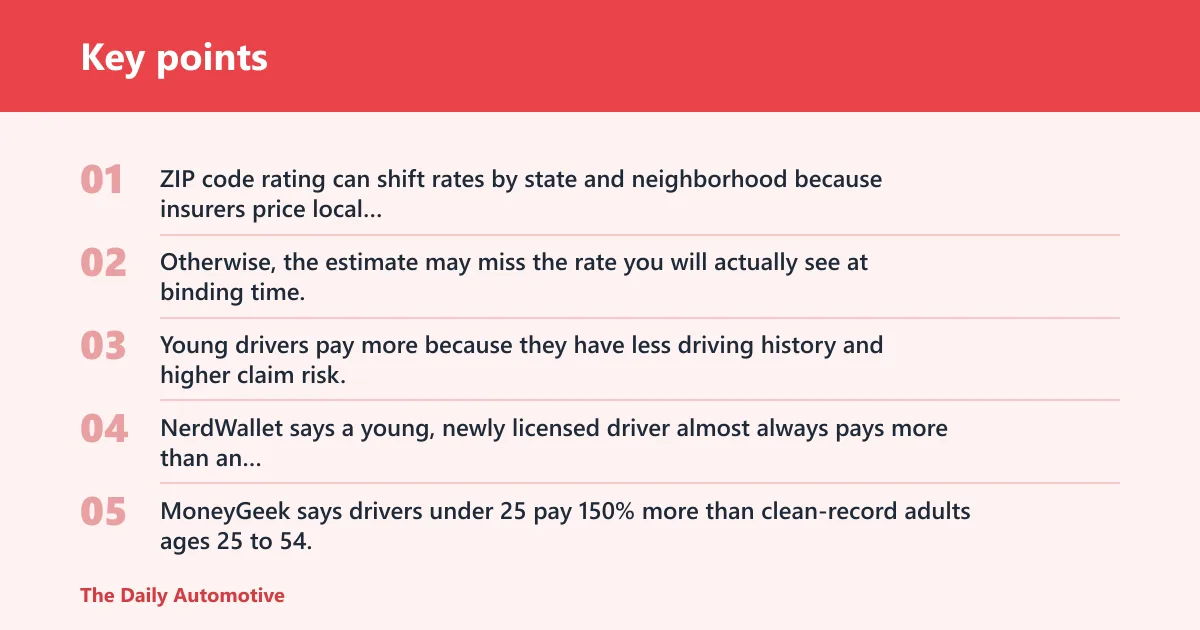
ZIP code rating can shift rates by state and neighborhood because insurers price local theft, crash, weather, repair, and litigation patterns. Enter your ZIP code before comparing quotes. Otherwise, the estimate may miss the rate you will actually see at binding time.
Driver age and experience
Young drivers pay more because they have less driving history and higher claim risk. The same source says a young, newly licensed driver almost always pays more than an experienced driver. The same source says drivers under 25 pay 150% more than clean-record adults ages 25 to 54, which makes age one of the largest pricing factors.
Credit-based insurance score and state exceptions
In most states, a poor credit-based insurance score can double rates compared with excellent credit. That input is not used in California, Hawaii, Massachusetts, or Michigan. In those states, the quote will lean more heavily on driving record, ZIP code, vehicle, and coverage choices.
Driving record, vehicle, and insurer choice
A recent accident or ticket usually makes rates more expensive than average. NerdWallet also says a lapse or gap in insurance history affects rates. The same source says a single at-fault accident raises full coverage premiums 42%, and a DUI raises premiums 64%. Insurer choice still matters because the same profile can produce quotes that differ by hundreds a year.
Say your profile is otherwise ordinary: 32 years old, clean record, good credit, and a sedan parked in a moderate-risk ZIP code. If one quote lands $700 a year above several others with the same deductibles and limits, the spread is not random. It usually points to carrier pricing, a missed discount, or a quote input that needs correction.
How much does full coverage cost by age?
Age can move full coverage cost more than almost any other single factor. Adults ages 25 to 54 often function as the baseline in sample pricing, while under-25 drivers pay much more. The younger the driver, the more likely the quote is to land above the national benchmark.
New drivers
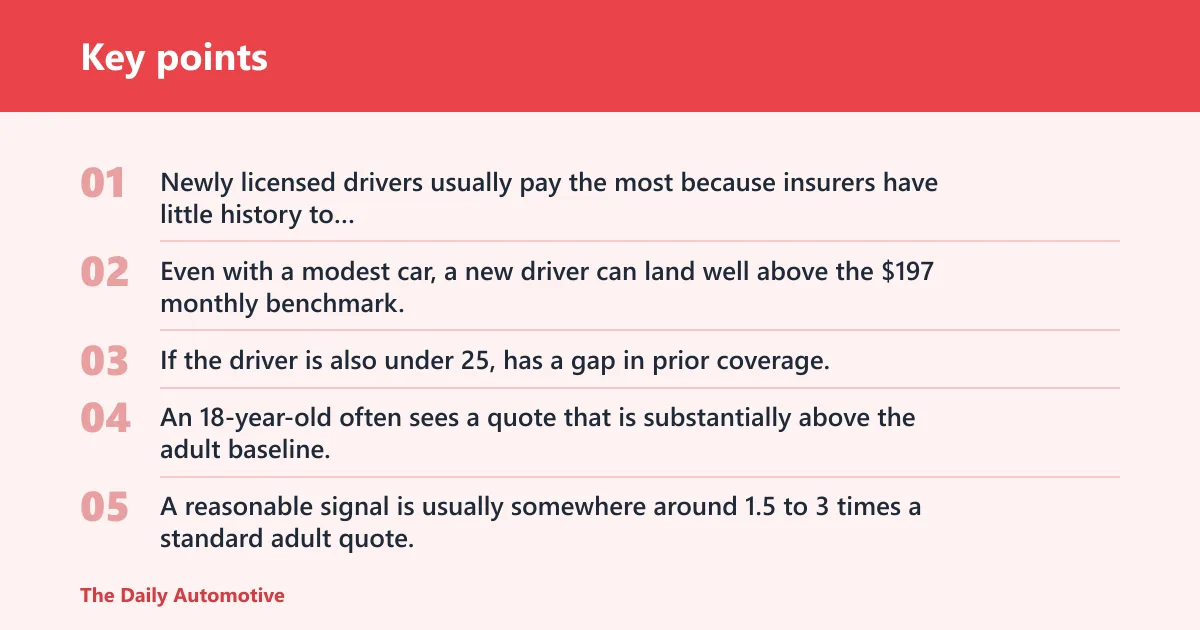
Newly licensed drivers usually pay the most because insurers have little history to price from. Even with a modest car, a new driver can land well above the $197 monthly benchmark. If the driver is also under 25, has a gap in prior coverage, or is in a high-cost ZIP code, the premium can climb sharply.
How much does full coverage car insurance cost for an 18 year old?
An 18-year-old often sees a quote that is substantially above the adult baseline. A reasonable signal is usually somewhere around 1.5 to 3 times a standard adult quote, depending on car, ZIP code, and record. If a clean adult quote is near $200 a month, an 18-year-old could reasonably see a much higher figure.
How much does full coverage car insurance cost for a 20 year old?
A 20-year-old generally pays less than an 18-year-old but still well above the 25-to-54 baseline. Expect the quote to stay elevated unless the driver has a long clean record and very modest coverage choices. If the number is only slightly above an adult quote, that is unusually favorable and worth checking for missing inputs.
How much does full coverage car insurance cost for a 21 year old?
A 21-year-old typically remains in a higher-priced band, though the quote can start moving closer to adult pricing. A clean record, no lapse in coverage, and a lower-value car can help. If the quote sits only moderately above a 35-year-old’s quote, that can be normal for a low-risk setup.
25 to 54 as a common pricing baseline
For many rate examples, ages 25 to 54 are the clean benchmark. NerdWallet’s sample uses a 35-year-old driver with good credit and a clean record. If your age is in this range and your quote still runs far above the national median, look at ZIP code, vehicle, limits, deductibles, and insurer choice.
How much does full coverage car insurance cost by state?

State pricing varies a lot. Florida can run much higher than many other states, while California, Hawaii, Massachusetts, and Michigan also need special attention because credit-based pricing rules are different there. A state quote should always be judged with the rules that apply in that state.
Florida
The same source says a driver in Florida pays $243 a month for coverage, compared with $97 a month in Vermont. Florida’s higher cost is a warning sign that state averages can move dramatically from national norms. If your Florida quote is well above $243 a month, check for age, ZIP code, and coverage choices before assuming it is normal.
Texas
Texas prices often sit above the national median in urban, storm-prone, or theft-prone areas. If you are comparing Texas quotes, use the same deductibles and liability limits across every insurer. A quote that is much higher than nearby competitors with the same profile often points to carrier appetite rather than a true market average.
California
California is commonly described as not using credit-based insurance scores the way many other states do, so that factor may not explain a quote spread there. Focus instead on driving record, ZIP code, vehicle value, mileage, and limits. If a California quote looks inflated, compare it against the same coverage structure from several insurers before deciding it is normal.
Michigan
Michigan is also commonly described as not using credit-based insurance scores in pricing. That means the quote should be judged mainly on injury coverage rules, limits, vehicle, ZIP code, and record. Because the state’s rules differ, do not compare a Michigan quote against a national average without adjusting for the missing credit factor.
Why credit rules change the comparison in some states
When credit scoring is restricted, a driver with poor credit may not see the same rate jump that would happen elsewhere. That makes the quote mix look different across states. For that reason, a “high” quote in one state may be perfectly ordinary in another once the rule set changes.
Full coverage price reality check
This table turns the quote into a quick check. Use it to see which input most likely pushed the price up or down, and whether the number looks like a normal quote signal or an outlier. It is a sanity check, not a promise of what any one carrier must charge.
| Factor | Most likely price push | What a reasonable quote signal looks like |
|---|---|---|
| Age band: 25 to 54 | Usually the baseline | Near the national median, unless ZIP code or vehicle is costly |
| Age band: under 25 | Up sharply | Often well above adult quotes; 150% more than clean-record adults can be normal |
| Credit tier: excellent | Down | Closer to the lower end of your state and carrier range |
| Credit tier: poor | Up sharply in most states | Can be about double excellent-credit pricing; not used in CA, HI, MA, or MI |
| Driving record: clean | Down | Closer to benchmark pricing for your age and state |
| Driving record: at-fault accident | Up | About 42% higher than a clean-record full coverage premium can be a normal signal |
| Driving record: DUI | Up sharply | About 64% higher than a clean-record premium can be a normal signal |
| State rule exception: CA, HI, MA, MI | Credit factor removed | A quote that ignores credit input is normal; compare other risk inputs more carefully |
Suppose a 21-year-old in Texas gets a quote that is 30% above a sibling’s quote for the same car and coverage. If both drivers have the same record and ZIP code, the age factor may explain most of the gap. If the younger driver also has a prior lapse, the quote can rise again.
When does full coverage stop making sense?
Full coverage can stop making sense when the annual premium gets too close to the car’s actual value, especially on an older vehicle. A practical threshold is when one year of full coverage costs a large share of the car’s market value and the cash payout after a total loss would not materially help. At that point, liability-only may be the cleaner buy.
Older car value versus annual premium
If your car is worth $4,000 and full coverage costs $1,500 a year, the premium is expensive relative to the payout ceiling. A car with a low market value may not justify collision and comprehensive, especially if you can comfortably absorb a repair or replacement loss yourself.
Liability-only tradeoff
Minimum coverage is cheaper, and NerdWallet’s median minimum coverage rate is $54 a month, or $648 a year. But liability-only protects other people and not your car. If you still owe money on the vehicle, liability-only can leave a serious gap after a crash.
How low limits can still leave you underinsured
Buying full coverage does not guarantee enough protection. If liability limits are too low, a bad crash can still create a large out-of-pocket bill. Full coverage on the car does nothing to fix weak liability limits, so compare both the property damage and injury side of the policy before you buy.
- Enter the same ZIP code, vehicle, driver age, and driving record on every quote.
- Keep liability limits, comprehensive deductible, and collision deductible identical across insurers.
- Compare the monthly premium and the annual premium, not just the first number you see.
- Check whether the policy includes uninsured motorist, underinsured motorist, PIP, or medical payments coverage.
- Ask whether a lower deductible, a higher deductible, or a vehicle change would move the quote more than expected.
- Flag any quote that is more than 20% above other quotes for the same setup.
Frequently asked questions
How much does full coverage car insurance cost per month?
For many drivers, a solid monthly benchmark is about $197, based on NerdWallet’s median full coverage rate. The same source lists a higher national average at $216 a month. If your quote is much higher than both, check age, ZIP code, record, deductibles, and carrier choice before assuming the number is normal.
How much does full coverage car insurance cost per year?
The same source lists a median annual rate of $2,361 for full coverage. That figure is based on a 35-year-old driver with good credit and a clean record. A quote that lands well above that level can still be normal for a younger driver, a costly ZIP code, or a higher-value car.
How much does full coverage car insurance cost for a new driver?
A new driver usually pays more than an experienced driver, often by a wide margin. The exact price depends on age, credit where allowed, ZIP code, vehicle, and history. If the driver is also under 25, the quote can move far above the standard adult benchmark even with modest coverage.
How much does full coverage car insurance cost in Florida?
The same source says Florida coverage averages $243 a month, which is well above many national benchmarks. That makes Florida one of the clearest examples of why state averages matter. If your Florida quote is much above that number, compare the same limits and deductibles across several carriers before deciding it is fair.
How much does full coverage car insurance cost in California?
California quotes should not be judged by credit score because that factor is not used there. Price differences usually come from driver age, ZIP code, vehicle, limits, and deductibles. A quote that looks high may still be normal for the area, so compare several insurers with identical coverage settings.
How much does full coverage car insurance cost in Michigan?
Michigan also does not use credit-based insurance scores, so a quote should be compared mainly on the policy structure, vehicle, location, and driving record. If one quote is far above the others, the issue is more likely carrier pricing or coverage differences than credit history.
Products related to this article
Sponsored / affiliate links. As an Amazon Associate I earn from qualifying purchases. I may earn additional commission from eligible campaigns.