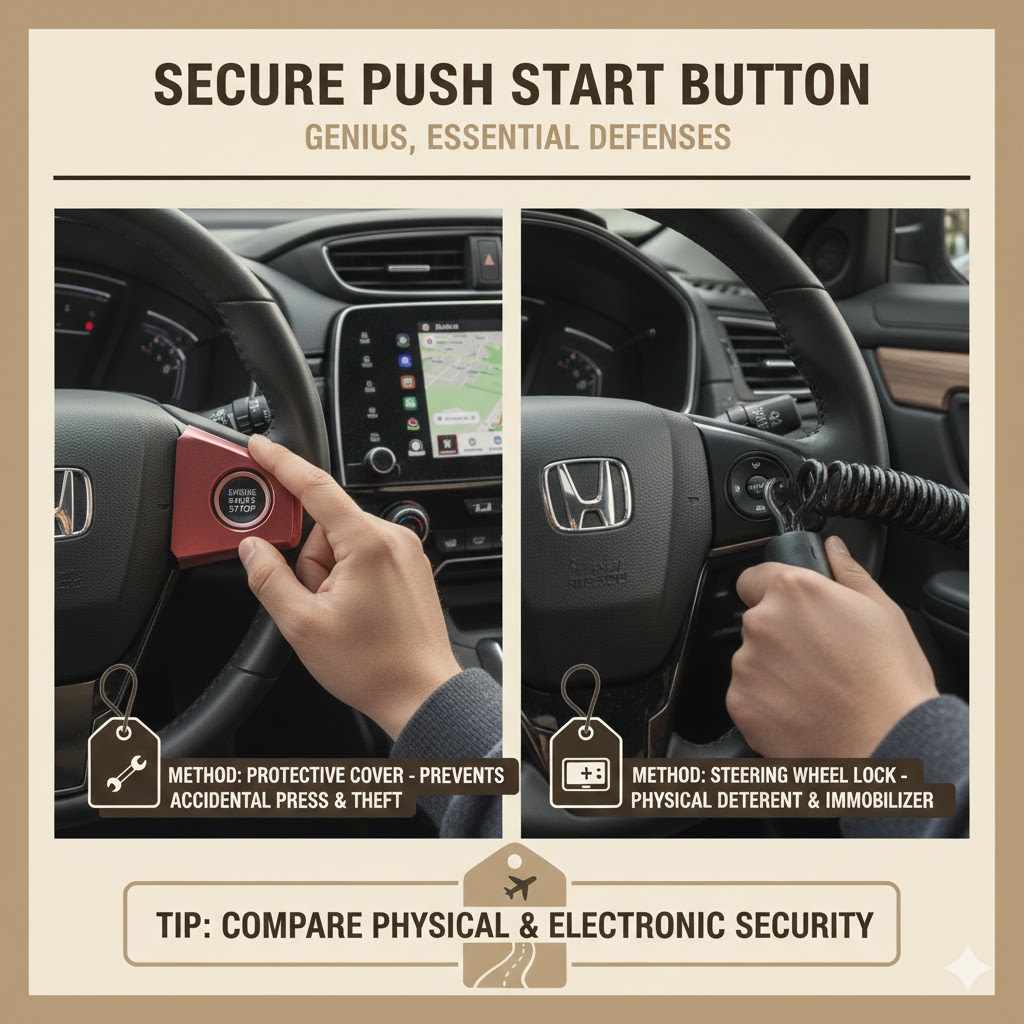
Secure Push Start Button: Genius, Essential Defenses
To secure your push-start button car from theft, use a layered defense. The most effective methods are storing your key fob in a signal-blocking Faraday pouch to prevent relay attacks, using a highly visible steering wheel lock as a physical deterrent, and installing an OBD-II port lock to stop thieves from programming a new key.
How to Secure Your Push-Start Car From Theft: A Beginner’s Guide
Hello there! It’s your friend, Md Meraj. I’m here to help you understand your car better. The push-start button is a wonderful feature. It makes starting your car so easy and modern. But you may have heard stories about thieves targeting these cars. It can be worrying.
The good news is that you can protect your car. You don’t need to be a mechanic or a security expert. There are simple, genius, and essential defenses you can use right now. These steps will make your car a much harder target for thieves.
In this guide, I will walk you through everything, step-by-step. We will talk about how thieves steal these cars and the best ways to stop them. You will learn about simple habits, smart tools, and a layered security plan. Let’s make your car safe and give you peace of mind.
Understanding the Threat: How Thieves Steal Push-Start Cars
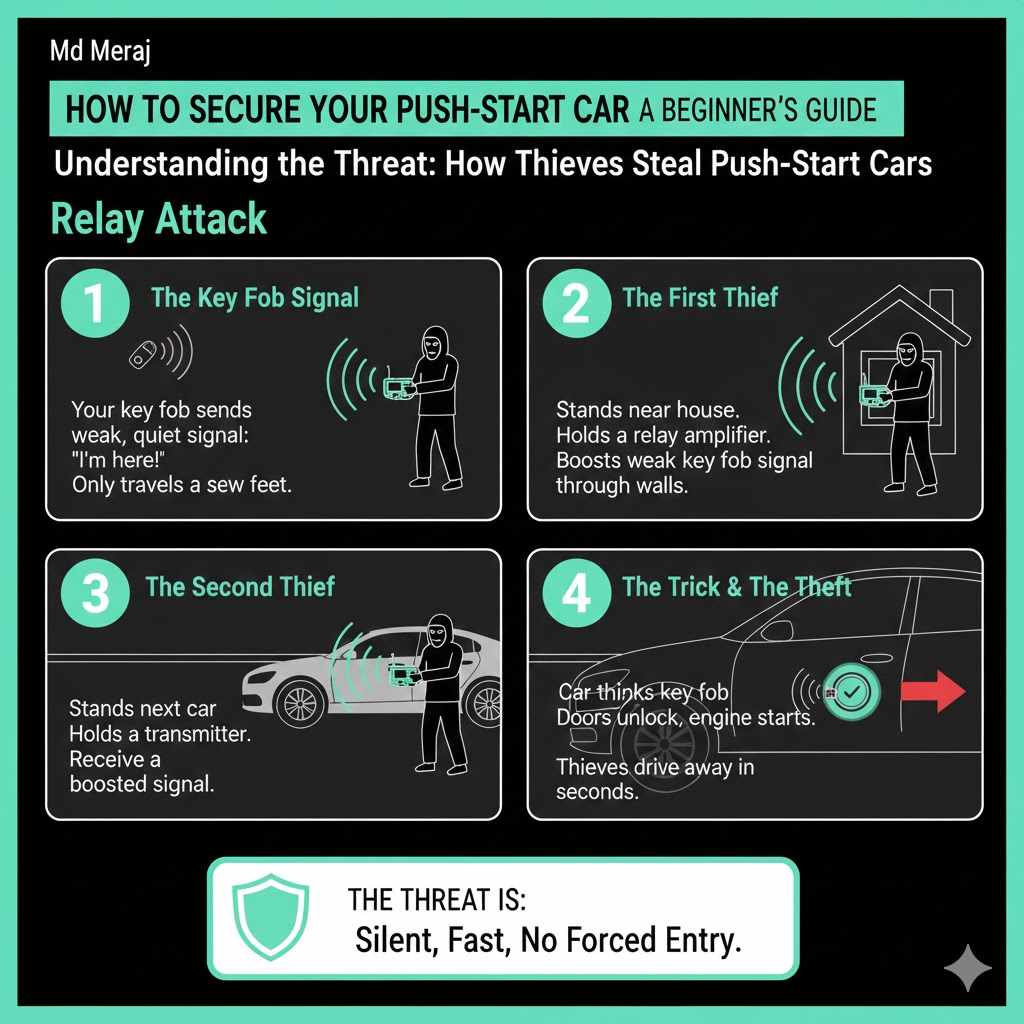
To protect your car, you first need to know how thieves work. Cars with push-start buttons are not stolen by “hot-wiring” like in old movies. Instead, thieves use clever technology to trick your car. The most common method is called a “relay attack.”
It sounds complex, but the idea is simple. Here is how it happens:
- The Key Fob Signal: Your key fob is always sending out a quiet signal. This signal tells your car, “I’m here! It’s safe to open and start.” This signal is only meant to travel a few feet.
- The First Thief: One thief stands near your house, perhaps by your front door or a window. They hold a special device called a relay amplifier. This device picks up the weak signal from your key fob, even through walls.
- The Second Thief: Another thief stands next to your car with a second device, a transmitter. This device receives the boosted signal from the first thief’s box.
- The Trick: The transmitter next to your car broadcasts the signal. Your car thinks your key fob is right there beside it. The doors unlock, and the push-start button works. The thieves can then drive your car away in seconds, all without ever touching your key.
Think of it like two people using walkie-talkies to extend a conversation. One person listens and the other speaks, making it seem like you are much closer than you really are. This attack is silent, fast, and leaves no signs of forced entry. Another, more advanced technique is a CAN injection attack, where thieves access your car’s internal network through the headlight wiring to unlock it. But for now, let’s focus on stopping the common relay attack.
Level 1 Defense: Simple, Everyday Habits
The best security starts with small, smart habits. These cost nothing but are incredibly effective at stopping thieves before they even begin. Think of this as your first wall of defense.
Store Your Key Fob Safely at Home
Where do you keep your keys when you get home? Most people leave them on a hook or in a bowl near the front door. This is the worst place to put them. It makes it very easy for a thief with a relay box to grab the signal from outside.
Instead, follow these simple rules:
- Create Distance: Store your key fob as far away from your home’s exterior walls and windows as possible. A central room or an upstairs bedroom is much safer than the front hallway.
- Use a Metal Box: A simple metal container, like a coffee can or a small metal box, can block the signal. Place your keys inside and put the lid on.
- Get a Faraday Pouch: We will talk more about these later, but a Faraday pouch (or box) is specifically designed to block all signals. Make it a habit to drop your keys in the pouch the moment you walk in the door.
Be Aware When You Are Out
Relay attacks don’t just happen at home. Thieves can also target you in public places like shopping mall parking lots or restaurant patios. If a thief can get within a few feet of you, they can capture your key fob’s signal while their partner is at your car.
When you are out, keep your key fob in a signal-blocking pouch or a secure inside pocket. Be mindful of people getting unusually close to you for no reason.
Know Your Key Fob’s Features
Some newer key fobs have a “sleep mode” feature. This is a genius defense built right in. If the key fob doesn’t move for a few minutes, it stops broadcasting its signal. This completely stops relay attacks. Check your car’s owner’s manual to see if your fob has this feature and how to activate it. Sometimes it’s automatic, and sometimes you need to press a combination of buttons.
Level 2 Defense: Physical Deterrents
Thieves are looking for a quick and easy target. A physical deterrent is anything they can see that tells them, “This car will be a lot of work.” Even if they can get inside your car, these devices will stop them from driving away. They are a powerful visual warning.
The Classic Steering Wheel Lock
You have probably seen these bright, heavy metal bars locked onto a steering wheel. This old-school tool is one of the best defenses for modern cars. Why? Because it is simple and it works.
- It’s Highly Visible: A thief will see the lock through the window and will likely move on to an easier car.
- It Takes Time to Defeat: Cutting through a quality steering wheel lock requires noisy power tools and a lot of time—two things a car thief hates.
- It’s Affordable: A good steering wheel lock is an inexpensive, one-time purchase that provides lasting security.
Using it every day can feel like a small chore, but that one extra minute can be the difference between your car being there in the morning or not.
Brake or Pedal Locks
Similar to a steering wheel lock, a pedal lock attaches to your brake or clutch pedal, making it impossible to press down. The car cannot be put into gear or stopped safely, so it cannot be driven. These are also very visible and send a strong message to any potential thief.
Tire Locks (Wheel Clamps)
A tire lock, or wheel clamp, is an extreme but highly effective deterrent. It’s the same type of device that parking enforcement uses. While it’s probably too much for daily use at the grocery store, it’s an excellent option if you are parking your car for an extended period, like at an airport or while on vacation.
Comparing Physical Deterrents
Not sure which physical lock is right for you? Here’s a simple comparison to help you decide.
| Device | Average Cost | Ease of Daily Use | Effectiveness as a Deterrent |
|---|---|---|---|
| Steering Wheel Lock | $30 – $100 | Good (Takes about 30 seconds) | Excellent |
| Pedal Lock | $50 – $150 | Fair (Requires bending down) | Excellent |
| Tire Lock / Wheel Clamp | $40 – $120 | Poor (Best for long-term parking) | Maximum |
Level 3 Defense: Electronic and Advanced Security
Now we move to the genius defenses that directly counter the technology thieves use. These solutions block signals and protect your car’s computer system, making electronic theft nearly impossible.
Faraday Bags (Signal-Blocking Pouches)
A Faraday bag is a small pouch lined with a special material that blocks radio signals, including the one from your key fob. When your key is inside the pouch, its signal cannot escape. This is the number one defense against relay attacks.
They are affordable and easy to use. You should have one for your main key and your spare key. Remember, your spare key also broadcasts a signal, even when it’s sitting in a drawer in your house!
How to Test Your Faraday Bag:
- Place your key fob inside the bag and seal it completely.
- Walk up to your car with the bag in your hand.
- Try to open the car door.
If the door does not unlock, your bag is working perfectly. If it does unlock, the bag is not effective and you should get a different one.
OBD-II Port Locks
What is an OBD-II port? It’s a small port, usually under your steering wheel, that mechanics use to plug in a computer and diagnose problems with your car. Unfortunately, sophisticated thieves can also use this port. They can plug in their own device and program a brand new blank key for your car in under a minute.
An OBD-II port lock is a simple, tough cap or box that physically blocks access to the port. It can only be removed with a special key that you keep. This is a fantastic defense that stops thieves who have bypassed your car’s initial security. They get in, but they can’t start the car because they can’t program a key.
Aftermarket Alarms and Immobilizers
While your car comes with a factory alarm, an aftermarket system can add more layers of security. These systems can include more sensitive shock sensors, glass-break sensors, and even a separate immobilizer. An immobilizer is an electronic device that prevents the engine from starting unless the correct key or code is present. A professionally installed aftermarket immobilizer can be very difficult for a thief to defeat.
GPS Trackers
A GPS tracker is a recovery tool, not a prevention tool. If your car is stolen despite all your defenses, a hidden GPS tracker can tell you exactly where it is. This drastically increases the chances that law enforcement can recover your vehicle. Some trackers have a one-time cost, while others require a monthly subscription for real-time tracking services.
Putting It All Together: Your Layered Security Strategy
The secret to great car security isn’t finding one perfect solution. It’s about using several solutions together. This is called “layered security.” Each layer makes a thief’s job harder and more time-consuming. Most will give up and find an easier car to steal.
You can build a plan that fits your budget and your needs. Here are a few examples:
Example Strategy 1: Budget-Friendly & Effective
- Habits: Store keys away from doors at home.
- Electronic: Use a Faraday pouch for both main and spare keys ($10-$20).
- Physical: Use a quality steering wheel lock every time you park ($40).
This simple, low-cost setup provides excellent protection against the most common types of theft.
Example Strategy 2: Enhanced Security
- Everything from the Budget-Friendly plan.
- Advanced: Add an OBD-II port lock ($50-$100).
This plan protects you from both relay attacks and key programming attacks, covering the two biggest vulnerabilities of push-start cars.
Example Strategy 3: Maximum Security
- Everything from the Enhanced Security plan.
- Advanced: Install a professionally hidden kill switch (cuts power to the fuel pump or ignition).
- Recovery: Install a hidden GPS tracker.
This is for those who want the ultimate peace of mind. It makes your car nearly impossible to steal and highly likely to be recovered if it is.
Building Your Security Plan
Use this table to mix and match solutions for your own personal security plan.
| Security Layer | Devices & Habits | Estimated Cost (One-Time) | Protects Against |
|---|---|---|---|
| Basic (Good) | Good Key Habits + Faraday Pouch | $10 – $20 | Relay Attacks |
| Mid-Tier (Better) | Basic Layer + Steering Wheel Lock | $50 – $120 | Relay Attacks + Quick Physical Theft |
| Advanced (Best) | Mid-Tier Layer + OBD-II Port Lock | $100 – $220 | Relay Attacks, Physical Theft, & Key Programming |
What Car Manufacturers Are Doing
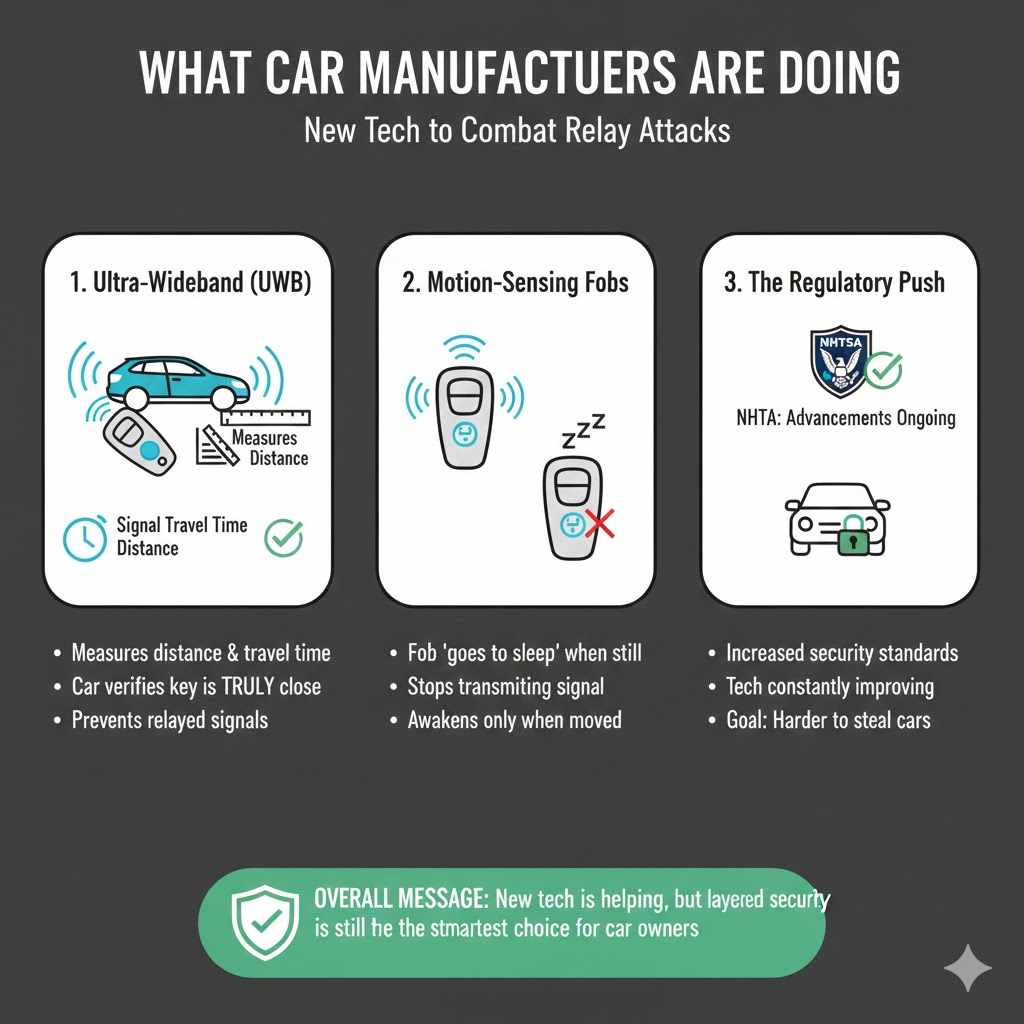
The good news is that car companies are aware of these new theft methods. They are working on solutions to make their cars more secure. According to the National Highway Traffic Safety Administration (NHTSA), advancements in anti-theft technology are ongoing.
Some newer key fobs now use Ultra-Wideband (UWB) technology instead of just RFID. This technology can measure the exact distance and travel time of the signal, meaning it can tell the difference between a key that is actually next to the car and a signal that is being relayed from far away. Others include motion sensors that put the fob to sleep when it is not moving. As technology improves, cars will become harder to steal, but for now, using your own defenses is still the smartest choice.
Frequently Asked Questions (FAQ)
1. Is a push-start car easier to steal than a traditional key car?
It’s different, not necessarily easier. Push-start cars are very hard to hotwire, but they are vulnerable to high-tech relay attacks. A traditional key car is the opposite. The key is to use the right defenses for your type of car.
2. Will a Faraday bag really work?
Yes, a quality Faraday bag works extremely well. It creates a signal-proof cage around your key fob. Always test your bag when you first get it by putting the key inside and trying to unlock your car while standing next to it. If the car stays locked, it’s working.
3. Is a steering wheel lock really worth the hassle?
Absolutely. Thieves want the easiest target. When a thief looks into two cars and one has a big, bright steering wheel lock and the other doesn’t, they will almost always choose the one without the lock. That small hassle is a huge deterrent.
4. Can I just wrap my key fob in aluminum foil?
While a few layers of aluminum foil can sometimes block the signal, it is not a reliable solution. The foil can get small tears, and it might not provide a complete seal. A proper Faraday pouch is designed for this purpose and is far more dependable for a very low cost.
5. Where is my car’s OBD-II port located?
In most cars, the OBD-II port is located on the driver’s side, underneath the dashboard, usually within a foot of the steering column. A quick search online for your car’s make and model will show you the exact location.
6. What if I lose my key fob?
If you lose your key fob, you should contact your dealership immediately. They can deactivate the lost fob’s signal so it can no longer be used to start your car. They can then program a new key fob for you.
7. Does turning off my key fob (if it has a sleep mode) drain the battery?
No, it actually does the opposite. When a key fob is in sleep mode, it stops broadcasting a signal, which conserves its battery life. Check your owner’s manual to see if your fob has this feature.
Your Confidence is Your Best Defense
Protecting your car doesn’t have to be complicated or expensive. Now you know exactly how thieves target push-start cars and, more importantly, how to stop them. By creating smart habits and using a few simple tools, you can build layers of security that will give you real peace of mind.
Start with the basics: get a Faraday pouch and be mindful of where you keep your keys. Add a steering wheel lock for a strong visual deterrent. From there, you can decide if you want to add more layers like an OBD-II lock or a tracker.
You have the knowledge now. You can take these simple, powerful steps to make your car a fortress. Stay safe, drive smart, and enjoy your car without the worry.