Testing TH350 Torque Converter Stator Clearance
Getting the stator clearance right on a TH350 torque converter can seem tricky at first. Many people find this step confusing when working on their transmission. It’s a really important part of making sure everything works smoothly.
Don’t worry, this guide will walk you through it step-by-step. We’ll make Testing TH350 Torque Converter Stator Clearance Guide simple and clear.
Why Stator Clearance Matters for TH350
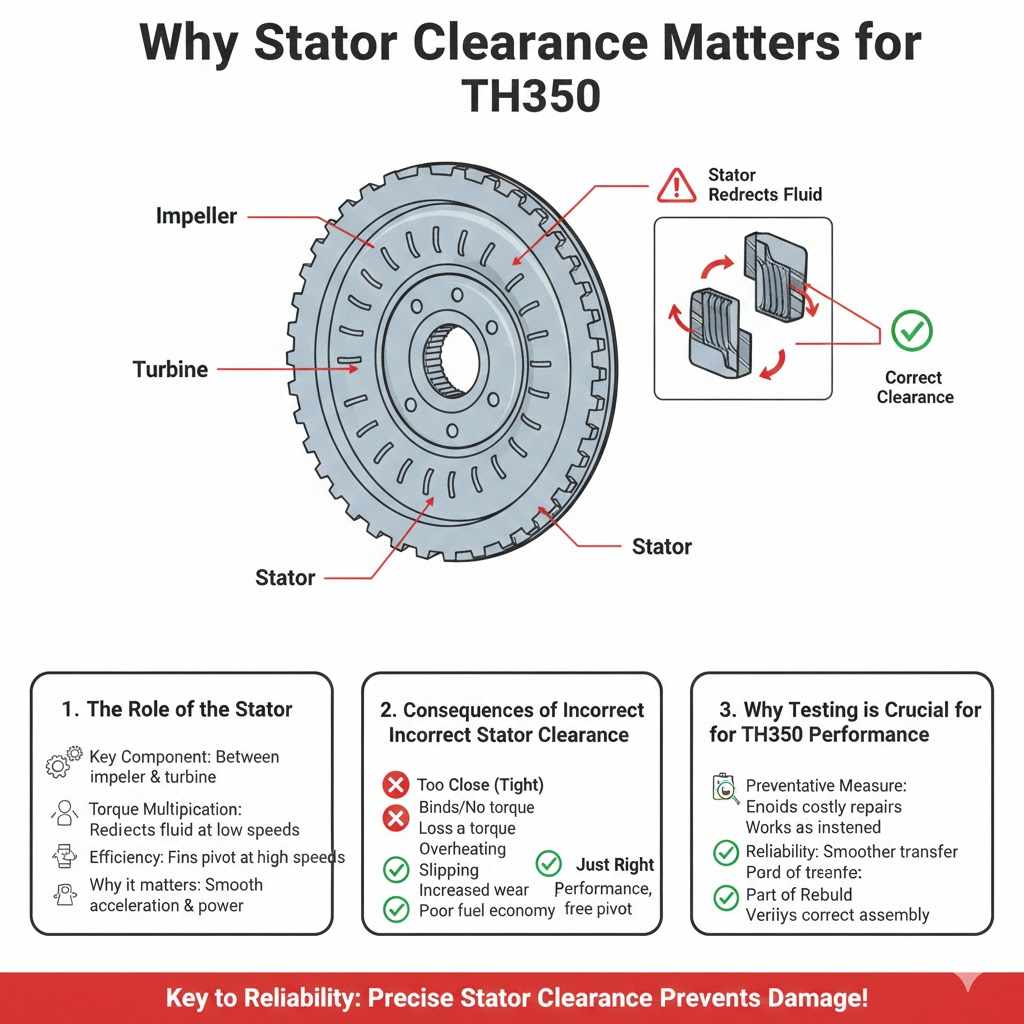
The stator in a torque converter is like a finned wheel that directs fluid. Its position relative to the turbine and impeller is critical for how the transmission performs. When the stator is too close or too far from other parts, it can cause problems.
This affects how well your transmission shifts gears and transfers power. Getting the clearance just right ensures optimal efficiency and longevity for your TH350 transmission. It helps prevent slipping, overheating, and premature wear.
This section covers the basics of why this measurement is so important for your automatic transmission.
The Role of the Stator
The stator is a key component that sits between the impeller and the turbine within the torque converter. It has angled fins that can pivot. When your engine accelerates, the impeller spins and throws transmission fluid outwards.
This fluid then hits the turbine, making it spin and drive the transmission. The stator’s job is to redirect the fluid that returns from the turbine back to the impeller. By redirecting this fluid, the stator can actually multiply torque, especially at lower engine speeds.
This torque multiplication is what gives automatic transmissions their “push” off the line. The angle of the stator fins changes based on engine speed and load. At low speeds, when you need more power to get moving, the fins are angled to redirect fluid in a way that boosts torque.
As engine speed increases, the fins pivot. They become almost stationary relative to the fluid flow. This allows for more efficient fluid transfer and less slip, which is good for fuel economy at cruising speeds.
The ability of the stator fins to pivot is what makes the torque converter so versatile. Without this feature, the torque converter would be much less effective. It would be like a simple fluid coupling, offering no torque multiplication.
The precise design and placement of these fins, including their ability to move freely, are what allow for smooth acceleration and efficient power delivery.
Consequences of Incorrect Stator Clearance
If the stator fins are too close to the turbine or impeller, they can bind or not pivot correctly. This can cause a loss of torque multiplication. It might also lead to the converter overheating because fluid isn’t flowing as it should.
You might notice rough shifting or a general lack of power, especially when accelerating from a stop. The transmission might feel sluggish.
On the other hand, if the stator is too far away, the fluid redirection won’t be as effective. This can reduce the torque multiplication capability. You’ll likely experience a significant loss of power.
The transmission might slip more than it should. This leads to increased wear and tear on transmission components. It can also negatively impact fuel economy.
The goal is to have the stator positioned just right so it can do its job effectively.
The correct clearance ensures that the stator can pivot freely through its designed range of motion. This allows the torque converter to perform optimally under various driving conditions. It’s a balance between maximizing torque when needed and maximizing efficiency when cruising.
This balance is achieved through precise engineering and correct assembly, including proper stator clearance.
Why Testing is Crucial for TH350 Performance
Proper testing of the stator clearance ensures that your TH350 transmission operates at its best. It’s a preventative measure that can save you a lot of headaches and repair costs down the road. When you’re rebuilding or replacing a torque converter, this is one of the most important checks you can perform.
It guarantees that the torque converter will work as intended by the manufacturer.
A torque converter that has been assembled with incorrect stator clearance might seem to work initially. However, you’ll likely encounter problems as you drive. These issues can range from poor performance to outright transmission failure.
Taking the time to test and verify the clearance is a small effort compared to the potential cost of fixing a damaged transmission.
This testing is a crucial part of the overall transmission rebuild process. It confirms that the critical internal components are correctly positioned. This allows for the smooth transfer of power and the intended torque multiplication characteristics of the TH350.
It’s a sign of a well-built and properly functioning transmission.
Understanding Torque Converter Components
Before we get into the actual testing, it’s helpful to know what makes up a torque converter. Think of it as a fluid coupling that also multiplies torque. It connects your engine to your transmission.
Inside, there are a few main parts that work together. Understanding these parts helps you see why measuring the space between them is so important. We’ll cover the impeller, turbine, and stator, and how they interact.
The Impeller
The impeller is like a fan that’s driven by the engine’s crankshaft. It’s typically bolted to the flexplate, which is connected to the engine. Inside the torque converter housing, the impeller has many curved fins.
As the engine spins, the impeller spins with it. It acts like a pump, throwing transmission fluid outwards and into the turbine.
The fluid is under pressure and moves at high speed. This is the initial force that transfers power from the engine to the transmission. The design of the impeller’s fins is crucial for how efficiently it moves fluid.
More aggressive or differently angled fins can affect the torque converter’s performance characteristics. Some aftermarket torque converters are designed with different impeller fin shapes to improve performance.
The impeller is directly connected to the engine’s rotation. So, when the engine is idling, the impeller spins slowly. When you accelerate, the impeller spins much faster, pushing more fluid.
The amount of fluid and the speed at which it’s thrown are key to how the torque converter functions. It’s the starting point of the power transfer process.
The Turbine
The turbine is located opposite the impeller and is connected to the transmission’s input shaft. Like the impeller, it has curved fins. The fluid thrown by the impeller hits these turbine fins, causing the turbine to spin.
This spinning motion is what ultimately drives the transmission’s gears and turns the wheels.
The turbine’s fins are also designed to work with the fluid flow. In a basic fluid coupling, the turbine would spin at almost the same speed as the impeller. However, in a torque converter, the turbine’s interaction with the stator allows for torque multiplication.
This means the turbine can sometimes spin slower than the impeller, but with more force.
The turbine’s speed is directly related to how much power is being sent to the wheels. When you’re stopped with the engine running, the impeller is spinning, but the turbine is stationary. This is known as “stall.” As you accelerate, the turbine speed increases.
The difference in speed between the impeller and the turbine is a measure of slip. Too much slip indicates inefficiency.
The Stator and Its Pivoting Action
As mentioned before, the stator is the component that allows a torque converter to multiply torque. It’s positioned between the impeller and the turbine. It has angled fins that can pivot.
When the fluid returns from the turbine back towards the impeller, the stator intercepts it.
The stator fins are designed to redirect this returning fluid. At lower engine speeds, the fins are angled to send the fluid back to the impeller in a way that “helps” the impeller spin. This redirection of fluid effectively increases the force applied to the turbine, thus multiplying the engine’s torque.
This is the magic behind getting a strong start from a stop.
As the turbine speeds up and approaches the impeller speed, the fluid returning from the turbine hits the stator fins from a different angle. The stator has a one-way clutch mechanism. This allows the stator fins to pivot and essentially become stationary relative to the fluid flow.
In this state, the stator stops redirecting fluid and simply allows it to pass through. This minimizes drag and allows for efficient power transfer at higher speeds.
The ability of the stator to pivot is controlled by the angles of the fins and how they interact with the fluid. The clearance between the stator and the other components is crucial for this pivoting action to happen correctly. If the stator is too close, it can’t pivot freely.
If it’s too far, it won’t redirect fluid effectively. This is why precise measurement is so important.
How to Perform Stator Clearance Testing
Now, let’s get to the practical part: actually testing the stator clearance. This process requires some basic tools and a careful approach. We’ll break it down into simple steps so you can be confident in your measurements.
Remember, accuracy here makes a big difference in how your transmission performs.
Tools and Materials Needed
To perform this test, you’ll need a few things. First, you’ll need a set of feeler gauges. These are thin strips of metal of precise thickness.
They are perfect for measuring small gaps. You’ll also need a measuring tape or ruler. A torque wrench is important for reassembly later, though not for the clearance test itself.
You might also need a clean shop rag to wipe down surfaces. Make sure you’re working in a clean area. Any dirt or debris can interfere with your measurements or get into the transmission.
Having a small container to hold small parts like bolts is also helpful. Safety glasses are always a good idea when working on car parts.
Here’s a checklist:
- Feeler gauges (metric or standard, depending on your converter specs)
- Measuring tape or ruler
- Clean shop rags
- Small container for parts
- Safety glasses
Step-by-Step Clearance Measurement
First, ensure your torque converter is fully assembled. If you’re rebuilding it, make sure the stator is in its correct position and the one-way clutch is functional. You’ll need to be able to rotate the stator by hand in one direction (which should feel solid) and freely in the other.
If it doesn’t do this, you have a problem with the clutch itself, not the clearance.
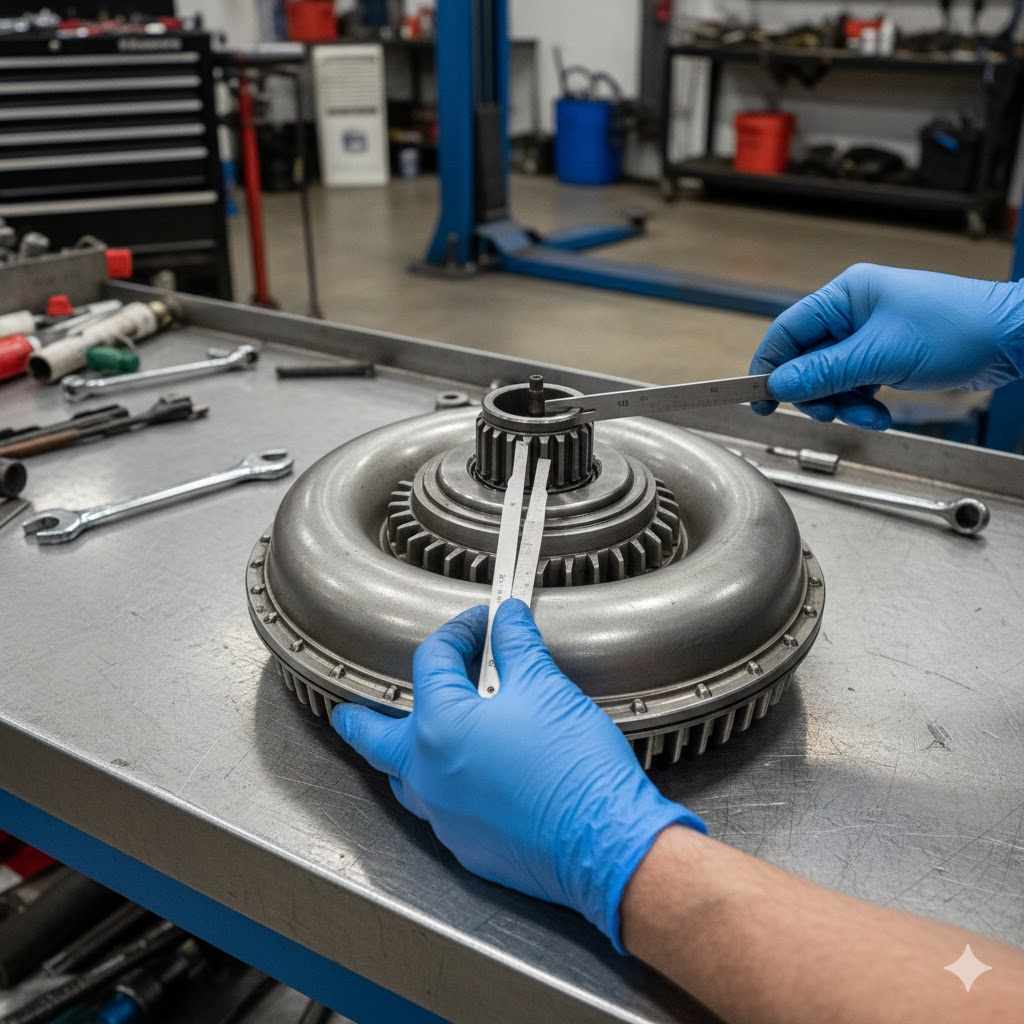
Next, you need to position the torque converter so you can measure the gap between the stator and the turbine. Usually, this is the most critical clearance to check. You can do this by laying the converter on a flat surface or holding it carefully.
The goal is to measure the space between the back of the stator fins and the front of the turbine fins.
This is where the feeler gauges come in. Select a gauge that seems like it might fit the gap. Gently slide it into the space.
Try different gauges until you find the one that just fits snugly. It should slide in without too much force, but also shouldn’t be loose.
You’ll want to check this clearance at several points around the stator. Rotate the converter and repeat the measurement. This ensures that the stator isn’t warped and that the gap is consistent.
You’re looking for a specific range of clearance, usually a few millimeters or thousandths of an inch. Consult your specific torque converter’s service manual for the exact specifications.
Some guides also recommend checking the clearance between the stator and the impeller. This is less common as the primary measurement, but it’s good to be aware of. The principles are the same: use feeler gauges to find the snug fit.
Always refer to the manufacturer’s specifications for the exact gap you need to achieve.
Interpreting the Measurements
Once you have your measurements, you need to compare them to the recommended specifications. For a TH350 torque converter, the typical stator-to-turbine clearance often falls within a range of 0.030 to 0.080 inches (approximately 0.76 mm to 2.03 mm). However, this can vary significantly based on the specific converter model and manufacturer.
If your measurement is too small, it means the stator is too close. This can restrict its ability to pivot. It might cause the torque converter to overheat or perform poorly.
You may need to adjust the position of the stator or related components. Sometimes, this involves shims or spacers. Other times, it might mean a component is not seated correctly.
If your measurement is too large, the stator is too far away. This reduces its effectiveness in redirecting fluid. You’ll likely experience a loss of torque multiplication.
This can lead to sluggish acceleration and poor performance. Adjustments might involve adding shims or ensuring all components are properly seated.
It’s vital to use the exact specifications for your particular torque converter. A generic range is helpful, but the manufacturer’s manual is the ultimate guide. Getting this clearance right is a critical part of ensuring your transmission performs as it should.
Adjusting Stator Position (If Needed)
If your measurements are outside the acceptable range, you’ll need to make adjustments. This is usually done by adding or removing shims. These are small, thin pieces of metal that go between components.
The torque converter’s design will dictate where these shims are placed.
For example, if the clearance is too large, you might need to add a shim between the stator support and the converter housing. This pushes the stator further back. If the clearance is too small, you might remove a shim, or use a thinner one.
The goal is to achieve the specified gap.
Sometimes, the issue isn’t with shims but with a component being incorrectly installed. For instance, the stator might not be fully seated on its shaft or bearing. Double-checking the assembly process and ensuring all parts are correctly aligned is important.
If you’re unsure, it’s best to consult the torque converter’s service manual or seek professional advice.
Making these adjustments requires patience. You’ll likely need to reassemble the torque converter partially, take new measurements, and then adjust again. It’s a trial-and-error process to get it just right.
Don’t rush it; careful adjustments lead to better results.
Common TH350 Stator Clearance Issues and Solutions
Even with careful work, some common problems pop up when dealing with torque converter stator clearance. Knowing what these issues are can help you avoid them or fix them quickly. We’ll look at typical scenarios and how to get them resolved.
This knowledge is key to a successful rebuild.
Binding Stator Fins
One of the most common issues is when the stator fins bind. This means they can’t pivot freely. It’s often caused by the stator being too close to the turbine or impeller.
Debris trapped between the components can also cause binding.
The solution is to first identify the source of the binding. If it’s a clearance issue, you’ll need to adjust the spacing as described earlier. This might involve adding or removing shims.
If it’s due to debris, a thorough cleaning of all components is necessary. You might need to disassemble the converter further to remove any foreign material.
Sometimes, the one-way clutch mechanism itself can cause binding if it’s not functioning correctly. Ensure the clutch engages in one direction and spins freely in the other. If the clutch is damaged, it will need to be replaced.
A binding stator will severely impact transmission performance, leading to a lack of power and potential overheating.
Inconsistent Measurements
If you get different measurements when checking the clearance at various points around the stator, something is likely not aligned correctly. This could mean the stator is warped, the converter housing is distorted, or the stator isn’t seated properly on its bearing or shaft.
To fix this, carefully inspect the stator for any signs of damage or warping. Ensure it’s perfectly centered. You might need to rotate the stator and check the mating surfaces for flatness.
If the converter housing is bent, it might need to be replaced. Often, inconsistency points to a deeper assembly error.
Try disassembling the stator and reassembling it. Make sure all seals and bearings are properly in place. A common cause is a bearing that hasn’t been seated correctly.
After reassembly, re-check your measurements. The goal is to have a consistent gap all the way around.
Worn Stator Components
Over time, the components within the torque converter can wear down. This includes the stator, its bearings, and the surfaces it interacts with. Worn parts can lead to increased clearances or improper alignment, affecting performance.
If you suspect wear, it’s often best to replace the entire torque converter. However, if you are rebuilding it, you might be able to replace individual worn parts. Inspect the stator fins for nicks or damage.
Check the stator shaft and bearing for play or roughness. Any significant wear on these parts warrants replacement or a new converter.
Symptoms of worn components might include excessive slip, a noisy torque converter, or erratic shifting. If you’ve tested the clearance and it’s within spec, but you still have issues, worn internal parts are a likely culprit. It’s a good practice to replace the torque converter during a transmission rebuild, especially if it has high mileage.
The Importance of the One-Way Clutch
The one-way clutch is integral to the stator’s function. It allows the stator to lock up and redirect fluid at low speeds but freewheel at high speeds. If this clutch fails, the torque converter will behave more like a simple fluid coupling, losing its torque multiplication ability.
Testing the one-way clutch is part of the stator clearance check. You should be able to turn the stator in one direction (it should feel like it’s grabbing or locked) and spin it freely in the other. If it doesn’t lock, or if it binds in both directions, the clutch is bad.
A failed one-way clutch can also cause inconsistent measurements or binding. The solution is to replace the torque converter or have the stator and its clutch assembly professionally serviced. This component is so critical that its failure means the torque converter is not performing its intended function.
Real-World Examples and Scenarios
Let’s look at a couple of examples to see how stator clearance testing plays out in practice. These scenarios show why this step is so important.
Scenario 1 A Truck with Sluggish Acceleration
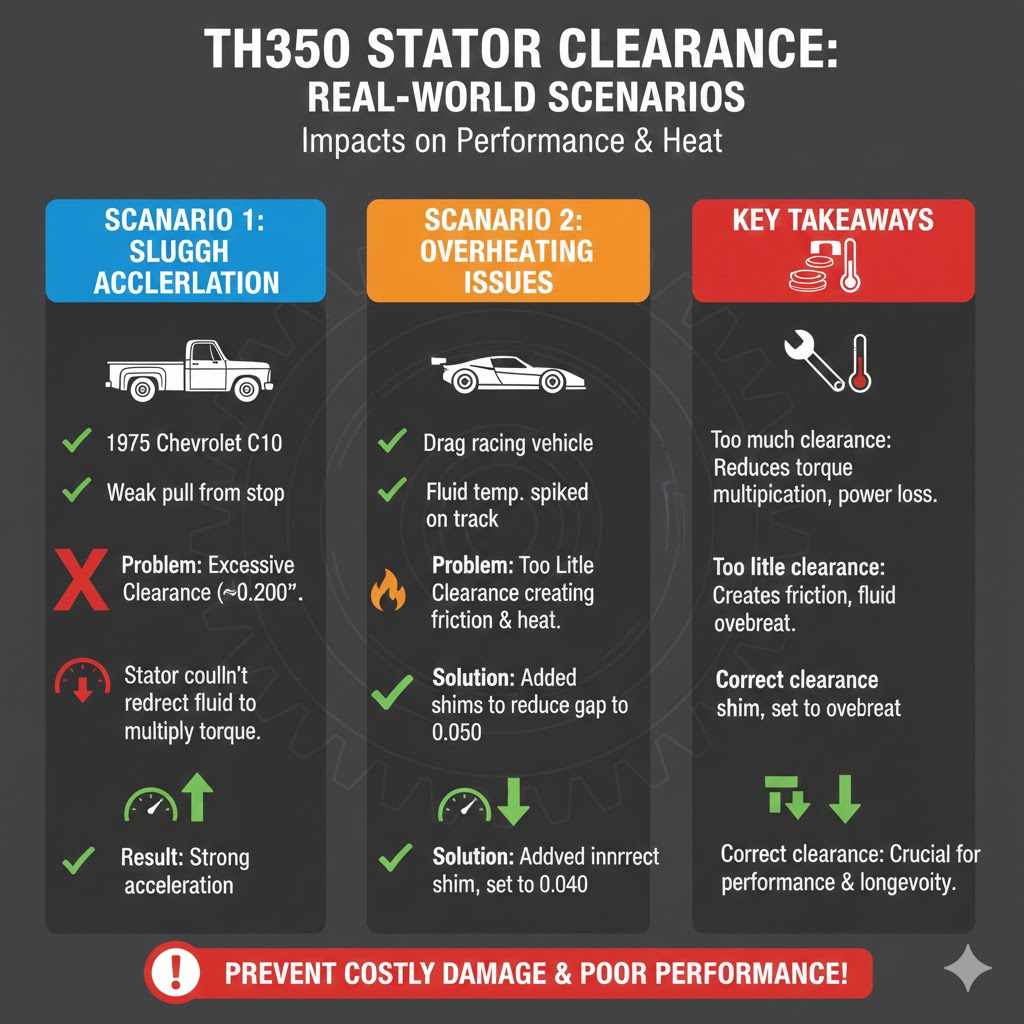
A user was rebuilding their 1975 Chevrolet C10 pickup’s TH350 transmission. After the rebuild, they noticed the truck felt very weak when accelerating from a stop. It struggled to get up to speed.
All other gears shifted fine, but the initial pull was poor.
They decided to pull the transmission and re-examine the torque converter. Upon checking the stator-to-turbine clearance, they found it was too large. The feeler gauge slipped in very easily, indicating a gap of nearly 0.200 inches, far beyond the typical specification.
Because the stator was too far from the turbine, it wasn’t effectively redirecting fluid to multiply torque.
By adding the correct shims to reduce the clearance to around 0.050 inches, the torque converter was reinstalled. After this adjustment, the truck accelerated strongly off the line, like it used to. This case highlights how excessive clearance can rob a vehicle of power.
Scenario 2 A Race Car with Overheating Issues
A performance shop was working on a drag racing vehicle that used a modified TH350. During testing on the track, the torque converter was overheating rapidly, causing the transmission fluid temperature to spike. This led to premature runs and potential damage.
After checking the fluid level and cooling lines, they focused on the torque converter. They measured the stator-to-turbine clearance and found it to be too small, almost zero clearance in some spots. The stator fins were clearly rubbing against the turbine.
This restricted fluid flow and caused extreme friction.
The shop disassembled the converter and removed a shim that had been incorrectly installed. After reassembly and re-measuring, the clearance was adjusted to a more appropriate 0.040 inches. This allowed the stator to pivot freely and the fluid to flow correctly.
The overheating issues on the track were resolved, allowing the car to complete its runs safely.
These examples show the direct impact of correct stator clearance. Too much clearance starves the torque multiplication process. Too little clearance creates friction and heat.
Both extremes lead to significant performance problems.
Frequently Asked Questions
Question: What is the typical range for TH350 torque converter stator clearance
Answer: The typical range for TH350 torque converter stator-to-turbine clearance is generally between 0.030 and 0.080 inches, or about 0.76 mm to 2.03 mm. However, it is crucial to consult the specific service manual for your torque converter model as this can vary.
Question: Can I use a standard feeler gauge set for this
Answer: Yes, a standard feeler gauge set is ideal for measuring torque converter stator clearance. Ensure you have a set that includes the necessary fractional inch or millimeter measurements to match your converter’s specifications.
Question: What happens if the stator clearance is too small
Answer: If the stator clearance is too small, the stator fins may bind and not pivot properly. This can restrict fluid flow, leading to overheating of the torque converter and transmission, and causing a loss of torque multiplication and poor acceleration.
Question: What happens if the stator clearance is too large
Answer: If the stator clearance is too large, the stator will not be able to effectively redirect fluid to multiply torque. This results in reduced torque multiplication, leading to sluggish acceleration, increased slip, and inefficient power transfer.
Question: How often should I check stator clearance
Answer: You should check stator clearance whenever you are rebuilding or replacing a torque converter, or if you are experiencing performance issues related to transmission operation such as slipping or poor acceleration. It is a critical step during transmission servicing.
Summary
Testing TH350 Torque Converter Stator Clearance Guide is essential for proper transmission function. Getting the gap between the stator and turbine just right ensures optimal torque multiplication and fluid flow. Too little clearance causes binding and heat, while too much leads to lost power.
Accurate measurements with feeler gauges and adjustments with shims are key. This careful process guarantees your transmission performs reliably and efficiently.