The Art of Storytelling in Automotive Lifestyle Blogging
Turn repairs, routes, receipts, and meetups into one clear arc: problem, evidence, decision, result. Without that structure, automotive lifestyle posts read like ads and lose trust fast. Use ownership proof to build specific, human, story-driven posts.
What makes an automotive lifestyle blog feel real?
An automotive lifestyle blog feels real when it blends ownership, culture, travel, events, and community into a reader-facing voice. Strong posts use a real ownership story plus specific, verifiable detail, not broad praise or brand language. That separates lived experience from copy that could fit any model.
What readers can sense in the first 200 words
Readers look for signs that a post came from actual use. A service invoice, a fuel receipt, a route log, a track-day note, or a photo of a worn part can all give the story weight. A vague opening about “loving cars” does not.
Say your post opens with a cold-start problem, a 180-mile route to a weekend meet, and a note that the alternator light came on near mile marker 42. That is concrete. A sentence about “the thrill of driving” is not.
Believable detail versus generic enthusiasm
Believable detail names parts, places, and consequences. Generic enthusiasm leans on phrases like “incredible build,” “amazing day,” or “pure passion,” which sound interchangeable. Authenticity matters because readers can tell when a writer has evidence and when a writer only has tone.
A common first-timer mistake is to stack adjectives where facts should go. A better approach is to mention the tire size, the weather, the fuel stop, the delay, and what changed after the repair or trip.
Why storytelling matters in car culture content

Storytelling makes automotive content stick. The guide frames automotive lifestyle blogging as a bridge between car passion and storytelling, and that bridge matters because readers remember a sequence of events more easily than a spec dump. A plain feature post can inform, but it rarely brings repeat visits on its own.
How stories create memory and repeat visits
A post built around a problem, decision, and outcome gives readers a reason to come back. They want to know whether the fix held, whether the route was worth repeating, or whether the event changed the next plan. That is especially useful in a reader-facing blog that also relies on photos and video support.
Where plain feature posts fall short
Feature posts often flatten the experience into praise. They describe the car, then stop. Story-led posts give the reader motion: what failed, what was tried, what cost time, what changed after the repair, and what the next drive revealed.
That difference matters in restoration, road trips, overlanding, EV ownership, and track days. Each niche has its own evidence trail, but all of them benefit from a clear arc and concrete proof.
What trust looks like in a reader-facing voice
Trust comes from candor about what is known and what is not. If the evidence is thin, say so. If a result is mixed, report the mix. If a post includes a partnership, disclose it clearly. Sponsored content disclosure is part of trust, not a footnote.
How do you structure a car post like a story?
Use the CAR framework: context, action, results. Start by explaining the situation, move through the decision or repair, then finish with a result that changes the next drive, repair, or plan. That structure keeps the post readable and prevents it from drifting into a parts list with no payoff.
Write the opening so the reader knows the stakes
The opening should quickly cover what happened, why it mattered, and what evidence seems to support the story. Mention the symptom, the route, the event, or the deadline. Then anchor it with a receipt, service note, or photo.
Build the middle from decisions, obstacles, and outcomes
The middle is where the story earns its place. Include the diagnostic path, the trip interruption, the weather, the charging stop, the wait for parts, or the event schedule that shaped the day. That is where the post becomes specific instead of promotional.
End with a result that changes the next drive, repair, or plan
Do not end only with relief. End with what changes next. Maybe the new brake pads fixed the fade, but the next step is a fluid flush. Maybe the EV route planning worked, but the charging stop needs a different timing window. A result should move the story forward.
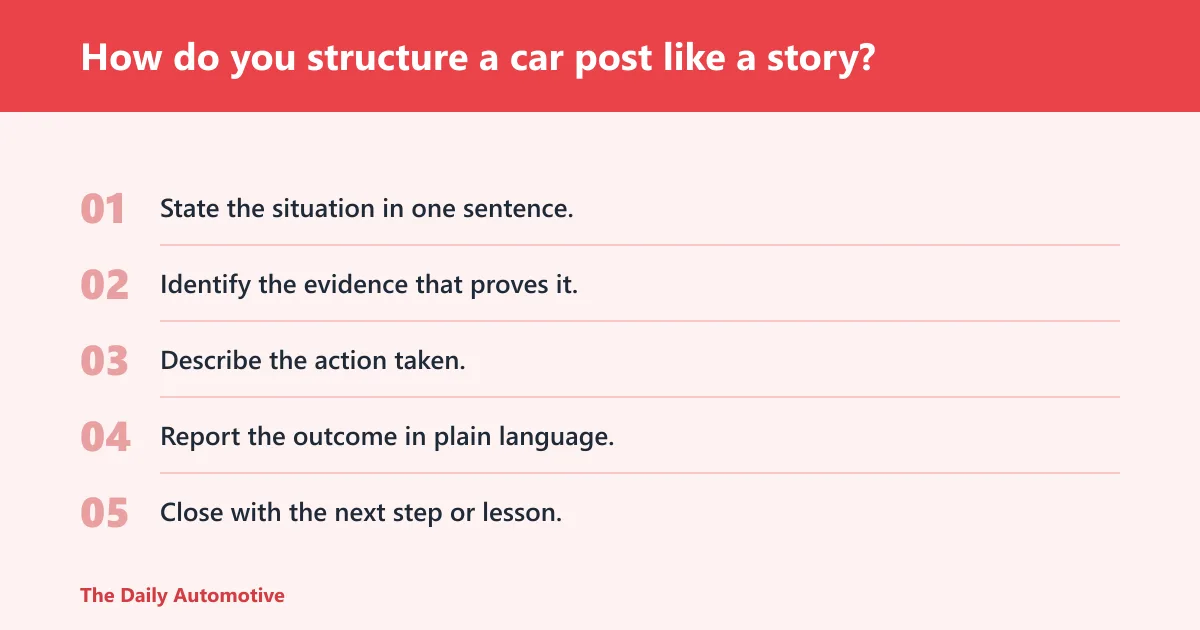
- State the situation in one sentence.
- Identify the evidence that proves it.
- Describe the action taken.
- Report the outcome in plain language.
- Close with the next step or lesson.
| Story part | What to include | Evidence type |
|---|---|---|
| Context | What was wrong, where it happened, and why it mattered | Route log, event note, service warning, photo |
| Action | What you checked, fixed, changed, or documented | Repair order, receipt, interview snippet, checklist |
| Results | What improved, what stayed unresolved, and what comes next | After photo, follow-up note, revised route plan |
What counts as proof in automotive storytelling?
Proof is anything a reader can verify or at least recognize as grounded in real ownership or event participation. Repair orders, fuel receipts, route logs, before-and-after photos, and event notes can all count as proof because they help connect the story to a place, time, or action. Interview snippets add another layer when the post covers a builder, owner, or organizer.
Repair orders, fuel receipts, and service notes
These details help the post avoid generic enthusiasm. A repair order can confirm the part number, the labor, or the symptom. Fuel receipts can support trip timing and range claims. Service notes can show the fault code, the maintenance interval, or the advice given by a shop.
Route logs, trip notes, and event schedules
Route logs and trip notes turn a drive into a narrative. Event schedules do the same for meets, shows, and cars-and-culture gatherings. The guide notes that car culture coverage should go beyond cars to events and meet-ups, and those documents help show the reader how the day unfolded.
Before/after photos and detail shots
Before/after images make the result visible. Detail shots of wear, cleanup, alignment, or fitment keep the story honest. Photography should use quality equipment, good lighting, smart angles, and careful editing so the visual record supports the text instead of replacing it.
Interview snippets from owners, builders, or organizers
Short interview lines can clarify intent and context. Ask what failed, what changed, or why a build choice mattered. Keep the quote tied to a fact the reader can place in the story, such as a meet date, a route, or a modification list.
Story-source checklist and post template
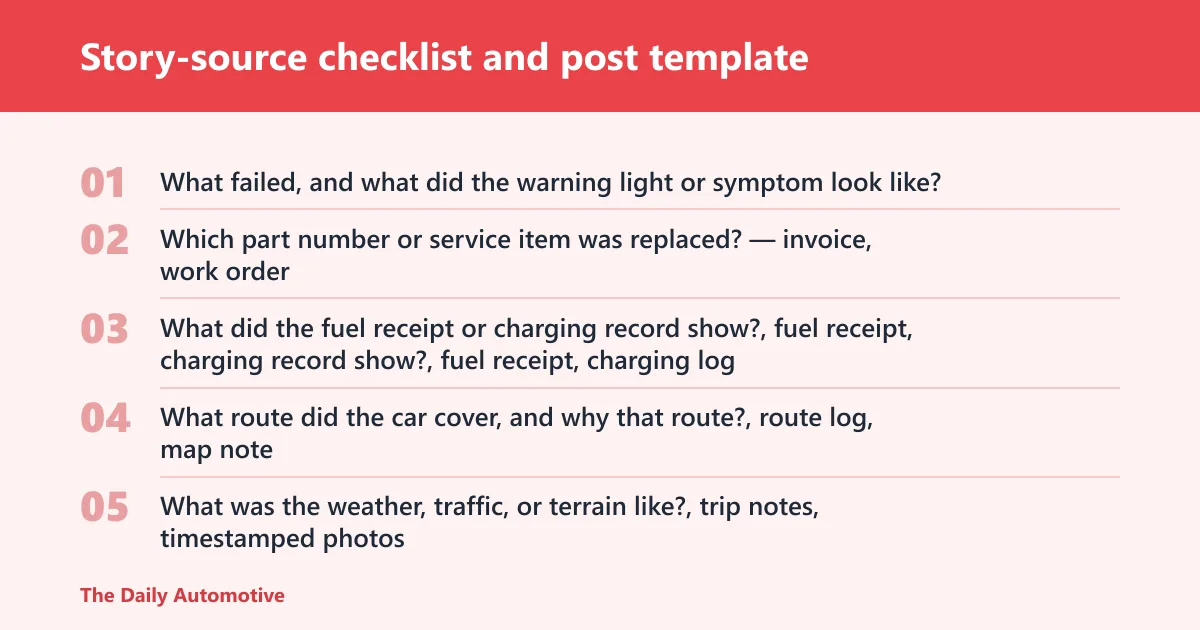
Good automotive stories come from organized source material. The checklist below turns raw ownership evidence into publishable material, and it helps writers avoid filler. Use it before drafting, not after.
12 prompts mapped to evidence types
- What failed, and what did the warning light or symptom look like? — repair order, dash photo
- Which part number or service item was replaced? — invoice, work order
- What did the fuel receipt or charging record show?, fuel receipt, charging log
- What route did the car cover, and why that route?, route log, map note
- What was the weather, traffic, or terrain like?, trip notes, timestamped photos
- What happened at the meet, show, or gathering?, event schedule, attendance note
- What detail changed before and after the work?, before/after photos
- What did the owner, builder, or organizer say?, interview snippet
- What did the repair or trip cost in time, not just money?, service timeline, delay note
- What did you expect to happen, and what actually happened?, planning note, result note
- What remains unresolved?, follow-up list, inspection note
- What should the next post cover?, editorial note, photo queue
A fill-in template for one publishable post
Opening: Start with the problem, route, or event. Name the evidence in the first paragraph. Example: “The warning light came on halfway to a Saturday meet, and the service note showed a charging issue that changed the rest of the trip.”
Body: Explain the decision, the work, or the route in order. Add one or two verified details per paragraph. Keep each paragraph tied to a source: receipt, photo, schedule, or quote.
Payoff: End with the result and the next step. Say what improved, what still needs attention, and how that changes the next drive or event plan.
How to turn raw notes into a clean draft
Sort your material by type first, then by time. Put receipts with receipts, photos with photos, and event notes with event notes. Then write the story from the evidence outward. That keeps the post grounded and stops it from drifting into brand copy.
How do you keep the story authentic instead of salesy?
Keep the writing close to evidence and away from brochure language. Authenticity comes from specific lived detail, clear disclosure, and honest limits. If a post sounds like it could be pasted into a product page, it needs more context and less polish.
Avoid copy that sounds like a brochure
Brochure language fills space without adding proof. Words like “premium,” “iconic,” or “best-in-class” are weak on their own. Replace them with part numbers, route distances, repair symptoms, event names, or specific changes after a modification.
Signal uncertainty when the evidence is thin
If the car is still being diagnosed, say that. If the road trip result depends on a future service visit, say that. Readers trust a post more when it distinguishes between what is confirmed and what is still being checked.
Disclose sponsorships, affiliate links, and brand deals clearly
Transparency matters. If a post includes sponsored content, a partnership, or an affiliate relationship, disclose it plainly. The guide advises disclosing sponsored content or partnerships because readers can tell when a post is trying to hide the commercial layer.
Use specific details to separate lived experience from hype
Specificity is the antidote to hype. Mention the tire wear pattern, the charging stop timing, the mud on the rocker panels, or the event lot layout. Those details make the post look observed rather than assembled from marketing language.
Which photos and video support the narrative best?
Photography and videography should support the story, not compete with it. Quality equipment matters, but so do angles, lighting, editing, route footage, detail shots, and short clips that can be shared on social platforms. The image should prove the point the paragraph makes.
Photography basics: equipment, lighting, angles, editing
Use quality equipment, but do not confuse gear with judgment. Good light makes body lines, repair work, and interior details easier to read. Choose angles that show the issue or result, then edit for clarity instead of dramatic filters that hide the evidence.
Videography basics: route footage, motion, detail shots
Route footage gives motion to road trips and overlanding stories. Motion shots show a car in context, not only in static poses. Detail clips can document startup behavior, suspension movement, wheel clearance, or a charging stop in a way a still frame cannot.
How to cut clips for short-form social distribution
In my experience, short-form clips work best when they carry one point each. Use one clip for the problem, one for the repair, one for the result, and one for the event or route. That makes the social version feel like a useful excerpt rather than a random teaser.
How do I find my voice as an automotive blogger?
Find your voice by deciding what evidence you notice first and what you want readers to learn from it. A strong voice is not a louder voice. It is a consistent way of selecting details, framing uncertainty, and connecting the machine to the event, trip, or community around it.
Voice changes by niche
Restoration blogs may favor patience, sourcing, and fitment. Road trip posts often need route context and practical stops. Overlanding stories should show terrain, cargo choices, and recovery decisions. EV ownership needs charging data, route planning, and range realism. Track-day writing should report lap conditions, tire behavior, and brake consistency.
Two common writing habits that help
First, use the same level of specificity every time. Second, keep a reader-facing tone that explains rather than performs. That helps the blog feel like a source of useful ownership knowledge, not a string of unrelated impressions.
How do automotive lifestyle blogs attract and keep readers?
Blogs keep readers when they combine clear storytelling, consistent evidence, and active engagement. An SEO-friendly platform with customization and flexibility helps the site organize posts well, while social media integration supports distribution. Responding to comments and messages also builds relationships that make readers come back.
Choosing a platform and publishing rhythm
Choose a platform that can be shaped around your categories, image needs, and social sharing habits. The right setup should be SEO-friendly and integrate with social media without making every post feel forced into one template. Publish on a rhythm you can keep with real evidence.
Community interaction matters
Reader comments often surface the next story. Someone asks about tire wear, another asks about the route, another wants the event schedule. Those questions point to the next useful post and keep the blog tied to community interest rather than isolated publishing.
How can I monetize an automotive lifestyle blog without losing trust?
Monetization works when it does not hide the commercial layer. Affiliate marketing, sponsored content, and merchandise sales are common revenue streams, but they only help if the audience trusts the reporting. Clear disclosure and a consistent editorial standard are what keep the site credible.
Brand collaborations and affiliate links
Brand collaborations should fit the topic and the evidence trail. If the post is about a repair, the partnership should not bury the diagnostic story. If an affiliate link is present, make the relationship visible and keep the recommendation tied to an actual use case or a clear editorial judgment.
Merchandise and community support
Merch works best when it grows out of the blog’s identity, not the other way around. It should be an extension of the community and the narrative voice. That keeps the commercial side from crowding out the evidence-based writing readers came for.
Frequently asked questions
How do you tell a good story in an automotive lifestyle blog?
Start with a concrete situation, then move through evidence, action, and result. A good story names the problem, shows what was verified, explains what changed, and ends with a next step. That structure gives readers something to follow instead of a loose collection of car thoughts.
What makes automotive storytelling feel authentic instead of salesy?
Authentic writing uses specific, verifiable detail and keeps marketing language out of the way. Repair orders, receipts, route notes, and event schedules make the post feel grounded. Clear disclosure also matters, because readers trust writers who are direct about sponsorships and partnerships.
How can I structure a car blog post like a story?
Use the CAR framework: context, action, results. Context sets the stakes, action covers the decision or repair, and results show what changed. That order keeps the post readable and prevents it from turning into a list of parts with no narrative payoff.
What photos and video work best for automotive lifestyle blogging?
Use photos and clips that support the story’s evidence. Good lighting, useful angles, and clean editing help readers read the car and the moment. Route footage, motion shots, and detail clips are especially effective when the post covers a drive, build, meet, or track day.
How do I find my voice as an automotive blogger?
Find your voice by deciding what you notice and how you report it. Some writers lean toward road trip logistics, others toward restoration detail, event coverage, or EV ownership. A steady reader-facing tone, plus consistent evidence and disclosure, does more than trying to sound dramatic.
How can I monetize an automotive lifestyle blog without losing trust?
Use affiliate links, sponsored content, partnerships, or merchandise only when the editorial standard stays clear. Disclose paid relationships, separate opinion from promotion, and keep the story tied to real ownership evidence. Readers usually stay when the commercial layer is visible and the reporting still feels honest.
Products related to this article
Sponsored / affiliate links. As an Amazon Associate I earn from qualifying purchases. I may earn additional commission from eligible campaigns.