Hot Wheels Car Culture Ford GT Review and Verdict Details
Hot Wheels Car Culture Ford GT earns shelf space if you want a premium 1:64 Ford GT with metal/metal construction, Real Riders, and a clean casting; pass if your version has rough tampos, wheel mis-match, or casting defects. Buy the wrong release and you can overpay for a common variant that looks better in photos than in a display case. This guide identifies the main Car Culture Ford GT versions, what to inspect, and how they compare with other premium Ford castings.
Verdict

For collectors, the appeal is narrow and clear: Car Culture sits in Hot Wheels’ premium collector-focused lineup, so you should expect better wheels, better paint, and more detail than mainline cars. That still does not make every release equal. The release ID, deco, and condition matter more than the badge on the card, especially when GT, GT40, and MkIV variants are easy to mix up.
📊 The Hot Wheels GT40 could have gone on for five days, one hour, 10 minutes, and 42 seconds before breaking. Source: Weird Experiment: This Hot Wheels Car Drove 13,459 Scale ….
Specs at a glance
| Spec | Hot Wheels Car Culture Ford GT |
|---|---|
| Scale | 1:64 |
| Line | Hot Wheels premium Car Culture |
| Construction | Metal body with plastic base, premium wheel setup |
| Collector focus | Display-first diecast with higher detail than mainline |
| Heritage connection | Ford GT / GT40 lineage, including Le Mans ties |
| Packaging | Release-specific card art and branding vary by run |
That table is the easy part. The harder part is identifying the exact release in hand, because Car Culture Ford GT castings can differ by deco theme, wheel choice, and packaging, while older Ford race cars in the same collector space can point to GT40 or MkIV rather than the road-going GT.

Who it is for
The Hot Wheels Car Culture Ford GT is for display collectors, Car Culture completionists, and Ford racing fans who want a premium 1:64 model with real shelf presence. It is less compelling for buyers who only want a sturdy toy, because the price and condition sensitivity make sense mainly in a collector case.
If your goal is a loose Ford GT to roll around a desk, a mainline casting can be easier to replace. If your goal is a carded premium piece or a clean loose example for a themed display, Car Culture is the better lane.
Display collectors
Collectors who keep cars carded or line them up in acrylic cases will care most about paint, tampos, wheel stance, and packaging. For that buyer, the Ford GT works when the release theme is strong and the example is clean.
Car Culture completionists
If you build full Car Culture sets, the Ford GT matters even when it is not the rarest car in the mix. Completionists should prioritize card condition, unbent blister edges, and a release that matches the series art.
Ford racing fans
Ford fans may buy it for the lineage as much as the casting. That is fair, but the exact version matters: a Ford GT is not a GT40, and a GT40 MkIV carries a different motorsport story tied to Ford’s 1967 Le Mans win.
Play-first buyers
Buyers who want play value first may find the premium line less practical. The cars are durable and collectible, but premium wheels and finish mean you should care more about condition than you would with a basic mainline release.
What works
The best Car Culture Ford GT releases look convincingly premium in 1:64 scale. You get the collector-line mix of paint, deco, and wheel treatment that makes the model read as a display piece instead of a throw-in toy.
The casting also benefits from Ford’s racing story. Even when the release is based on the modern Ford GT rather than the older GT40 family, the shape sits in a familiar endurance-racing lineage that collectors recognize immediately.
Paint and tampo placement
Good examples have clean paint with sharp graphics and well-centered tampo placement. That matters more than the card art because a slightly off tampo or fuzzy logo can make a premium release look cheaper than its price suggests.
Wheel choice and stance
Real Riders-style premium wheels are part of the appeal, but the real check is stance. A car that sits crooked or has one wheel tucked in oddly loses display value fast, even if the rest of the casting is solid.
Lineage and shelf appeal
The Ford GT name carries enough Le Mans and GT40-era history to give the model context. Ford’s 1967 Le Mans win is directly tied to the GT40 MkIV lineage, and that connection gives the premium Ford family extra weight for collectors who care about motorsport history. (thedrive.com)
Say your shelf already has a premium Mustang and a Bronco from Car Culture. A Ford GT adds a lower, more race-focused shape, so the lineup does not feel repetitive. The car reads differently at a glance, which is half the point of a collector shelf.
What does not
The casting is still subject to the usual premium Hot Wheels wear points. Paint chips, axle wear, wheel alignment problems, and blister or card damage can turn a good release into a pass, especially if the seller prices it like a mint piece.
Used examples also age in ways that matter more on premium cars than mainline ones. Once the wheels wear or the paint edge chips, the loss is obvious in a display case.
Packaging risk
Carded examples should be checked for bends, soft corners, and crushed blisters. On a premium release, packaging condition can change the value more than a casual buyer expects.
Wheel and axle wear
A common first-timer mistake is to assume a premium car still rolls like new if it looks clean from the top. Bent axles, uneven wheel contact, or scuffed rims can be hidden until you spin the car in hand.
When the casting feels less convincing
Some Ford castings in the broader Hot Wheels premium line read more clearly than others. The Ford GT can lose ground if the release deco is too plain or if the wheel choice does not suit the body shape, while stronger GT40 or race-liveried pieces may carry more visual drama.
What should you inspect before buying used?
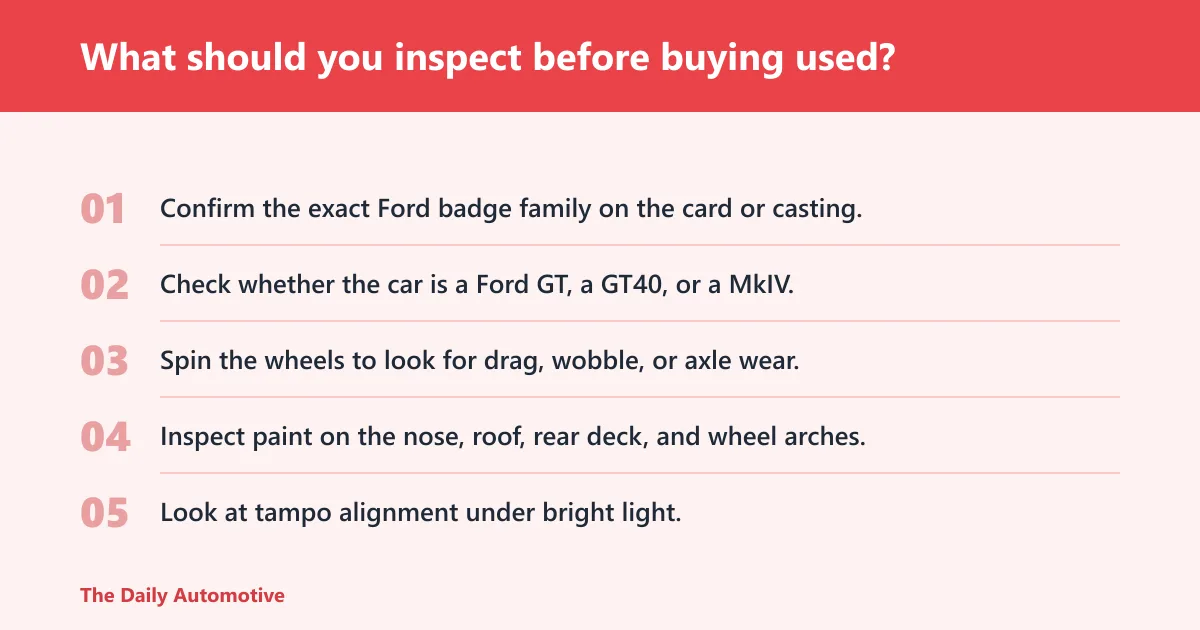
Check the exact release first, then inspect condition in hand. The most common problems are misread lineage, worn wheels, paint chips, tampo error, and package damage. A used premium Ford GT is worth buying only when the version and condition match the asking price.
The checklist below is built for collector decisions, not play value. It separates ID cues from wear points so you can tell whether the car belongs in a display case or should be skipped.
| Release ID cues | Common condition issues | What premium details to verify | Buy/skip verdict by collector type |
|---|---|---|---|
| Car Culture card art and series branding; Ford GT name on the blister card | Bent card, lifted blister, edge wear | Card match to the release theme and clean printing | Buy carded if you collect sealed Car Culture; skip if packaging is rough and price is high |
| Modern Ford GT shape with road-car proportions | Paint chips on nose, mirrors, or rear deck | Sharp body lines and even paint coverage | Buy for display collectors if paint is clean; skip if chips sit on visible edges |
| GT40 or MkIV cues: lower, older race-car profile, long-tail endurance-racer look | Misidentified listing, wrong decade, swapped photos | Correct lineage match to Ford GT, GT40, or MkIV | Buy only if the listing matches the actual casting; skip if the seller confuses the family |
| Premium wheels, not basic mainline rollers | Wheel wobble, axle drag, uneven ride height | Round tires, aligned axles, smooth spin | Buy for loose display if the wheels are true; skip if roll issues are visible |
| Series-specific deco and tampo layout | Fuzzy logos, off-center stripes, missing tampo edges | Clean tampo placement across hood, sides, and rear | Buy if the deco is sharp; skip if the graphics look weak in hand |
- Confirm the exact Ford badge family on the card or casting.
- Check whether the car is a Ford GT, a GT40, or a MkIV.
- Spin the wheels to look for drag, wobble, or axle wear.
- Inspect paint on the nose, roof, rear deck, and wheel arches.
- Look at tampo alignment under bright light.
- For carded cars, inspect blister clarity and corner crush before paying.
How does it compare with other Car Culture Ford castings?
The Ford GT sits in the middle of the Car Culture Ford conversation. It is usually cleaner and more contemporary than many older race cars, but it can feel less dramatic than a GT40 or a MkIV when the other car wears a period racing livery with stronger visual contrast.
Compared with Car Culture Mustangs and Broncos, the Ford GT has a lower, sleeker, more supercar-like shape. That helps it stand out on a shelf, but it also means the casting has less rugged character than an off-road or muscle-car premium Ford.
Ford GT versus Mustang and Bronco premiums
Mustang premiums tend to lean on muscle-car identity and broad market recognition. Broncos bring truck presence. The Ford GT is the cleaner display pick if you want one Ford that looks like an endurance-minded exotic instead of a street machine or utility vehicle.
Ford GT versus GT40 and MkIV releases
GT40 and MkIV castings usually matter more to collectors who want Ford’s racing history in its purest form. The GT40 MkIV, in particular, carries the direct Le Mans connection that Ford’s 1967 win made famous, so some collectors place it above the modern GT.
That comparison is not about which car is better in the abstract. It is about what reads strongest in a cabinet. A race-liveried GT40 or MkIV can draw the eye more quickly, while a modern Ford GT may fit better in a contemporary performance display.
How it sits in the premium Hot Wheels line
Hot Wheels premium cars are expected to bring metal bodies, collector paint, and more authentic wheels than mainline releases. The Ford GT hits that brief when the release is clean, but it still depends on execution. Premium does not cancel out sloppy wheels or weak tampo placement.
Should you buy it?
Buy a Hot Wheels Car Culture Ford GT when the release is correctly identified, the wheels sit straight, and the paint and tampo work are clean. Expect a used loose example to land in a collector range rather than a bargain bin range, with carded or especially clean variants asking more. If the seller cannot confirm the exact release, move on.
For loose display, a clean example is enough. For sealed collecting, card condition matters more than whether the car rolls well. If you already own strong premium Ford castings, buy the Ford GT only when the deco or release theme adds something your shelf does not have yet.
Say your shelf is 12 inches deep and the Ford GT sits beside two long-tail race cars. A crooked axle becomes obvious immediately, because the car will look like it leans toward one side under light. In that case, the cleanest example is the only one worth paying for.
Alternatives

Auto World 1966 Ford GT40#2 Black Limited Edition is the better buy if you want a more explicit GT40 race-car presentation with true-to-scale detail and officially licensed limited-edition positioning. Its drawback is simple: it is a different casting family, so collectors looking specifically for a modern Ford GT should not treat it as a substitute.

Greenlight 2024 Ford Mustang GT Convertible fits collectors who want a modern Ford premium with a different body style and a metal build at a similar price point. The tradeoff is that it lacks the Ford GT’s endurance-racing identity, so it works better as a companion piece than a direct comparison.
Frequently asked questions
Is the Hot Wheels Car Culture Ford GT worth buying?
Yes, if you want a premium 1:64 Ford with better paint, Real Riders, and stronger display appeal than a mainline car. It is worth skipping when the release is misidentified, the tampos are rough, or the wheels and packaging show obvious wear.
What makes the Hot Wheels Car Culture Ford GT different from basic Hot Wheels Ford GT castings?
The Car Culture version sits in Hot Wheels’ premium collector-focused lineup, so it usually brings better wheels, more detailed paint, and a display-first finish. Basic castings are more about broad availability and play value, while Car Culture is built for shelf appeal.
How detailed is the Hot Wheels Car Culture Ford GT?
It is detailed enough for a 1:64 premium car, with sharper paint and tampo work than mainline releases. The detail level still depends on the specific release, so clean graphics and correct wheel choice matter more than the badge on the card.
Which Ford GT version is the Car Culture release based on?
That depends on the exact release. Some versions are modern Ford GT castings, while collector confusion often comes from GT, GT40, and MkIV names being used in the same conversation. Check the card art, body shape, and deco before buying.
What should I check on a used Hot Wheels Car Culture Ford GT?
Check wheel alignment, axle wear, paint chips, tampo placement, and card or blister damage if it is sealed. Also confirm the exact release, because a seller may list a GT40 or MkIV as a Ford GT, which changes collector value.
What price range should I expect for Hot Wheels premium Ford GT releases?
Expect used prices to vary with release, condition, and whether the car is loose or carded. Common releases should stay in a collector range rather than an extreme premium range, but scarce variants, mint cards, and complete series examples can climb fast.
Is the Hot Wheels Car Culture Ford GT good for display or play?
It is better for display. The premium build still holds up as a diecast car, but collectors usually care more about paint, wheels, and packaging than rough play. If play value comes first, a cheaper mainline car is easier to replace.
Products related to this article
Sponsored / affiliate links. As an Amazon Associate I earn from qualifying purchases. I may earn additional commission from eligible campaigns.