Car Ownership and Outdoor Adventure Guide for Buyers
Car ownership can shorten the drive to trailheads, lakes, and campsites, and it lets you carry gear that buses and trains usually cannot. The right vehicle depends on passenger count, cargo volume, range, and road type. Pick poorly and you pay more in fuel, parking, maintenance, and missed trips because the vehicle cannot handle the route or the load. This guide explains how car ownership affects hiking, camping, road trips, and gear hauling, plus how to choose between sedan, hatchback, wagon, SUV, truck, or EV.
How car ownership changes access to outdoor adventure
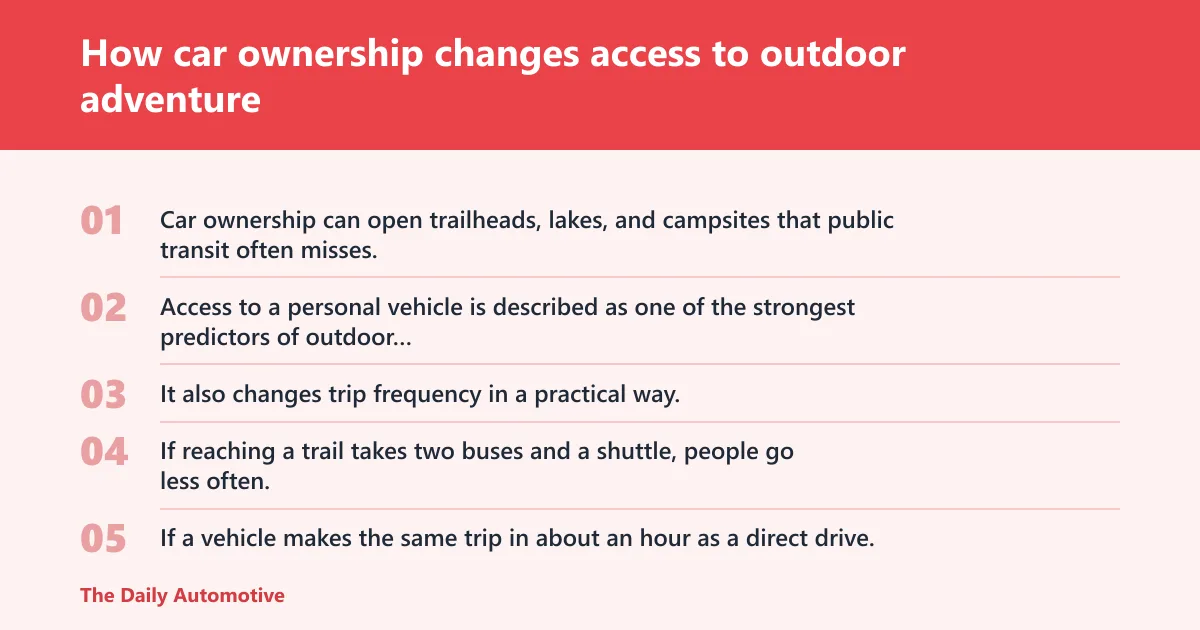
Car ownership can open trailheads, lakes, and campsites that public transit often misses. Access to a personal vehicle is described as one of the strongest predictors of outdoor participation, because the car turns a long, awkward transfer into a direct trip that fits after-work hikes, dawn launches, and weekend runs to remote sites.
It also changes trip frequency in a practical way. If reaching a trail takes two buses and a shuttle, people go less often. If a vehicle makes the same trip in about an hour as a direct drive, the outing can be easier to repeat, even when the destination itself stays the same.
When ownership helps less than people expect
Car access is not a guarantee. A vehicle can fail to improve access when purchase price, insurance premiums, fuel and maintenance costs, parking, or storage crowd out the recreation budget. It can also fall short when roads are restricted, the trailhead still sits too far away, or the vehicle is too low for the route.
Picture a driver with a compact sedan trying to reach a winter trail on an unplowed forest road. The car may get them close, but if clearance is low and the last mile is rough, the vehicle adds stress rather than access. In that case, a different route, a shuttle, or a rental can be the better answer.
What type of car works best for your outdoor trips?

The best body style depends on what you carry and where you drive. Sedans can work for light, day-trip use. Hatchbacks add flexibility. SUVs and crossovers suit mixed road conditions and bulky cargo. Pickup trucks can suit hauling equipment and rougher routes, especially when open bed space matters more than enclosed storage.
How sedan, hatchback, SUV, crossover, and pickup compare
| Vehicle type | Typical cargo space | Ground clearance | Roof-rack potential | Fuel cost tendency | Best-fit activities |
|---|---|---|---|---|---|
| Sedan | Low to moderate | Low | Sometimes, but limited | Usually lower | Day hikes, solo trips, small coolers, light weekend bags |
| Hatchback | Moderate, flexible with folded seats | Low to moderate | Often available | Usually lower to moderate | Day hikes, biking, light camping, urban-to-trail use |
| SUV | Moderate to high | Moderate to high | Common | Moderate to high | Camping, mixed weather, dirt roads, family trips |
| Crossover | Moderate | Moderate | Common | Moderate | Weekend camping, hiking, road trips, mixed daily use |
| Pickup | High in bed, variable in cab | Moderate to high | Common with cab and bed systems | Moderate to high | Hauling, kayaks, bikes, heavy gear, rough terrain |
SUVs and trucks are presented as preferred choices for adventurers in competitor content, and that makes sense for cargo room and rougher routes. Still, a sedan can be the smarter buy if most trips are paved, close to home, and light on gear. The best car is the one that fits the actual route mix.
Use this vehicle-fit matrix before you buy
Use the matrix as a filter, not a slogan. If you mostly carry one pack and a pair of boots, a hatchback may cover your trips with lower operating cost. If you move a family, a cooler, and wet gear every weekend, an SUV or crossover may reduce repacking and keep the cabin usable.
Fuel cost matters because recurring spending changes how often you can go out. A vehicle that costs less to run may leave more room in the budget for campsite fees, trail permits, or a second trip in the same month.
How do you choose a car for hiking, camping, and gear hauling?

Choose around the gear you actually move. Camping gear such as tents, coolers, sleeping bags, bikes, and kayaks can be bulky enough to affect vehicle choice. If the cargo does not fit without folding seats, stacking to the roof, or strapping on external racks, the vehicle is too small for the trips you plan.
Match the vehicle to the activity
For hiking, a hatchback or sedan is often enough if the group is small and the load is light. For camping, an SUV or crossover usually makes more sense because tents, sleeping bags, and coolers take space fast. For biking or kayaking, roof racks, hitch carriers, or bed space become the deciding factor.
For climbing, the load is often compact but awkward: ropes, pads, shoes, helmets, and bins can fill a trunk quickly. For bikepacking, a hatchback with flat-folding seats may be easier than a tall SUV because it swallows long bags without wasting fuel on unused bulk. For winter camping, clearance and traction matter more because slush, ruts, and snowpack change access.
Check the storage plan before you buy
Ask three questions. Does the interior fit the gear without blocking the driver’s view? Can you add a rack without creating noise or awkward loading? Will the vehicle still work as a daily driver when the outdoor kit is left at home?
Say your weekend setup includes a couple of bikes, a tent, and camp chairs. A sedan may need a trunk rack and careful packing, while a hatchback or crossover can usually keep the cabin cleaner and faster to load. That difference matters when you leave after work.
Can a car make it easier to transport bikes, kayaks, or camping gear?
Yes. A car can make bulky equipment far easier to move because it creates enclosed storage, roof-rack space, or bed space that public transit usually does not offer. Bikes, kayaks, paddles, tents, and sleeping gear are all easier to manage when the vehicle is designed around them rather than squeezed into a passenger-only plan.
What to look for in gear transport
- Measure the longest item first, such as a kayak, bike wheelbase, or tent pole bag.
- Check whether seats fold flat and whether the load area stays usable with rear passengers installed.
- Confirm roof-rack compatibility or hitch capacity before you buy carriers.
- Leave room for wet, muddy, or sharp gear so it does not damage the cabin.
A pickup truck can be especially useful when bed space matters more than enclosed cargo space. That helps with dirty bikes, firewood, or heavy bins. A hatchback can also do a lot if the rear opening is wide and the seats fold flat, which is why some outdoor users prefer them for mixed use.
What are the real costs of owning a car for recreation?
The real cost is more than the sticker price. Purchase price is a major factor, but insurance premiums are an ongoing expense, and fuel and maintenance costs continue every month. Add depreciation, parking, and occasional repairs, and a car can pull enough from the recreation budget to change how often you travel.
Buying versus renting versus ride-sharing
If outdoor trips are rare, renting can be cheaper than owning. Ride-sharing can work for a short trip to a city trail, but it breaks down when the destination is remote, returns are uncertain, or there is wet, bulky gear. Ownership makes sense when the car is used often enough to justify the fixed costs.
For some drivers, the equation changes by season. If someone camps only a few times in summer and hikes locally the rest of the year, they may not need a large vehicle. Another person who drives to trailheads weekly might save more overall by owning a modest, efficient car than by paying repeated rentals.
How can you cut the environmental impact of outdoor driving?
You can lower the impact by choosing efficient vehicles, combining trips, sharing rides, and planning charging or fuel stops before departure. Hybrid vehicle options can reduce fuel use for repeated trips, while electric vehicle choices reduce tailpipe emissions but require route and charging planning for remote destinations.
Practical ways to drive cleaner
Start with the vehicle. A hybrid can be a good fit for frequent local trips because it trims fuel use without changing your route planning much. An EV can work well if the destination has dependable charging access or if the round trip fits comfortably within the car’s real-world range.
Then change the trip pattern. Carpooling cuts per-person emissions, and combining errands with trail runs avoids extra miles. Check tire pressure before longer drives, since underinflated tires raise rolling resistance and waste fuel. Plan the route so you do not backtrack for food, fuel, or charging.
What should you check before driving to remote outdoor spots?
Before a remote trip, check tires, fluids, and fuel or charge range, then confirm weather, road conditions, and backup routes. Remote access fails fast when a tire is weak, a road turns rough, or a charger is farther away than expected. Good planning matters more as the route gets less forgiving.
Remote-trip readiness checklist
- Inspect tire tread, sidewalls, and pressure.
- Confirm oil, coolant, washer fluid, and brake fluid levels.
- Verify fuel range or battery range with a margin left over.
- Check weather, closures, and road surface conditions.
- Carry recovery basics like a flashlight, phone charger, first aid kit, tire inflator, and basic tools.
- Pack food, water, layers, and a printed or downloaded map if service is weak.
A common first-timer mistake is packing for the campsite but not for the drive. A bottle jack and spare may be standard equipment, but they do not help much if the route needs traction boards, a tow strap, or an alternate exit. Match the backup plan to the road, not just the activity.
What are the financial tradeoffs of owning a car for recreation?
The tradeoff is access versus fixed expense. Owning a car can make weekend trips easier and more frequent, but fuel, insurance, maintenance, depreciation, and parking can reduce discretionary spending. If those costs crowd out camping fees or trip budgets, ownership may be less practical than renting or ride-sharing.
When ownership makes financial sense
Ownership fits best when the vehicle serves daily life and outdoor trips. If it sits unused for weeks, the fixed costs become hard to justify. If it replaces repeated rentals, taxis, or complicated transit connections, the math can swing the other way. Frequency is the key variable.
Frequently asked questions
How does car ownership affect access to outdoor adventure?
Car ownership can expand access to trailheads, lakes, and campsites that public transit routes often do not cover. That direct access can make outings easier to repeat and can reduce trip time, especially for places with early starts, awkward transfers, or gear that is hard to carry on buses or trains.
What type of car is best for camping and hiking trips?
For light hiking trips, a sedan or hatchback may be enough. For camping, an SUV or crossover is often a better fit because it usually provides more cargo room and a higher driving position. Pickup trucks work well when hauling equipment or rough routes matter more than enclosed storage.
How do I choose a car for outdoor activities?
Start with the gear list and route type, not the badge. Compare cargo volume, ground clearance, roof-rack potential, and fuel cost against your actual trips. If you hike locally, a smaller car may work. If you haul bikes, kayaks, or winter gear often, choose a vehicle with more space and flexibility.
Are SUVs and trucks better for outdoor adventure than sedans?
Not always. SUVs and trucks are often preferred by adventurers because they offer more cargo room and can handle rougher routes better, but they cost more to fuel and may be larger than needed. A sedan can be the better choice for lighter trips, lower costs, and easier daily parking.
How can I reduce the environmental impact of driving to outdoor destinations?
Choose an efficient vehicle, consider a hybrid or electric vehicle, share rides when possible, combine errands, and plan fuel or charging stops before you leave. Tire pressure matters too. The goal is to cut wasted miles and avoid a vehicle choice that is far larger or heavier than the trips require.
Products related to this article
Sponsored / affiliate links. As an Amazon Associate I earn from qualifying purchases. I may earn additional commission from eligible campaigns.