Top Technologies Integrated Into Modern Cars
Learning about the Top Technologies Integrated Into Modern Cars might seem a bit tricky at first, with all the new terms and features. It’s like trying to figure out a new gadget with no instructions. But don’t worry!
We’re going to break it all down in a way that’s super easy to follow. Get ready for a simple guide that explains everything step by step. Let’s discover what makes today’s cars so smart and connected.
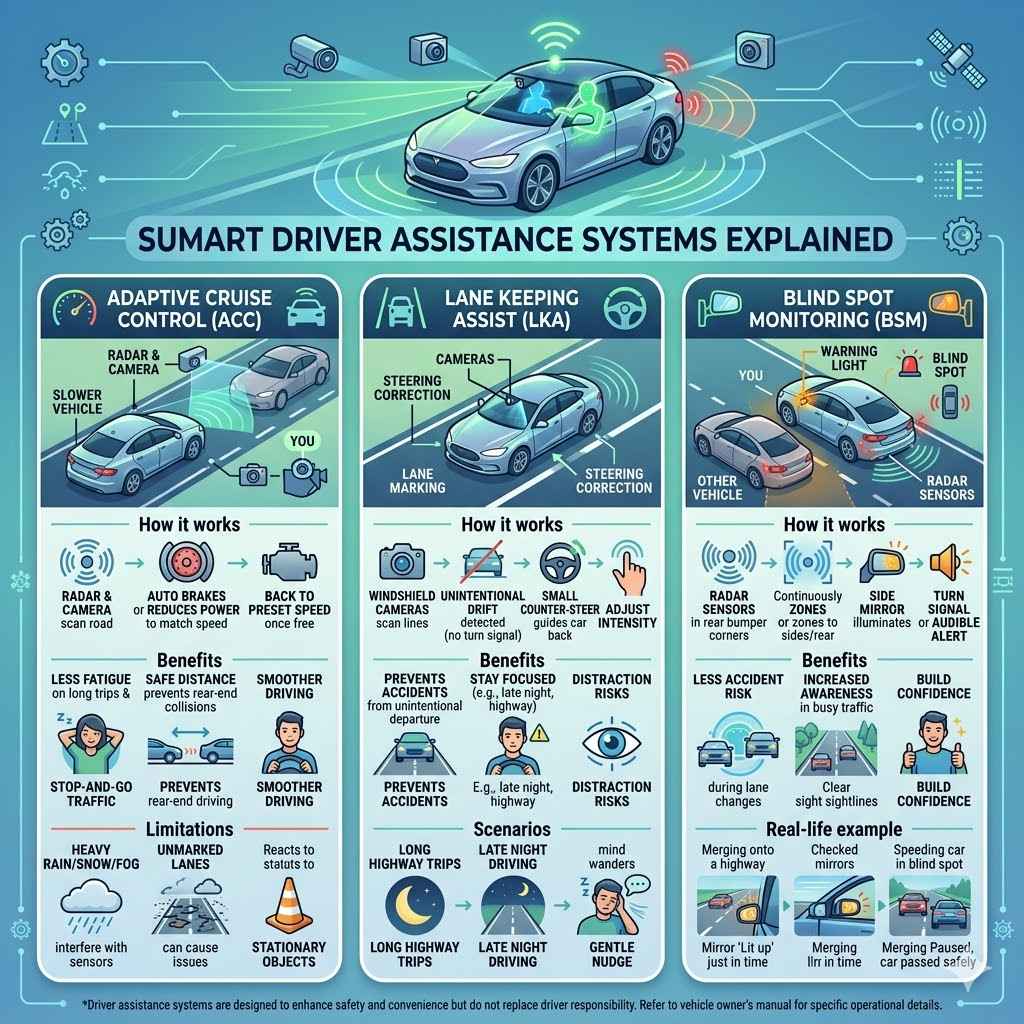
Smart Driver Assistance Systems Explained
Driver assistance systems are like a co-pilot, always watching out for you. They use sensors and cameras to help prevent accidents and make driving less stressful. These systems are becoming a standard feature in many new vehicles, offering everything from simple alerts to active interventions.
They represent a significant leap forward in automotive safety and convenience, making driving more accessible and less prone to human error.
Adaptive Cruise Control
Adaptive cruise control (ACC) is an advanced version of regular cruise control. It doesn’t just maintain a set speed; it also adjusts your car’s speed to keep a safe distance from the vehicle in front. If the car ahead slows down, your car slows down too.
When the car ahead speeds up or moves out of the way, your car returns to your set speed. This technology uses radar or cameras mounted on the front of the vehicle to monitor traffic.
How it works: Radar or camera sensors scan the road ahead. When a slower vehicle is detected within a set range, the system automatically reduces engine power or applies the brakes to match the speed of the vehicle in front. Once the obstruction is gone or speeds up, the system accelerates back to the preset speed.
Benefits: ACC reduces driver fatigue on long journeys and in stop-and-go traffic. It helps maintain a consistent and safe following distance, which can prevent rear-end collisions. This technology also contributes to smoother driving by avoiding sudden braking and acceleration.
Limitations: ACC systems may not perform optimally in heavy rain, snow, or fog, as these conditions can interfere with sensor accuracy. They also rely on clear lane markings and well-defined road edges. The system might react to stationary objects or debris, which could lead to unnecessary braking in some situations.
Lane Keeping Assist
Lane keeping assist (LKA) is designed to help keep your vehicle centered within its lane markings. If the system detects that your car is unintentionally drifting out of its lane, it will provide a gentle steering correction to guide it back. Some systems may also provide a visual or audible warning before intervening.
This technology is particularly useful on highways and long stretches of road where driver attention can wane.
How it works: Cameras mounted on the windshield scan the road for lane markings. When a lane departure is detected without the turn signal being activated, the system applies a small counter-steer to bring the vehicle back into the lane. The intensity of the steering correction can often be adjusted by the driver.
Benefits: LKA helps prevent unintentional lane departures, a common cause of accidents. It can help drivers stay focused on the road and reduce the risk of side-swipe collisions or running off the road. This feature is especially helpful for drivers who experience fatigue or distraction.
Scenarios where it’s useful: Imagine driving on a long, monotonous highway late at night. Your mind might wander for a moment. Lane Keeping Assist will gently nudge the steering wheel back to center if you start to drift, giving you a crucial alert.
Blind Spot Monitoring
Blind spot monitoring (BSM) uses sensors to detect vehicles in your blind spots, the areas around your car that are not visible in your mirrors. When a vehicle is detected, a warning light typically illuminates in the side mirror. If you activate your turn signal while a vehicle is in your blind spot, the warning light may flash or an audible alert may sound.
This technology is a significant safety enhancement, especially when changing lanes.
How it works: Radar sensors are usually placed in the rear bumper corners. They continuously scan the areas to the rear and sides of the vehicle. When another car enters these detection zones, the system alerts the driver.
Benefits: BSM greatly reduces the risk of collisions during lane changes. It provides drivers with increased awareness of their surroundings, especially in busy traffic. This can help avoid dangerous situations and build driver confidence.
Real-life example: Sarah was merging onto a busy highway. She checked her mirrors, but a speeding car was in her blind spot. Her car’s blind spot monitoring system lit up her side mirror, warning her just in time. She paused her merge, letting the car pass safely.
Advanced Infotainment and Connectivity Features
Modern cars are becoming rolling entertainment and information hubs. Infotainment systems combine audio, video, and navigation functions, offering a connected experience for drivers and passengers. These systems are designed to be intuitive and user-friendly, providing access to a world of digital services and entertainment.
They also play a vital role in vehicle diagnostics and communication.
Touchscreen Displays and User Interfaces
The centerpiece of most modern infotainment systems is the touchscreen display. These screens allow drivers to control various vehicle functions with simple taps and swipes, similar to a smartphone or tablet. The user interface is designed for ease of use, with clear icons and menus.
Many systems also support voice commands, allowing drivers to operate features without taking their hands off the wheel.
Technology behind touchscreens: Capacitive touchscreens are most common. They detect the electrical charge of a human finger. This allows for responsive and accurate touch input, enabling smooth scrolling, pinching to zoom, and multi-touch gestures.
User interface design: Interfaces are crafted to minimize driver distraction. They often feature large buttons, simple navigation paths, and customizable layouts. Voice control further enhances this by allowing hands-free operation for many functions, such as setting navigation destinations or changing radio stations.
Connectivity options: These displays often connect to smartphones via Apple CarPlay or Android Auto, mirroring your phone’s apps on the car’s screen. This provides seamless access to navigation, music streaming, messaging, and calls.
Smartphone Integration (Apple CarPlay and Android Auto)
Apple CarPlay and Android Auto are revolutionary technologies that allow you to connect your iPhone or Android smartphone to your car’s infotainment system. This integration brings your phone’s familiar interface and apps onto the car’s screen, offering a safer and more convenient way to use your devices while driving. You can access navigation, make calls, send texts, listen to music, and use your favorite apps, all through the car’s controls.
How it works: When you plug your compatible smartphone into the car’s USB port, or wirelessly connect it, the car’s system recognizes it. It then displays a simplified version of your phone’s operating system, optimized for driving.
Key features: Access to GPS navigation from apps like Google Maps or Waze, making calls and sending messages with voice commands, playing music from streaming services like Spotify or Apple Music, and using voice assistants like Siri or Google Assistant.
Statistic: A survey found that over 70% of smartphone users who own cars with Apple CarPlay or Android Auto use these features regularly, citing convenience and safety as primary reasons.
In-Car Wi-Fi Hotspots
Many modern cars now offer built-in Wi-Fi hotspots. This allows passengers to connect their devices to the internet using the car’s cellular connection. It’s a fantastic feature for families on road trips, allowing kids to stream movies or play online games.
It also means drivers can access real-time traffic updates, stream music, or even check emails hands-free while on the go.
Technology involved: These systems use a built-in modem and antenna, connecting to cellular networks. They then create a Wi-Fi signal that multiple devices can connect to. Some systems require a subscription service for data usage.
Benefits for passengers: Keeps everyone entertained and connected, making long drives more pleasant. Children can stay occupied with their devices, and adult passengers can work or browse the internet.
Benefits for drivers: Enables access to online services for navigation, weather, and traffic updates. It also allows for hands-free communication and entertainment streaming without relying on personal data plans.
Powertrain Innovations and Electrification
The way cars are powered is undergoing a massive transformation. Beyond traditional gasoline engines, we’re seeing the rise of hybrid and fully electric powertrains. These advancements aim to improve fuel efficiency, reduce emissions, and offer new driving experiences.
This shift represents one of the most significant changes in automotive history, driven by environmental concerns and technological progress.
Hybrid Powertrains
Hybrid vehicles combine a traditional internal combustion engine with an electric motor and battery. This combination allows the car to run on electricity alone at low speeds or for short distances, use both power sources together for increased performance, or use the gasoline engine to charge the battery. Hybrids offer a good balance between fuel economy and the convenience of gasoline fueling.
Types of hybrids:
Mild Hybrid (MHEV): Has a small electric motor that assists the gasoline engine but cannot power the car on its own. It primarily aids in acceleration and regenerative braking.
Full Hybrid (HEV): Can drive on electric power alone for short distances at lower speeds. The electric motor and gasoline engine can work together or independently.
Plug-in Hybrid (PHEV): Has a larger battery that can be charged by plugging into an external power source. This allows for a longer electric-only driving range, often up to 30-50 miles, before the gasoline engine needs to engage.
How regenerative braking works: When you slow down or brake, the electric motor acts as a generator, capturing kinetic energy that would normally be lost as heat. This energy is converted into electrical energy and stored in the battery, which can then be used to power the car later.
Fuel efficiency gains: By using electric power at certain times and recapturing energy during braking, hybrid vehicles can achieve significantly better miles per gallon compared to conventional gasoline cars. This also leads to reduced tailpipe emissions.
Electric Vehicle (EV) Technology
Electric vehicles run solely on electricity stored in a large battery pack. They have an electric motor that drives the wheels, producing instant torque for quick acceleration and a smooth, quiet ride. EVs produce zero tailpipe emissions, making them a greener alternative to gasoline cars.
The infrastructure for charging is growing rapidly, making EV ownership more practical than ever.
Battery technology: The heart of an EV is its lithium-ion battery pack. These batteries are designed for high energy density, allowing for significant driving range. Advances in battery chemistry are continuously improving lifespan, charging speed, and cost.
Charging methods:
Level 1 charging: Uses a standard household 120-volt outlet. It’s the slowest method, typically adding only a few miles of range per hour.
Level 2 charging: Uses a 240-volt outlet, similar to what some home appliances use. This is common for home charging stations and public charging. It can add 20-30 miles of range per hour.
DC Fast Charging (Level 3): Found at public charging stations, these can charge an EV’s battery to 80% in as little as 20-30 minutes, depending on the vehicle and charger.
Driving experience: EVs offer a unique driving experience with silent operation, instant acceleration, and smooth power delivery. The absence of engine noise and vibrations creates a more relaxing cabin environment.
Environmental impact: EVs have a significantly lower carbon footprint over their lifetime compared to gasoline cars, especially when charged using renewable energy sources.
Autonomous Driving Features
Autonomous driving, or self-driving, technology aims to allow vehicles to operate without human intervention. While fully autonomous vehicles are still in development and testing, many cars today feature advanced driver-assistance systems (ADAS) that offer partial autonomy. These systems can control steering, acceleration, and braking under specific conditions, acting as sophisticated aids for the driver.
Levels of automation: The Society of Automotive Engineers (SAE) defines six levels of driving automation, from Level 0 (no automation) to Level 5 (full automation). Most current systems are at Level 2 (partial automation), where the car can control steering and speed but the driver must remain engaged and supervise.
Key components: Autonomous systems rely on a suite of sensors including cameras, radar, lidar, and ultrasonic sensors to perceive the environment. Sophisticated algorithms and artificial intelligence process this sensor data to make driving decisions. High-definition maps and GPS also play a crucial role.
Real-world applications: Advanced driver-assistance systems (ADAS) are already common. Features like automatic emergency braking, adaptive cruise control with lane centering, and automated parking assist are steps towards higher levels of autonomy.
Vehicle Connectivity and Software Updates
Cars are becoming more connected than ever, not just to our phones but to the internet and manufacturers. This allows for over-the-air (OTA) software updates, remote diagnostics, and enhanced security. It means your car can improve over time, much like your smartphone, receiving new features and performance enhancements without a visit to the dealership.
Over-the-Air (OTA) Software Updates
Over-the-air updates allow car manufacturers to send software improvements directly to your vehicle wirelessly. This is similar to how your smartphone or computer gets updates. These updates can fix bugs, improve performance, enhance existing features, or even add new capabilities to your car.
This technology ensures that vehicles can evolve and stay up-to-date with the latest advancements, enhancing both functionality and security.
How it works: The car’s communication module connects to the manufacturer’s servers via cellular or Wi-Fi. Software updates are downloaded and then installed, often when the car is parked and not in use, to avoid interrupting driving.
Benefits for owners: Your car can gain new features or improved performance long after you’ve purchased it. It also means important security patches can be deployed quickly, protecting your vehicle from potential threats.
Examples of updates: Updates might include improvements to the infotainment system, enhancements to driver assistance features, or even optimizations for battery management in electric vehicles.
Remote Diagnostics and Vehicle Health Monitoring
Modern cars can monitor their own health and report potential issues to both the owner and the manufacturer. Through connected services, your car can detect a problem and send an alert to your smartphone or a service center. This proactive approach helps in addressing issues before they become serious, preventing breakdowns and costly repairs.
It’s like having a mechanic constantly checking your car’s vital signs.
Sensor network: Vehicles are equipped with numerous sensors that constantly monitor various systems, from engine performance and tire pressure to battery health and brake wear.
Data transmission: When a sensor detects an anomaly or a predefined threshold is crossed, the car’s onboard computer sends diagnostic data to a secure cloud server managed by the manufacturer or a third-party service provider.
Benefits: Early detection of problems can prevent minor issues from becoming major repairs. It also allows for scheduled maintenance to be more efficient, as technicians can be prepared with the right parts and knowledge before you even bring the car in.
Cybersecurity in Connected Cars
As cars become more connected and software-driven, cybersecurity becomes increasingly important. Manufacturers are implementing advanced security measures to protect vehicles from hacking and unauthorized access. This includes secure coding practices, encrypted communication channels, and regular security updates to defend against emerging threats.
Ensuring the safety and privacy of connected car data is a top priority.
Threats to connected cars: Potential threats include unauthorized access to vehicle controls, data theft (like location history or personal information), or denial-of-service attacks that disable vehicle functions.
Protective measures: Manufacturers use firewalls, intrusion detection systems, secure boot processes for software, and encryption for data transmission. Regular software updates are crucial for patching vulnerabilities discovered after a vehicle is released.
Importance of updates: Similar to how you update your home computer or smartphone to protect against new viruses, keeping your car’s software updated is vital for maintaining its security against evolving cyber threats.
Safety and Security Enhancements
Beyond driver assistance, modern cars incorporate a range of passive and active safety features to protect occupants in the event of a collision and prevent accidents from occurring in the first place. These technologies work together to create a safer driving environment for everyone on the road. The focus is on both occupant protection and accident avoidance.
Advanced Airbag Systems
Modern vehicles are equipped with sophisticated airbag systems designed to deploy in a way that offers the best possible protection to occupants in various crash scenarios. These systems go beyond basic front airbags, including side curtain airbags, knee airbags, and even airbags designed to deploy in specific ways depending on the severity and angle of impact.
Types of airbags:
Front airbags: Deploy from the steering wheel and dashboard to protect the driver and front passenger.
Side airbags: Located in the seats or doors, they protect the torso in side impacts.
Curtain airbags: Extend from the roofline to protect the head in side impacts and rollovers.
Knee airbags: Protect the driver’s legs from striking the dashboard.
Smart deployment technology: Advanced systems use sensors to measure the force and trajectory of a collision. They can then determine the optimal speed and inflation level for each airbag, and even decide which airbags should deploy, to minimize injury.
Seatbelt pre-tensioners: Work in conjunction with airbags. In a crash, they rapidly tighten the seatbelt to hold occupants firmly in their seats, ensuring they are in the optimal position for airbag deployment.
Electronic Stability Control (ESC)
Electronic Stability Control (ESC) is a critical safety feature that helps drivers maintain control of their vehicle during extreme steering maneuvers or when traction is lost, such as on slippery surfaces. It uses sensors to detect when the car is skidding or about to spin out and automatically applies individual brakes to help steer the car back onto its intended path. ESC is credited with saving thousands of lives annually.
How it works: ESC systems continuously monitor steering wheel angle, wheel speed, and vehicle yaw rate (how fast the car is rotating). If it detects a difference between the driver’s intended direction and the car’s actual direction, it intervenes by braking individual wheels and reducing engine power if necessary.
When it’s most useful: ESC is invaluable in preventing single-vehicle accidents caused by loss of control, such as rollovers or skidding off the road. It’s particularly effective in preventing accidents on wet, icy, or gravelly surfaces.
Statistic: Studies by the National Highway Traffic Safety Administration (NHTSA) have shown that ESC reduces the risk of fatal single-vehicle crashes by about 30% and fatal single-vehicle rollovers by up to 70%.
Advanced Braking Systems
Modern cars feature sophisticated braking systems that go beyond basic stopping power. Anti-lock Braking Systems (ABS) prevent wheel lock-up during hard braking, allowing the driver to steer. Electronic Brakeforce Distribution (EBD) optimizes the braking force between the front and rear wheels.
Brake Assist (BA) detects a panic stop and applies maximum braking force automatically.
Anti-lock Braking System (ABS): When you slam on the brakes, ABS rapidly pulses the brakes on and off, preventing the wheels from locking up. This allows you to maintain steering control while braking, helping you avoid obstacles.
Electronic Brakeforce Distribution (EBD): EBD works with ABS to automatically adjust the amount of brake pressure applied to the front and rear wheels based on vehicle load and braking conditions. This ensures optimal braking efficiency and stability.
Brake Assist (BA): BA is designed to recognize an emergency braking situation, even if the driver hasn’t pressed the brake pedal with sufficient force. It then automatically increases the braking pressure to the maximum, shortening stopping distances.
User Experience and Comfort Technologies
Beyond driving and safety, modern cars are designed to provide a more comfortable and enjoyable experience for everyone inside. This includes advanced climate control, premium audio systems, and features that reduce noise and vibration. The goal is to make every drive a pleasure, whether it’s a short commute or a long road trip.
Multi-Zone Climate Control
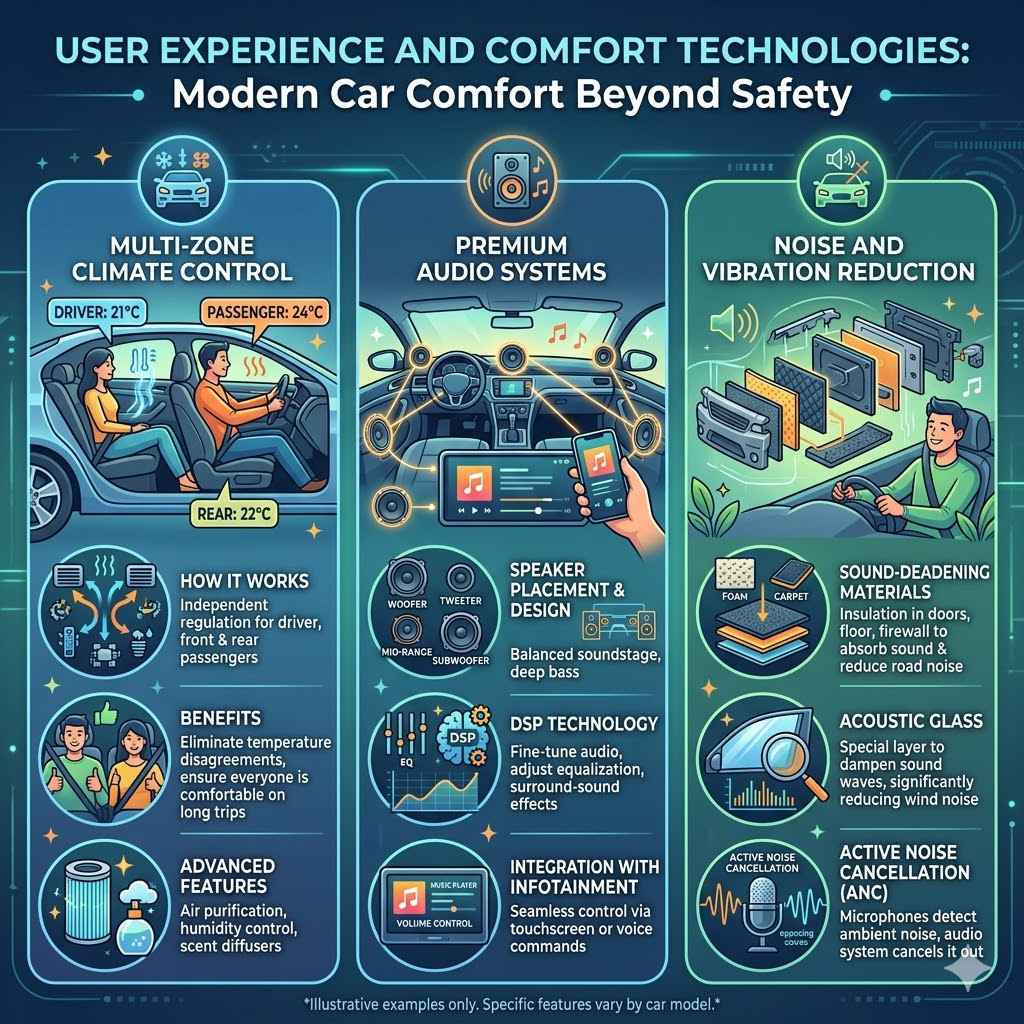
Multi-zone climate control allows different occupants of the car to set their preferred temperature and fan speed in their specific zone. For example, the driver might want it cooler, while a passenger prefers it warmer. This technology uses multiple sensors and vents to create personalized comfort zones within the cabin, enhancing the overall travel experience for all passengers.
How it works: The system uses temperature sensors in different areas of the cabin and actuators to control airflow through various vents. This allows for independent temperature regulation for the driver, front passenger, and rear passengers.
Benefits: Eliminates disagreements over cabin temperature, ensuring everyone is comfortable. This is especially valuable on long trips with multiple passengers with different comfort preferences.
Advanced features: Some systems include air purification filters, humidity control, and even scent diffusers to further enhance cabin air quality and ambiance.
Premium Audio Systems
Car manufacturers are increasingly partnering with renowned audio brands to equip vehicles with high-fidelity sound systems. These premium audio setups feature multiple speakers strategically placed throughout the cabin, advanced amplifiers, and sophisticated sound processing to deliver a rich and immersive listening experience. Whether you prefer music, podcasts, or audiobooks, these systems elevate your in-car entertainment.
Speaker placement and design: Systems often include a variety of speaker types like woofers, tweeters, and mid-range drivers, carefully positioned to create a balanced soundstage. Some systems even incorporate subwoofers for deep bass.
Digital Signal Processing (DSP): DSP technology is used to fine-tune the audio output, adjust equalization, and create surround-sound effects, making the listening experience more dynamic and engaging.
Integration with infotainment: These systems are seamlessly integrated with the car’s infotainment system, allowing for easy control of music playback, volume, and sound settings through the touchscreen or voice commands.
Noise and Vibration Reduction
Automakers invest heavily in technologies to minimize unwanted noise and vibration within the cabin, creating a more serene and comfortable environment. This includes using sound-deadening materials, acoustic glass, active noise cancellation technology, and sophisticated engine and suspension tuning. The result is a quieter ride that reduces driver fatigue and enhances the enjoyment of conversation or audio entertainment.
Sound-deadening materials: Many cars use specialized foam, carpets, and insulation materials in areas like the doors, floor, and firewall to absorb sound and reduce road noise entering the cabin.
Acoustic glass: This type of glass has an inner layer designed to dampen sound waves, significantly reducing wind noise at higher speeds.
Active Noise Cancellation (ANC): Similar to noise-canceling headphones, ANC systems use microphones to detect ambient noise and then emit opposing sound waves through the car’s audio system to cancel it out.
Frequently Asked Questions
Question: What is the most important technology in modern cars
Answer: It’s hard to pick just one as most important, as many technologies work together. However, advanced driver-assistance systems that help prevent accidents, like automatic emergency braking and blind-spot monitoring, are considered vital for safety.
Question: How do self-driving cars work
Answer: Self-driving cars use a combination of sensors such as cameras, radar, and lidar to see their surroundings. They also use GPS and detailed maps. Powerful computers process this information to make decisions about steering, accelerating, and braking.
Question: Are electric cars really better for the environment
Answer: Yes, electric cars produce zero tailpipe emissions, which is great for air quality in cities. Their overall environmental impact is lower than gasoline cars, especially when the electricity used to charge them comes from renewable sources.
Question: How often do cars get software updates
Answer: It varies by manufacturer and model. Some cars receive regular updates for infotainment and safety features, while others might get them less frequently. Many updates can be done wirelessly over the air.
Question: What is the difference between a hybrid and an electric car
Answer: An electric car runs only on electricity from a battery. A hybrid car uses both a gasoline engine and an electric motor. Plug-in hybrids have a battery that can be charged by plugging into an outlet, allowing for a longer electric-only driving range.
Summary
Modern cars are packed with impressive features that enhance safety, convenience, and enjoyment. From smart driver assistance and connected infotainment to efficient powertrains and comfortable interiors, these technologies transform the driving experience. Embracing these advancements makes driving safer and more pleasant.
Exploring these innovations is a key step to appreciating today’s vehicles.