What Cars Do Auto Jigglers Work On? Compatibility Guide
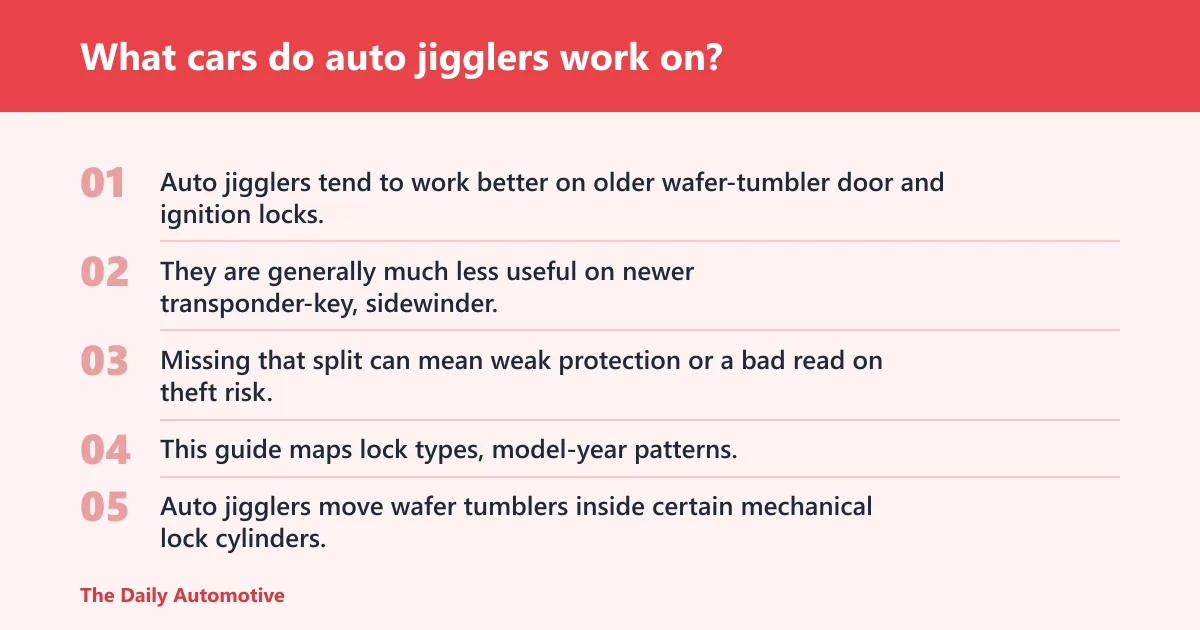
Auto jigglers tend to work better on older wafer-tumbler door and ignition locks, especially on older cars, vans, and pickups with simpler mechanical cylinders. They are generally much less useful on newer transponder-key, sidewinder, or smart-entry systems. Missing that split can mean weak protection or a bad read on theft risk. This guide maps lock types, model-year patterns, and anti-theft features into a simple compatibility decision tree.
What cars do auto jigglers work on?
The short answer: only some mechanical lock systems
Auto jigglers move wafer tumblers inside certain mechanical lock cylinders. The target is the lock hardware, not the electronic authorization layer. If the vehicle uses an immobilizer, a transponder key, or a push-button start with electronic authorization, a turning lock does not mean the engine will run.
The practical question is not “Is the car old?” It is “What lock family is installed, and has it worn enough to allow manipulation?”
Why make, model, year, and region matter
Vehicle make, model, year, trim, and market region can change the keyway, wafer count, and security package. Two cars from the same model line can differ if one was sold in a market with extra anti-theft hardware. A replaced or rekeyed cylinder can also change the answer completely.
That is why broad older-car assumptions fail. A late-1990s truck with a worn wafer cylinder may be easier to manipulate than an older sedan with a different lock family and tighter tolerances.
How wafer lock cylinders affect compatibility
Wafer lock cylinders are the main mechanical target. Instead of pin tumblers, they use flat wafers that align at cut depths in the key. That design can be easier to manipulate when the cylinder is worn, dirty, or loose, but susceptibility still varies by manufacturer and lock family.
Why wafer tumblers are the main target
Auto jigglers are built around the idea that a worn wafer stack can be moved into a temporary alignment. If the lock uses a different internal design, the tool is much less likely to work. Mechanical keyway profile matters here, because the blank shape and cut geometry must match the cylinder family.
How wear and contamination change lock behavior
Wear, dirt, and contamination can change how smoothly wafers move. A cylinder with years of key use may feel looser, while grit can make it hang up in odd positions. That can raise or lower manipulation risk, and it also makes results inconsistent. A sticky lock is not the same as an openable lock.
Suppose a door cylinder on a 1997 pickup turns with slight binding and the key has to be wiggled every time. That points to wear, not proof of compatibility. The same truck may still have an immobilizer retrofit, a different ignition cylinder, or a replaced door lock that changes the risk profile.
Why non-wafer keyways are a poor fit
Non-wafer keyways, sidewinder patterns, and newer electronic start systems sharply reduce usefulness. If the lock family does not use wafer tumblers, the jiggler has little to work with. If the vehicle uses electronic start authorization, mechanical movement alone cannot deliver a running engine.
Do auto jigglers work on all car keys?
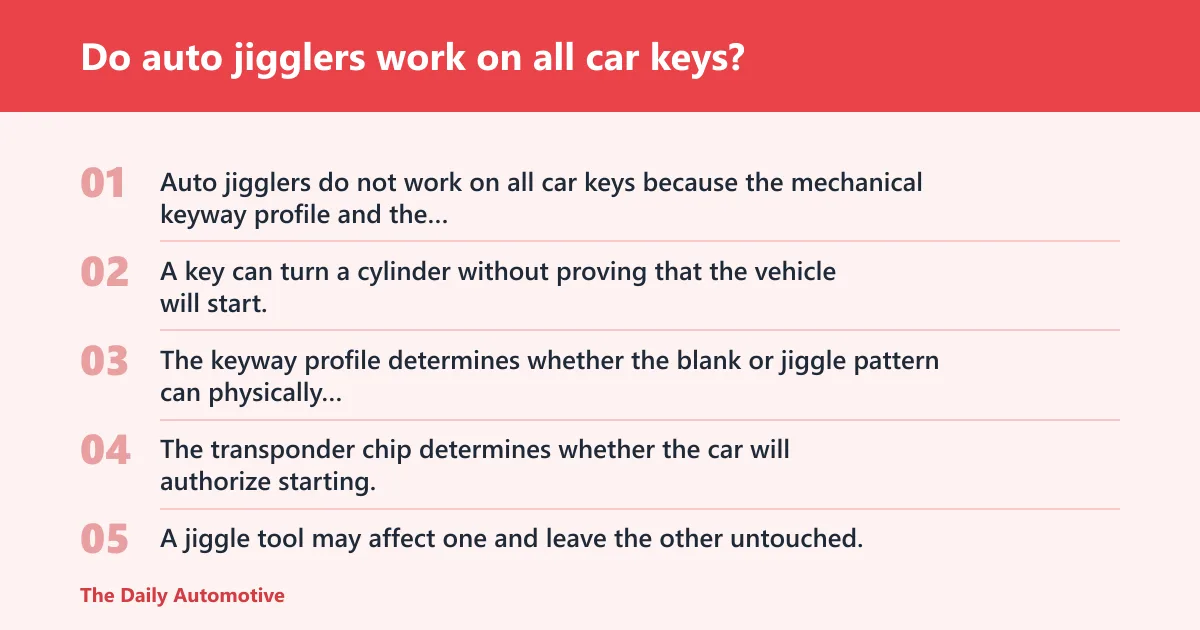
No. Auto jigglers do not work on all car keys because the mechanical keyway profile and the electronic authorization system are separate issues. A key can turn a cylinder without proving that the vehicle will start, and many modern keys carry a transponder chip that the immobilizer must recognize before the engine will run.
Mechanical keyway profile versus electronic authorization
The keyway profile determines whether the blank or jiggle pattern can physically interact with the lock. The transponder chip determines whether the car will authorize starting. Those are different systems. A jiggle tool may affect one and leave the other untouched.
Why transponder keys limit the result
A transponder key contains an electronic chip. In many vehicles, the immobilizer may read that chip and block engine start if the code is missing or wrong. So a cylinder can turn and still leave the engine dead. That is why mechanical movement is not the same as theft success.
Why a turned cylinder does not mean a started engine
The ignition cylinder is the mechanical interface. The engine-start authorization layer is electronic. If the cylinder rotates but the immobilizer does not accept the code, the starter circuit or fuel delivery can stay disabled. That split is one of the main reasons jiggle-key usefulness drops on newer vehicles.
Ignition cylinder versus door lock cylinder
Door lock cylinders can behave differently from ignition cylinders even on the same vehicle. The door may be looser, more exposed to weather, or used far more often than the ignition. Shared keyways do not guarantee shared vulnerability, because wear patterns and internal tolerances can differ.
Why the door may behave differently from the ignition
A front door lock may collect dirt, corrosion, and repeated keying stress. The ignition cylinder may see fewer insertions but tighter tolerances. Either one can become easier or harder to manipulate over time. A vehicle with an easy-to-turn door cylinder is not automatically vulnerable at the ignition.
A common first-timer mistake is assuming that if a worn ignition cylinder still rotates smoothly, an auto jiggler will work on that vehicle. A door may rotate with an old, worn keyway while the ignition still resists movement or the immobilizer blocks the start sequence. Those are separate checks.
What cylinder wear tells you about risk
Wear tells you that tolerances have changed, not that a lock is open. If the key rocks side to side, sticks, or requires extra force, the cylinder may be aging. That can increase manipulation risk in some wafer systems, but it can also signal a failing cylinder that should be replaced or rekeyed for security.

Compatibility matrix: how to self-check your vehicle
Use the matrix below as a decision aid, not as a green light. Start with the lock family, then confirm whether the vehicle has transponder or immobilizer protection. After that, sort by make, model, year, trim, and region. If the cylinder was replaced, check the new part, not the model badge.
| Make / model / year | Lock type | Immobilizer or transponder status | Likely jiggle-key susceptibility | Recommended anti-theft upgrade |
|---|---|---|---|---|
| 1992–1999 domestic sedans and pickups | Often wafer cylinder; verify keyway | Often none on base trims; verify market and trim | Medium to high if worn | Steering-wheel lock plus cylinder rekeying or replacement |
| 1995–2004 compact cars with basic trims | Often wafer cylinder in ignition and doors | May have early immobilizer on some trims | Medium, depending on wear | Alarm system and rekeyed ignition cylinder |
| 2000–2008 vehicles with transponder keys | Mechanical cylinder may still be wafer-based | Transponder key and immobilizer commonly present | Low for start theft; medium for door entry if worn | Steering-wheel lock and alarm upgrade |
| 2005 and newer push-button start models | May use a mechanical emergency cylinder only | Immobilizer standard in most cases | Low | Factory immobilizer check and alarm reinforcement |
| Any vehicle with sidewinder or non-wafer keyway | Non-wafer profile | Often electronic authorization as well | Low | Deadlocks or steering-wheel lock; inspect cylinder condition |
| Any vehicle with replaced or rekeyed cylinder | Depends on installed part | Depends on vehicle and retrofit status | Unknown until verified | Match replacement part to OEM spec and add alarm coverage |
How to read a low-, medium-, or high-risk result
Low risk usually means a non-wafer keyway, a modern transponder system, or both. Medium risk means a wafer cylinder exists but the vehicle has some electronic protection or a tighter, less-worn lock. High risk means a worn wafer cylinder, no immobilizer, and an older model with simple mechanical hardware.
- Identify whether the keyway is wafer-based or not.
- Check whether the vehicle has a transponder key or immobilizer.
- Confirm the exact make, model, year, trim, and market region.
- Inspect whether the ignition cylinder has been replaced or rekeyed.
- Separate door-lock behavior from ignition behavior.
- Rate the result as low, medium, or high risk.
Which security features reduce jiggle-key risk?
Immobilizers and transponder keys are the biggest limiter, because they block engine start even when the mechanical lock moves. Alarm systems, steering-wheel locks, deadlocks, and cylinder replacement all raise the effort needed. The best protection is layered, because no single device covers every failure mode.
Immobilizers and transponder keys
An immobilizer prevents unauthorized start by verifying a key chip or coded fob. That means a jiggled cylinder does not automatically translate into drive-away theft. If your vehicle supports a factory immobilizer, confirm it is active and not bypassed after a repair or swap.
Alarm systems, steering-wheel locks, and deadlocks
Alarms add noise and attention. Steering-wheel locks add visible delay. Deadlocks can limit interior access on some vehicles. None of these replaces a healthy ignition or door cylinder, but they can reduce the payoff of trying a mechanical workaround in the first place.
When rekeying or replacing the cylinder makes sense
If the ignition or door cylinder is worn, sticky, or mismatched after a repair, rekeying or replacement can reduce manipulation risk. That is especially relevant if the vehicle is already a wafer-cylinder model and the lock shows obvious wear. A bad cylinder is not just an annoyance; it is a security gap.
Why do some older cars get targeted more than newer ones?
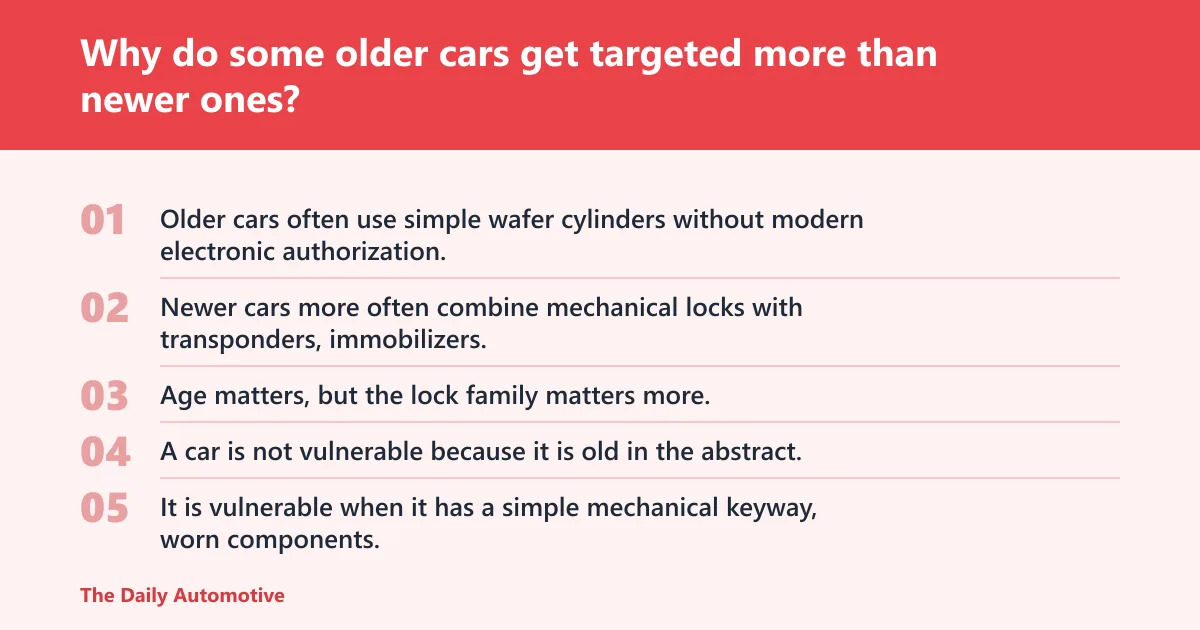
Older cars often use simple wafer cylinders without modern electronic authorization, which makes them easier to manipulate in some cases. Newer cars more often combine mechanical locks with transponders, immobilizers, and additional anti-theft layers. Age matters, but the lock family matters more.
Older-car exposure is about hardware, not nostalgia
A car is not vulnerable because it is old in the abstract. It is vulnerable when it has a simple mechanical keyway, worn components, and little or no electronic start authorization. That is why market region and trim level can matter as much as model year.
Mix-and-match hardware can change the answer
One vehicle family can have different door cylinders, ignition cylinders, and security options across trims. A base model might use a plain wafer lock, while a higher trim adds an immobilizer or different keyway. That is why compatibility has to be checked at the part level, not only at the brochure level.
Are auto jigglers legal to own or use?
Legality depends on local law and intent. Ownership rules can differ from use rules, and a tool that is legal for locksmith training or emergency access can still create legal problems if used without authorization. If the purpose is uncertain, stop and involve a licensed locksmith.
Why intent and local law matter
Some places regulate possession of lock tools when intent is unclear. Others focus on unauthorized entry or attempted theft. That means the same object can be treated differently depending on how, where, and why it is used. There is no safe assumption across jurisdictions.
When to stop and call a licensed locksmith
If the goal is to regain access to your own car, a licensed locksmith or dealer is the safer route. If a cylinder is failing, they can assess whether rekeying, replacement, or a different anti-theft setup makes more sense. That keeps the issue in the repair lane, not the legal one.
What should I do if my car was easy to start with a jiggle key?
If a vehicle was easy to manipulate, treat that as a security warning. The cylinder may be worn, the keyway may be an older wafer design, or the car may lack a working immobilizer. The next step is a full lock and anti-theft inspection, not continued experimentation.
Immediate next steps
Check whether the ignition and door cylinders are original. Confirm whether the car has a transponder key or immobilizer. Then ask a locksmith or dealer to assess wear, rekey options, and replacement parts. If the vehicle is parked on the street, add visible deterrents immediately.
Common follow-up upgrades
Steering-wheel locks, alarm systems, deadlocks, and cylinder replacement are the most practical upgrades. If the vehicle has a damaged or loose wafer cylinder, replacement often makes more sense than trying to preserve a compromised lock. Security should start with the weakest entry point.
Frequently asked questions
What cars do auto jigglers work on?
They are most relevant to older vehicles with wafer-tumbler ignition or door cylinders, especially when those locks are worn. Compatibility changes with make, model, year, trim, and region, so an older badge alone is not enough to predict risk. Electronic authorization lowers usefulness sharply.
Do auto jigglers work on all car keys?
No. They only interact with certain mechanical keyways and lock families. If the vehicle uses a non-wafer profile, sidewinder key, or modern electronic authorization, the result is likely to be poor or inconsistent. The mechanical fit and the start authorization are separate checks.
Can an auto jiggler open my car if it has a transponder key?
It may move the cylinder in some cases, but that does not mean the car will start. A transponder key must be recognized by the immobilizer. If the chip is missing or not authorized, the mechanical lock can turn while the engine remains disabled.
Which ignition types are most vulnerable to jigglers?
Older wafer-style ignition cylinders with visible wear are the main concern. Looser tolerances, dirt, and repeated use can increase manipulation risk. Non-wafer keyways, tighter modern cylinders, and systems with electronic start authorization are much less exposed.
How can I tell if my car uses a wafer-style lock cylinder?
Check the owner literature, the keyway profile, and the lock hardware itself. Wafer cylinders often appear on older ignitions and door locks, but the exact part varies by make, model, year, and region. A locksmith can identify the lock family quickly if the badge is not enough.
What anti-theft upgrades reduce jiggle-key risk?
Immobilizers and transponder systems provide the biggest reduction in drive-away risk. Add a steering-wheel lock, a working alarm, and, where appropriate, cylinder replacement or rekeying. If the door and ignition use different worn cylinders, address both instead of only one.
Products related to this article
Sponsored / affiliate links. As an Amazon Associate I earn from qualifying purchases. I may earn additional commission from eligible campaigns.