What Does CC Mean in Car Engine: The Genius Answer
In short, CC in a car engine means Cubic Capacity. It measures the total volume inside all the engine’s cylinders in cubic centimeters. Think of it as the engine’s “lung capacity”—it tells you the size and potential power of the engine. A higher CC generally means more power but often uses more fuel.
Have you ever been in a conversation about cars and heard someone mention “CC”? Maybe you were looking at a car listing and saw numbers like 1500cc or 2.0L and felt a little lost. Don’t worry, you’re not alone! This is one of the most common pieces of car jargon, and it sounds way more complicated than it actually is. It’s a simple number that tells you a lot about your car’s heart: the engine.
My name is Md Meraj, and I’m here to make car stuff simple. Forget the confusing mechanic-speak. We’re going to break down what CC means in a way that anyone can understand. By the end of this guide, you’ll know exactly what it is, why it matters, and how it affects everything from your car’s speed to how much you spend on gas. Let’s get started!
So, What Exactly Does CC Mean in an Engine?
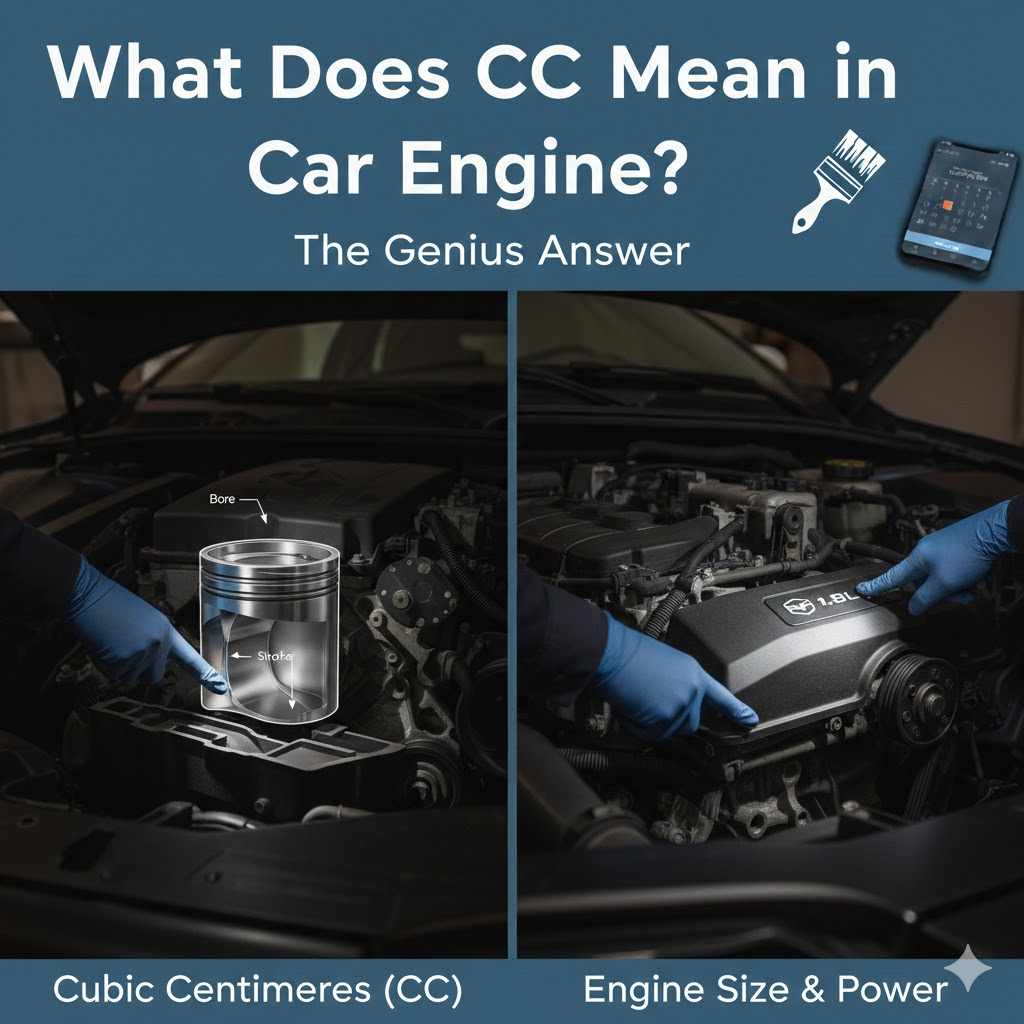
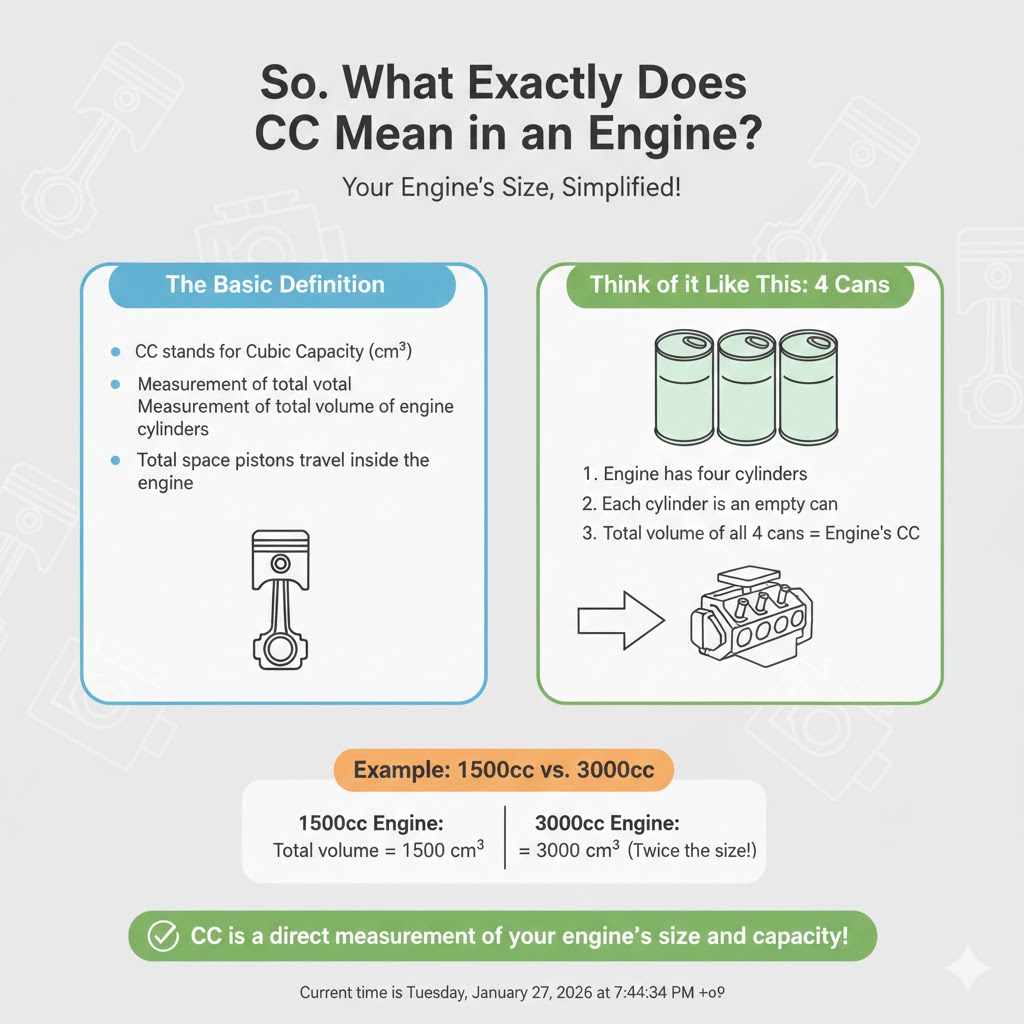
Let’s start with the basics. As we covered in the summary, CC stands for Cubic Capacity. It’s a measurement of volume, just like ounces in a soda bottle or cups in a recipe. Specifically, it measures the total volume of all the cylinders in your engine in cubic centimeters (cm³).
But what does that really mean? Imagine your car’s engine has several cylinders. Inside each cylinder, a piston moves up and down. The space the piston travels through is called its displacement. The “Cubic Capacity” or “Engine Displacement” is the total volume of that space across all the cylinders combined.
Think of it like this:
- Imagine your engine has four cylinders.
- Each cylinder is like an empty can.
- The total amount of air and fuel that can fit into all four cans at once is the engine’s Cubic Capacity, or CC.
So, a 1500cc engine can hold a total of 1500 cubic centimeters of an air-fuel mixture across all its cylinders. A 3000cc engine can hold twice that amount. It’s a direct measurement of the engine’s size.
Why You Should Care About Your Engine’s CC
Okay, so CC is about size. But why is that number so important? Because that volume is directly related to how much power your engine can produce. The basic principle of an internal combustion engine is simple: mix air and fuel, ignite it with a spark, and create a small explosion. This explosion pushes the piston down, which turns the crankshaft, and ultimately, makes your wheels spin.
A larger CC means your engine can suck in more air and fuel for each explosion. A bigger explosion creates a more forceful push on the piston, which translates into more power. This affects several key aspects of your vehicle:
- Power and Performance: Generally, a higher CC engine produces more horsepower and torque, leading to faster acceleration and better performance, especially when carrying heavy loads or going uphill.
- Fuel Economy: The trade-off for more power is often lower fuel efficiency. A bigger engine needs more fuel to fill its larger volume, so a high CC car will typically consume more gas than a low CC car.
- Vehicle Type: The CC often tells you what kind of vehicle you’re looking at. Small city cars have low CCs for efficiency, while large trucks and sports cars have high CCs for power.
- Cost and Insurance: Cars with larger engines are often more expensive to buy and can sometimes have higher insurance premiums because they are seen as higher-performance vehicles.
Understanding CC helps you choose the right car for your needs. If you mostly drive in the city and want to save on gas, a smaller CC engine is perfect. If you need to tow a trailer or crave thrilling performance, a larger CC engine is the way to go.
CC, Liters, and Horsepower: Untangling the Terms
When you’re researching cars, you’ll see CC, Liters (L), and Horsepower (HP) thrown around. They are all related, but they measure different things. Let’s clear up the confusion.
CC vs. Liters: Two Sides of the Same Coin
CC and Liters are both units for measuring volume, just like inches and feet are both units for measuring length. Many car manufacturers, especially in North America and Europe, use Liters instead of Cubic Centimeters to describe engine size.
The conversion is incredibly simple:
1000 CC = 1 Liter (L)
So, when you see a car advertised with a “2.0L engine,” it’s the exact same size as a “2000cc engine.” A 1.5L engine is the same as a 1500cc engine. They are just different labels for the same measurement.
Here’s a quick table to help you visualize the common conversions:
| Cubic Centimeters (CC) | Liters (L) | Common Vehicle Type |
|---|---|---|
| 800cc | 0.8L | Small Economy/City Car |
| 1000cc | 1.0L | Compact Car / Hatchback |
| 1500cc | 1.5L | Compact Sedan / Small SUV |
| 2000cc | 2.0L | Mid-Size Sedan / SUV |
| 3000cc | 3.0L | Large Sedan / Sports Car / SUV |
| 5000cc | 5.0L | Muscle Car / Large Truck |
Does More CC Equal More Horsepower?
This is a common assumption, and while there’s a strong link, it’s not a direct 1-to-1 relationship. Horsepower is a measure of an engine’s work rate, not its size.
Generally, a bigger engine (higher CC) has the potential to produce more horsepower because it can burn more fuel at once. However, modern engineering has changed the game. Technologies like turbocharging, supercharging, direct fuel injection, and variable valve timing can help a smaller CC engine produce as much, or even more, power than an older, larger engine.
Think of it this way: a big, untrained weightlifter might be strong (high CC), but a smaller, highly trained Olympic weightlifter can lift more weight (high horsepower) because of their superior technique and efficiency (advanced technology).
For example, a modern 1.5L (1500cc) turbocharged engine might produce more horsepower than a 2.5L (2500cc) engine from 15 years ago. The CC gives you a baseline for potential, but technology determines how efficiently that potential is used.
The Great Debate: Is a Bigger CC Engine Always Better?
The “bigger is better” mindset doesn’t always apply to car engines. The ideal engine size depends entirely on your priorities as a driver. Both high CC and low CC engines have significant pros and cons.
Let’s break them down in a table to make it easy to compare:
| Feature | High CC Engine (e.g., 3000cc / 3.0L+) | Low CC Engine (e.g., 1500cc / 1.5L or less) |
|---|---|---|
| Power & Torque | Excellent. Great for towing, hauling, and fast acceleration. | Adequate for daily driving, but can feel slow or strained under heavy loads. |
| Fuel Economy | Generally poor. Consumes more fuel to fill the larger cylinders. | Excellent. Sips fuel, making it very economical for commuting. |
| Driving Feel | Smooth and effortless power delivery. Quieter at high speeds. | Can be buzzy or noisy when pushed hard. Best suited for city speeds. |
| Best For | Highways, mountains, towing, performance enthusiasts. | City driving, commuting, drivers focused on saving money. |
| Cost | Higher initial purchase price and often higher maintenance costs. | Lower purchase price and generally cheaper to maintain. |
The Perks of a High CC Engine
A large displacement engine offers a feeling of effortless power. Merging onto the highway is a breeze, and you won’t feel the engine straining when the car is full of passengers and luggage. They are typically smoother and quieter because they don’t have to work as hard to maintain speed. For anyone who tows a boat or trailer, or simply loves the thrill of rapid acceleration, a high CC engine is often the best choice.
The Advantages of a Low CC Engine
In today’s world of high gas prices, the low CC engine is king. Its primary advantage is phenomenal fuel efficiency. For a daily commuter who spends most of their time in city traffic, a small engine provides all the power you need while saving you a significant amount of money at the pump. These engines are also lighter, which can contribute to more agile handling in smaller cars.
How CC Affects Your Daily Drive
Let’s get practical. How does this number actually translate to your experience behind the wheel every day?
CC’s Impact on Your Wallet: Fuel Economy
This is the most direct impact for most drivers. A bigger engine needs a bigger drink of fuel. It’s a simple law of physics. If you have twice the volume to fill with an air-fuel mixture, you’re going to use roughly twice the fuel. As the U.S. Department of Energy explains on their FuelEconomy.gov website, smaller engines tend to be more efficient. So, if your top priority is saving money, pay close attention to the CC or Liter number. A car with a 1.2L engine will almost always be more fuel-efficient than one with a 3.5L engine, assuming all other factors are equal.
CC Across Different Vehicle Types
To give you a real-world perspective, here are some typical CC ranges you’ll find in different types of vehicles:
- Motorcycles: The range is huge, from tiny 50cc scooters perfect for city errands to massive 2000cc+ touring bikes built for cross-country journeys.
- Small City Cars (Hatchbacks): These usually have engines between 800cc and 1200cc (0.8L to 1.2L). They are designed for maximum fuel efficiency in urban environments.
- Family Sedans: The sweet spot for many families is between 1500cc and 2500cc (1.5L to 2.5L). This provides a good balance of power for highway driving and reasonable fuel economy.
- SUVs and Trucks: These heavier vehicles need more power to move, so their engines typically start around 2000cc (2.0L) and can go up to 6000cc (6.0L) or even more for heavy-duty trucks.
- Sports and Performance Cars: Here, power is the priority. Engines often range from 3000cc (3.0L) to 8000cc (8.0L), often paired with turbochargers or superchargers for maximum horsepower.
How to Find Your Car’s Engine CC (It’s Easy!)
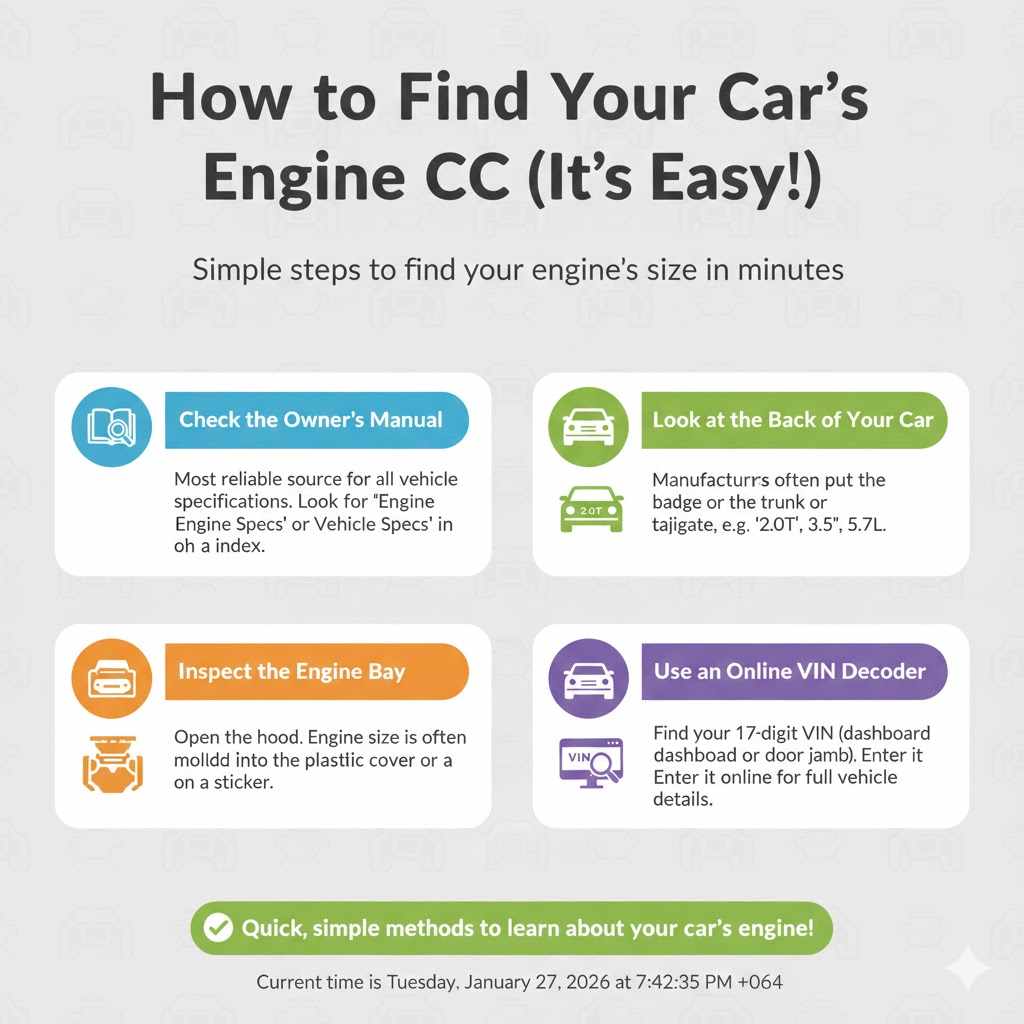
Curious about your own car’s engine size? Finding it is simple and takes just a few minutes. Here are the easiest ways to do it:
- Check the Owner’s Manual: This is the most reliable place to find all your vehicle’s specifications. Look in the index for “Engine Specifications” or “Vehicle Specifications.”
- Look at the Back of Your Car: Many manufacturers put a badge on the trunk lid or tailgate that indicates the engine size. It might say “2.0T,” “3.5,” or “5.7L.”
- Inspect the Engine Bay: Pop the hood and look for a plastic cover on top of the engine. The engine size is often molded right into the plastic or printed on a sticker.
- Check Your Vehicle Registration or Title: Your official vehicle documents will list key information, including the engine displacement (CC or Liters).
- Use an Online VIN Decoder: Your car’s Vehicle Identification Number (VIN) is a 17-digit code that contains all its manufacturing details. You can find it on your dashboard (visible through the windshield) or on the driver’s side door jamb. Enter this code into a free online VIN decoder, and it will tell you the engine size.
Frequently Asked Questions About Engine CC
You’ve got questions, and I’ve got simple answers. Here are some of the most common things people ask about engine CC.
1. What is a good CC for a car?
There’s no single “good” CC—it all depends on your needs. For city driving and fuel savings, 1000cc to 1600cc is great. For a versatile family car that handles highways well, 1800cc to 2500cc is a good balance. For towing or high performance, look for 3000cc and above.
2. Is 1500 CC a powerful engine?
A 1500cc (1.5L) engine is considered a great all-rounder in modern cars. In a small, lightweight car, it can feel quite zippy and fun. In a heavier SUV, especially if it has a turbocharger, it can provide adequate power and excellent fuel economy. It’s a very popular and balanced engine size today.
3. Does CC affect car insurance?
Yes, it can. Insurance companies use many factors to determine your premium, and engine size is one of them. A car with a larger, more powerful engine is often considered a higher risk for accidents and theft, which can lead to higher insurance costs.
4. Can I increase my car’s CC?
No, you cannot change the physical CC of your engine. The cubic capacity is determined by the engine’s physical construction (the size of the cylinders and the piston’s travel distance). To increase CC, you would need to replace the entire engine, which is a very complex and expensive process.
5. Are CC and engine displacement the same thing?
Yes, they are exactly the same. “Cubic Capacity” and “Engine Displacement” are two different names for the same measurement: the total volume swept by the pistons in the engine’s cylinders.
6. Why do some small engines feel so powerful?
This is usually due to “forced induction,” meaning a turbocharger or a supercharger. These devices force more air into the engine’s cylinders than they could normally draw in. More air means you can add more fuel, resulting in a more powerful explosion. This is how a small 1.0L turbocharged engine can feel as powerful as an older 1.8L engine.
7. Is a 1.0L engine the same as a 1000cc engine?
Yes, absolutely. Since 1000 cubic centimeters equals 1 liter, a 1.0L engine and a 1000cc engine are identical in size.
You’re Now an Engine CC Expert!
And there you have it! The mystery of “CC” is solved. It’s not a complicated code for mechanics—it’s just a simple measurement of your engine’s size. It tells you about the engine’s potential for power and its thirst for fuel.
Remember the key takeaways:
- CC means Cubic Capacity, the total volume of your engine’s cylinders.
- 1000cc is equal to 1.0 Liter.
- Higher CC generally means more power but lower fuel economy.
- Lower CC generally means better fuel economy but less power.
- The “best” CC depends entirely on your personal driving needs and priorities.
The next time you’re looking at a car or talking with friends, you can feel confident knowing exactly what that little number means. Understanding your car is the first step toward becoming a more empowered and knowledgeable owner. Keep learning, stay curious, and drive safely!