What Does DCT Mean in Cars? A Practical Owner’s Guide
DCT stands for dual-clutch transmission. It’s a type of automated manual gearbox that uses two separate clutches to shift gears faster than a traditional automatic. If you’ve felt a car snap through gears with zero interruption in power, you’ve felt a DCT at work.
The real question isn’t just what the letters mean. It’s whether a DCT car makes sense for your wallet, your commute, and your driving style. This guide covers how the system works, what it costs to own, its quirks in daily traffic, and how it compares to the alternatives.

Triax
TRIAX DCT ATF - Full Synthetic Dual…
- Superior Formulation: Full synthetic, PAO / Ester based formulation with extensive testing and performance data - far exceeding OE…
- Wide Compatibility: Compatible with a wide range of Dual Clutch Transmissions (DCT), including those manufactured by ZF, Mercedes…
- Exceptional Longevity: Lasts over 300,000 miles and is thus classified as a “fill-for-life” product in properly sealed transmissio…
You’ll also learn what fluid it needs, because that’s where many owners get burned. The wrong fluid in a DCT is a fast track to a very expensive repair.
If you own a DCT car or plan to, using the correct fluid matters more than you might think. A quality product like TRIAX DCT ATF is a full synthetic, PAO/ester-based fluid designed to handle the extreme heat and clutch pressure these gearboxes generate. It’s compatible with most major DCTs, including VW/Audi DSG, Ford, BMW, and ZF units. It’s a fill-for-life product in sealed transmissions, but check your owner’s manual for the specific service interval.
What Does DCT Stand For? (The Simple Definition)
DCT means dual-clutch transmission. It’s a gearbox that uses two clutch packs instead of one. One clutch handles the odd-numbered gears (1, 3, 5, 7). The other handles the even-numbered gears (2, 4, 6).
Because the clutches work independently, the transmission can pre-select the next gear while you’re still in the current one. The shift happens by swapping clutches, not by moving a gear selector. That’s why shifts are so fast.
You’ll see DCTs marketed under different names. Volkswagen and Audi call it DSG. Porsche calls it PDK. BMW uses the term M-DCT. Ford calls theirs PowerShift. They’re all the same basic idea with different engineering tweaks.
How a Dual-Clutch Transmission Actually Works
The Two Clutches: Odd vs. Even Gears
Imagine two manual gearboxes bolted together inside one housing. The odd-gear clutch connects to one input shaft. The even-gear clutch connects to a second, hollow shaft that sits inside the first. Both shafts are always spinning, but only one clutch is engaged at a time.
When you’re in third gear, the odd clutch is locked. The even clutch is open, but fourth gear is already selected on its shaft. The moment you shift, the odd clutch releases and the even clutch grabs. The whole swap takes milliseconds.
Pre-Selection: The Secret to Instant Shifts
Pre-selection is the magic trick. A computer decides what gear you’ll need next based on throttle position, speed, and brake pressure. It moves the next gear into place before you actually shift.
If you’re accelerating hard, it pre-selects the next higher gear. If you’re braking, it pre-selects a lower gear. When you finally pull the paddle or let the computer shift, the gear is already waiting. There’s no mechanical delay.
This is why a DCT shifts faster than a human can. A skilled driver takes about 300 milliseconds to shift a manual. A good DCT does it in 50 to 100 milliseconds. That difference matters on a race track, but it also makes the car feel sharper on a back road.
Wet vs. Dry DCT: What’s the Difference?
DCTs come in two flavors: wet and dry. The terms refer to the clutch environment.
A wet clutch runs in a bath of transmission fluid. The fluid cools the clutches and carries away heat. Wet DCTs handle high torque and aggressive driving without overheating. That’s why they’re used in performance cars like the Golf R, the BMW M3, and the Audi S4. The downside is more complexity and more fluid to maintain.
A dry clutch uses no fluid bath. It’s lighter, more efficient, and cheaper to build. But it can’t handle as much torque or heat. Dry DCTs are found in smaller cars like the Ford Fiesta and Focus (the PowerShift units), and some older VW models. They’re known for being jerky at low speeds and prone to premature wear if driven hard.
If you’re shopping used, know which type you’re getting. A dry DCT with 80,000 miles of city driving might be closer to the end of its life than you’d think.
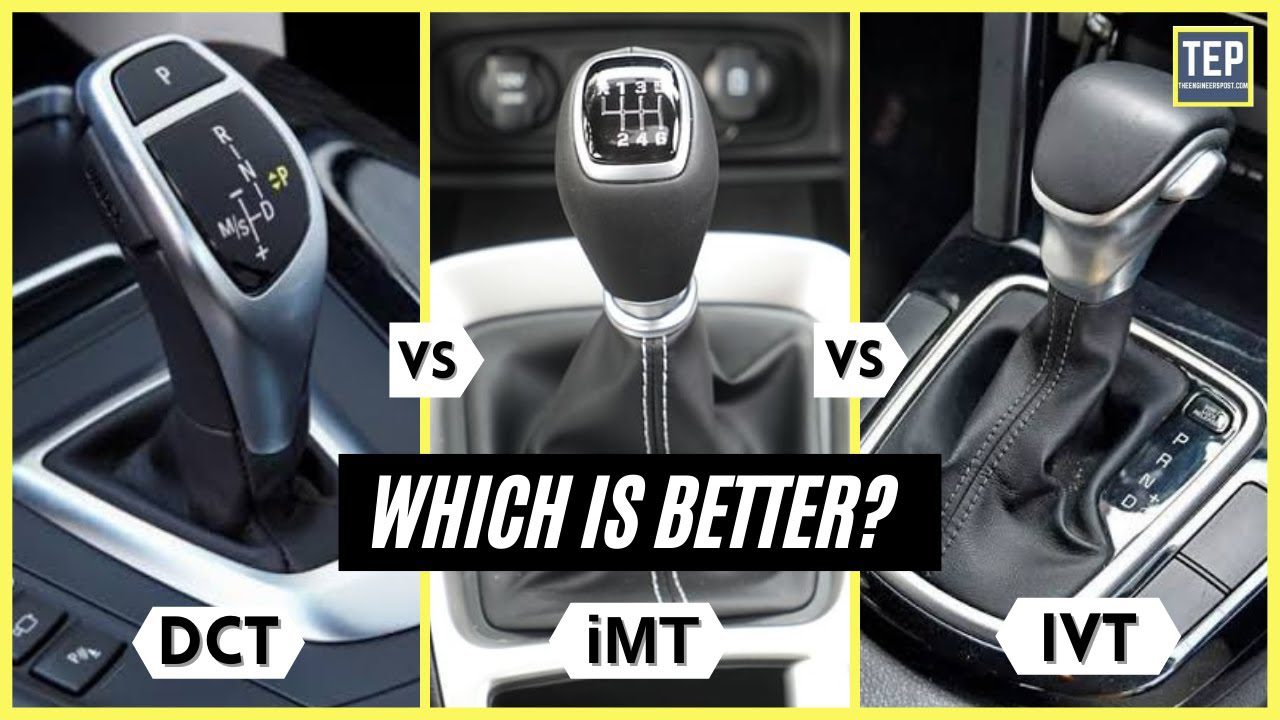
DCT vs. Automatic vs. CVT vs. Manual: The Ultimate Showdown
| Transmission Type | Shift Speed | Fuel Efficiency | Low-Speed Behavior | Repair Cost | Driver Engagement |
|---|---|---|---|---|---|
| DCT | Fastest | Excellent | Can jerk or shudder | High | High |
| Torque Converter Automatic | Slow to moderate | Good | Smooth | Moderate | Low |
| CVT | Variable (no fixed gears) | Best in city | Very smooth | High (often replaced) | Low |
| Manual | Driver dependent | Good | Clutch control needed | Low to moderate | Highest |
Why a DCT is Faster Than a Manual
It’s not about driver skill. The DCT has a mechanical advantage. It can shift while the throttle is still open, so torque never drops. A manual requires lifting off the gas, pressing the clutch, moving the shifter, and re-engaging. That’s a power interruption.
A DCT also never misses a shift. No missed gears, no grinds, no money shifts. That consistency is why nearly every modern supercar and race car uses a DCT or a similar automated manual.
Why a DCT is Not a Torque Converter
A traditional automatic uses a torque converter to connect the engine to the transmission. The converter uses fluid to transfer power, which creates some slip. That slip is why automatics feel smooth but can feel lazy.
A DCT uses friction clutches, just like a manual. There’s no fluid coupling, so power transfer is direct. That’s why a DCT feels more responsive and gets better fuel economy than a comparable automatic. It’s also why it can feel abrupt at low speeds.
The trade-off is the creep function. A torque converter automatic naturally creeps forward at idle, like a manual with the clutch partially engaged. A DCT has to simulate this by slipping its clutches. That simulation is where the low-speed jerkiness comes from.
The Real Pros and Cons of Owning a DCT
The Good: Speed, Efficiency, and Fun
When you’re moving, a DCT is brilliant. Shifts are lightning fast, acceleration is uninterrupted, and fuel economy often beats a traditional automatic by a few miles per gallon. The driving dynamics are genuinely sporty. You get the engagement of a manual with the convenience of an automatic.
Paddle shifters make it even better. You can hold a gear to the redline, then let the computer handle the downshift as you brake. It rewards an active driver.
The Bad: Low-Speed Jerk and Repair Costs
Here’s the honest part. In stop-and-go traffic, a DCT can feel clumsy. The clutch engagement at low speed is often jerky, especially when the transmission is cold. Some cars shudder or hesitate when pulling away from a stop. It’s not broken; it’s just how DCTs behave.
Manufacturers have improved this with software updates. Many newer cars are significantly smoother than early DSG and PowerShift units. But if you drive in heavy traffic daily, a torque converter automatic will be more comfortable.
Repair costs are the bigger concern. A DCT is a complex piece of machinery. Replacing a clutch pack on a VW DSG can cost $1,500 to $2,500. A full transmission replacement can run $4,000 to $8,000, depending on the car. A torque converter automatic replacement is often cheaper, and a manual clutch job is usually under $1,500.
The best way to avoid these costs is preventive maintenance. DCTs need their fluid changed at regular intervals, typically every 40,000 to 60,000 miles. Skipping that service is the fastest way to kill the transmission. Use the correct spec fluid, not whatever generic ATF is on sale.
Common DCT Problems and How to Avoid Them
The most common DCT issues are clutch wear, mechatronic (the control unit) failure, and fluid degradation.
- Clutch judder: A vibration or shudder when pulling away. Often caused by overheating or aggressive launches. Avoid riding the clutch at a standstill.
- Mechatronic failure: The computer that controls the clutches can fail, causing erratic shifting or a no-drive condition. This is more common in older VW/Audi units. Rebuilding a mechatronic unit costs $1,000 to $2,000.
- Fluid contamination: DCT fluid wears out faster than automatic transmission fluid. If it’s not changed, the clutches slip and burn. Follow the manufacturer’s service schedule.
One more thing: don’t creep in traffic. If you’re stopped for more than a few seconds, put the car in Neutral or hold the brake firmly. Riding the clutch in stop-and-go traffic generates heat and accelerates wear. It’s the single best habit you can develop as a DCT owner.
And when it’s time for fluid, don’t cheap out. A full synthetic DCT fluid like TRIAX DCT ATF is designed to handle the heat and shear forces that destroy cheaper fluids. It maintains cold flow down to -60°F, which helps in cold climates.
Is a DCT Right for You? (Buying Guide)
Ask yourself three questions before buying a DCT car.
First, how much traffic do you sit in? If your commute is all stop-and-go, a torque converter automatic will be more pleasant. The DCT’s low-speed jerkiness will wear on you fast.
Second, can you handle the maintenance schedule? A DCT is not a set-and-forget transmission. You must change the fluid on time. If you buy used, verify that the previous owner did. No service records? Factor a fluid change into your purchase price.
Third, do you care about driving dynamics? A DCT is the best of both worlds for an enthusiast. You get manual-like control with automatic convenience. If you’re a purist who insists on three pedals, you’ll miss the clutch pedal. But if you want speed and efficiency without the hassle, a DCT is the answer.
Also consider the car itself. A DCT in a Golf GTI feels different than one in a Hyundai Veloster. Test drive the specific model you want, and pay attention to low-speed behavior. Some DCTs are much smoother than others.
If you’re considering a car with a DCT, you might also want to understand other common automotive terms. For example, knowing what D1, D2, D3 mean in cars can help you understand gear selection modes on older automatics. And if you’re looking at performance cars, understanding what SV means in cars might clarify trim levels.
The Future of DCT in an Electric Car World
DCTs are facing an existential threat: electric vehicles. EVs don’t need multi-speed gearboxes. An electric motor delivers full torque from zero RPM, so a single-speed reduction gear is all that’s needed. That’s why most EVs have no transmission at all.
Hybrids are a different story. Some hybrids use a DCT paired with an electric motor. Porsche’s Taycan uses a two-speed gearbox, but it’s not a DCT. The trend is toward simpler, more robust single-speed units.
That said, DCTs aren’t disappearing overnight. They’re still the performance choice for gas-powered sports cars. The Porsche 911 GT3 uses a PDK, and it’s one of the best driving cars on sale. As long as internal combustion engines exist, DCTs will have a place.
But if you’re buying a new car in 2026, you’ll find fewer DCT options than you did five years ago. Many manufacturers are shifting to traditional automatics or EVs. The used market is where you’ll find the best DCT deals.
Frequently Asked Questions
Is a DCT more reliable than a traditional automatic?
It depends on the manufacturer and maintenance. A well-maintained DCT from a company like Porsche or VW can last 200,000 miles. A neglected one can fail at 60,000. Torque converter automatics are generally more forgiving of neglect, but they’re also less efficient and slower.
Can I drive a DCT like a regular automatic?
Yes, you can just put it in Drive and go. The computer handles everything. But you should avoid creeping in traffic and use Neutral when stopped for long periods. That’s the main behavioral difference.
Does a DCT need special transmission fluid?
Yes. DCT fluid is not the same as standard ATF. It’s formulated to handle higher clutch pressures and heat. Using the wrong fluid can cause slipping and premature failure. Always use the spec listed in your owner’s manual or a compatible full synthetic DCT fluid.
Why does my DCT jerk at low speeds?
That’s the clutch engagement. At low speeds, the computer is slipping the clutch to simulate an automatic’s creep. This generates heat and can feel jerky. It’s more noticeable when cold. Software updates have improved this on many models, so check if your car has the latest calibration.
Is a DCT the same as a DSG?
DSG is Volkswagen’s name for their dual-clutch transmission. It stands for Direkt-Schalt-Getriebe, which means direct-shift gearbox. It’s a DCT, just branded differently. Porsche’s PDK is also a DCT.
Final Verdict
A DCT is a fantastic transmission when you understand its character. It’s fast, efficient, and engaging. It’s also fussy at low speeds and expensive to repair if ignored.
- DCT means dual-clutch transmission. Two clutches handle odd and even gears for instant shifts.
- Wet DCTs handle high torque. Dry DCTs are lighter but less durable.
- Low-speed jerkiness is normal, especially when cold. Software updates help.
- Fluid changes every 40,000 to 60,000 miles are mandatory. Use the correct spec.
- Repair costs run $1,500 to $8,000. Maintenance is cheaper than replacement.
- A DCT is not a torque converter automatic. It feels different and drives differently.
- Test drive the specific model you want. Some DCTs are much smoother than others.
If you’re shopping for a car, weigh the driving experience against the ownership costs. A DCT rewards an engaged driver and punishes neglect. If you’re willing to follow the maintenance schedule, it’s one of the best transmissions ever made. If you’re not, stick with a traditional automatic.
For more clarity on other car tech terms, check out what Quattro means on Audi cars or what NA means in cars.
Products related to this article
Sponsored / affiliate links. As an Amazon Associate I earn from qualifying purchases. I may earn additional commission from eligible campaigns.