Are Hummers Good Cars? Buyer Guide for Real-World Use
Hummers fit a narrow buyer profile. The GMC Hummer EV is a strong premium off-road EV, while older H2 and H3 models are poor daily-driver picks because of size, fuel use, and upkeep. Buy the wrong one and you can face high running costs, awkward parking, or an EV that fits your needs badly. This guide weighs Hummers by commuting, off-roading, used value, and EV ownership so you can decide which version makes sense.
What Hummer means today



Hummer began as a military-rooted name and moved through several identities. The original civilian Hummer brand launched in 1992, then ended in 2010 before returning as the GMC Hummer EV. That matters because today’s Hummer is not one simple product; it is a revived badge on very large electric trucks and SUVs.
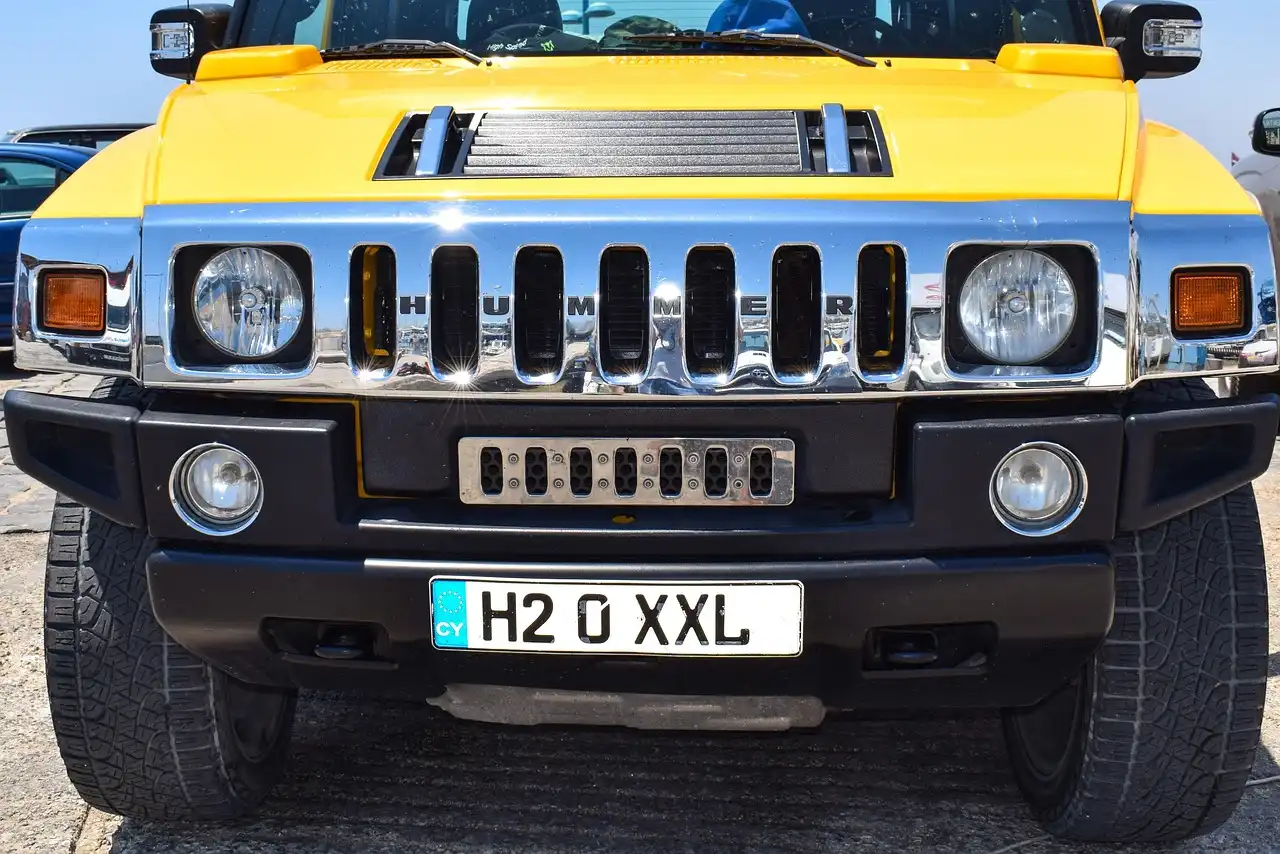
The old lineup was built around the H1, H2, and H3. The H1 is the civilian descendant of the Humvee. The H2 came later as a massive full-size SUV, and the H3 was the smaller, more practical brother of the H2. Modern Hummers now wear GMC badging and electric powertrains, but the size, presence, and off-road stance remain part of the identity.
From Humvee roots to the H1, H2, and H3
The H1 set the template: wide stance, tough hardware, and little concern for city convenience. The H2 scaled that formula into a more mainstream SUV package, while the H3 aimed to reduce size and improve usability. Even so, both H2 and H3 stayed true to the brand’s oversized, truck-like character.
That history explains why Hummers still attract buyers who want something that stands out. It also explains why they frustrate people who want a normal SUV. Size has always been part of the pitch.
How GMC revived the name with the Hummer EV
GMC revived the name for an all-electric lineup: the Hummer EV Pickup and Hummer EV SUV. The modern trucks are very powerful, expensive, and heavy, with off-road hardware that includes four-wheel drive, rear-wheel steering for Crab Walk movement, and software tuned for low-speed trail work. They are not subtle.
📊 The Hummer EV Pickup has an EPA estimated range of 312–318 miles. Source: 2026 GMC Hummer EV Pickup Review, Pricing, and Specs.
Are Hummers good cars?
Yes, if your priorities match the vehicle. Hummers are good as statement vehicles, serious off-road machines, and premium electric trucks for buyers who can live with size and cost. They are poor choices for tight-city commuting, easy parking, or low-cost ownership. “Good” depends on whether you value capability over practicality.
That split matters. A Hummer can be desirable without being sensible. It can also be capable without being economical. The right buyer sees that before signing.
The short answer by use case
For off-road buyers, the Hummer EV is the best fit. For luxury EV shoppers who want something bold and unusual, it can make sense too. For commuters, apartment dwellers, and drivers who need easy parking, the answer is usually no. Older H2 and H3 models are even less attractive if fuel cost and upkeep matter.
Say your garage opens onto a narrow alley and your daily route includes crowded downtown parking. A Hummer is the wrong tool. Suppose you want a weekend trail truck that can also pull attention at a charging stop. Then the Hummer EV starts to make sense.
GMC Hummer EV lineup and pricing
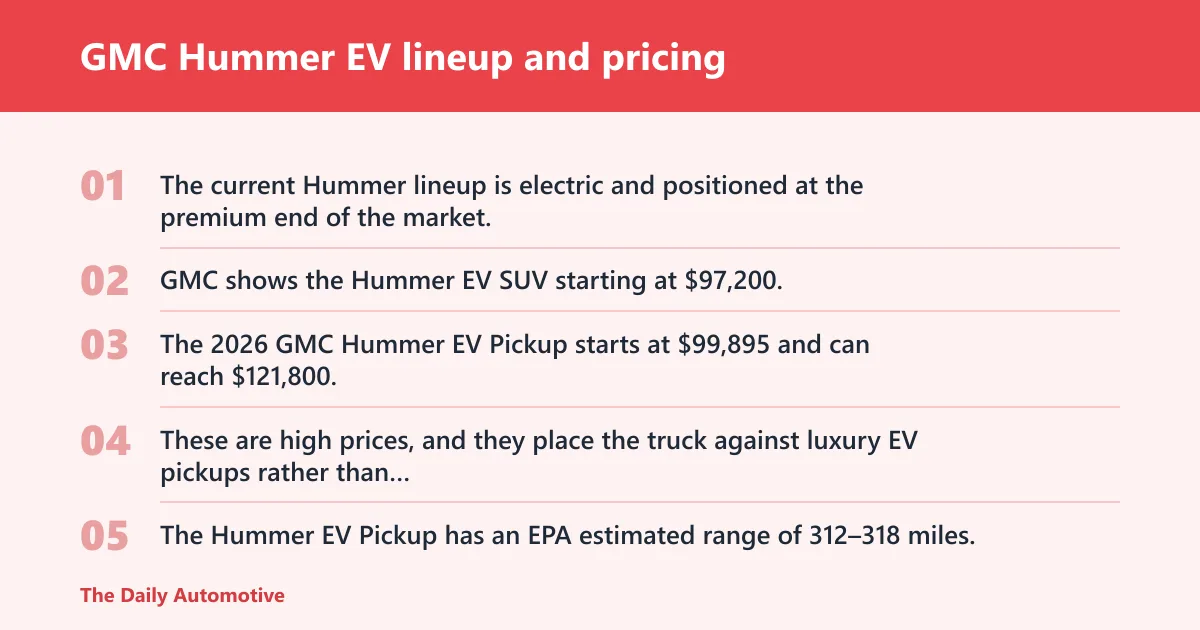
The current Hummer lineup is electric and positioned at the premium end of the market. GMC shows the Hummer EV SUV starting at $97,200. The 2026 GMC Hummer EV Pickup starts at $99,895 and can reach $121,800. These are high prices, and they place the truck against luxury EV pickups rather than mainstream SUVs.
The Hummer EV Pickup has an EPA estimated range of 312–318 miles, dual-motor and tri-motor versions with 570 hp or 1000 hp, and a 3-year/36,000-mile limited warranty. The pickup also tested 0–60 mph in 3.3 seconds with Watts to Freedom, which is absurdly quick for something this large.
Hummer EV Pickup: price, range, power, and warranty
The pickup’s numbers are the headline. A 1000 hp tri-motor version gives the truck enormous straight-line speed, while the 570 hp dual-motor setup still delivers more performance than most buyers will ever use. The warranty is ordinary for the segment, but the purchase price is not.
Car and Driver also ranked the Hummer EV Pickup 6th among electric pickup trucks in its review, which is a reminder that spectacle is not the same as overall class leadership.
Hummer EV SUV: pricing and positioning
The SUV uses the same Hummer EV nameplate under GMC, but the body style shifts it toward buyers who want the brand image with less pickup-bed utility. It still sits in the same expensive, oversized category. If you want a luxury EV SUV with off-road hardware, it is the cleaner packaging choice.
What 1000 hp and 570 hp mean in practice
Those power figures matter because they change the experience in merging, passing, and on-ramp acceleration. They do not make the truck small, efficient, or easy to park. More power can also tempt owners into heavier use, which matters in a vehicle that already weighs a lot and carries expensive tires and brakes.
Is the Hummer EV good off-road?
Yes. Off-road ability is one of the Hummer EV’s clearest strengths. The truck and SUV are built with four-wheel drive, a lifted body, low-speed maneuverability, and Crab Walk rear-wheel steering that helps in tight trail situations. This is serious off-road hardware, not cosmetic trim.
That said, size is still a tradeoff. The same dimensions that help with ground clearance and obstacle clearance can be awkward on narrow trails, tight switchbacks, and crowded trailheads. A vehicle can be excellent off pavement and annoying everywhere else.
Crab Walk, 4WD, and low-speed maneuverability
Crab Walk lets the Hummer move diagonally at low speed, which can help position a long vehicle around rocks or in narrow access areas. Combined with four-wheel drive and updated damper tuning, the Hummer EV aims at technical terrain as much as rough dirt roads.
It is the sort of setup that matters when the trail is slow and uneven. It matters less if your “off-road” life is a gravel driveway and a muddy campsite entrance.
Why the size helps on rough trails and hurts in town
The lifted body, wide stance, and heavy hardware help the Hummer feel planted on rough ground. In town, those same traits make curb clearance, parking, and sightline judgment harder. A big vehicle can feel useful on a trail and stressful in a parking garage.
How practical is a Hummer EV for daily driving?
For daily driving, the Hummer EV is a mixed bag. It offers quiet electric torque, available handsfree Super Cruise, and a cabin that suits premium-truck expectations, but it is still large, expensive, and heavy. Parking stress, charging planning, and tire and brake wear all matter more than they do in smaller EVs.
That is where ownership gets real. A Hummer EV may be easy to admire and hard to fit into an ordinary routine. The daily-driver question is less about technology and more about friction.
Parking stress, ride quality, and visibility
A vehicle this large can be tiring in dense traffic and annoying in parking structures. Visibility may be helped by height, but width and length still create stress. Updated damper tuning can improve ride control, yet size and mass remain part of the experience.
For families, that can mean more space and a commanding driving position. For city drivers, it can mean more careful planning at every stop.
Charging, range, and home setup considerations
The Hummer EV Pickup’s 312–318 miles of EPA estimated range is respectable for a large EV, but range is only useful if charging fits your life. If you can install home charging, the ownership picture improves. If you rely on public charging often, the truck’s size and energy use become harder to ignore.
Bidirectional charging is a useful feature for buyers who value power backup or device charging capability. It is not a fix for poor charging access. Modern EV ownership still depends on where and how you plug in.
What heavy weight can mean for brakes and tires
Car and Driver’s note that braking performance was disappointing, with a 70-mph stop taking 211 feet, points to a practical concern: mass. Heavy vehicles ask more of tires and brakes, especially when driven hard or loaded. That can raise long-term running costs even before battery charging enters the equation.
A common first-timer mistake is to focus on horsepower and ignore consumables. On a vehicle this heavy, brake wear and tire replacement are part of the cost of entry.
How good are used H2 and H3 models?
Used H2 and H3 models can work for the right buyer, but they are not simple ownership bets. The H2 is the bigger, more imposing truck and was listed at a starting price of $62,535 in the reference material. The H3 was the smaller and more practical brother, with 14–16 combined mpg in Car and Driver’s reference, but it is still a thirsty, discontinued SUV by modern standards. (caranddriver.com)
These models are appealing if you want the old-school Hummer shape without new-car pricing. They are less appealing if you want cheap, reliable commuting. Depreciation may help the purchase price, but age and maintenance can erase that advantage fast.
H2 ownership tradeoffs and used pricing context
Car and Driver describes the H2 as suitably massive. That sums up the ownership tradeoff. You get presence and size, but you also get bulk, fuel use, and the usual issues that come with an older full-size SUV. Used pricing can look tempting until maintenance and fuel are added back in.
Why the H3 is the smaller, more practical used choice
The H3 is the smarter pick if you want a discontinued Hummer for regular road use. It is smaller than the H2 and easier to place in traffic and parking. But 14–16 combined mpg is still poor by modern SUV standards, so “more practical” does not mean economical.
What to check before buying a discontinued Hummer
- Check maintenance records for cooling system work, suspension wear, and brake service.
- Inspect tires for uneven wear, because weight and alignment issues can be expensive.
- Verify 4WD operation and drivetrain behavior on a proper test drive.
- Look for interior wear, dash faults, and evidence of deferred maintenance.
- Compare insurance and fuel cost before you buy, not after.
Buyer-fit scorecard: which Hummer fits which driver?
This scorecard translates the Hummer lineup into actual use cases. It separates daily use, off-road ability, charging or fuel cost, parking stress, and ownership risk. Higher scores mean a better fit for that category. The goal is not to crown a winner; it is to match the vehicle to the job.
| Model | Daily driving | Off-road ability | Charging or fuel cost | Parking or size stress | Ownership risk | Best fit |
|---|---|---|---|---|---|---|
| GMC Hummer EV Pickup | 3/5 | 5/5 | 3/5 | 2/5 | 3/5 | Off-road buyer who wants the most dramatic EV truck |
| GMC Hummer EV SUV | 3/5 | 5/5 | 3/5 | 2/5 | 3/5 | Premium EV SUV shopper who wants trail hardware |
| Hummer H2 | 2/5 | 4/5 | 1/5 | 1/5 | 2/5 | Used-buyer who wants size and old-school Hummer style |
| Hummer H3 | 3/5 | 3/5 | 1/5 | 2/5 | 2/5 | Used-buyer who wants the smallest traditional Hummer |
Best for off-road buyers: the GMC Hummer EV Pickup. Best for EV luxury buyers: the Hummer EV SUV. Best for used-truck shoppers: the H3, if you accept higher fuel use and older-vehicle maintenance. Worst fit for commuters and tight-city drivers: the H2, with the EV Pickup close behind because of size and parking stress.
Frequently asked questions
Are Hummers good cars?
Hummers are good cars for buyers who want size, off-road ability, and a strong visual statement. They are not good for everyone. If you need easy parking, low running costs, or a normal commute, a Hummer is usually the wrong choice. “Good” depends on whether capability matters more than convenience.
Is a Hummer reliable for daily driving?
That depends on the model and the use case. A new Hummer EV has modern hardware and a limited warranty, but it is still large, heavy, and costly to live with. Older H2 and H3 models can be daily driven, but age, maintenance history, and fuel use make them less appealing than mainstream SUVs.
Are GMC Hummer EVs worth the money?
They can be, if you specifically want a premium EV with extreme power and real off-road hardware. The Hummer EV Pickup starts at $99,895 and the SUV at $97,200, so value is relative. Buyers who want the best range-per-dollar or easiest urban ownership will likely find better options elsewhere.
How much does a Hummer EV cost?
The 2026 GMC Hummer EV Pickup starts at $99,895 and can reach $121,800. GMC shows the Hummer EV SUV starting at $97,200. Those prices put both models in luxury territory, well above mainstream EV trucks and SUVs.
What is the range of a GMC Hummer EV?
The Hummer EV Pickup has an EPA estimated range of 312–318 miles. That is useful for a large EV, but real-world convenience still depends on charging access, speed, and trip length. Range is one part of the ownership equation, not the whole story.
Is the Hummer EV good off-road?
Yes. Off-road performance is one of its main strengths, thanks to four-wheel drive, Crab Walk rear-wheel steering, a lifted body, and low-speed maneuverability. It is built for rough terrain, but its size can make narrow trails and tight trailheads more stressful than in smaller off-road vehicles.
What are the biggest problems with Hummers?
The biggest problems are size, cost, and practicality. Modern Hummers are expensive and heavy, which affects parking, tire wear, and brake demand. Older H2 and H3 models add fuel cost and age-related maintenance risk. None of that makes them bad in every case, but it does narrow the buyer pool.
Are older Hummer H2 and H3 models reliable used cars?
They can be acceptable used buys if the maintenance history is strong, but they are not low-risk choices. The H2 is massive and costly to fuel. The H3 is smaller and more practical, yet Car and Driver’s 14–16 combined mpg figure shows why it still needs a buyer who accepts high running costs.
Products related to this article
Sponsored / affiliate links. As an Amazon Associate I earn from qualifying purchases. I may earn additional commission from eligible campaigns.