
What Does GT Mean in Motoring Full Explanation
Lots of car talk uses letters and acronyms that can be confusing. One of these is “GT.” You might see it on sports cars or luxury sedans, and it makes you wonder, What Does GT Mean in Motoring? Full Explanation.
It’s not always clear right away what these letters stand for and why they are used. But don’t worry, understanding GT is easier than you think. We’ll break it down simply so you can talk about cars with confidence.
Let’s get started!
Understanding The GT Badge What Does GT Mean
The GT badge on a car is something many people see and wonder about. It’s a common symbol in the automotive world, especially for vehicles that offer a blend of speed and comfort. For those new to cars, figuring out What Does GT Mean in Motoring?
Full Explanation can seem like a puzzle. It’s not just random letters; they represent a specific kind of car designed for a particular driving experience. This section will help you understand what GT truly signifies and why it’s a popular designation.
The Italian Origin Of GT
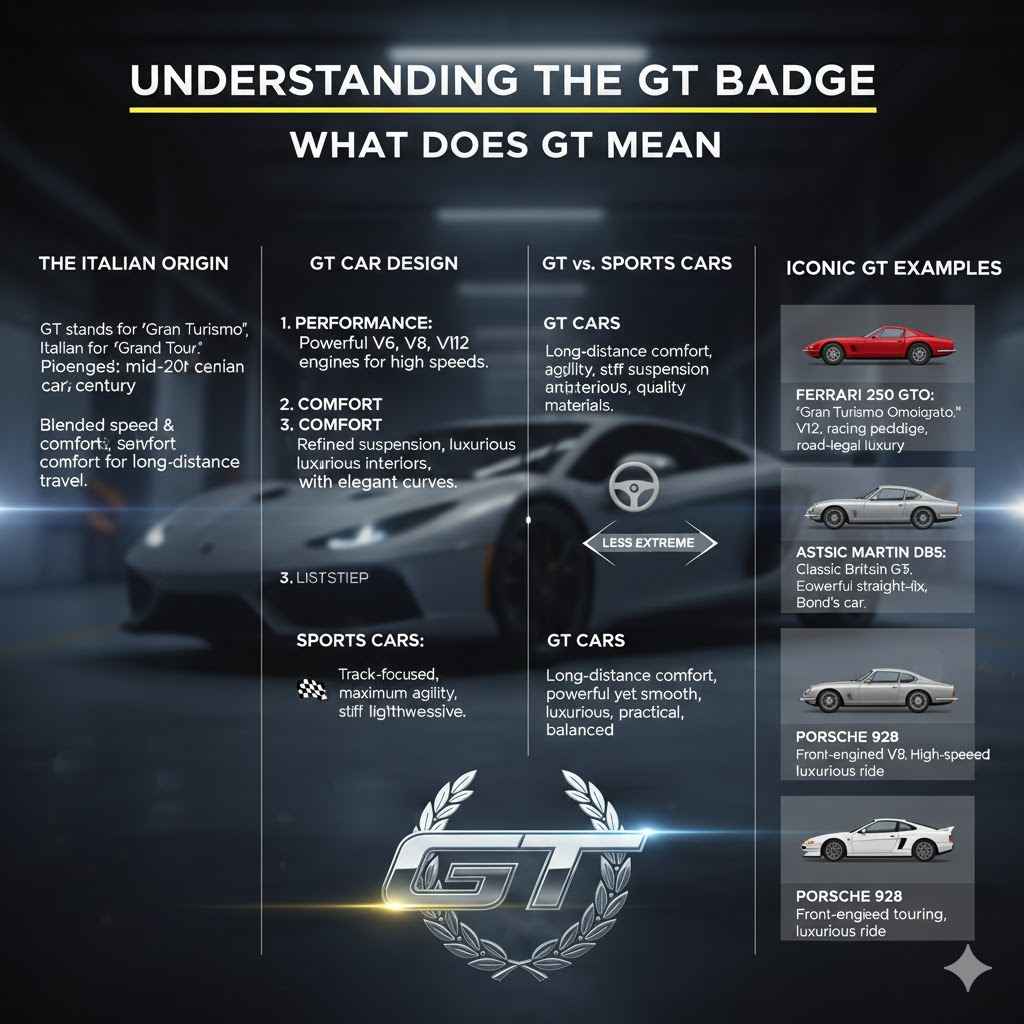
The term “GT” actually comes from Italy. It’s short for “Gran Turismo.” This Italian phrase translates to “Grand Tour” in English. This name hints at the car’s intended purpose.
It suggests a vehicle built for comfortable, long-distance driving. Think of it as a car that can take you on a long trip without being uncomfortable, while still being enjoyable to drive.
The “Gran Turismo” concept emerged in the early to mid-20th century. Italian car makers were pioneers in this design philosophy. They wanted to create cars that were fast enough for spirited driving but also luxurious enough for travel.
This balance was key to their appeal.
These cars were meant to be driven on paved roads, often across countries or continents. The focus was on making the journey as pleasant as the destination. This meant combining performance with creature comforts.
What GT Means For Car Design
When a car is labeled as a GT, it tells you a lot about its design and engineering. It’s not just about raw speed like a pure sports car. Instead, GT cars aim for a balance of several important features.
This makes them versatile and appealing to a wide range of drivers who want a bit of everything in their vehicle.
A primary characteristic of GT cars is their performance. They typically have powerful engines that can accelerate quickly and maintain high speeds. This allows for enjoyable driving on open roads or highways.
The engine is often a V6, V8, or even a V12 in more exotic models.
Comfort is another key element. GT cars usually feature more refined suspension systems than pure sports cars. This smooths out bumps and makes the ride more comfortable for passengers.
The interior is also designed with luxury in mind, often including high-quality materials and advanced features.
The styling of GT cars often blends sporty lines with elegant curves. They tend to look athletic but also sophisticated. This aesthetic appeal is part of what makes them desirable.
They are meant to look good both on a winding road and when parked at a nice restaurant.
GT Cars Versus Sports Cars
It’s important to distinguish GT cars from pure sports cars. While both are designed for performance, their priorities differ. Sports cars are typically built with the racetrack or aggressive driving in mind.
Their focus is on maximum agility, braking, and acceleration, sometimes at the expense of comfort.
A sports car might have a stiffer suspension, a more basic interior, and less sound insulation to save weight. The goal is ultimate driving engagement and performance. Think of a car that’s built for carving up corners.
GT cars, on the other hand, are built for covering long distances quickly and comfortably. They offer a more relaxed driving experience. While they are certainly fast and capable, they are not as intensely focused on track-day performance as a dedicated sports car.
This means a GT car might have more features that enhance comfort and practicality. It could include a more spacious interior, better luggage capacity, and a smoother ride. The engine might be tuned for strong mid-range torque, which is useful for overtaking on highways, rather than just peak power.
Examples Of Iconic GT Cars
Throughout automotive history, many cars have earned the GT designation and become legendary. These vehicles exemplify the “Gran Turismo” philosophy. They are celebrated for their blend of performance, luxury, and style, making them desirable for collectors and enthusiasts alike.
Their enduring appeal speaks to the success of the GT concept.
- Ferrari 250 GTO One of the most famous and valuable cars ever made, the 250 GTO was a racing car that was also homologated for road use. It achieved incredible success on the track while offering a sophisticated driving experience. Its V12 engine provided immense power, and its aerodynamic design was revolutionary. The “GTO” stands for Gran Turismo Omologato, meaning homologated for Gran Turismo racing. This car perfectly embodies the spirit of a high-performance GT.
- Aston Martin DB5 Famously driven by James Bond, the Aston Martin DB5 is the epitome of a classic British GT. It combines elegant styling with a powerful straight-six engine, offering a refined and luxurious experience. It was designed for comfortable high-speed cruising and grand touring. The car’s luxurious interior and smooth ride made it ideal for long journeys. Its association with cinema cemented its status as an icon.
- Porsche 928 This front-engined V8 car from Porsche was a departure from their rear-engined tradition. It was designed specifically as a comfortable, high-speed touring car. The 928 offered a more luxurious interior and a smoother ride than the 911, making it a true GT. Its innovative design and powerful engine made it a competitor to other European GTs. It showed that Porsche could excel in different automotive segments.
Performance Aspects Of GT Vehicles
When we talk about cars, performance is a huge part of the conversation. For GT vehicles, performance means more than just going fast in a straight line. It’s about how the car handles, how it brakes, and how it feels to drive over various types of roads, especially over long distances.
Understanding these elements helps explain why GT cars are so special.
Engine Power and Torque
The heart of any GT car is its engine. GTs are known for having powerful engines that deliver ample horsepower and torque. Horsepower is a measure of how fast the engine can do work, often related to top speed.
Torque, on the other hand, is the twisting force an engine produces, which is crucial for acceleration and pulling power. A good GT car needs both to provide an exhilarating driving experience.
Typically, GT cars are equipped with engines larger than those found in standard sedans. This often means V6, V8, or even V12 engines. These larger engines inherently produce more power and torque, allowing the car to accelerate swiftly and maintain speed effortlessly.
For instance, a V8 engine often provides a muscular rumble and strong low-end torque, making highway overtaking a breeze.
The power delivery is usually tuned for responsiveness. This means that when you press the accelerator, the engine reacts quickly. This is important for both spirited driving and for safety when you need to accelerate to merge or avoid a hazard.
The transmission also plays a key role, often featuring quick shifts to keep the engine in its optimal power band.
A common characteristic is that GT engines are built for reliability and endurance. Since these cars are meant for long drives, the engines need to be able to sustain high performance for extended periods without overheating or faltering. This often means advanced cooling systems and robust internal components.
Handling and Suspension
How a car handles is critical to its performance, especially for a GT. While comfort is important, GT cars also need to be engaging and stable to drive. The suspension system is the primary component responsible for this balance.
It connects the wheels to the car’s body and absorbs shocks from the road.
GT cars usually have a suspension setup that is firmer than that of a standard luxury car but softer than that of a pure sports car. This provides a good compromise. The firmer setup allows the car to corner with less body roll, meaning it stays more level when turning.
This gives the driver more confidence when taking corners at speed.
However, the suspension is also designed to absorb bumps and imperfections in the road. This ensures that the ride remains comfortable, even on long journeys. Advanced suspension technologies, like adaptive dampers, can adjust the stiffness of the shocks in real-time.
This allows the car to provide a firm ride during spirited driving and a softer ride during normal cruising.
Steering is another vital aspect of handling. GT cars typically feature responsive steering systems that provide good feedback to the driver. This means the driver can feel what the front wheels are doing, which helps in precise maneuvering.
The steering is usually direct enough for sporty driving but not so heavy that it becomes tiring on a long trip.
The overall goal of GT suspension and handling is to provide a confident and enjoyable driving experience. The car should feel planted and stable, allowing the driver to relax and enjoy the drive, whether on a winding mountain road or a long highway stretch.
Braking Systems
Powerful engines need equally capable braking systems. GT cars are equipped with brakes designed to bring them to a rapid and safe stop from high speeds. This is crucial for both performance driving and everyday safety, especially considering the speeds these cars are capable of achieving.
Most GT cars feature larger brake discs and calipers than standard vehicles. Brake discs are the rotating metal plates that the brake pads clamp onto. Calipers are the units that house the brake pads and push them against the discs.
Larger discs provide more surface area for heat dissipation, which is vital for preventing brake fade – a dangerous loss of braking power due to overheating.
High-performance brake pads are also common. These pads are made from materials that can withstand higher temperatures and offer stronger friction. This allows for more consistent and powerful braking performance, even under demanding conditions.
Many GT cars also incorporate advanced braking technologies. Anti-lock Braking Systems (ABS) are standard, preventing the wheels from locking up during hard braking, allowing the driver to maintain steering control. Electronic Brake-force Distribution (EBD) helps to optimize the braking force applied to each wheel.
Some higher-end GTs may feature carbon-ceramic brakes. These are significantly lighter than traditional iron brakes and offer superior heat resistance and stopping power. While more expensive, they are often found on performance-oriented GTs where absolute braking performance is a priority.
Aerodynamics
Aerodynamics plays a significant role in the design of GT cars. It’s not just about how the car looks; it’s also about how air flows over and around it. Proper aerodynamics helps with stability, efficiency, and overall performance, especially at higher speeds.
A well-designed GT car uses its shape to reduce drag. Drag is the force that opposes the car’s motion through the air. Lower drag means the car can move more easily through the air, improving fuel efficiency and top speed.
Smooth lines, a low profile, and minimal protrusions help in reducing drag.
At the same time, aerodynamics is used to generate downforce. Downforce is a force that pushes the car downwards onto the road. This increases tire grip, which is essential for stability and handling, especially when cornering at speed.
Features like spoilers, diffusers, and sculpted body panels are designed to manage airflow and create downforce.
For example, a rear spoiler can lift air up and over the rear of the car, creating a low-pressure area behind it. This low-pressure area pulls the back of the car down. Similarly, a front splitter at the bottom of the front bumper can direct air downwards, increasing pressure on the front tires.
The active aerodynamic elements are also found in some modern GT cars. These are components that can adjust their angle or position automatically or manually. For instance, a rear spoiler might tilt up during hard braking to act as an air brake, or it might retract on the highway to reduce drag.
Luxury And Comfort Features In GTs
While performance is a major part of the GT identity, these cars are also designed for enjoyable long-distance travel. This means luxury and comfort are just as important as speed and handling. The interior of a GT car is a place where you can relax and enjoy the ride, whether you’re on a short trip or a cross-country adventure.
Interior Materials And Design
The cabin of a GT car is typically appointed with high-quality materials. You’ll often find soft leather upholstery, real wood or brushed metal trim, and high-quality plastics. These materials contribute to a sense of luxury and sophistication.
The fit and finish are usually excellent, with no squeaks or rattles, even on rough roads.
The design of the interior is often driver-focused. This means that the controls and instruments are arranged in a way that is easy for the driver to access and use. The seats are usually designed for both comfort and support.
They might be ergonomically shaped with good lumbar support to prevent fatigue on long drives. Bolstering is often present to hold occupants securely during spirited driving.
The color schemes and overall aesthetic lean towards elegance rather than stark sportiness. While there may be sporty touches like a leather-wrapped steering wheel and sporty pedals, the overall impression is one of refined comfort. Ambient lighting is also a common feature, adding to the sophisticated atmosphere of the cabin at night.
Storage space is often considered, although it might not be as generous as in a large SUV. GTs usually have well-designed center consoles, door pockets, and a decent-sized glove box. The trunk space is usually sufficient for luggage for a weekend getaway or even a longer trip for two people.
Infotainment And Technology
Modern GT cars are equipped with advanced infotainment systems that make long journeys more enjoyable and convenient. These systems typically include a large touchscreen display that controls various functions, such as navigation, audio, and climate control. The interfaces are generally intuitive and easy to use.
Connectivity features are standard. This includes Bluetooth for hands-free calling and audio streaming, as well as USB ports for charging devices and connecting media players. Apple CarPlay and Android Auto integration are common, allowing drivers to seamlessly use their smartphones on the car’s display.
This provides access to familiar apps like maps, music, and messaging.
Premium audio systems are often an option or standard on higher trim levels. Brands like Bose, Bang & Olufsen, or Meridian might provide the sound systems, delivering a rich and immersive audio experience. These systems are tuned to the specific acoustics of the car’s interior.
Navigation systems are highly sophisticated, offering real-time traffic updates and detailed maps. Voice command functionality allows drivers to control various features without taking their hands off the wheel or their eyes off the road. Advanced driver-assistance systems (ADAS) are also increasingly common, adding layers of safety and convenience.
Seating And Ride Comfort
The seats in a GT car are a critical component of its comfort. They are designed to provide a balance of support for spirited driving and cushioning for long-distance comfort. You’ll often find seats that are electrically adjustable, with multiple settings to find the perfect driving position.
Features like heating and ventilation are common for the front seats, and sometimes for the rear seats as well. Lumbar support is usually adjustable, and some seats offer a massage function for ultimate relaxation on long drives. The materials used, typically high-quality leather or Alcantara, are chosen for their comfort and durability.
The ride quality is managed by the suspension system, as discussed earlier. However, the overall effect is a smooth and composed ride. Even on less-than-perfect roads, a GT car should absorb most of the imperfections, preventing them from disturbing the occupants.
The cabin is also well-insulated from road noise and wind noise, further enhancing the sense of tranquility.
While GT cars are often presented as two-door coupes, some models offer a 2+2 seating configuration. This means there are two full-sized seats in the front and two smaller, often less spacious, seats in the rear. These rear seats are best suited for children or for short trips for adults.
The focus remains on the front occupants’ comfort and the overall driving experience.
Practicality For Touring
Even though GT cars are performance-oriented, they are still designed with practicality for touring in mind. This means they offer more usability than a pure sports car, making them suitable for longer journeys where you might need to carry more than just a small bag.
Trunk space in GT cars varies, but it’s generally more generous than in compact sports cars. You can typically fit a couple of suitcases, making it viable for weekend trips or even shorter holidays. Some GTs might offer a pass-through from the trunk to the cabin, allowing for longer items like skis or golf clubs.
The doors on a GT car can vary. Two-door coupes are common, but four-door GT sedans also exist, offering easier access to the rear seats and often more rear legroom. The overall design aims to balance sporty aesthetics with enough space for passengers and luggage.
The fuel tank size is also a consideration for touring. GT cars often have larger fuel tanks than their sportier counterparts. This allows for a longer driving range between refueling stops, which is highly convenient on long road trips.
The engines are also often engineered for a good balance between power and fuel efficiency, especially on the highway.
What Does GT Mean In Motoring? Full Explanation And Key Takeaways
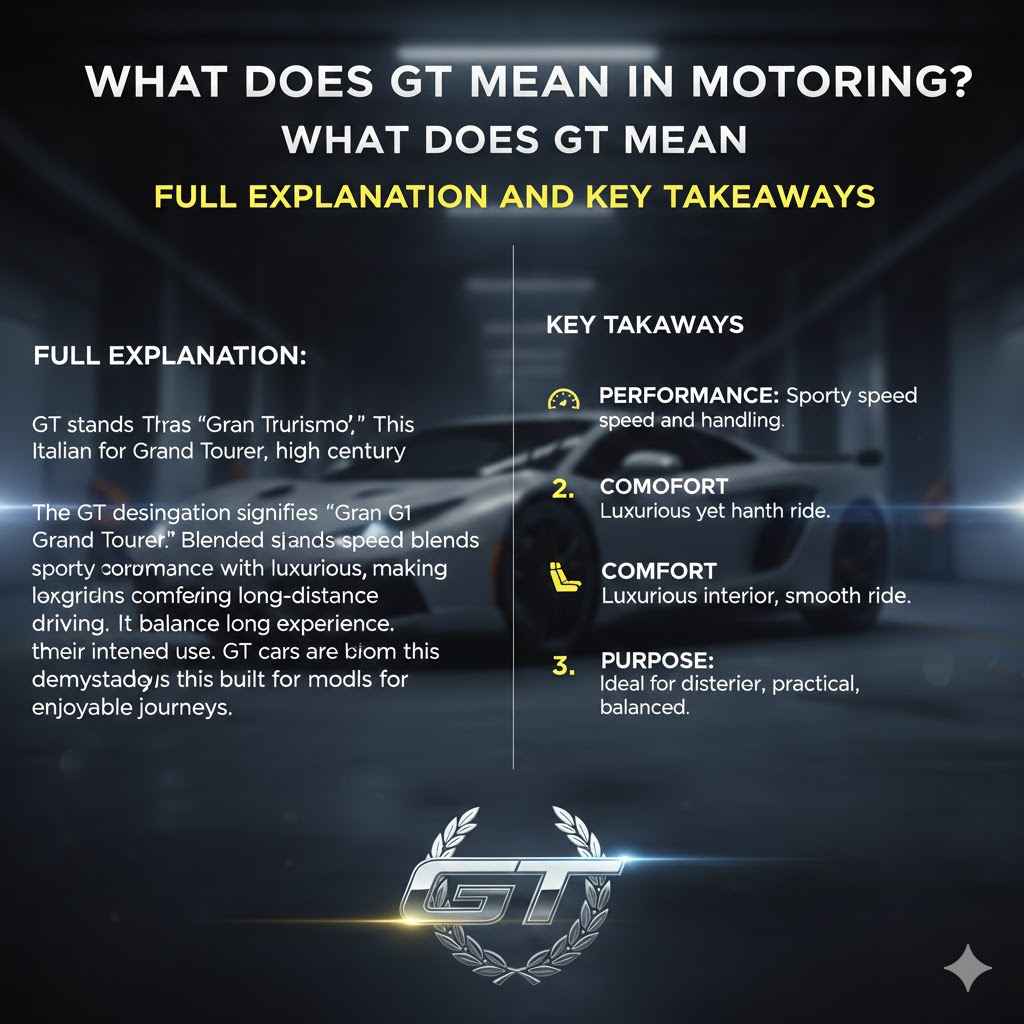
The GT designation in motoring signifies a “Gran Turismo” or “Grand Tourer.” This type of car blends sporty performance with luxurious comfort, making it ideal for long-distance driving. It’s a balance between speed, handling, and a refined travel experience. Understanding this helps demystify car models and their intended use.
GT cars are built for enjoyable journeys.
Frequently Asked Questions
Question: What does GT stand for?
Answer: GT stands for Gran Turismo, which is Italian for “Grand Tour.”
Question: Are GT cars good for long road trips?
Answer: Yes, GT cars are specifically designed for comfortable and enjoyable long-distance driving.
Question: Is a GT car the same as a sports car?
Answer: No, while both are performance-oriented, GT cars prioritize comfort and luxury for touring more than pure sports cars.
Question: What kind of engines do GT cars usually have?
Answer: GT cars typically have powerful engines like V6, V8, or V12 engines, delivering strong horsepower and torque.
Question: What are some examples of famous GT cars?
Answer: Iconic examples include the Ferrari 250 GTO, Aston Martin DB5, and Porsche 928.
Summary
Understanding what GT means in motoring, or Gran Turismo, reveals cars built for thrilling yet comfortable journeys. They offer powerful engines, capable handling, and luxurious interiors. These vehicles provide a balanced driving experience perfect for covering long distances with enjoyment and style.
You now know GT cars are designed for both performance and pleasure on the road.