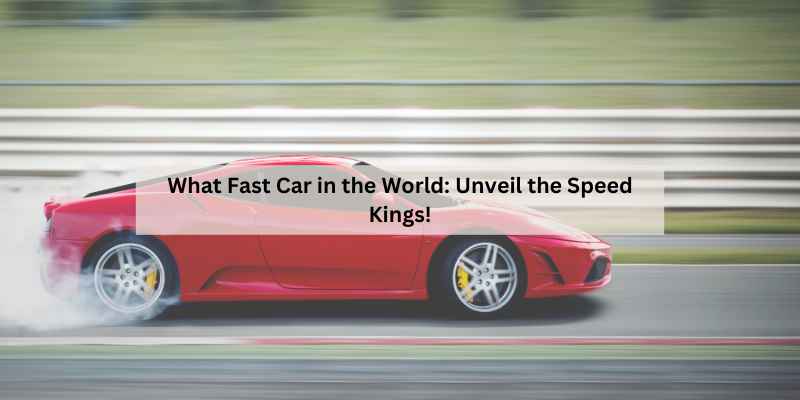
The Fastest Car in the World: Claims vs. Proven Records (2026)
You’ve seen the headlines. A new hypercar hits 300 mph, and the internet loses its mind. Then six months later, a different brand claims 310. Then someone else says 330. It gets exhausting trying to keep up, and honestly, most of those numbers don’t hold up under scrutiny.
This guide cuts through the noise. I’m going to show you which cars actually hold the title for the fastest car in the world, how those speeds get verified (and why most claims fail), and what it really costs to own one of these machines. You’ll walk away knowing exactly which records are real, which ones are marketing spin, and why 0-60 mph times matter more than you think.

Maisto
Maisto 1:24 Special Edition Bugatti Chiron
- Die-cast metal body with plastic parts
- Opening doors and engine compartment
- Detailed chassis
If you’re a fan of these machines but don’t have a spare $3 million, a detailed scale model is a great way to appreciate the engineering. The Maisto 1:24 Special Edition Bugatti Chiron captures the design with a die-cast metal body, opening doors, and a detailed chassis. It’s a solid desk piece that lets you study the proportions up close without the insurance headache.
The Fastest Cars in the World: A 2026 Ranking
Before we get to the list, you need to understand how speed records actually work. This is where most people get fooled.
How We Rank and Verify Top Speed Claims
Official records require an average of two runs in opposite directions. You drive down the track, turn around, and drive back. The average of those two top speeds is the official number. This eliminates wind and slight elevation changes that could flatter a single pass.
Manufacturers love to quote one-directional runs. They’ll say a car hit 304 mph, but that was with a tailwind on a slightly downhill stretch. The two-way average might be 295 mph. That’s a massive difference.
Verification also requires independent testing equipment. Most credible runs use a VBOX GPS data logger, not the car’s own speedometer. Speedometers can be off by 5-10 percent at those speeds. The VBOX is a third-party device that records satellite data, and it’s the industry standard for proving a run.
There’s also the question of tires. A production car needs street-legal tires that can handle 300 mph without exploding. That’s not a given. Many top speed runs use specially rated tires that cost $30,000 a set, and they’re only rated for one high-speed event. The surface matters too. A bumpy road at 300 mph can upset the aerodynamics and send the car airborne. These runs happen on closed tracks, usually in places like the Ehra-Lessien test track in Germany or the Kennedy Space Center runway in Florida.
Keep all that in mind as you read the list below. The numbers in parentheses are the claimed figures, not necessarily verified records.
The Current Top 10 Fastest Production Cars
This list ranks cars by their highest claimed top speed, with notes on what’s actually been proven. The order shifts constantly, so treat this as a snapshot of early 2026.
1. Koenigsegg Jesko Absolut (Claimed 330 mph)
The Jesko Absolut is built for one thing: top speed. It uses a 5.0-liter twin-turbo V8 making 1,600 horsepower on E85 fuel. The body is a low-drag missile with a drag coefficient of 0.278 Cd. Koenigsegg claims 330 mph, but as of early 2026, they haven’t made a verified two-way run. The car is limited to 125 units, and most are already delivered. Until they do a proper run, this is a theoretical number.
2. Bugatti Bolide (Claimed 311 mph)
The Bolide is a track-only hypercar, which disqualifies it from some lists, but it’s still a production vehicle in the sense that Bugatti builds them. It uses the 8.0-liter quad-turbo W16 engine producing 1,825 horsepower. Bugatti claims a top speed of 311 mph, but the car is so aerodynamically aggressive that it generates massive downforce, which limits straight-line speed. It’s designed for lap times, not land speed records. The claim is unverified.
3. Yangwang U9 Xtreme (308 mph)
This is the wildcard. Yangwang is BYD’s premium brand, and the U9 is an electric supercar with four motors making 1,305 horsepower. The Xtreme variant claims 308 mph, which would be an enormous achievement for an EV. But there’s a catch: no independent verification exists. The car is heavy, around 5,000 pounds, and the battery drains fast at those speeds. I’m skeptical until I see a VBOX log.
4. Bugatti Chiron Super Sport 300+ (304 mph)
This is the car that actually did it. In September 2026, driver Andy Wallace hit 304.773 mph in a pre-production Chiron Super Sport 300+ at Ehra-Lessien. That run was one-directional, so it’s not an official record. But it’s the fastest speed ever recorded for a production-based car. The 300+ uses the W16 with 1,578 horsepower and a longer, lower body than the standard Chiron. It’s a real achievement, even if the record books don’t count it.
5. SSC Tuatara (295 mph)
The Tuatara had a messy record attempt. In October 2026, SSC claimed a two-way average of 316 mph, but the video evidence didn’t match the data logs. Independent analysts found the GPS data was inconsistent with the video. SSC later admitted the run was flawed and went back to test again. In 2026, they did a verified run averaging 282.9 mph, with a one-way peak of 295 mph. The car makes 1,750 horsepower from a 5.9-liter twin-turbo V8. It’s fast, but the original claims were inflated.
6. Bugatti Mistral (282 mph)
The Mistral is a roadster version of the Chiron, and it’s the last car to use the W16 engine. Bugatti claims 282 mph, which is remarkable for an open-top car. The aerodynamics are tricky without a roof, but Bugatti did extensive wind tunnel testing. No verified run yet, but the engineering is solid.
7. Koenigsegg Agera RS (278 mph)
This is the current official record holder. In November 2026, a Koenigsegg Agera RS averaged 277.9 mph over two runs on a closed highway in Nevada. The car made 1,360 horsepower from a 5.0-liter twin-turbo V8. This is the number every other manufacturer is trying to beat. It’s a verified, independent, two-way average.
8. Hennessey Venom F5 (272 mph)
Hennessey has been promising 300 mph for years. The F5 makes 1,817 horsepower from a 6.6-liter twin-turbo V8. In 2026, they did a verified run at 272 mph, which is quick but far from their target. The car is aerodynamically efficient, but they’re struggling to find a track long enough and smooth enough to hit the big number. They’re still trying.
9. Bugatti Veyron Super Sport (268 mph)
The Veyron Super Sport held the official record from 2026 to 2026 with a verified two-way average of 267.8 mph. It made 1,200 horsepower from the 8.0-liter W16. It was a landmark car, but it’s been surpassed by a wide margin now.
10. Rimac Nevera R (258 mph)
The Nevera R is an electric hypercar with 2,107 horsepower from four motors. Rimac claims 258 mph, which is the fastest for a production EV. The standard Nevera did a verified 258 mph in 2026, but that was with a special tire set. The R version is lighter and more powerful, so the claim is plausible. Rimac is the real deal when it comes to EV performance, but they haven’t done a formal two-way record attempt for the R yet.
The Honorable Mentions and Disputed Claims
You’ll see cars like the Hennessey Venom GT (270 mph one-way in 2026) and the Saleen S7 Twin-Turbo (248 mph claimed) on other lists. The Venom GT did a one-way run at Kennedy Space Center, but it never did the return run, so it’s not official. The S7 was fast for its era, but it’s long outclassed.
Then there’s the Devel Sixteen. The company claimed 5,000 horsepower and 350 mph. They showed a prototype with a V16 engine, but it never made a production run. The car exists as a concept, but no verified performance data exists. Treat any Devel Sixteen claim as fiction until proven otherwise.
You also have the fastest car guide on this site, which covers some of the older records in more detail. The history matters because it shows how quickly the bar moves.
Top Speed vs. Acceleration: The Real-World Performance
Here’s the thing nobody tells you about top speed: you’ll never use it. There’s no public road on Earth where you can legally exceed 100 mph, let alone 250. The autobahn has sections without speed limits, but you won’t find a 300 mph car there because the surface isn’t smooth enough and there’s traffic.
What you will use is acceleration. The 0-60 mph time is the number that matters in the real world. It gets you onto the highway, past a slow truck, or out of a dangerous situation. And this is where the rankings flip.
The Rimac Nevera R does 0-60 mph in 1.74 seconds. The Tesla Model S Plaid does it in 1.99 seconds. The Bugatti Chiron Super Sport takes 2.3 seconds. The Koenigsegg Jesko Absolut takes 2.5 seconds because it’s geared for top speed, not launch. Electric cars dominate acceleration because they have instant torque and all-wheel drive traction. Gas-powered hypercars need to build boost and manage clutch slip.
So if you’re buying one of these cars (or just arguing about them online), remember that the fastest car in the world for top speed is not the same as the fastest car in the world from a standstill. They’re different engineering challenges.
For a deeper look at how EVs stack up, check out this piece on Tesla’s speed claims. It explains why electric powertrains changed the game.
The Cost of Ultimate Speed: Price and Ownership
Buying a 300 mph hypercar is not like buying a Corvette. These are seven-figure machines with running costs that will make your eyes water.
The Koenigsegg Jesko Absolut starts around $3 million. The Bugatti Chiron Super Sport 300+ was priced at $3.9 million. The Rimac Nevera R is about $2.5 million. And that’s just the purchase price. You’ll also pay a gas guzzler tax, import duties if you’re not in the country of origin, and shipping costs for a car that needs a specialized enclosed trailer.
Insurance is the hidden killer. A standard policy won’t cover a $3 million car. You need a specialty insurer like Hagerty or Chubb. Premiums run $50,000 to $150,000 per year, depending on your driving record and where you store the car. Some owners create a separate LLC just to hold the title and insure it commercially.
Maintenance is another beast. A Bugatti Chiron needs a $25,000 service every 10,000 miles or so. The tires cost $30,000 a set and last about 2,500 miles if you drive aggressively. The carbon ceramic brakes are $60,000 to replace. The W16 engine requires a complete rebuild after 100,000 miles, which costs over $100,000. Koenigsegg is a bit better because they use more off-the-shelf parts, but you’re still looking at five-figure service bills.
Then there’s the practical side. These cars have almost no storage space. The Chiron has a tiny front trunk that fits a weekend bag. The Jesko Absolut has no storage at all. Ground clearance is minimal, so speed bumps and steep driveways are a constant threat. You can’t just park these cars anywhere; they attract crowds and potential damage. Most owners keep them in climate-controlled garages and only drive them to cars and coffee events.
If you want the look without the financial commitment, the Maisto 1:24 Bugatti Chiron model is a practical alternative. It’s not a real car, but it gives you the design language and the opening doors to show off the engine bay. Check the current price on Amazon if you’re curious.
The Future of Speed: What’s Next?
The 300 mph barrier is the next big target. The Koenigsegg Jesko Absolut is the most likely candidate to break it, but they need a track that’s long enough and smooth enough. The Ehra-Lessien track is 5.5 miles long, which is barely enough for a 330 mph run. You need about 2 miles to accelerate and 1 mile to brake safely.
Electric cars are closing the gap too. The Rimac Nevera R proves that EVs can hang with gas hypercars at the top end. Battery technology is improving, and solid-state batteries could offer more energy density without the weight penalty. We might see an EV crack 300 mph within the next five years.
But there’s a ceiling. Tire technology is the limiting factor. A tire that can handle 300 mph needs to withstand enormous centrifugal force. At 330 mph, the tire is spinning at over 3,000 RPM, and the sidewall is under incredible stress. No street-legal tire is currently rated for that. The tire companies would need to develop a new compound and construction method, which takes years and millions in R&D.
Aerodynamics also hit a wall. To go faster, you need less drag, but less drag means less downforce. At 300 mph, a car needs downforce to stay planted, but downforce creates drag. It’s a delicate balance. The Jesko Absolut trades downforce for low drag, which makes it unstable at high speeds. That’s why Koenigsegg hasn’t done a full-speed run yet; they’re worried about the car taking off.
So the future is exciting, but it’s not guaranteed. The fastest car in the world title might stay with the Agera RS for a while longer if no one can verify a faster run. The engineering is there, but the logistics of proving it are brutal.
Frequently Asked Questions
What is the fastest car in the world right now?
The official record holder is the Koenigsegg Agera RS with a verified two-way average of 277.9 mph, set in 2026. The fastest one-way speed ever recorded for a production car is 304.773 mph by the Bugatti Chiron Super Sport 300+ in 2026. The Koenigsegg Jesko Absolut claims 330 mph, but that hasn’t been verified yet. So it depends on whether you count official records or single-direction runs.
Is the Devel Sixteen real?
The Devel Sixteen is a real prototype, but it’s not a production car. The company showed a V16 engine and claimed 5,000 horsepower, but no production version exists. There’s no verified performance data, no crash testing, and no emissions certification. It’s a concept car that generated headlines but never delivered. Treat any speed claim from Devel as marketing hype until they produce a road-legal car and do an independent test.
What is the fastest 0-60 mph car?
The Rimac Nevera R holds the current production car record with a claimed 1.74 seconds. The Tesla Model S Plaid does it in 1.99 seconds with the appropriate launch mode. The Bugatti Chiron Super Sport takes about 2.3 seconds. Electric cars dominate this metric because they have instant torque and all-wheel drive. Gas-powered hypercars are slower off the line because they need to build boost and manage traction.
What You Should Actually Remember
- Official records require a two-way average, not a single run. One-directional speeds are impressive but not official.
- The Koenigsegg Agera RS is the verified record holder at 277.9 mph. Everything faster is a claim, not a fact.
- Top speed claims from manufacturers are often inflated. Wait for independent VBOX verification before believing a number.
- Tires and road surface are the real limits. A car can have enough power, but if the tires can’t handle it, the speed doesn’t happen.
- 0-60 mph times matter more for real-world driving. Electric cars like the Rimac and Tesla are the kings of acceleration.
- Ownership costs are astronomical. Insurance, tires, and maintenance can add hundreds of thousands of dollars per year on top of a multi-million dollar purchase price.
- If you want to appreciate these machines without the cost, a detailed scale model like the Maisto Bugatti Chiron is a practical way to study the design.
Products related to this article
Sponsored / affiliate links. As an Amazon Associate I earn from qualifying purchases. I may earn additional commission from eligible campaigns.
 New 2026 Car Tire Ceramic - Powerful Wheel Cleaning Refurbish Wax, Tire Nourish Wax Cream, Protect Tires from Aging and Provide Deep Cleaning (2PCS)
 4G GPS Tracker Car Anti-Theft Long Battery Life 20000mAh Real Time GPS Tracking Device Magnet No Geographic Restriction Car Tracker with Alerts, Geo Fence, History Playback TK905C