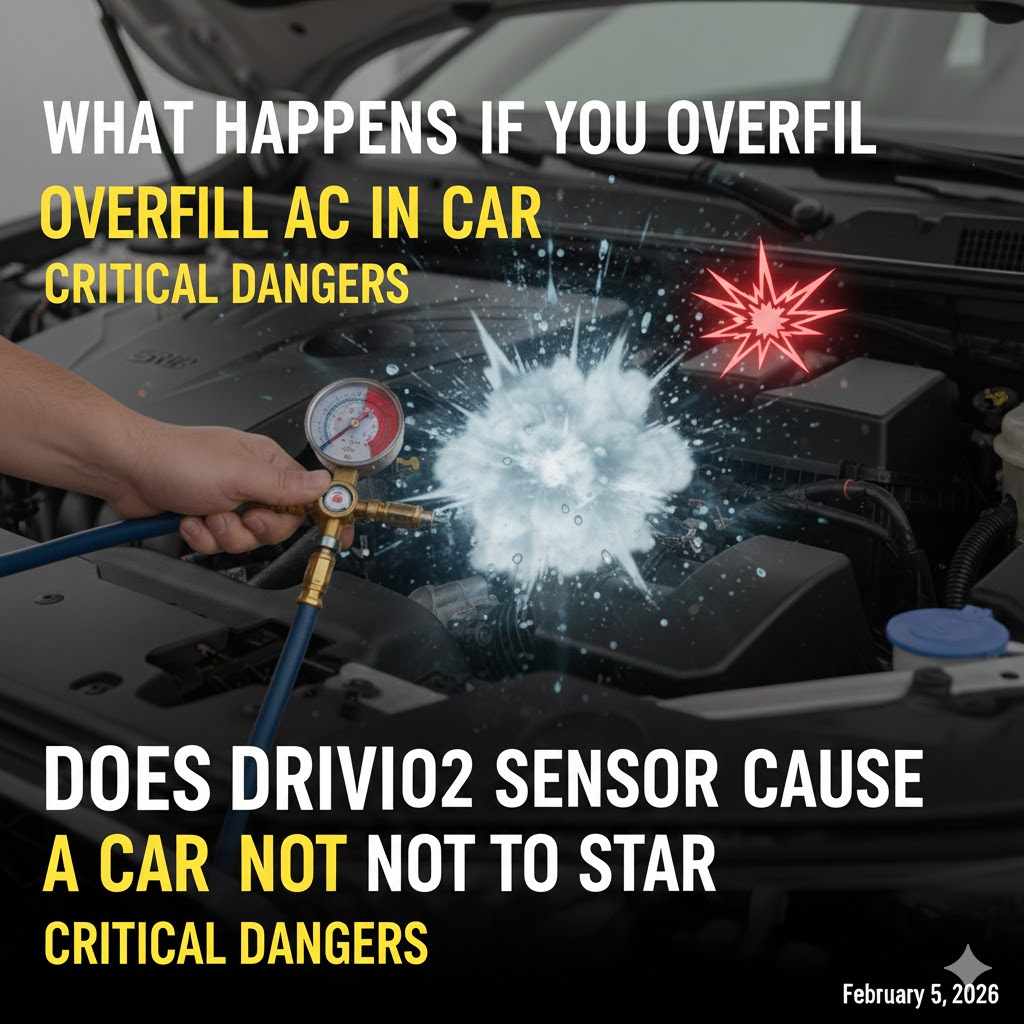
What Happens If You Overfill AC In Car: Critical Dangers
Overfilling your car’s AC with too much refrigerant causes dangerously high pressure, leading to poor cooling, damaged components like the compressor, and potential leaks. This can result in expensive repairs and safety hazards. Always follow your vehicle’s specifications to avoid damaging the system.
When the summer heat hits, a blast of cold air from your car’s AC is pure relief. It’s tempting to think that adding a little extra refrigerant will make it even colder, right? Unfortunately, when it comes to your car’s air conditioning, more is definitely not better. In fact, overfilling your AC system can cause serious problems that are far more frustrating—and expensive—than a weak air conditioner.
I’m Md Meraj, and I’m here to help you understand your car without the confusing jargon. Many drivers try a DIY AC recharge, but it’s easy to make a mistake and add too much. Don’t worry, it happens. We’re going to walk through exactly what happens when you overfill your AC, how to spot the signs, and what you can do to fix it safely. Let’s get your car cooling correctly and keep you safe on the road.
Why “More” Isn’t Better: Understanding Your Car’s AC System
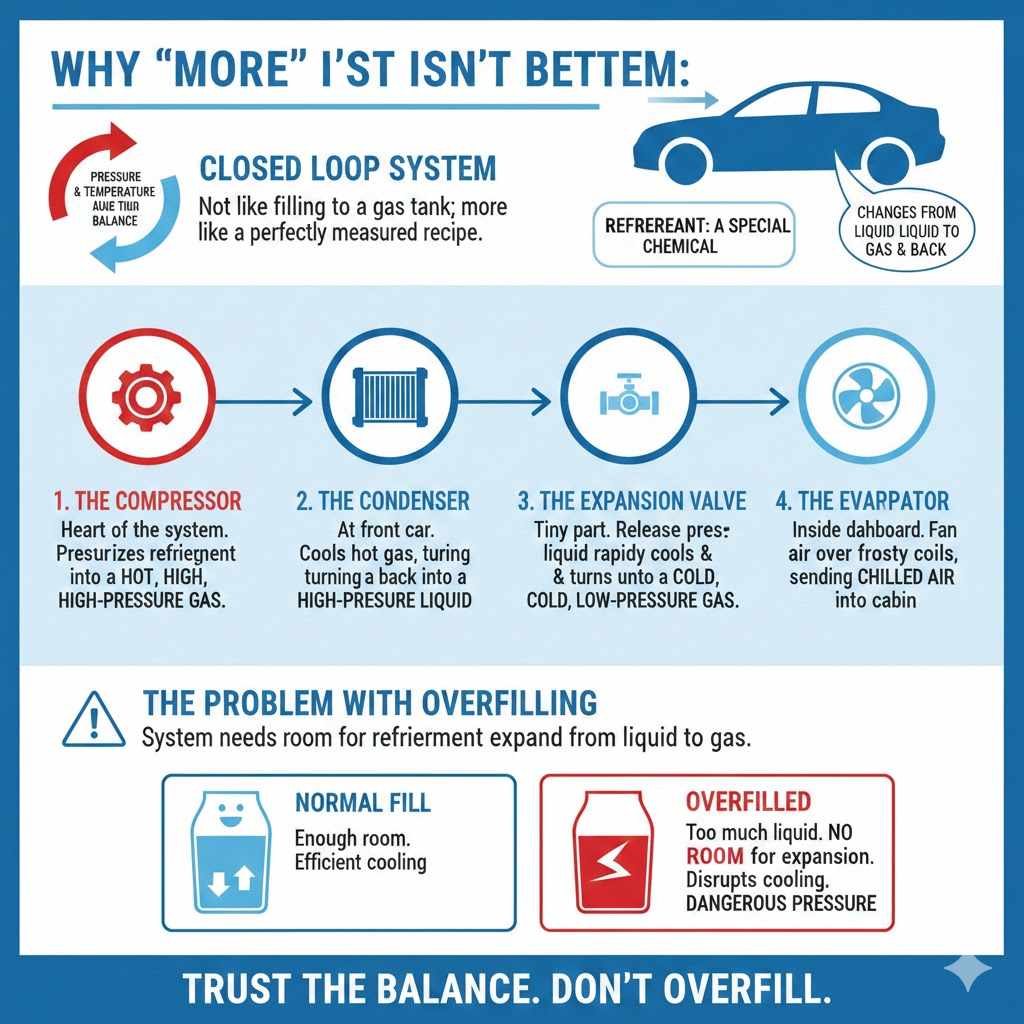
Your car’s air conditioning system is a closed loop that works on a delicate balance of pressure and temperature. It’s not like filling a gas tank; it’s more like a perfectly measured recipe. The system is designed to hold a very specific amount of refrigerant, which is a special chemical that changes from a liquid to a gas and back again.
Here’s a super simple breakdown of how it works:
- The Compressor: Think of this as the heart of the system. It pressurizes the refrigerant, turning it into a hot, high-pressure gas.
- The Condenser: Located at the front of your car, it cools the hot gas, turning it back into a high-pressure liquid.
- The Expansion Valve: This tiny part releases the pressure, causing the liquid refrigerant to rapidly cool and turn into a cold, low-pressure gas.
- The Evaporator: This is inside your car’s dashboard. As the cold gas flows through it, a fan blows air over the frosty coils, sending chilled air into your cabin.
This cycle depends on the refrigerant having enough room to expand from a liquid into a gas. When you overfill the system, you add too much liquid refrigerant. This leaves no room for expansion, disrupting the entire cooling process and creating dangerous levels of pressure.
The Critical Dangers: What Really Happens When You Overfill Your AC
Adding too much refrigerant isn’t just a small mistake—it can trigger a chain reaction of failures throughout your AC system. Here are the most common and critical dangers you need to be aware of.
1. Your AC Stops Blowing Cold Air
This is the most confusing part for many people. You added more refrigerant, so why is the air warm? When the system is overcharged, the excess liquid refrigerant cannot properly expand into a gas in the evaporator. The cooling effect in your AC comes from this expansion process. Without it, the refrigerant remains in a liquid state, and the air blowing into your cabin will be lukewarm or even hot.
2. Extreme Pressure Puts Your System at Risk
Your AC system is designed to operate within a specific pressure range. Overfilling it sends the pressure skyrocketing. This puts an immense strain on every single component, from the hoses and seals to the expensive metal parts. The system’s high-pressure switch may even shut down the compressor to prevent it from destroying itself, leaving you with no AC at all.
3. Catastrophic Compressor Failure
The compressor is the most expensive part of your AC system, often costing over $1,000 to replace. It is designed to pump gas, not liquid. When the system is overfilled, liquid refrigerant can get forced back into the compressor. This is called “slugging,” and it’s like trying to compress water—it can’t be done. This immense stress can cause the internal parts of the compressor to bend, break, or completely seize up, leading to a total failure.
4. Leaks, Bursts, and Damaged Seals
The intense pressure from an overcharged system has to go somewhere. It will find the weakest points, which are usually the rubber seals, O-rings, and hoses. The pressure can cause these parts to stretch, crack, or burst, leading to a major refrigerant leak. Not only does this stop your AC from working, but releasing refrigerant into the atmosphere is also harmful to the environment.
5. Poor Fuel Economy
When the AC compressor is under strain from high pressure, it has to work much harder. This extra work requires more power from your engine. As a result, your engine has to burn more fuel just to keep the AC running (or trying to run). You might notice your car feeling a bit more sluggish and your gas mileage dropping.
Spot the Problem: Telltale Signs of an Overcharged AC System
If you recently recharged your AC and are now experiencing issues, you might have overfilled it. Look out for these common symptoms:
- Warm Air from Vents: This is the number one sign. If your AC was cool before and is now blowing warm after a recharge, it’s likely overcharged.
- Strange Noises: You might hear a hissing sound from the high-pressure buildup or a whining, grinding, or rattling noise from the compressor as it struggles to work.
- AC Compressor Constantly Cycling: The compressor might turn on and off rapidly as the high-pressure switch repeatedly trips to protect the system.
- Visible Leaks: You might see a greasy, oily residue on the AC hoses or components. This is the lubricating oil mixed with the refrigerant leaking out.
- Frost on the Compressor: In some cases, you might see ice or frost forming on the compressor or its lines, which is a sign that liquid refrigerant is where it shouldn’t be.
AC Pressure 101: Understanding High and Low Sides
To properly diagnose an AC system, mechanics use a set of manifold gauges to read the pressure on the “low side” and “high side” of the system. These readings tell them exactly what’s going on inside. While you might not have these gauges, understanding the numbers helps explain why overfilling is so bad.
The ideal pressure varies based on the ambient (outside) air temperature. Here’s a general comparison of normal readings versus overcharged readings on a typical hot day (around 85-95°F or 29-35°C).
| System State | Low-Side Pressure (PSI) | High-Side Pressure (PSI) | What It Means |
|---|---|---|---|
| Normal Charge | 40–50 PSI | 225–250 PSI | The system is balanced. Refrigerant can change states properly, providing excellent cooling. |
| Overcharged | Above 55 PSI | Above 300 PSI (Can reach 400+ PSI) | Both pressures are dangerously high. The compressor is under extreme strain, and the system cannot cool effectively. |
As you can see, the pressure on both sides skyrockets in an overcharged system, confirming the immense stress it puts on all components.
How to Safely Fix an Overfilled Car AC System
If you suspect your AC is overcharged, you need to remove the excess refrigerant. However, this is not a simple task and can be dangerous if done incorrectly. Refrigerant can cause frostbite on contact and is harmful if inhaled. Additionally, it is illegal to release refrigerant into the atmosphere.
Your options are to either take it to a professional or, if you have the right equipment and experience, do it yourself. Safety must be your top priority.
Step-by-Step Guide for Safe Refrigerant Removal (for advanced DIYers)
Disclaimer: This is a job best left to professionals. It requires specialized tools and knowledge. Attempt this only if you are confident and have the proper safety gear.
Tools and Materials Needed:
- AC Manifold Gauge Set
- Refrigerant Recovery Machine (required by law to prevent venting into the air)
- Approved Refrigerant Recovery Tank
- Safety Goggles and Gloves
- Your Vehicle’s Service Manual
The Steps:
- Safety First: Put on your safety goggles and gloves. Work in a well-ventilated area. Make sure the engine is off and has been off for a while.
- Locate the Service Ports: Find the low-side and high-side AC service ports in your engine bay. They will have blue (low) and red (high) caps.
- Connect the Manifold Gauges: Attach the blue hose to the low-side port and the red hose to the high-side port. Do not start the car yet. The gauges will show the static pressure of the system.
- Connect the Recovery Machine: Connect the middle (yellow) hose from your gauge set to the intake port on the refrigerant recovery machine. Then, connect the machine’s output hose to the approved recovery tank. Follow the machine’s instructions precisely.
- Recover the Refrigerant: Turn on the recovery machine to safely pull the refrigerant out of the AC system and store it in the recovery tank. You will need to remove all of the refrigerant from the system. According to the U.S. Environmental Protection Agency (EPA), technicians must be certified to handle and recover refrigerants to prevent environmental harm.
- Perform a Vacuum: After recovering the refrigerant, you must use a vacuum pump to remove all air and moisture from the system. This step is critical for proper AC performance.
- Recharge to a Precise Level: Find the exact refrigerant capacity for your vehicle. This is usually on a sticker under the hood or in your owner’s manual. Use a digital scale to measure and add the precise weight of new refrigerant back into the system.
- Check Performance: Start the car, turn the AC on high, and check the gauge pressures and vent temperatures to ensure the system is operating correctly.
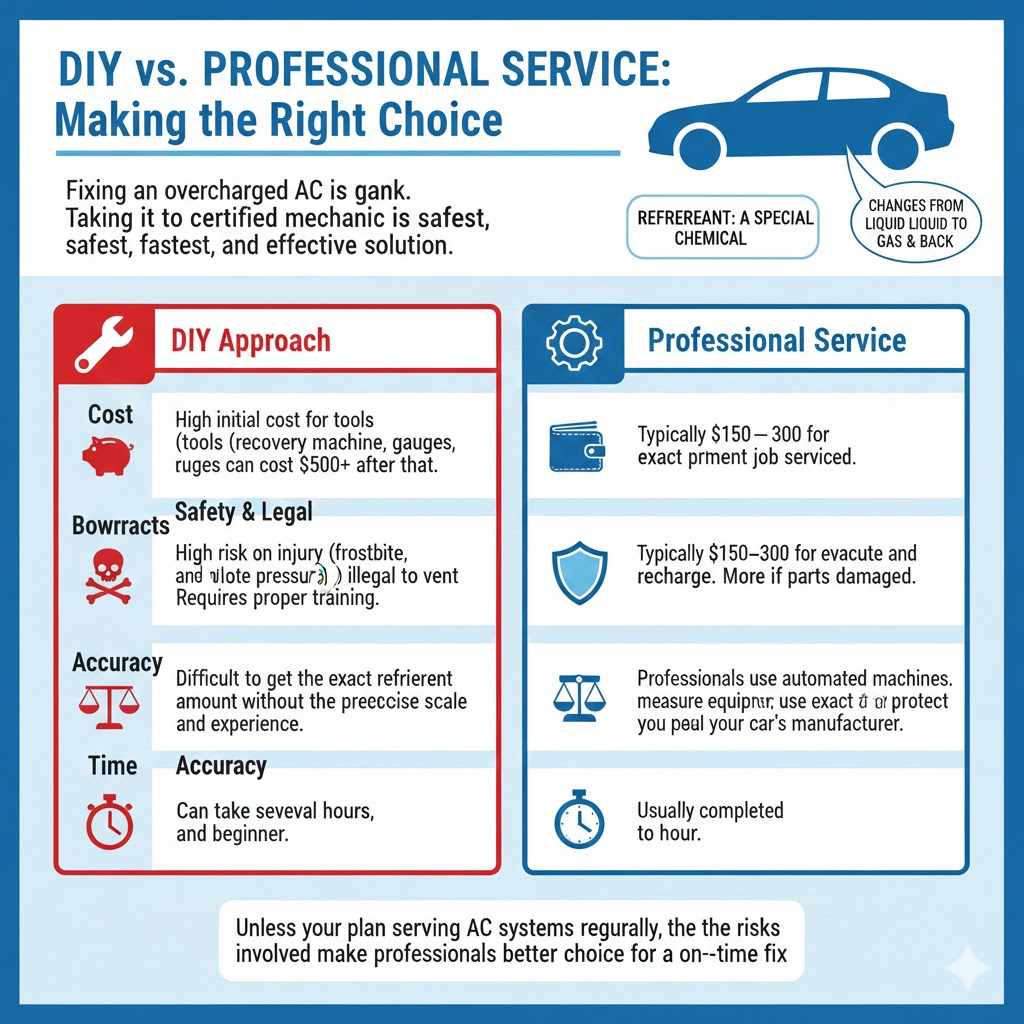
DIY vs. Professional Service: Making the Right Choice
The steps above show that fixing an overcharged AC system is a complex job. For most drivers, taking the car to a certified mechanic is the safest, fastest, and most effective solution.
| Factor | DIY Approach | Professional Service |
|---|---|---|
| Cost | High initial cost for tools (recovery machine, gauges, vacuum pump can cost $500+). Lower cost per job after that. | Typically $150–$300 for an evacuate and recharge service. More if parts are damaged. |
| Safety & Legal | High risk of injury (frostbite, high pressure) and illegal to vent refrigerant. Requires proper training. | Certified technicians are trained in safe handling. They use approved equipment to protect you and the environment. |
| Accuracy | Difficult to get the exact refrigerant amount without a precise scale and experience. | Professionals use automated machines that measure the exact weight of refrigerant required by your car’s manufacturer. |
| Time | Can take several hours, especially for a beginner. | Usually completed in about an hour. |
Unless you plan on servicing AC systems regularly, the investment in tools and the risks involved make professional service the better choice for a one-time fix.
Frequently Asked Questions (FAQ)
1. How much does it cost to fix an overcharged AC?
If no damage has occurred, a professional “evacuate and recharge” service typically costs between $150 and $300. This involves safely removing all refrigerant, pulling a vacuum to remove moisture, and refilling it to the exact specification. If the compressor or other parts are damaged, the repair costs can rise to over $1,500.
2. Can an overfilled AC fix itself?
No, an overfilled AC system cannot fix itself. The excess refrigerant must be manually and safely removed. Ignoring the problem will only lead to further damage and more expensive repairs.
3. How do I know the correct amount of refrigerant for my car?
The correct refrigerant capacity is listed on a sticker in your engine bay, often on the radiator support or firewall. It will specify the type of refrigerant (e.g., R-134a or R-1234yf) and the exact amount in ounces or grams.
4. Is it safe to release a little refrigerant to fix it?
Absolutely not. It is illegal to knowingly release refrigerant into the atmosphere because it is a potent greenhouse gas. It can also cause severe frostbite if it comes in contact with your skin. Always use a recovery machine or have a professional do it.
5. Will my car’s AC compressor explode from overcharging?
While a full-blown “explosion” is extremely unlikely due to safety features like pressure relief valves, an overcharged system can cause hoses to burst with significant force, which is very dangerous. The primary risk is not an explosion but catastrophic mechanical failure of the compressor.
6. What’s the difference between overfilling and a blockage?
An overcharged system has too much refrigerant, causing both high-side and low-side pressures to be too high. A blockage (like a clogged expansion valve) will cause very high pressure on one side and very low pressure on the other. Both can cause poor cooling, but the pressure readings are different.
Conclusion: Stay Cool and Stay Safe
When it comes to your car’s air conditioning, precision is key. Overfilling the system with refrigerant is a common mistake that can lead to a cascade of expensive and dangerous problems, from poor cooling and damaged parts to serious safety risks. The heart of your AC, the compressor, is especially vulnerable and costly to replace.
Remember the signs of an overcharged system: warm air, strange noises, and a struggling compressor. If you suspect you’ve added too much, the best course of action is to stop driving the car with the AC on and take it to a certified mechanic. They have the right tools and training to safely correct the refrigerant level, protecting your car, your wallet, and the environment.
By understanding how your AC works and respecting its limits, you can ensure it keeps you cool and comfortable for many summers to come. Stay safe, and happy driving!