How Social Factors Impact We Buy Any Car Growth
Social factors grow We Buy Any Car by cutting trust friction: one visible referral, review, or peer signal can move a hesitant seller toward a valuation booking faster than price messaging alone. Ignore them, and you pay with lower lead quality, weaker conversion, and more abandoned valuations. This guide breaks down the social signals that shape used-car selling and how to turn them into referral, review, and peer-proof systems that lift acquisition.
Why social factors move car buyers
Cars carry identity, freedom, and status, so social pressure enters the decision before a seller ever reaches a valuation form. Emotional motivation influences 95% of consumer buying behavior for high-priced products such as cars, which means confidence, belonging, and fear of regret often matter more than a spreadsheet.
Emotion, identity, and perceived risk
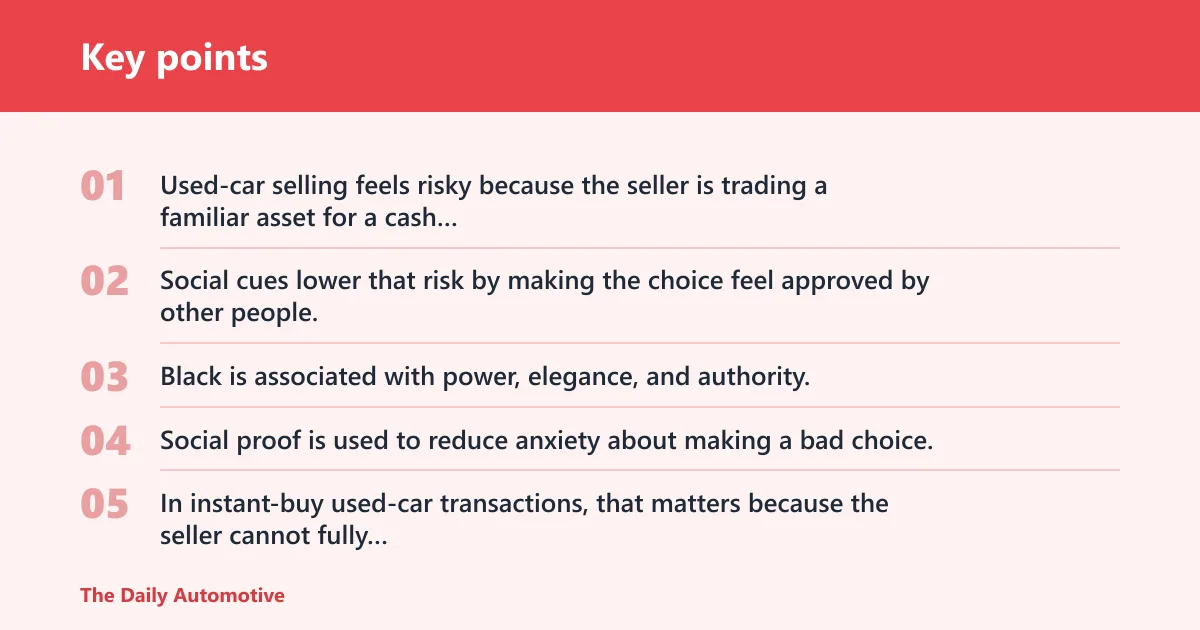
Used-car selling feels risky because the seller is trading a familiar asset for a cash offer from a brand that may be unknown. Social cues lower that risk by making the choice feel approved by other people, not faced alone. Black is associated with power, elegance, and authority, while red is presented as the color of passion, speed, and excitement; those cues shape how people read vehicle appeal, but the larger effect is emotional reassurance.
How social cues lower uncertainty
Social proof is used to reduce anxiety about making a bad choice. In instant-buy used-car transactions, that matters because the seller cannot fully inspect the buyer’s process from the outside. Reviews, testimonials, and named local signals tell the seller that other people accepted the same path, which lowers friction at the moment of booking and again at the moment of acceptance.
Why used-car decisions depend on trust
A used-car sale combines price uncertainty, time pressure, and fear of being underpaid. That is why the social layer matters more than it does in many lower-stakes purchases. A brand can have strong pricing and still lose the lead if the seller does not feel socially safe enough to proceed.
How social proof changes used-car sales
Social proof matters in used-car purchases because it shortens the gap between curiosity and commitment. In a high-friction sale, people want evidence that others completed the same transaction without trouble. Reviews, testimonials, and visible volume of completed sales reduce the mental cost of saying yes.
Reviews and testimonials as trust signals
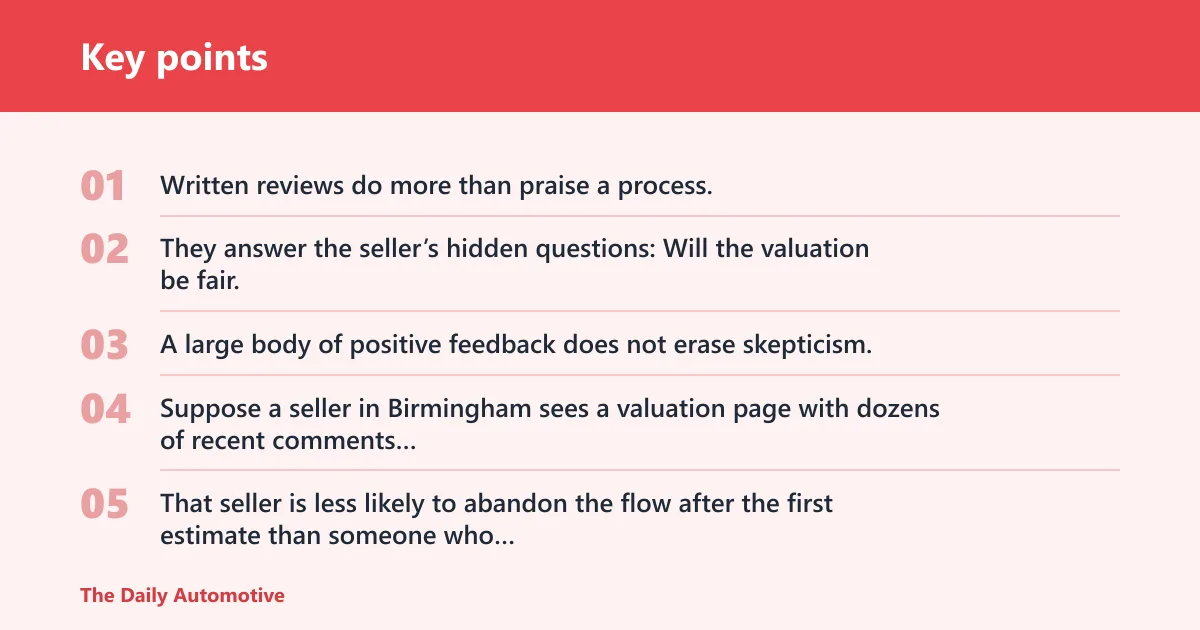
Written reviews do more than praise a process. They answer the seller’s hidden questions: Will the valuation be fair, will the handoff be quick, and will the offer change at the end? A large body of positive feedback does not erase skepticism, but it makes the brand feel less speculative and more socially validated.
Suppose a seller in Birmingham sees a valuation page with dozens of recent comments about fast payouts and clear paperwork. That seller is less likely to abandon the flow after the first estimate than someone who sees only a price promise with no supporting proof.
Local proof and familiar voices
Local social proof is especially useful for a national instant-buy brand because it turns a distant company into a familiar option. A seller is more willing to trust “people like me” than a generic claim. That is where reference groups matter: the people a buyer associates with shape habits, influence vehicle choice, and help decide what is acceptable.
Family influence starts early. It forms brand familiarity through repeated exposure, and that familiarity can survive into adulthood when the seller is choosing how to dispose of a car. A parent who has heard the same brand name for years is less likely to treat it as a risky unknown.
Where social proof fits in the funnel
At awareness, social proof should answer “Is this brand real and used by people like me?” At appraisal, it should answer “Will the quote process feel fair?” At sale completion, it should answer “Will the handoff be smooth enough to finish?” The social signal changes at each stage, but the job stays the same: reduce doubt.
Family and reference groups in vehicle choice
Family and reference groups shape what people view as normal, safe, or worth paying for. The sociological consumer behavior model says people are impacted by who they are around, and that applies directly to car choice. If the surrounding group values convenience, status, or practicality, the seller tends to interpret those values as personal priorities too.
Early exposure and brand familiarity
Family influence creates early brand familiarity through repeated exposure to dealership habits, trim levels, body styles, and ownership norms. That familiarity can later reduce resistance to a brand seen in the household before. In the used-car market, familiarity often matters more than deep product knowledge because the seller is deciding under time pressure.
Peer validation and acceptable choices
Reference groups also establish what counts as a sensible move. A parent may choose an SUV because peers all do. That same logic appears when a seller sees friends using quick-sale brands, reading positive reviews, or talking about the ease of valuation booking. The choice feels more acceptable when the social circle has already normalized it.
Age and life-stage differences in influence
Younger sellers often respond strongly to peer validation and online reviews because those signals are immediate and easy to compare. Mid-career sellers are more likely to care about time savings, convenience, and the ability to justify the choice to a partner or household. Older sellers may weight familiar brands, local reputation, and process clarity more heavily. Income matters too: higher-income buyers often have more alternatives, so status cues and time efficiency can carry more weight; budget-sensitive sellers may focus on certainty and fair treatment.
Which consumer behavior models explain it?
Several consumer behavior models help explain why social factors move car buying. The psychoanalytical view points to motives beneath the surface. The sociological view focuses on the people around the buyer. The economic view assumes people compare value, while Engel-Kollat-Blackwell and the Black Box model describe how outside signals enter the decision path and shape the outcome.
Psychoanalytical and sociological views
The psychoanalytical model is useful because cars often carry emotional meaning beyond transport. The sociological model is even more direct for used-car growth because it says social setting changes choice. That includes family habits, peer comments, and what a buyer thinks will earn approval from the people around them.
Emotion should not be treated as a side note. For cars, it is central. The buyer is not only evaluating money out and money in; the buyer is also protecting self-image and avoiding regret in front of other people.
Economic and Black Box models
The economic model still matters because the seller compares offers, fees, and convenience. But the Black Box model is the better fit for social influence because it hinges on external stimuli influencing consumers. A valuation page, a review score, a referral message, or a friend’s recommendation all enter that box and shape the response that comes out.
Engel-Kollat-Blackwell in the buying path
The Engel-Kollat-Blackwell model includes five stages. For a used-car seller, those stages map neatly to need recognition, information search, evaluation, purchase, and post-purchase evaluation. Social proof can intervene at each stage: it can create awareness, support comparison, reduce fear at booking, and prevent second-guessing after acceptance.
Which psychological biases shape car purchase decisions?
Car selling is vulnerable to bias because the first valuation, the first review, and the first social cue often anchor the rest of the judgment. Anchoring bias means the first piece of information sets the tone for negotiation. Confirmation bias then pushes the seller to seek support for the decision already forming. Scarcity effect adds urgency and can speed action when used carefully.
Anchoring bias in price negotiation
The first listed price becomes a baseline. A discount can feel larger when it sits next to a high anchor, even if the final offer is still not attractive. For a brand that buys used cars, the opening valuation has to be credible because it sets expectations before any human interaction happens.
Confirmation bias after the first quote
After a quote appears, sellers often look for evidence that the number is fair and ignore contradictory information. That is why reviews matter after the valuation screen appears, not only before it. Supportive testimonials help the seller justify a choice already leaning in that direction.
Scarcity effect and urgency
The scarcity effect is triggered by messages like only two left at this price. Used carefully, it can move a seller to book sooner. Used carelessly, it can feel manipulative and damage trust. The goal is to communicate real availability or limited appointment windows, not fake pressure.
A common first-timer mistake is to assume that a limited-time offer will boost interest on its own, without considering how neighborhood norms and peer recommendations shape buyers’ response. Suppose a seller sees “limited slots today” and then discovers the same message tomorrow. The brand gains a booking in the short term but loses credibility for the next visit, which is costly in a trust-friction category.
Social influence playbook table
This table translates social signals into growth actions for a used-car buy-side brand. Each row links a social factor to a buyer signal, a practical use case, a misuse risk, and one metric you can track.
| Social factor | Buyer signal | Growth use case for We Buy Any Car | Risk if misused | One metric to track |
|---|---|---|---|---|
| Family influence | “My household trusts familiar brands.” | Use family-friendly message framing and simple explanations for the valuation process. | Overlooking solo sellers who do not consult family members. | Booking-to-completion rate by household-led leads |
| Peer validation | “People like me have done this.” | Show peer stories by life stage, car type, and region. | Generic testimonials that feel unrelated. | Lead conversion rate after testimonial exposure |
| Review volume | “Others have already checked this out.” | Display recent, specific reviews on booking and quote pages. | Chasing volume without quality control. | Review-to-booking conversion rate |
| Local social proof | “This brand is known near me.” | Surface branch-level feedback and city-specific reassurance. | Claiming locality without real local evidence. | Local page conversion rate |
| Status signaling | “This choice fits how I want to be seen.” | Frame quick sale as efficient, sensible, and confident rather than desperate. | Overplaying prestige and alienating value-focused sellers. | Quote acceptance rate by income proxy |
| Scarcity cues | “I should act before the slot is gone.” | Use real appointment limits and time-bound booking windows. | Fake urgency that erodes trust. | Same-day booking rate |
How should We Buy Any Car use this?
We Buy Any Car should treat social influence as a conversion system, not a branding extra. The highest-value use is to move hesitant sellers through awareness, appraisal, and completion with proof that the process is normal, fair, and socially validated. That means building review, referral, and local proof into the path, not around it.
Awareness tactics built on peer proof
At awareness, the brand should lead with familiar signals: recent customer feedback, local branch visibility, and simple explanations of the offer process. Social media has changed how social influence works in consumer decisions, so short-form peer proof can now do work that once required long-form persuasion.
For younger sellers, mobile-first review snippets and social content may matter more than static brand claims. For older or higher-income sellers, a cleaner emphasis on reputation, process clarity, and time saved may be more persuasive. The message should match the buyer’s likely reference group.
Appraisal and sale-completion tactics
At appraisal, the brand should reduce uncertainty with precise language, consistent offer logic, and visible signals that the process is normal for many sellers. At sale completion, reassurance matters most. A seller who has already searched for validation will notice any mismatch, so the handoff has to feel orderly and predictable.
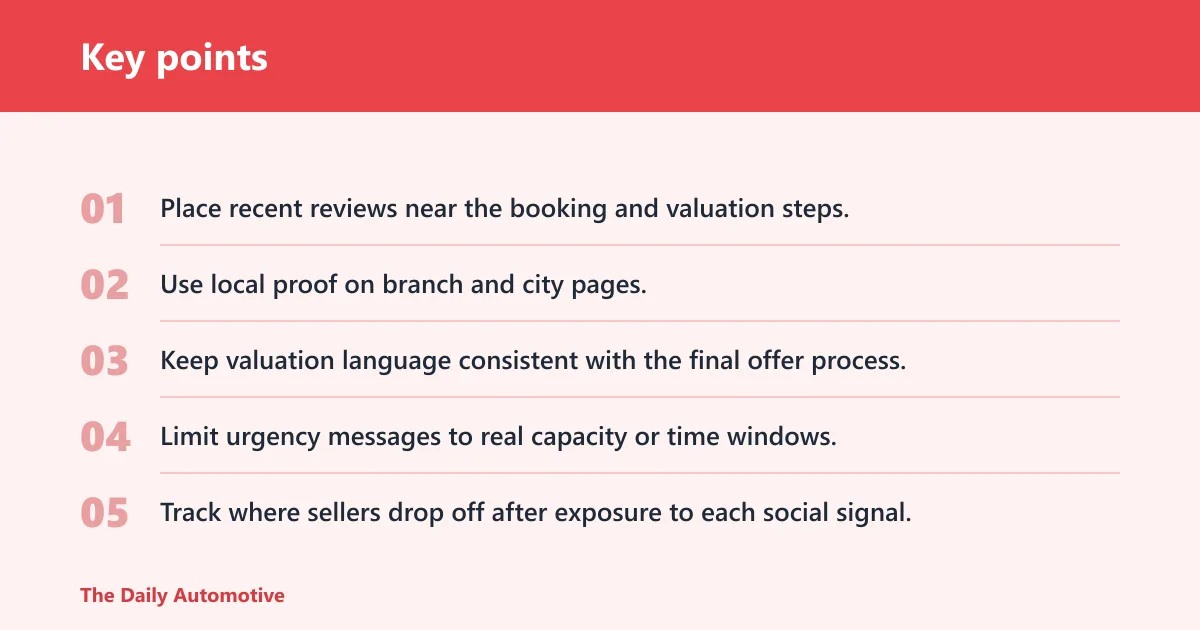
- Place recent reviews near the booking and valuation steps.
- Use local proof on branch and city pages.
- Keep valuation language consistent with the final offer process.
- Limit urgency messages to real capacity or time windows.
- Track where sellers drop off after exposure to each social signal.
Referral loops and review systems
Referral loops work best when the inviter can explain the brand in one sentence. Give that person a simple reason to share: quick booking, clear process, or straightforward handoff. Review systems should ask for detail, not just stars, because detail gives the next seller a reason to believe the experience will repeat.
Cars are symbols of identity, freedom, and achievement, and some buyers use them to express beliefs as well as status. Environmental or values-based signaling may matter here too: EVs and hybrids can suggest sustainability, while other buyers may prefer signals of practicality or prestige. The brand should respect those signals rather than flatten them into one message.
Frequently asked questions
How do social factors influence car buying decisions?
Social factors shape which cars feel acceptable, credible, and worth the money. Family habits, peer opinions, status cues, and online reviews all affect confidence. In used-car selling, those same forces decide whether a seller trusts the brand enough to book a valuation and accept an offer.
Why does social proof matter in used-car purchases?
Social proof matters because it reduces anxiety about making a bad choice. Reviews, testimonials, and visible completions tell the seller that other people have already taken the same path. That reassurance is especially valuable when the buyer cannot inspect the brand’s process in person before committing.
How do family and reference groups affect vehicle choice?
Family influence builds early familiarity with brands, body styles, and ownership habits. Reference groups then shape what feels normal or desirable. If a person’s circle values convenience, status, or practicality, those preferences often carry into the car decision and into the choice of who to trust when selling.
What consumer behavior models explain car buying?
The psychoanalytical model explains the emotional side of the choice. The sociological model explains the impact of family and peers. The economic model explains value tradeoffs. Engel-Kollat-Blackwell maps the five stages of purchase, and the Black Box model explains how outside signals shape the final response.
How can a used-car brand use social influence to grow?
A used-car brand can grow by placing trust signals where hesitation appears: reviews at awareness, local proof at comparison, and clear reassurance at completion. Referral loops work when customers can explain the brand quickly. The best systems are measurable, because each social signal should improve booking, acceptance, or completion rates.
Products related to this article
Sponsored / affiliate links. As an Amazon Associate I earn from qualifying purchases. I may earn additional commission from eligible campaigns.
 Nyambo Fixapro Scratch Remover, The Magic Car Cleaning Cloth for Any Car Scratches, Quickly & Easily Removes Scratches, Works on All Vehicles and Any Color (10 PCS) (10)
 RVS Technology G6 Engine oil Treatment; For Gasoline Engines with a Motor oil capacity up to 6 quarts; Save fuel, Boost Power and Safely Restore and protect your Car, Truck, and all other engines