Selling to CarMax, Carvana or a Private Buyer: Who Pays More?
A private buyer usually pays the most, often about 5% to 15% above a dealer offer. But CarMax or Carvana can still leave you with more net cash if speed, payoff handling, or repair risk would wipe out that spread. Pick the wrong path and you can lose hundreds in fees, weeks of time, or a failed sale. This guide turns offer price, taxes, payoff, prep costs, and risk into a simple decision matrix.
Who pays more overall?
A private buyer usually offers the highest sticker price, but the highest sticker price does not always mean the most money left after costs. CarMax and Carvana can beat a private sale on net cash when the car needs work, the payoff is tricky, or your time has real value. The better answer depends on the car and the sale path.
Why the highest sticker offer is not always the most cash in your pocket
Private sales tend to cost money before the car leaves your driveway. Cleaning, photos, listing time, message screening, test-drive setup, title paperwork, payment checks, and the risk of a buyer walking away all cut into the spread. If you need quick payoff handling or want to skip repair haggling, a lower dealer offer can still net more.
CarMax says its upfront prices are set, and Carvana does not negotiate either. Both usually give you a 7-day offer window. That makes the comparison simpler: compare the real cash you keep, not the number on the first quote.
CarMax vs. Carvana at a glance
CarMax is built for in-person appraisal and fast in-store completion. Carvana is built for online quoting and handoff by pickup or vending machine. Both can work well for a running car in normal condition, and both are useful when you want a fixed offer instead of buyer back-and-forth.
How each offer process works
CarMax appraises the car in person at one of its 250+ stores nationwide. Carvana starts with an online quote, then completes the handoff by pickup or, in some locations, a vending machine. In both cases, the offer is firm for 7 days and not negotiable.
Payment timing and payout method
CarMax offers same-day payment by bank draft. Carvana pays by check or ACH after the sale is completed. That timing matters if you need to clear a loan, avoid a lapse in insurance planning, or move on before the next payment is due.
When each buyer is more likely to fit the car
Carvana is often a better fit for newer running cars that fit its online process cleanly. CarMax can be a better fit when you want an in-person review and same-day payout. Neither buyer should be treated as automatic for every car, especially if it has major damage, title issues, or does not run.
Selling carmax carvana or table
The table below translates sticker price into estimated net cash. The “private-sale price” is the likely sale number before costs. The instant-offer range reflects the kind of dealer spread a seller may see. The net column subtracts common private-sale costs, a simple payoff timing assumption, and a modest time cost for the sale process.
| Vehicle type | Estimated private-sale price | Instant-offer range | Likely private-sale selling costs | Estimated net cash after title transfer, payoff handling, and time cost assumptions |
|---|---|---|---|---|
| Newer clean-title sedan or crossover | $18,000 | $16,200 to $17,200 | $500 to $900 | $16,300 to $17,500 |
| Older high-mileage truck or SUV | $9,500 | $8,200 to $9,100 | $600 to $1,100 | $8,000 to $9,000 |
| Car with cosmetic or mechanical issues | $6,500 | $5,400 to $6,200 | $700 to $1,400 | $5,200 to $6,100 |
These figures are decision numbers, not quoted offers. The point is directional: a private sale can bring more gross money, but the gap narrows fast once you price in prep, time, and the risk of a failed buyer. A clean newer car has the best odds of beating dealer offers by a wider margin.
What private sale costs really add up?
Private sales cost more than most sellers expect. The obvious expenses are cleaning and listing. The less obvious ones are screening messages, setting up test drives, checking payment, and handling the title transfer without a mistake. Those hidden costs can turn a better sticker price into a smaller net check.
Cleaning, photos, listings, and time spent screening buyers
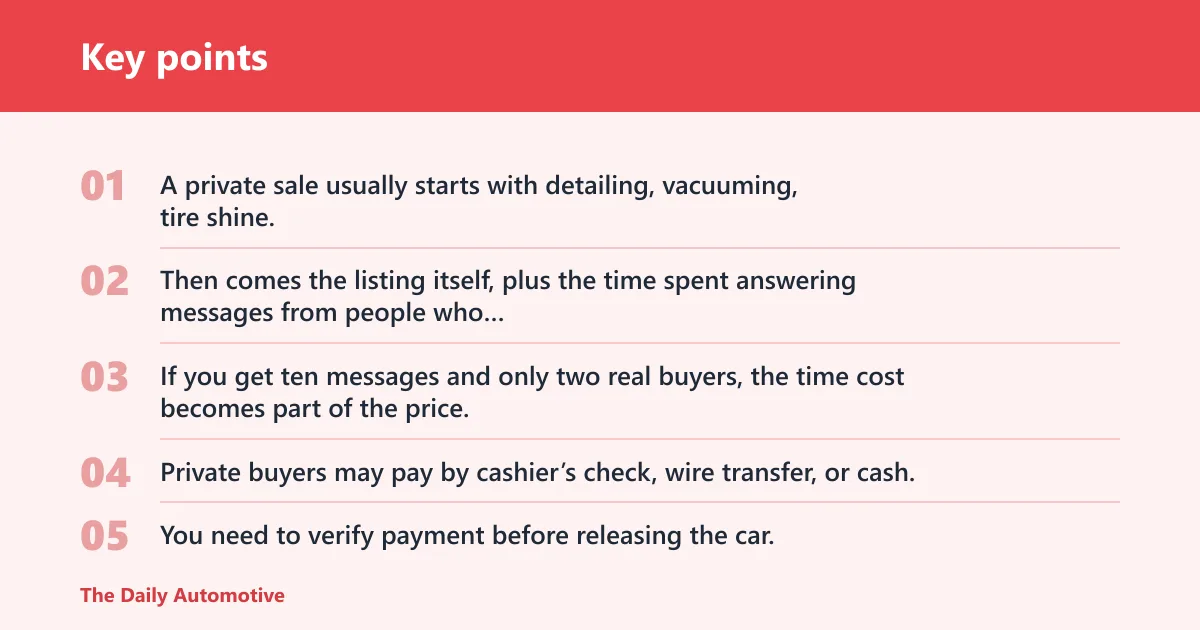
A private sale usually starts with detailing, vacuuming, tire shine, and photos from several angles. Then comes the listing itself, plus the time spent answering messages from people who are not serious. If you get ten messages and only two real buyers, the time cost becomes part of the price.
Payment verification risk and title-transfer friction
Private buyers may pay by cashier’s check, wire transfer, or cash, but each method carries friction. You need to verify payment before releasing the car. You also need to transfer the title correctly, collect the bill of sale if your state uses one, and avoid handing over the keys until the money is real.
For example, a sedan might be worth about $18,000 in a private sale, while a dealer offer might be about $16,900. If you spend three weekends fielding messages, pay for detailing, and later lose a buyer over a financing hiccup, the gap can shrink fast. A lower dealer offer can still be the better net result.
Sales tax savings if you buy your next car from a dealer
One overlooked comparison is sales tax treatment on your next car. In many states, a dealer trade-in can reduce the taxable amount on the replacement vehicle, while a private sale does not. That does not make a dealer offer automatically better, but it can change the math if you are replacing the car right away.
What happens if you still owe money?
Both CarMax and Carvana can handle loan payoff during the sale. If the offer is lower than your balance, you pay the difference at closing or through the lender’s payoff process. If the car is upside down, keep making payments until the lender shows a zero balance, because payoff posting can lag the sale date.
How lender payoff works with CarMax and Carvana
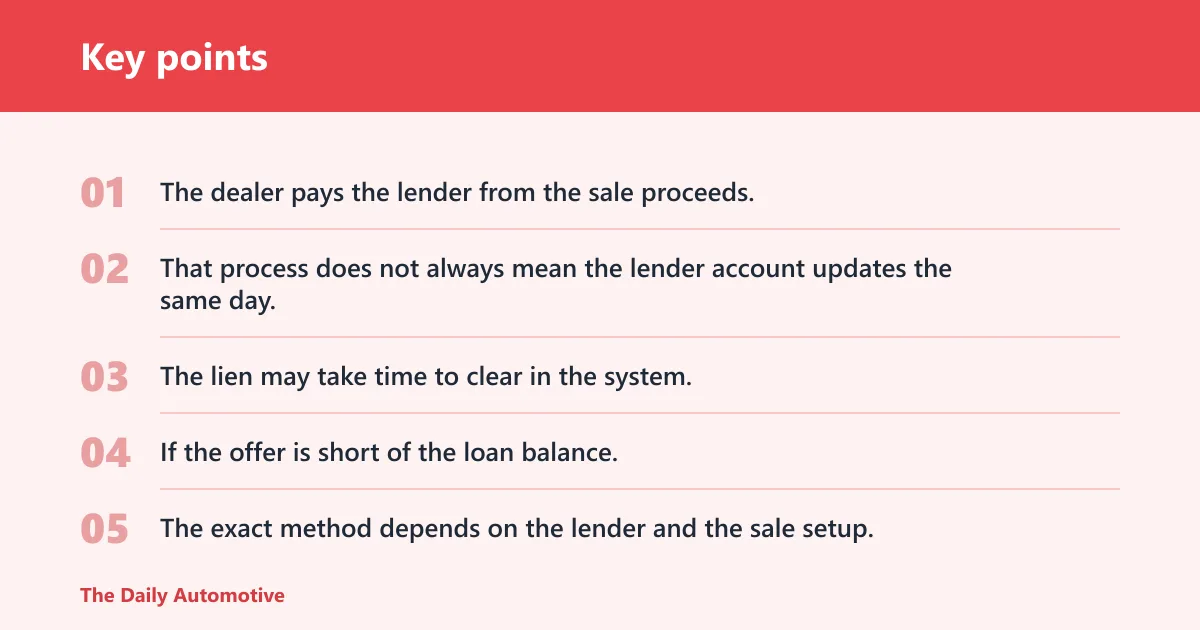
The dealer pays the lender from the sale proceeds, then closes the rest of the transaction. That process does not always mean the lender account updates the same day. The lien may take time to clear in the system, so the seller should keep paying until the account shows zero or the lender confirms the payoff is complete.
What happens when the offer does not cover the loan balance
If the offer is short of the loan balance, you bring cash to closing or arrange the difference with the lender. The exact method depends on the lender and the sale setup. If you do not cover the gap, you do not get a clean title transfer and the sale can stall.
A common first-timer mistake is assuming the payoff is finished the moment the car leaves the driveway. That is not safe. The lender may still show a payment due for a short period, and missing that payment can create late fees or credit trouble if the payoff posting takes time.
Choose CarMax if… / Choose Carvana if… / private buyer if…
Choose CarMax if you want an in-person appraisal, same-day payment, and a sale that can be wrapped up fast at a local store. Choose Carvana if you want an online quote, pickup or vending-machine handoff, and a process that avoids a lot of face-to-face selling. Choose a private buyer if the car is clean and the extra spread is large enough to justify the work.
Best fit for newer clean-title cars
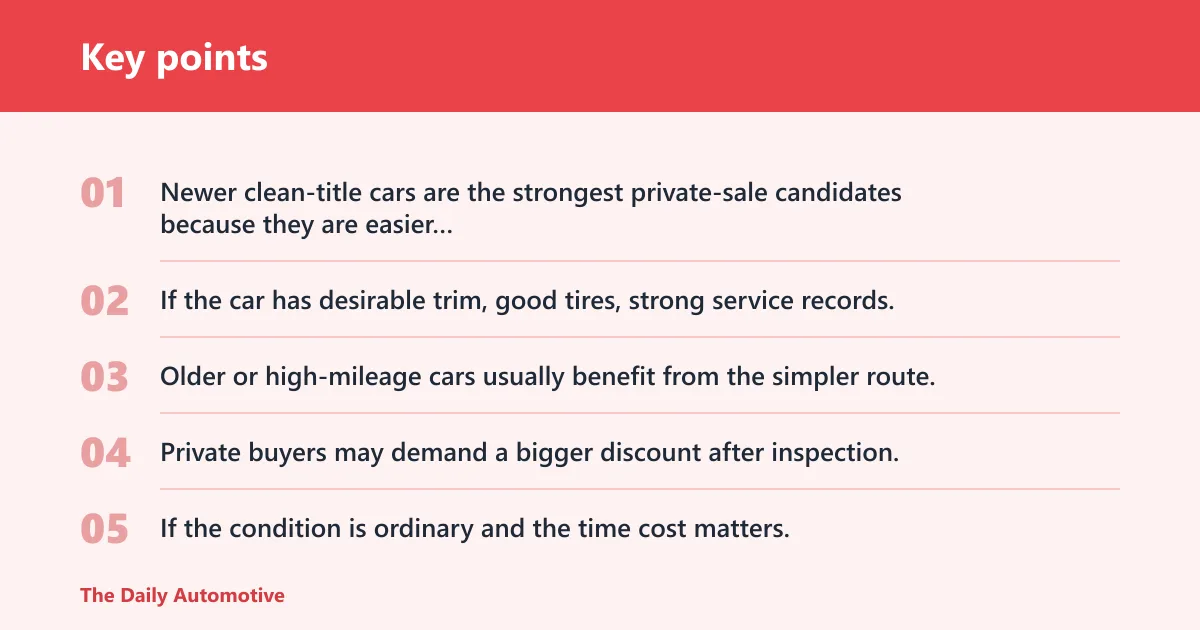
Newer clean-title cars are the strongest private-sale candidates because they are easier to price, easier to inspect, and more attractive to retail buyers. If the car has desirable trim, good tires, strong service records, and no major cosmetic damage, a private buyer can often pay more than either instant-offer buyer.
Best fit for older or high-mileage cars
Older or high-mileage cars usually benefit from the simpler route. Private buyers may demand a bigger discount after inspection, and the car can sit longer before it sells. If the condition is ordinary and the time cost matters, CarMax or Carvana may produce better net value even with a lower quote.
Best fit for cars with cosmetic or mechanical issues
Cars with dents, warning lights, rough paint, or overdue maintenance are the hardest private-sale cases. Every flaw creates negotiation room. If the car still runs, an instant offer often reduces hassle and price-chopping risk. If it does not run, you may need a different outlet entirely.
Suppose a midsize SUV has 132,000 miles, a cracked bumper cover, and a clean title. A private buyer may still pay more, but only after an inspection, a detailed disclosure conversation, and a likely discount. If you need the sale finished this week, the instant offer may be the better net choice.
How long does a CarMax or Carvana offer last?
CarMax and Carvana both make offers valid for 7 days. That window gives you time to compare bids, check your payoff, and decide whether a private buyer is worth the extra effort. The offers are firm, but only inside the validity window and only if the car matches the disclosed condition.
Can Carvana or CarMax lower the offer after inspection?
Yes. If the car’s condition, title status, mileage, equipment, or history does not match the details used for the quote, the final offer can change after inspection. That is why the seller should disclose damage, warning lights, missing keys, prior body work, flood history, and title problems up front.
- Match the photos to the real car, including wheels, glass, and interior wear.
- List every warning light, accident history item, and known mechanical issue.
- Bring the title, registration, and payoff information before the appointment.
- Remove personal items and verify the car can be driven or started as described.
- Ask for the written offer terms and the inspection conditions before you accept.
How fast do CarMax and Carvana pay sellers?
CarMax is the faster option for payment because it offers same-day payment by bank draft. Carvana’s payment method is check or ACH, so the money may land later depending on the process and the bank. If timing matters more than every last dollar, CarMax has the clearer payout speed.
Private sale timing versus instant-offer timing
A private sale can take days or weeks before money changes hands, especially if the buyer is still comparing cars or arranging a loan. That delay matters if you are trying to line up a replacement car, avoid another insurance cycle, or pay off a lender quickly.
Frequently asked questions
Does CarMax or Carvana usually pay more for my car?
Carvana has sometimes quoted more than CarMax on comparable vehicles, but neither buyer is always highest. The right answer depends on the exact car, its condition, and the current market. Compare both offers and then compare them with realistic private-sale net proceeds before deciding.
Should I sell my car privately or to CarMax or Carvana?
Sell privately if you want the highest possible price and you are willing to handle the work. Use CarMax or Carvana if you value speed, clean payoff handling, and less risk of a buyer backing out. The better choice is the one that leaves you with the most net cash after costs.
What happens if I still owe money on my car?
CarMax and Carvana can handle the payoff from the sale. If the balance is higher than the offer, you cover the shortfall. Keep making payments until the lender account shows zero, because payoff posting can lag and a delayed update can cause a missed payment problem.
Which option is best for an older or high-mileage car?
Older or high-mileage cars often fit CarMax or Carvana better than a private listing, especially if the car needs work or might trigger heavy negotiation. A private sale can still pay more, but the buyer pool is smaller and the inspection questions are usually tougher.
Is the extra money from a private sale worth the hassle?
Sometimes, but only when the spread is wide enough to cover your time, prep costs, and risk. If the private offer is only a little higher than CarMax or Carvana, the dealer route may leave you better off in net dollars. If the spread is large, private sale wins more often.
Products related to this article
Sponsored / affiliate links. As an Amazon Associate I earn from qualifying purchases. I may earn additional commission from eligible campaigns.