What Is a Good APR for a Car Loan Right Now?
A good car-loan APR is often around 2% to 6% for top-tier borrowers on new cars, and used-car rates are often reported as 1 to 3 points higher. If your quote sits above that, compare it first against other lenders, then check the term and total interest before you sign. A weak APR can add thousands in interest over the loan term. This guide shows how to judge a rate by credit tier, vehicle age, term length, and total loan cost.
What APR means
APR is the annual borrowing cost of the loan. It includes interest and some lender fees, so it gives you a cleaner comparison than the headline rate alone. A lower APR usually cuts the monthly payment and reduces total interest over time.
APR vs. interest rate
The interest rate is only part of the cost. APR folds in fees, which is why two loans with the same rate can still cost different amounts. If one lender offers a lower rate but loads the deal with fees, the APR may tell a less flattering story.
That matters because the monthly payment is only half the picture. A quote can look affordable and still cost more overall if the term is long or the lender tucks fees into the loan.
What counts in APR disclosures
Some lenders advertise a representative APR. That is not the same as your personal APR. Your actual rate depends on credit score, income and financial history, the vehicle, the term, and the size of your deposit.
Suppose two borrowers both see a 6.9% representative APR. One has super-prime credit and a 48-month term on a new car. The other has a thin file, a used car, and a 72-month term. Their personal APRs can be very different.
What is a good APR right now?
A good APR is not one fixed number. It depends on credit tier, whether the car is new or used, and how long you will borrow. As a practical shopper rule, a quote near the top of your expected credit band is usually fair; a quote above it needs a harder look.
Rate bands by credit tier
Credit score is one of the two most important factors in car-loan pricing, and it often drives the biggest swing in APR. A rough shopper guide looks like this: super-prime borrowers at 2% to 4%, prime at 3% to 6%, nonprime at 6% to 11%, subprime at 11% to 18%, and deep subprime at 14% to 21%.
Those bands are not a promise from any lender. They are a shopper test. If your quote lands near the low end of your tier, that is generally a strong result. If it lands near the high end, the deal may still be usable, but only if the rest of the contract is clean.
How new car loans differ from used car loans
New-car financing usually carries lower APR than used-car financing. New cars often qualify for lower rates, and manufacturer incentives can sometimes push them down further. Used cars usually cost more to finance because the vehicle is older, the collateral value is less predictable, and lender loss risk is higher if the borrower falls behind.
Used-car financing typically attracts slightly higher APRs, even when the borrower is otherwise strong. That does not make every used-car quote expensive. It does mean you should compare the quote against both the credit tier and the vehicle age.
When a quote is good enough to take
A quote is usually good enough when it fits the borrower’s tier, the vehicle is not unusually old, and the total cost stays sensible for the term. As a simple rule, a shorter-term loan should usually be closer to the low end of your tier, while a longer-term loan should only be accepted if it is still near the low end and the rest of the deal is clean. A lower APR helps, but it does not cancel out a high sale price, a stretched loan term, or expensive add-ons.
A common mistake is focusing on the APR while ignoring the loan term, fees, and monthly payment. A 5.9% APR on an overmarked used SUV with a 72-month term can be worse than a 6.9% APR on a fairly priced new car with a 48-month term.
What is a good APR for a used car loan right now?
A good used-car APR is often about 1 to 3 points higher than the same borrower might see on a new car. For strong credit, that can still mean a competitive quote in the mid-single digits. For nonprime and weaker files, a “good” used-car rate may still sit well above 10%.
Why used loans usually cost more
Used cars bring more lender risk because age, mileage, and collateral value matter more. If the car is older or has high mileage, the lender has less cushion if the borrower defaults. That risk tends to show up as a higher APR, especially on longer terms.
Vehicle age is not the only factor, but it is a real one. A newer used car with a clean history and modest mileage will usually price better than an older vehicle with uncertain resale value.
When a used-car quote is still competitive
A used-car quote can still be competitive if it sits near the lower end of the rate band for your credit tier and the term is not stretched too far. The deal gets weaker when the rate is fair but the loan runs long, the price is padded, or the lender pushes add-ons you do not need.
Picture a 5-year-old compact car with 60,000 miles. A mid-single-digit APR for a prime borrower may be reasonable. The same rate on a 10-year-old car with a longer term deserves more scrutiny.
What moves your rate
Lenders price car loans from several risk factors, not just one score. Creditworthiness matters most, but term length, deposit size, and vehicle age also affect the APR you are offered. Thin credit files and weaker repayment history often push the quote higher even when the score looks acceptable.
Credit score and file thickness
Borrowers in the super-prime and prime bands usually see the best pricing. Nonprime, subprime, and deep subprime borrowers face much steeper rates, and thin-file borrowers can be treated conservatively because the lender has less history to judge.
If your file is thin, the APR may reflect uncertainty more than a single credit score. That is one reason two shoppers with similar scores can get different quotes.
Loan term length
Longer terms usually mean more interest paid, even if the monthly payment looks easier. A longer term can also raise the APR in some offers because the lender is exposed for more time. Shorter terms usually improve the total cost if the payment fits your budget.
That is where shoppers get trapped. The payment falls, but total interest rises. A lower monthly bill is not automatically a better deal.
Down payment and vehicle age
A larger deposit lowers the amount financed, which can reduce lender risk and sometimes improve pricing. It also reduces the interest you pay because you borrow less. Older vehicles usually price worse than newer ones because age and mileage weaken the collateral.
Say your down payment trims the loan from $25,000 to $20,000. Even with the same APR, total interest falls because you are financing less principal.
APR comparison table
This table turns “good APR” into a shopper test. The rate bands below are deal-quality bands, not guarantees. The cost column shows the approximate interest change from a 1% APR difference on a $25,000 loan.
| APR range | Borrower profile, vehicle type, and term | 1% APR cost impact on $25,000 | Verdict |
|---|---|---|---|
| 2% to 4% | Super-prime borrower, new car, 36 to 60 months | About $600 more interest over 48 months; about $716 more over 72 months | Strong deal |
| 3% to 6% | Prime borrower, new car or clean used car, 36 to 60 months | About $600 more interest over 48 months; about $716 more over 72 months | Acceptable |
| 6% to 11% | Nonprime borrower, used car, 48 to 72 months | About $600 more interest over 48 months; about $716 more over 72 months | Shop harder |
| 11% to 18% | Subprime borrower, used car, often longer term | About $600 more interest over 48 months; about $716 more over 72 months | Shop harder |
| 14% to 21% | Deep subprime borrower, older used car, higher-risk file | About $600 more interest over 48 months; about $716 more over 72 months | Shop harder |
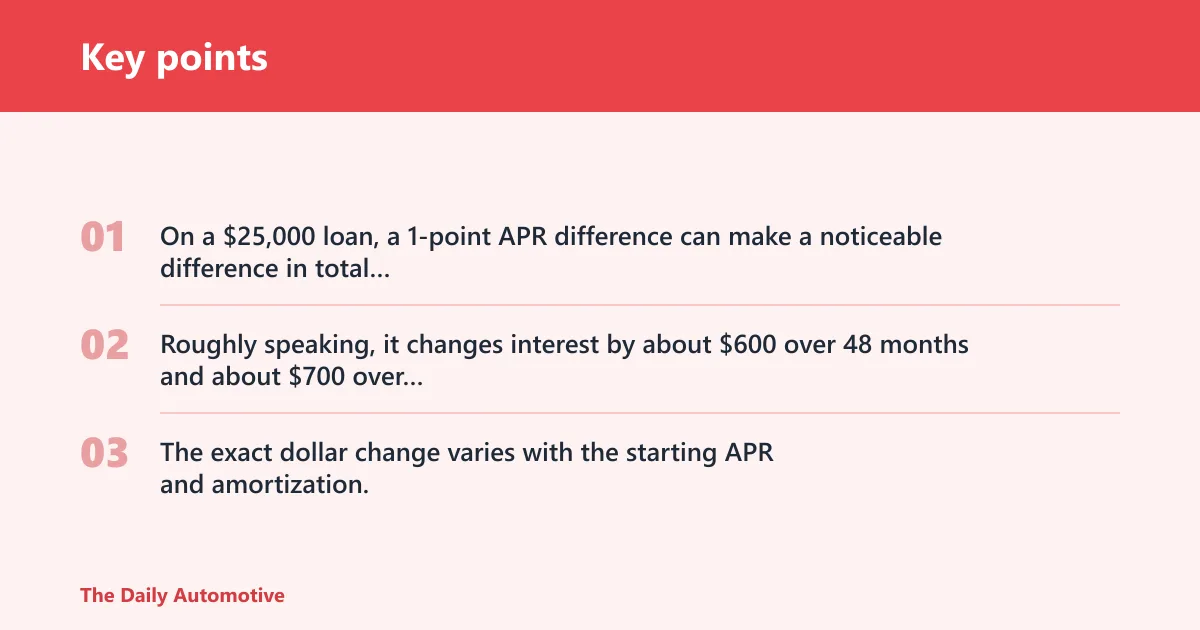
On a $25,000 loan, a 1-point APR difference can make a noticeable difference in total interest. Roughly speaking, it changes interest by about $600 over 48 months and about $700 over 72 months. The exact dollar change varies with the starting APR and amortization, so treat this as a shopping guide rather than a fixed rule.
How to judge an offer
Compare offers from banks, credit unions, captive finance arms, and dealer-arranged loans before you sign. A dealer quote can be convenient, but it is only one offer. The best rate is not always tied to the car on the lot.
- Check the APR against your credit tier and whether the car is new or used.
- Compare the monthly payment and the total interest over the full term.
- Watch for term creep, which can make a lower payment hide more interest.
- Review add-ons and fees so the APR does not hide a costly package.
- Ask whether a larger deposit or shorter term would improve the quote.
Watch for term creep and add-ons
A low APR can still hide a poor deal if the loan term is stretched, the vehicle price is inflated, or add-ons are rolled into the financing. The monthly payment may look manageable, but the borrower can still pay far more than necessary.
One useful check is simple: compare the out-the-door cost, the total financed amount, the APR, and the total interest side by side. If any one of those looks off, the deal deserves a second pass.
What about the Bank of England rate?
Frequently asked questions
What is a good APR for a car loan right now?
A good APR is usually 2% to 6% for strong borrowers on new cars, with used-car rates commonly 1 to 3 points higher. If your quote is above the top of your expected credit band, compare it with other lenders and check the total interest before you accept it.
What is considered good APR for a car loan?
Good APR means the rate is fair for your credit tier, the car’s age, and the term length. A rate that looks fine on a new car can be expensive on an older used car. Judge the quote by the full deal, not a single number pulled out of context.
What’s the APR for a car loan right now?
Car-loan APRs vary widely by credit tier. Super-prime borrowers may see 2% to 4%, prime 3% to 6%, nonprime 6% to 11%, subprime 11% to 18%, and deep subprime 14% to 21%. The vehicle being used versus new also affects where your quote lands.
What’s the lowest APR for a car loan right now?
The lowest rates generally go to super-prime borrowers on new cars, and they can sit in the 2% to 4% range. Manufacturer incentives can sometimes push lower on specific models. Still, the “lowest” rate is only useful if the car price, term, and fees are also reasonable.
What is a good interest rate for a car loan?
A good interest rate is one that fits your credit tier and keeps the total interest sensible for the term. In practice, that usually means mid-single digits for strong borrowers, more for used cars, and much higher figures for weaker credit. Compare total cost, not just the headline rate.
Products related to this article
Sponsored / affiliate links. As an Amazon Associate I earn from qualifying purchases. I may earn additional commission from eligible campaigns.
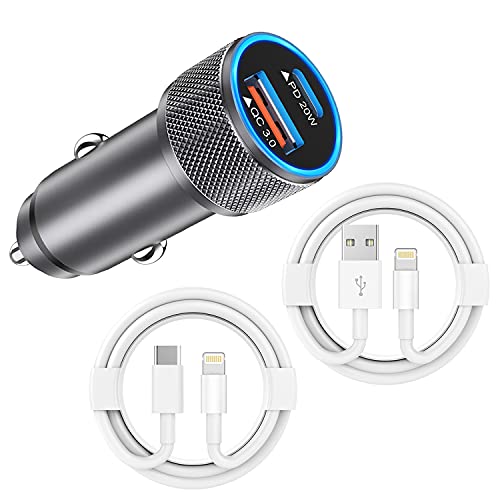 iPhone Car Charger,USB C Fast Car Charger[Apple MFi Certified] Apple Car Charging 38W Dual Port CarCharger Cigarette Lighter Adapter 2x3ft PD&QC 3.0 Lightning Cable for iPhone 14/13/12 Pro/11/Airpods
 HLWDFLZ Car Emergency Kit with 2000A Car Battery Jump Starter- Car Roadside Emergency Kit, First Aid Kit, Tow Rope, Emergency Car Kit, Roadside Safety Tool Kit for Women, Men