Is It Better to Sell Your Car to a Dealer or Privately?
Sell privately only if the extra money is clearly larger than the added prep, tax, and hassle; if the dealer offer is within roughly 10% to 15%, the dealer is often the better deal. Pick the wrong route and you can waste time, invite scams, or give up cash after fees and repairs. This guide compares payout, costs, taxes, risk, and speed so you can decide which route breaks even.
Dealer sale vs private sale
Private sale usually pays the most. Dealer sale is faster and simpler. That is the main trade-off, but the real answer depends on how much more you can net after cleaning, repairs, listing fees, tax effects, and the time you spend screening buyers and handling paperwork.
| Criterion | Private sale | Dealer outright sale | Trade-in | Online car buyer |
|---|---|---|---|---|
| Typical payout | Usually highest if the car is clean and in demand | Lower than private sale | Usually lower than private sale, sometimes close after tax savings | Often above a traditional dealer offer, below private sale |
| Speed | Weeks rather than same day | Same day | Same day when tied to a purchase | Offer in minutes, pickup once scheduled |
| Paperwork | You handle the title transfer, bill of sale, and buyer follow-up | Dealer handles paperwork | Dealer handles paperwork in the transaction | Usually more streamlined than a private sale |
| Payment risk | Higher; you must verify funds and buyer identity | Low; dealer payment is routine | Low; transaction closes through the dealer | Lower than private sale, though terms still matter |
| Effort | Cleaning, photos, ads, messages, test drives, and meetings | Lowest effort | Low effort | Moderate effort |
Where the dealer gap comes
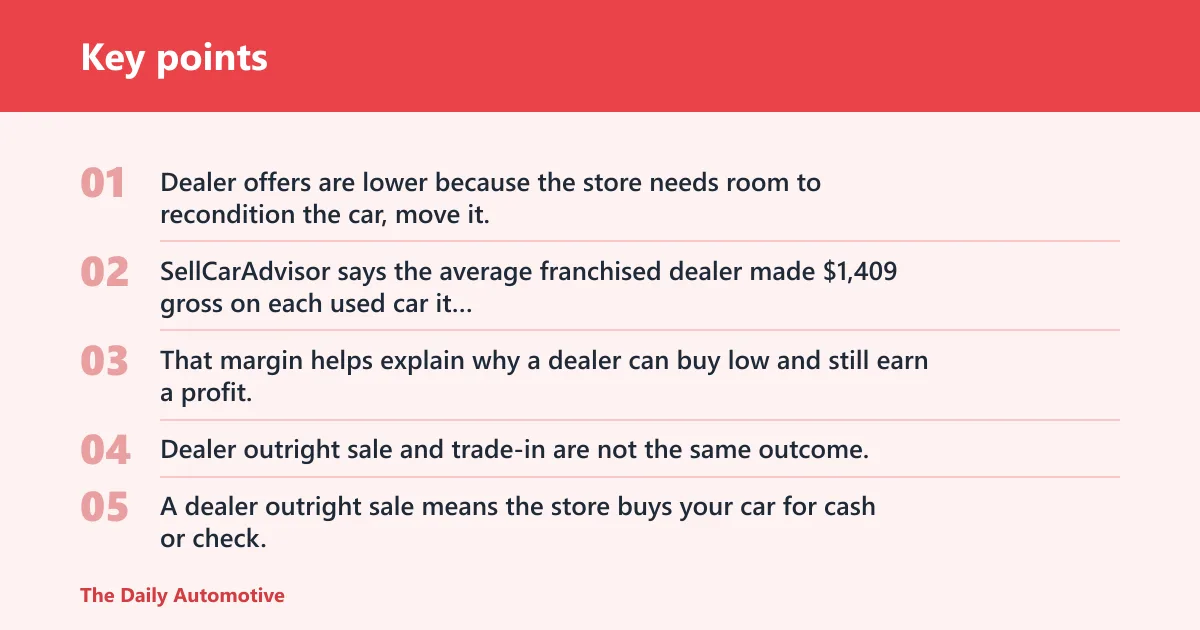
Dealer offers are lower because the store needs room to recondition the car, move it, and cover overhead before resale. SellCarAdvisor says the average franchised dealer made $1,409 gross on each used car it resold in the year to mid-2026. That margin helps explain why a dealer can buy low and still earn a profit.
Dealer outright sale and trade-in are not the same outcome. A dealer outright sale means the store buys your car for cash or check, often the same day. A trade-in means the car becomes credit toward another vehicle, which can change the math because taxes may drop in some states.
When convenience beats extra cash
Convenience wins when your deadline is tight, the car has title or mechanical issues, or the private-sale gap is too small to justify the work. If the dealer or online offer is close enough after prep costs and tax effects, the simpler route can be the better net deal.
Say your sedan might bring about $12,000 privately, while a dealer offers about $10,900. If the private route costs about $400 in detailing, a $50 listing fee, and about $200 in rideshare and time costs, the extra gross becomes much smaller. Add risk and the gap can shrink fast.
Car sale break-even worksheet
Use this worksheet to compare net value, not just sticker price. Put in your numbers, subtract the friction costs, and then compare the private-sale net against the dealer or online offer.
| Line item | Private sale | Dealer or online offer |
|---|---|---|
| Expected sale price / offer | $12,000 | $10,900 |
| Detailing and cleanup | -$180 | $0 |
| Repair work to reach the market | -$250 | $0 |
| Listing, ad, or listing platform fees | -$50 | $0 |
| Rideshare, time off, and meeting costs | -$200 | $0 |
| Estimated tax savings | $0 | $0 to $900, depending on state and transaction type |
| Net after friction | $11,320 | $10,900 to $11,800 |
| Net advantage | Private sale wins by $420 in this example, but a trade-in with tax savings could close or beat the gap. | |
Decision rule: if the private-sale net is less than about 10% to 15% above the dealer or online offer, take the simpler route unless the car is especially desirable. If you still owe money on the car, or if the title is not in hand, lean toward the route that handles payoff and paperwork cleanly. If the car is damaged or will not start, private sale usually loses its edge.
Private-sale price column
Use the price you expect from a realistic local listing, not the highest ask you can imagine. A clean, well-documented car in good condition can earn a larger spread over dealer offers than an older, high-mileage, modified, or damaged car.
Dealer or online offer column
Get at least one dealer offer and one online car buyer offer on the same day if possible. The same source says an online car buyer gives an offer in minutes and pickup once scheduled. That can help you set a floor before you decide whether a private sale is worth the extra effort.
Friction costs and tax savings
Build in every cost that comes with selling privately: detailing, minor repairs, ad fees, rideshare or fuel for meetings, and the value of your time. Then compare that against any trade-in tax benefit. Chase says trading in may let you pay sales tax only on the difference between your new car price and trade-in value, but that depends on state law.
Loan balance, damage, and deadline rule
If the car has a loan balance, if it is damaged, or if you need the sale closed today, the math usually shifts toward a dealer, trade-in, or online buyer. A private sale can still work, but only when the added net cash clearly covers the extra steps and the added risk.
Is a private sale worth it?
A private sale is worth it when the net gain after all costs is large enough to justify the extra time and risk. SellCarAdvisor ranks the private sale as keeping the most money of the five selling options, and Quality Car Valuation says it usually yields more but requires significantly more effort and risk. The question is whether that spread survives the real-world costs.
How much more private sale needs to pay
Clairvo says private sales typically net 10 to 20 percent more than dealer offers. That range is useful, but it is not a guarantee. If your car needs detailing, fresh tires, or small repairs, those costs can eat into the spread quickly.
How long a private sale usually takes
Expect weeks, not same day. The same source says a private sale typically takes weeks, and Clairvo says a private transaction typically takes one to six weeks. The exact timing depends on price, demand, season, and how quickly buyers respond.
What the added work and risk look like
Private sale work is real: photos, a listing, messages, calls, test drives, price haggling, and paperwork. Payment risk also rises. You need to screen buyers, verify funds, and handle the title transfer correctly so the car leaves your name cleanly.
A common first-timer mistake is to price the car as if the first few messages are real offers. They are not. A serious buyer usually asks clear questions, wants a vehicle history report, and shows up ready to inspect the car in daylight.
Why dealer offers are lower
Dealer offers are lower because the dealer is buying at wholesale and taking on the costs needed to turn the car into retail inventory. That includes recon work, transport, reconditioning, storage, staff time, and overhead. The dealer still needs room for a profit after all of that.
Wholesale pricing and dealer margin
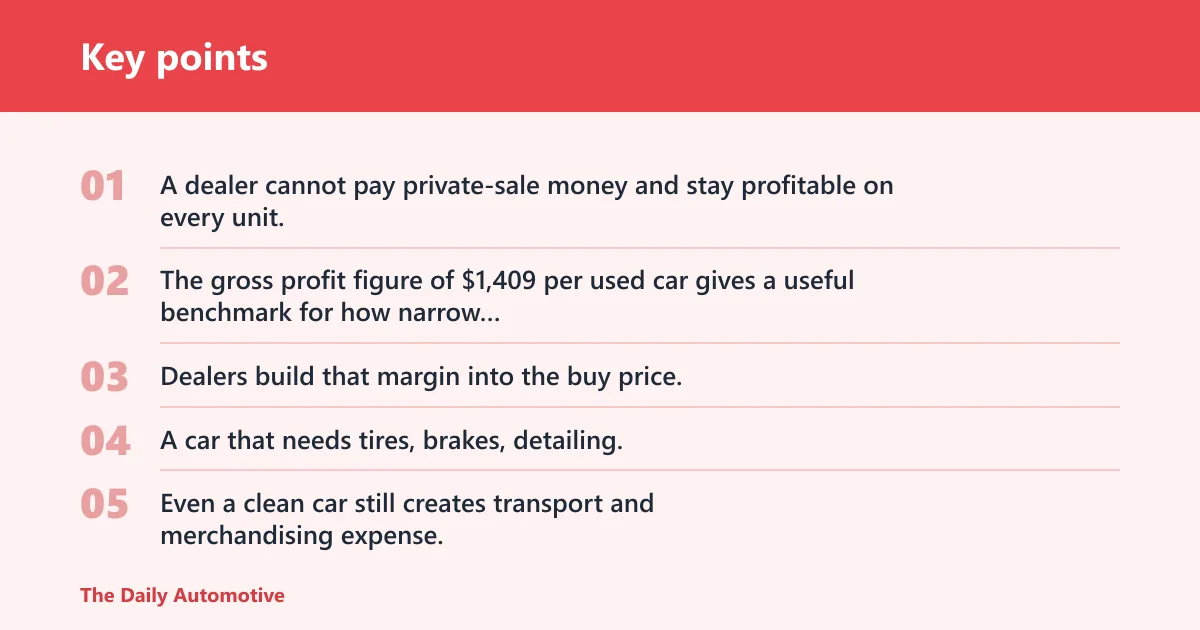
A dealer cannot pay private-sale money and stay profitable on every unit. The gross profit figure of $1,409 per used car gives a useful benchmark for how narrow many retail margins are. Dealers build that margin into the buy price, which is why the offer can feel conservative.
Reconditioning, transport, and overhead
A car that needs tires, brakes, detailing, or mechanical work costs more to move through the pipeline. Even a clean car still creates transport and merchandising expense. Those costs help explain why the same car can sell privately for more but bring less at a dealer desk.
Do trade-ins save sales tax?
Yes, sometimes. In states that allow a trade-in credit, you may owe sales tax only on the difference between the new car price and the trade-in value. That can narrow the gap between a trade-in and a private sale, especially on a newer purchase with a meaningful tax bill.
How trade-in tax credit works in some states
The tax break is state-specific. When it applies, the trade-in value reduces the taxable amount of the new purchase. That means a lower trade-in offer can still be competitive once the tax savings are included in the total net outcome.
When the tax break narrows the gap
The tax advantage matters most when the replacement car is expensive enough to create a large tax bill. It matters less if you are not buying another car, if your state does not offer the credit, or if the private-sale premium is already large.
Why you still need to compare net value
Do not compare a private-sale number against a trade-in number without adding the tax effect. Compare net cash after tax, not just the offer itself. That is the only way to know whether the private route really pays more.
What if you still owe money?
When a loan is still on the car, the title status matters as much as the offer. A dealer transaction can handle payoff inside the deal, while a private sale adds complexity because the lien must be cleared before the buyer gets clean ownership. Negative equity can also force you to bring cash to closing.
Lien payoff in a dealer transaction
A dealer can usually coordinate the payoff with the lender during the transaction. The same source notes that a dealer handles paperwork in a trade-in transaction, which can simplify the payoff flow. That is one reason sellers with loans often prefer the dealer route.
Negative equity and cash needed at closing
If you owe more than the car is worth, the difference does not disappear. You must cover the shortfall somehow. A dealer or online buyer can still be the better choice because the closing process is cleaner, even if the sale price is lower.
Why private sale is harder with a loan
Private buyers usually want a clear title. If the lender still holds it, the sale can become slow and awkward unless you have a clear payoff plan and a lender that can release the title quickly. That is more work than many sellers want to manage.
Choose dealer or private sale
Choose the dealer route if you need same-day cash, have a loan payoff to clear, or want the simplest close with minimal effort. Choose private sale if the car is in good condition, the market is strong, and the net premium remains clearly above your prep costs, time cost, and risk.
Choose dealer if you need same-day cash or a simple close
- You need the sale done today.
- The car has a lien, title issue, or negative equity.
- The car is older, high-mileage, damaged, or not running.
- The private-sale premium is too small after costs.
Choose private sale if the price gap clears your costs
- The car is clean, popular, and easy to inspect.
- The private-sale net beats the dealer or online offer by more than 10% to 15%.
- You can wait one to six weeks for the right buyer.
- You are ready to screen buyers, verify payment, and manage paperwork carefully.
Choose online buyers if you want a middle path
Online car buyers sit between dealer and private sale on price and convenience. They can be a strong fallback when you want a quick offer, a scheduled pickup, and less hassle than a private listing, but more money than a traditional dealer offer.
Picture a six-year-old crossover with 82,000 miles and a clean title. If the dealer offer is about $15,400, an online buyer comes in around $15,900, and a private listing might bring about $17,000, the private route may still win. But if the car needs $500 in work and you need it gone this weekend, the middle option starts to look better.
Frequently asked questions
Is it better to sell my car to a dealer or privately?
Private usually pays more, but dealer sales are faster and simpler. If the private-sale premium is small after prep costs, payment risk, and your time, the dealer can be the better net choice. If the gap is wide and the car is desirable, private sale usually wins.
How much more can I get selling privately vs trading in?
The same source says private sales typically net 10 to 20 percent more than dealer offers. That gap can shrink if you get sales-tax credit on a trade-in in your state. The right comparison is net cash after taxes, prep, and any repairs you need to make first.
Do I save money on sales tax if I trade in my car?
Sometimes. The same source says trading in may let you pay sales tax only on the difference between the new car price and trade-in value. The rule depends on state law, so check your state before you assume the tax savings will erase the dealer discount.
Is selling privately worth the extra time and risk?
Yes, when the price premium is large enough to cover the added effort and risk. The same source says private sale keeps the most money, but the seller must handle photos, screening, test drives, and payment verification. If the spread is thin, the dealer route is usually smarter.
How long does it take to sell a car privately?
The same source says a private transaction typically takes one to six weeks, and SellCarAdvisor says private sales typically take weeks. Popular, clean cars can move faster. Older, damaged, or niche vehicles often sit longer because the buyer pool is smaller.
What happens if I have a loan on the car I want to sell?
The lender must be paid off before the buyer gets a clean title. A dealer can usually handle that in the transaction, while a private sale adds more steps and timing risk. If you have negative equity, you may need to bring cash to close the deal.
Products related to this article
Sponsored / affiliate links. As an Amazon Associate I earn from qualifying purchases. I may earn additional commission from eligible campaigns.