
What Is the Average Automotive Technology Salary Range?
Automotive technology pay in the U.S. is often in the mid-$40,000s to around $60,000 a year, and it may be higher in high-cost metro areas, dealer shops, and for ASE-certified technicians. Guess wrong, and you may accept low pay or miss compensation you can press on. This guide breaks down pay by experience, location, and certifications so you can estimate a realistic salary range.
National Averages and Pay Variations Explained
The best answer is a range, not a single number. Nationally, automotive technicians earn an average of $64,426 per year as of 2026, while The Daily Automotive cites a U.S. median automotive technology salary in the mid-$40,000s and the BLS median annual wage for automotive service technicians and mechanics at $44,050. Those figures are all useful, but they measure different things.
Annual salary and hourly wage equivalents
Annual pay and hourly pay tell different parts of the story. A technician salary can be quoted as yearly pay, while job postings often list an hourly rate and may add overtime. In New York, NY, Indeed lists $31.87 per hour, with $5,000 overtime per year and a low-to-high range of $18.99 to $53.49 per hour based on 18 salaries.
Why different sources report different numbers
BLS, Indeed, and ZipRecruiter do not use the same method. BLS tracks labor-market wage data and publishes a median. Indeed reflects posting and salary data, including overtime. ZipRecruiter often surfaces estimate-based ranges and location comparisons. That is why you should compare sources instead of forcing them into one number.
📊 Typical automotive technician salary range is $58,353 to $69,604. Source: Automotive Technology Salary: 2026 National Averages.
How much do automotive technicians get paid by experience?
Experience changes automotive technician pay in a steady way: entry-level techs usually start near the low end, mid-career technicians move toward the middle of the range, and senior or specialized techs can approach top-earner pay. Nationally, entry-level pay starts closer to $43,500, the typical range is $58,353 to $69,604, and top earners reach $83,000.
Entry-level pay
New technicians usually earn below the national average while they build speed, tool inventory, and diagnostic judgment. That early pay often reflects training time, productivity ramp-up, and whether the employer pays hourly, flat rate, or a mix. If the offer is far below $43,500, the rest of the package matters even more.
Mid-career pay
Mid-career technicians often sit near the median or average, especially after earning ASE credentials and handling more complex work. This is where the gap between median and average matters. A few higher-paid technicians can pull the average up, while the median shows the middle of the market more clearly.
Senior and top-earner ranges
Senior technicians, diagnosticians, and shop leads can move above the common range. The top-earner figure cited here is $83,000 nationally, and location can push compensation higher. Suppose a technician in a dense metro area handles electrical faults, drivability complaints, and hybrid systems; that combination often pays better than routine maintenance alone.
What changes automotive technician pay the most?
Location, credentials, specialization, and employer type move pay more than almost anything else. A higher-cost metro usually pays more because rent, wages, and shop pricing run higher there. ASE certification can help during hiring, and advanced diagnostic work usually pays more than basic maintenance. Dealerships, independent repair shops, and specialty auto centers also pay differently.
Location and cost of living
Pay varies by state and city because shops compete in different labor markets and face different living costs. The Daily Automotive cites Austin, Texas average automotive technician pay at approximately $47,000 per year, while Talent.com lists Texas at $56,035 per year. New York, NY sits higher still in hourly terms, which fits a high-cost metro market.
Certifications such as ASE
ASE certification does not guarantee a raise, but it signals competence to employers and can support higher pay. Employers often use certifications as a screening tool for diagnostics, electrical work, brakes, drivability, or emissions-related jobs. That matters most when the shop needs a technician who can produce on day one.
Specialization and employer type
Specialization tends to lift earnings when the work is harder to replace. Diagnostics, hybrid vehicles, electric vehicle maintenance, and performance tuning can command more than routine service. Dealerships may offer structured pay and brand training, independent shops may reward broad flexibility, and specialty centers may pay more for narrow expertise.
How do national, hourly, and location-based estimates compare?
The clean way to compare pay is to anchor on one benchmark, then cross-check hourly postings and location-specific estimates. Use the BLS median of $44,050 as the labor-market baseline, then compare it with Indeed and ZipRecruiter figures to see how local demand, overtime, and employer type can shift the number.
BLS median wage as the baseline
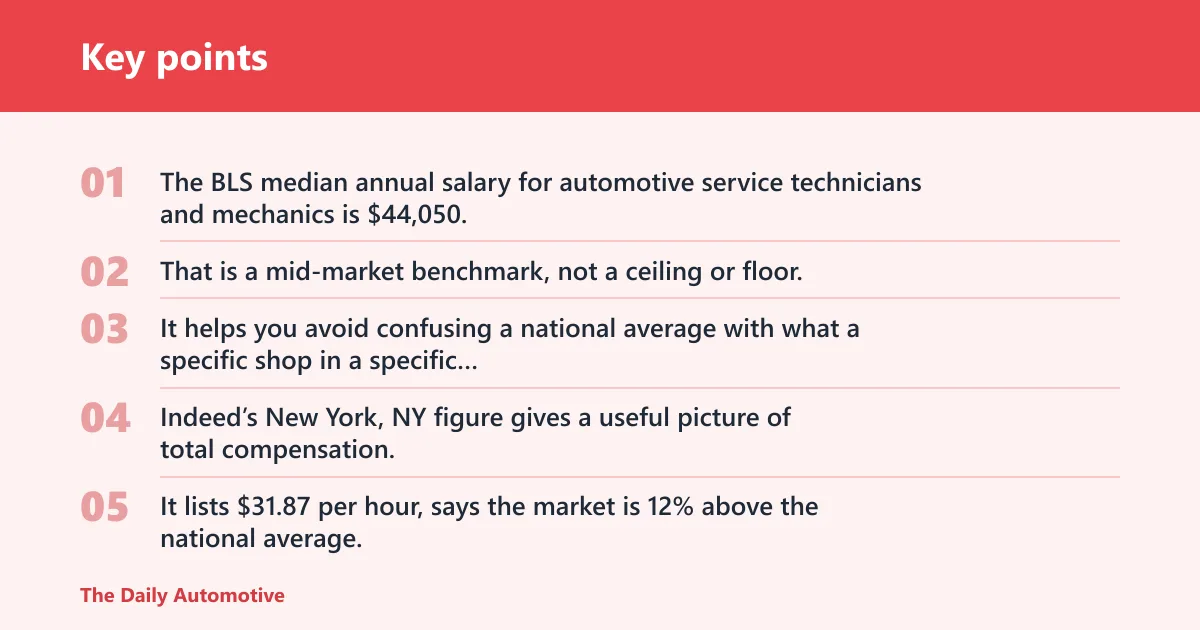
The BLS median annual salary for automotive service technicians and mechanics is $44,050. That is a mid-market benchmark, not a ceiling or floor. It helps you avoid confusing a national average with what a specific shop in a specific city may actually pay.
Indeed hourly and overtime context
Indeed’s New York, NY figure gives a useful picture of total compensation. It lists $31.87 per hour, says the market is 12% above the national average, and shows $5,000 overtime per year. That matters because two offers with the same base rate can differ once overtime, schedule, and benefits are added.
ZipRecruiter national, Texas, and Austin figures
ZipRecruiter estimates can help when you want a quick market check. The Daily Automotive cites ZipRecruiter’s highest paying automotive technology salary at $94,500 per year. For Texas comparisons, pair that with the cited Texas average of $56,035 and Austin’s approximate $47,000 to see how a state average and city average can diverge.
| Scenario | Likely annual pay | Hourly equivalent | Main driver behind the number |
|---|---|---|---|
| Entry-level technician | $43,500 | $20.91 | Limited experience and training ramp-up |
| Mid-career ASE-certified technician | $64,426 | $30.97 | Proven productivity plus certification signal |
| Specialized diagnostic technician | $83,000 | $39.90 | Advanced electrical and drivability expertise |
Those hourly equivalents are simple annual-to-hourly conversions based on 2,080 work hours per year. They are estimates, not a promise of a flat-rate paycheck. If overtime is common, the effective hourly rate can be higher.
Do certifications and specializations raise pay?
Yes, but not automatically. ASE certification can improve your bargaining position, and advanced specializations often command more because they are harder to hire for. The biggest gains usually appear when a technician can diagnose problems quickly, document the fix, and keep bays turning.
Diagnostics, hybrid, EV, and performance work
Diagnostics is the clearest pay lever because it solves expensive, time-sensitive problems. Hybrid vehicles and electric vehicle maintenance require a different skill set, especially around high-voltage safety and systems knowledge. Performance tuning can also pay well in the right market, but demand is narrower and employer dependent.
Why specialty shops may pay more
Specialty shops often pay more because they need fewer people who can do more difficult work. A dealership might pay for brand-specific training. An independent shop may pay for versatility. A specialty center may pay for one technician who can handle electrical faults, scan data, and module-level diagnostics without hand-holding.
How should you judge an automotive technician job offer?

Start with base pay, then price the rest of the offer. Overtime, bonuses, tool allowances, paid training, healthcare, retirement match, and uniform or boot stipends can materially change the real value of the job. Flat-rate pay can also inflate or depress income depending on shop volume and efficiency.
Base pay versus overtime
Base pay is only part of total compensation. A lower hourly rate with steady overtime may beat a higher rate with dead time between tickets. That is why the New York, NY figure from Indeed matters: the added $5,000 overtime per year changes the picture.
Bonuses and benefits
Ask whether the shop pays sign-on bonuses, productivity bonuses, comebacks protection, or certification reimbursement. Benefits matter too, especially health coverage and paid time off. Two offers with similar wages can differ meaningfully once benefits are priced in.
Flat-rate versus hourly pay
Flat-rate systems pay for billed labor time, not clock time. That can reward speed and skill, but it can also create income swings if the shop is slow or the work mix is weak. Hourly pay is more predictable. Before accepting an offer, ask how warranty work, training, and slow periods are handled.
Picture a 28-bay dealership and a four-tech independent shop offering the same base rate. The dealership may provide steadier workflow and brand training, while the smaller shop may let a strong diagnostician earn more through broader responsibility. The better deal depends on volume, benefits, and how the schedule is built.
Frequently asked questions
What is the average automotive technician salary?
The average automotive technician salary is roughly $64,426 per year nationally, but that is only one benchmark. The BLS median annual wage is $44,050, and The Daily Automotive cites a mid-$40,000s median. Use all three to understand average, middle, and market-range pay.
How much does an automotive technician make a year?
A reasonable national planning number is about $47,000 to $60,000 a year, with the national average at $64,426 and the BLS median at $44,050. Your actual figure depends on location, experience, certifications, overtime, and whether you work for a dealership or an independent shop.
What is the average automotive technician salary in Canada?
This article centers on U.S. labor-market data, so it does not give a Canada-specific benchmark. Canadian pay varies by province, city, employer type, and certification path. If you are comparing countries, use a Canadian labor source rather than converting U.S. figures directly.
What is the average automotive technician salary by state?
State pay differs because labor demand and cost of living differ. Texas is a useful example: The Daily Automotive cites $56,035 as the average there, while Austin comes in at approximately $47,000. State-level averages are useful, but city-level figures often explain more of the real paycheck.
Do certifications like ASE increase automotive technician salary?
ASE certification can increase earning potential, but it is not a guaranteed raise. It works mainly as a signal to employers that you can handle more complex work and need less supervision. That signal matters most in dealerships, diagnostic roles, and shops that price skill rather than only labor hours.
How much does automotive technology make?
Automotive technology pay usually sits in the same broad band as automotive technician pay, but the exact title depends on the employer’s wording. A practical U.S. estimate is roughly $47,000 to $60,000 a year, with higher pay possible in metros, specialty shops, and advanced diagnostic roles.
Products related to this article
Sponsored / affiliate links. As an Amazon Associate I earn from qualifying purchases. I may earn additional commission from eligible campaigns.