What Is Downforce On a Car? Essential Physics Guide
Downforce is aerodynamic force that pushes a car harder into the road as speed builds, which can raise tire grip. It also brings drag, so gains in cornering can come with slower straights and higher fuel use. Used badly, it can overheat tires and hide a weak mechanical setup. This guide explains how downforce works, why it helps in corners, and when it costs more than it gives.
What is downforce on a car?

Downforce is a downward aerodynamic force acting on a moving vehicle. It adds load to the tires, which can increase available grip, especially at higher speeds where airflow is moving fast enough to create meaningful force.
That is the core idea: more load on the contact patches usually means more traction, up to the tire’s limits. It is the opposite of lift, which tries to lighten the car at speed.
Many road cars do not produce much true downforce. They mainly reduce lift with small spoilers, undertrays, or body shapes that keep the car calmer at speed.
Why it matters at speed
Downforce is speed-sensitive. A car at a higher speed, such as around 120 mph versus 60 mph, can produce much more aero force because the force tends to grow roughly with the square of speed. If speed roughly doubles, aerodynamic load can increase by around four times when the setup and conditions are otherwise similar.
That is why downforce matters far more on track than in stop-and-go traffic. At low road speeds, the effect is often too small to change the car much.
How does downforce work on a car?
Downforce works by shaping airflow so pressure is lower above the car, higher below it, or both. The pressure difference creates a net downward force. Speed, air density, and the shape’s angle of attack all affect how much force the car makes.
The important part is that airflow must be moving fast enough for the pressure difference to matter. That is why aerodynamic devices feel mild at city speeds and much stronger on a fast straight.
Air pressure, airflow, and shape
When air is redirected around a car, it changes speed and pressure. A spoiler can disturb airflow to reduce lift at the rear. A wing uses an airfoil shape to generate a stronger downward force. A splitter and diffuser work mainly with the underside of the car, where pressure management matters a lot.
Why speed makes the force grow fast
A common approximation is that aerodynamic force scales with dynamic pressure, which depends on speed squared and air density. At higher speed, the air has much more energy to work with, so downforce rises sharply. Denser, cooler air can produce more force than thinner, warmer air at the same speed. (en.wikipedia.org)
Say a car gains useful front-end bite at 90 mph from a splitter and undertray. That same package may feel faint at 35 mph, because the air load is not high enough to matter much yet.
Coefficient of lift and angle of attack
The coefficient of lift is a dimensionless number used to describe how much lift or downforce a shape makes. A negative lift coefficient means downforce. Angle of attack, or the tilt of the device relative to airflow, changes that coefficient, but only to a point before drag rises sharply or airflow separates.
That is why adjustable wings can be tuned. More angle may add downforce, but it usually adds drag too, and beyond a certain point the extra angle stops paying off.
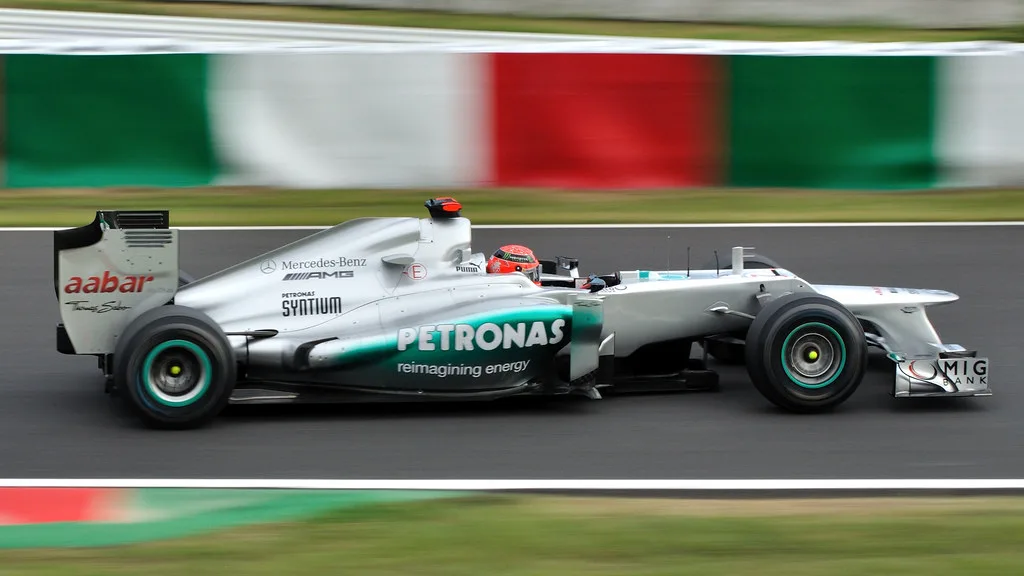
What does downforce do in a corner?
Downforce increases tire load, which can raise cornering grip and make the car hold a line better at speed. It can also improve braking stability and keep the car calmer as load transfers around the chassis.
The gain is not endless. Tires do not respond linearly to extra load, so each added pound of downforce helps less than the one before it.
More tire load and more grip
Tire grip depends on compound, temperature, surface, and vertical load. More load generally increases available traction, but not in a perfect one-to-one way. A tire carrying about twice the load does not usually deliver twice the grip. That is why aero works best when the rest of the setup already gives the tires a usable platform.
Why grip gains have limits
If a tire is already near its ideal load, more downforce can push it into a less efficient range. The carcass heats up, wear rises, and the extra force stops translating into proportional corner speed. Aero can also hide weak suspension tuning by making the car feel planted while the basic balance remains poor.
Effects on braking and tire wear
Downforce helps braking because it adds load to the tires while the car is decelerating, especially at higher speed. It can also raise tire temperatures and wear, since the tires are working harder for longer. On a long track session, too much aero for the tire and surface can shorten consistency.
Downforce vs. drag: what you gain and what you lose
Downforce and drag are linked, but they are not the same thing. Downforce pushes the car into the road. Drag resists motion through the air. Many aero parts increase both, and the tradeoff is the whole game.
More downforce usually means more drag, lower top speed, and more fuel use. The right amount depends on whether the car needs lap time, straight-line speed, or efficiency.
Why drag usually rises with downforce
Any device that changes airflow enough to make downforce usually adds resistance. A wing creates pressure differences that help grip, but they also pull backward. A splitter can add front grip, but if it is too large or poorly supported, it can create drag and may lose effectiveness from underbody turbulence.
Top speed, fuel use, and efficiency
Higher drag steals horsepower at speed. That can lower top speed and raise fuel consumption, especially on the highway. A spoiler that merely trims lift may cost little. A big wing can cost much more. The result depends on how aggressive the shape is and how fast the car spends its time moving.
A common first-timer mistake is bolting on a large wing to a street coupe, then discovering the car feels more stable but also more sluggish above 70 mph. The wing may help in one fast bend, yet the added drag can make the rest of the drive slower and less efficient.
When the tradeoff makes sense
The tradeoff makes sense when corner speed, braking, and tire load matter more than top-end efficiency. That is why racing cars accept much more drag than road cars. On a public road, the benefit often arrives too late, because the car rarely stays at the speeds where the aero package really works.
Which aero parts create downforce?
Spoilers, wings, splitters, and diffusers are the main parts people talk about, but they do not all work the same way. Some mainly reduce lift. Others create substantial downforce. Their effect also depends on placement, size, angle, and how well they work with the rest of the body.
Spoilers
A spoiler is usually a rear-mounted device that disturbs airflow leaving the car. On many road cars, its role is usually to reduce rear lift and improve stability rather than create very large downforce. A small trunk-lid spoiler can help balance the car without a large drag penalty.
Wings
A wing is an airfoil-shaped device that can produce stronger downforce than a simple spoiler. It works because air moves differently over and under the element, creating a pressure difference. Adjustable wings are common on performance cars because the angle can be tuned for more grip or less drag.
Splitters
A splitter is a front aero component that extends forward from the lower bumper area. It helps increase front-end downforce by limiting high-pressure air from going under the nose and by shaping the flow around the front of the car. It also helps balance front and rear grip when the rear aero is already strong.
Diffusers
A diffuser is a rear underbody component that helps manage the low-pressure airflow exiting from under the car. Done well, it can support downforce with less drag than some top-mounted devices because it works with the underside flow rather than fighting it. It still depends on a clean underbody and sensible ride height.
Downforce tradeoffs by driving use case
The best aero package depends on where you drive. Daily commuting does not need the same setup as an endurance-style track day. The more a car lives at higher speeds and higher lateral load, the more downforce starts to matter.
| Use case | Aero parts that help | What they improve | What they cost |
|---|---|---|---|
| Daily driving | Small rear spoiler, mild undertray | High-speed stability, slight lift reduction | Small drag gain, little low-speed benefit, possible noise increase |
| Canyon driving | Mild splitter, subtle rear spoiler | Turn-in confidence, front-end feel, steadier braking | Some drag, reduced ground clearance, limited benefit at moderate speeds |
| Autocross | Light splitter, modest wing, basic diffuser if well matched | Better transient grip, faster transitions, improved balance | More setup sensitivity, added weight and drag, possible fitment issues |
| Track day | Adjustable wing, splitter, diffuser, undertray | Corner speed, braking stability, tire load consistency | Lower top speed, higher fuel use, more tire heat and wear |
| Racing | Full aero package with tuned front and rear elements | Lap time, platform control, tire management at speed | High drag, more setup work, strict sensitivity to balance and ride height |
Street-car guidance
For normal road speeds, a large wing or aggressive splitter often gives less benefit than owners expect. A mild spoiler or factory aero package is usually the more sensible choice. If the car already feels loose or nervous, fixing tires, alignment, damping, and ride height usually pays off first.
Track-day guidance
On track, aero starts to matter because the car spends longer at speeds where force rises fast. The main target is balance. If the front gains grip but the rear does not, the car may understeer less yet still feel vague. If the rear gains too much and the front lags, the car can feel stable in a straight line and slow in the corner.
Suppose a coupe gets a large rear wing but no front splitter. The rear may feel planted on turn-in, yet the nose can wash wide because the front tires do not get the same support. The car feels calm, but the stopwatch says it is slower.
Frequently asked questions
What is the difference between downforce and drag?
Downforce pushes the car toward the road. Drag resists the car’s forward motion. Many aero parts create both, which is why a wing can improve corner speed while reducing top speed and efficiency. The best setup depends on whether the car needs grip more than low resistance.
How do spoilers and wings create downforce?
A spoiler mainly manages airflow and often reduces lift on the rear of the car. A wing is shaped like an airfoil and can create stronger downforce by making pressure lower above the element than below it. Wings usually produce more grip, but they also tend to create more drag than small spoilers.
Does more downforce always make a car faster?
No. More downforce can make a car faster in corners, but it usually adds drag, which hurts acceleration and top speed. Beyond a certain point, the gains in grip are smaller than the losses from resistance, tire heat, and added setup complexity. The fastest package is the one matched to the speed range and surface.
How does downforce affect grip, braking, and tire wear?
Downforce increases tire load, which helps grip and braking at speed. It also makes tires work harder, so heat and wear can rise. If the setup is unbalanced or too aggressive for the tire, the car may feel planted but become slower over a session as the rubber overheats or fades.
Why do race cars need more downforce than road cars?
Race cars spend much more time at high speed and high lateral load, so they gain more from aero grip than ordinary road cars do. They can accept extra drag because lap time depends heavily on cornering and braking. Road cars usually need better efficiency, lower noise, and more clearance than that.
Products related to this article
Sponsored / affiliate links. As an Amazon Associate I earn from qualifying purchases. I may earn additional commission from eligible campaigns.