How Much Does Blind Spot Monitoring Cost?
Blind spot monitoring typically costs about $150 to $600 for aftermarket parts and about $300 to $1,200 installed, while factory retrofit or repair can run about $500 to $2,000+ depending on sensors and programming. Skip cheap universal kits or poor calibration, and you can end up with false alerts, dead sensors, or a repair bill that is larger than the system itself. This guide breaks down parts, labor, coding, dealer fees, and repair costs so you can compare the real total before buying.
Blind spot monitoring cost breakdown
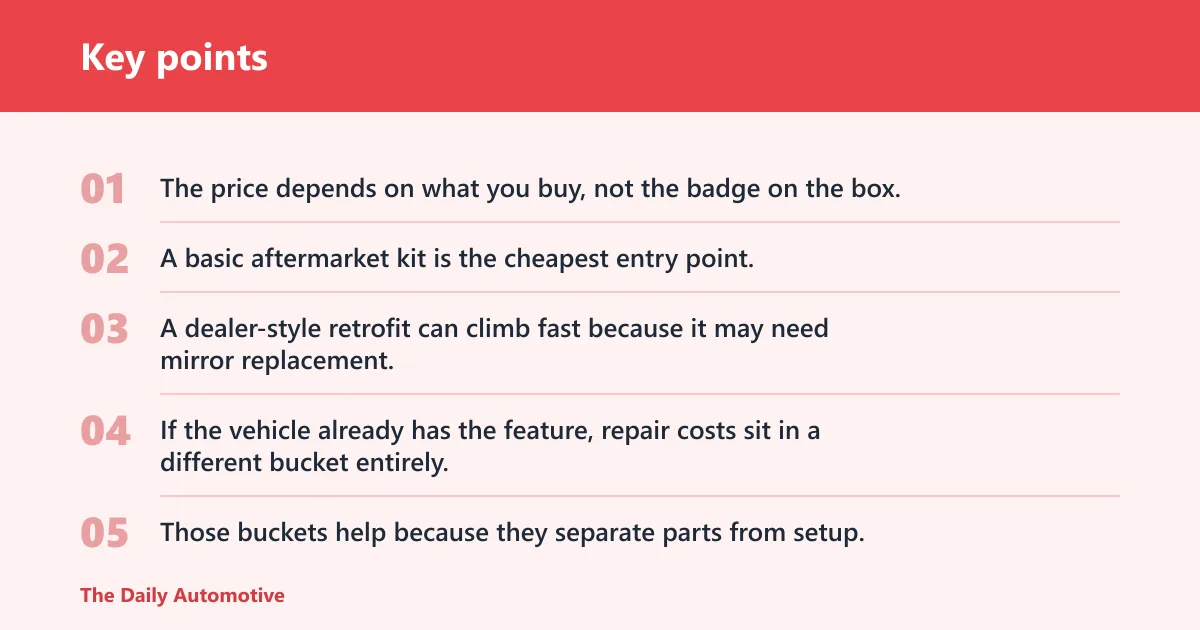

The price depends on what you buy, not the badge on the box. A basic aftermarket kit is the cheapest entry point. A dealer-style retrofit can climb fast because it may need mirror replacement, rear bumper sensors, wiring, and programming. If the vehicle already has the feature, repair costs sit in a different bucket entirely.
Typical price buckets
| Cost item | Low | Typical | High |
|---|---|---|---|
| Basic aftermarket kit | $150 | $300 to $600 | $800+ |
| Dealer-style retrofit | $500 | $900 to $1,500 | $2,000+ |
| Labor | $100 | $200 to $500 | $800+ |
| Coding / programming | $0 | $100 to $250 | $400+ |
| Likely repair scenario | $150 | $350 to $900 | $1,500+ |
Those buckets help because they separate parts from setup. A cheap kit without proper mounting or calibration can look like a bargain until the warning light stays on, the buzzer chimes constantly, or the system misses a fast-approaching car.
What drives the total
Factory-style systems use vehicle-specific sensors and software integration. That usually costs more than a universal kit with its own control box and warning lights. On many newer vehicles, blind spot monitoring may already be standard or optional equipment on specific trims, so the cheapest path is often to buy the trim that already has it.
Honda began rolling out its newest Blind Spot Monitoring feature in 2018 on the Accord and others, and Honda models cited with blind spot monitoring include Civic, Accord, CR-V, Pilot, Odyssey, and Ridgeline. Chevy Equinox offers blind spot monitoring as standard on Premier and optional on LT, but not on L or LS trims.
What you pay for in a retrofit
A retrofit cost stack usually includes hardware, installation, and programming. That is why dealer quotes can look high even when the visible parts seem simple. The system has to detect traffic behind the vehicle, warn the driver at the right time, and stay quiet when it should.
Radar sensors, control box, and power harness
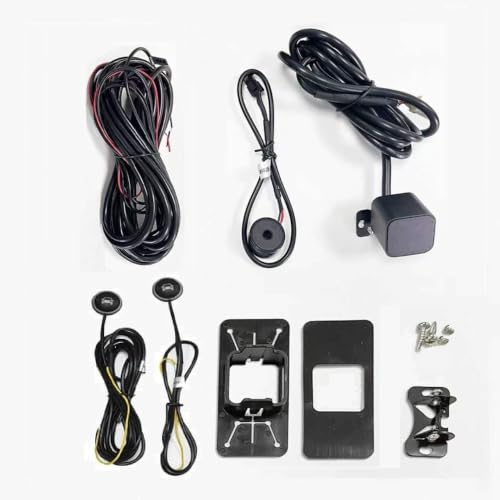
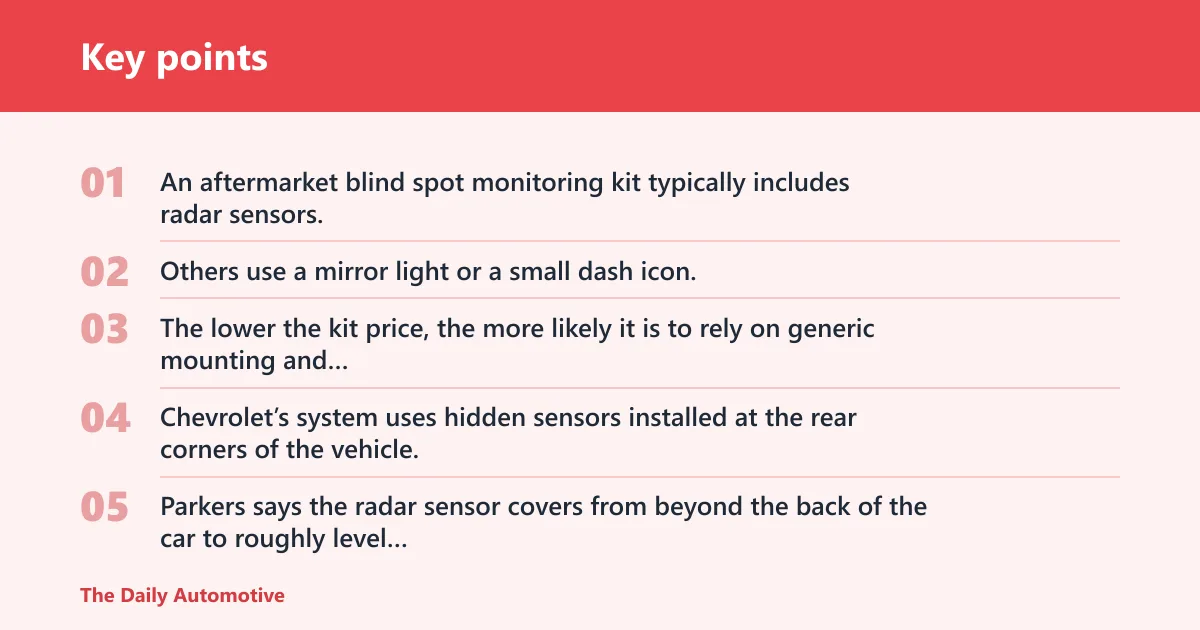
An aftermarket blind spot monitoring kit typically includes radar sensors, indicator lights, a control box, a power harness, and mounting brackets. Some kits add a buzzer or audible alert. Others use a mirror light or a small dash icon. The lower the kit price, the more likely it is to rely on generic mounting and simplified alerts.
Chevrolet’s system uses hidden sensors installed at the rear corners of the vehicle. Parkers says the radar sensor covers from beyond the back of the car to roughly level with the driver’s door. That coverage window is why placement matters so much.
Indicator lights, buzzer, or haptic alert hardware
Blind spot warning indicators can appear as a mirror light, an audible alert, or a haptic alert in broader ADAS packages. The same source notes warnings are typically an orange light on the driver’s door mirror. More advanced systems can add steering-wheel vibration, seat vibration, or audible warnings.
Those extras cost more because they are not only a sensor purchase. They also need the right output hardware, wiring, and software logic so the alert matches the vehicle’s signals.
Mounting brackets, mirror parts, and bumper modules
A dealership retrofit may require mirror replacement and blind spot modules in both rear bumpers. That adds parts cost and labor time. If the vehicle’s mirror housing, bumper cover, or wiring path was not designed for the feature, the quote rises quickly.
Say your 7-year-old crossover needs mirror replacement and both rear bumper modules to match an OEM layout. The parts bill may look manageable at first, but programming and labor can push the total far above a basic universal kit.
Can a dealer add blind spot monitoring?
Yes, a dealership can sometimes add blind spot monitoring, but only when the vehicle platform supports it and the quote still makes sense. Many dealer retrofits are possible on the same model family, yet they are rarely cheap because they often need factory parts, wiring, and software coding.
When dealer retrofit is possible
A dealer retrofit is most realistic on a newer vehicle, a trim that shares parts with a higher trim, or a model with a documented OEM retrofit path. If the wiring harness and module mounting points are already there, the job is easier. If not, the quote can balloon.
Why programming is often required
Programming is not optional on many OEM-style retrofits. The car has to know that the sensors exist, where they are mounted, and how the alert should behave. Without that step, the mirror light may never trigger, or it may trigger at the wrong time.
That is why labor and coding are separate line items. A quote that ignores programming is not a full quote.
When a dealer quote stops making sense
If the dealer price is close to the cost difference between your current trim and one that already has blind spot monitoring, the retrofit usually loses. The same is true on older vehicles. Once the quote moves into four figures, used-car buyers should compare it against a better-equipped trim or a different vehicle entirely.
Aftermarket kit vs factory system
An aftermarket kit and a factory system solve the same driver problem, but they do not deliver the same result. The factory setup is integrated into the vehicle’s electronics and trim logic. A universal kit is usually a bolt-on warning aid with fewer vehicle-specific details.
OEM integration and trim-level availability
A factory-installed blind spot monitoring system is built into the model’s options list. Availability varies by make, model, and trim level. That matters because some trims already have the mirror indicator and rear bumper sensors built in, while lower trims do not.
Vehicle-specific compatibility is the big divider. A factory-style system is designed for that exact vehicle family. A universal kit is designed to fit many vehicles, which makes it cheaper but less exact.
What a universal kit can and cannot match
A universal kit can add a warning if something is in the adjacent lane. It usually cannot match an OEM system’s integration with the mirror, turn signal behavior, or the rest of the driver-assistance package. It also may be more sensitive to installation quality.
For older cars, that tradeoff often makes sense. For newer cars with factory wiring already in place, an OEM-style retrofit or trim upgrade is usually cleaner.
How do blind spot alerts work?
Blind spot alerts are simple for the driver and picky for the hardware. Sensors watch the lanes behind and beside the vehicle, then the system warns you with a mirror light, sound, or vibration. It is a warning tool, not a substitute for checking mirrors and the shoulder.
Mirror indicator lights
The most common alert is a light in the side mirror. Some systems flash the icon when a vehicle enters the monitored zone. If you start a lane change while the light is on, many systems add a stronger warning. That is the basic blind spot warning indicator most drivers notice first.
Audible alerts and turn-signal interaction
When the turn signal is on, the system may get more aggressive. An audible chime or repeated buzzer can tell the driver that the lane is occupied. That interaction is useful, but it can also be annoying if the sensor placement is off or if road spray creates false returns.
Haptic warnings in broader ADAS packages
More advanced Lane Change Assist or Lane Change Alert systems can add steering-wheel vibration or seat vibration. Those systems are broader ADAS packages, and they can cost much more than simple blind spot monitors. F1 shows blind spot monitoring systems can range from $200 to $395, while F2 says lane change assist systems can cost about $1,400 per vehicle.
That gap is why buyers should compare the exact feature, not the marketing name.
Blind spot monitor cost table
The cheapest sensible path depends on age, trim, and how close you want to get to OEM behavior. A 15-year-old sedan is a different case from a 3-year-old crossover with plug-in-ready options. The table below puts the tradeoffs in one place.
| Scenario | Low | Typical | High | Best fit |
|---|---|---|---|---|
| Older vehicle, universal aftermarket kit | $150 | $300 to $500 | $700+ | Older cars, used-car buyers, simple lane-change aid |
| Newer vehicle, dealer-style retrofit | $500 | $900 to $1,500 | $2,000+ | Vehicles with compatible OEM parts and wiring paths |
| Trim upgrade instead of retrofit | $0 extra hardware | Varies by vehicle price gap | Often cheaper than retrofit | When the next trim already includes the feature |
| Sensor or mirror repair on equipped car | $150 | $350 to $900 | $1,500+ | Repair after impact, water intrusion, or module failure |
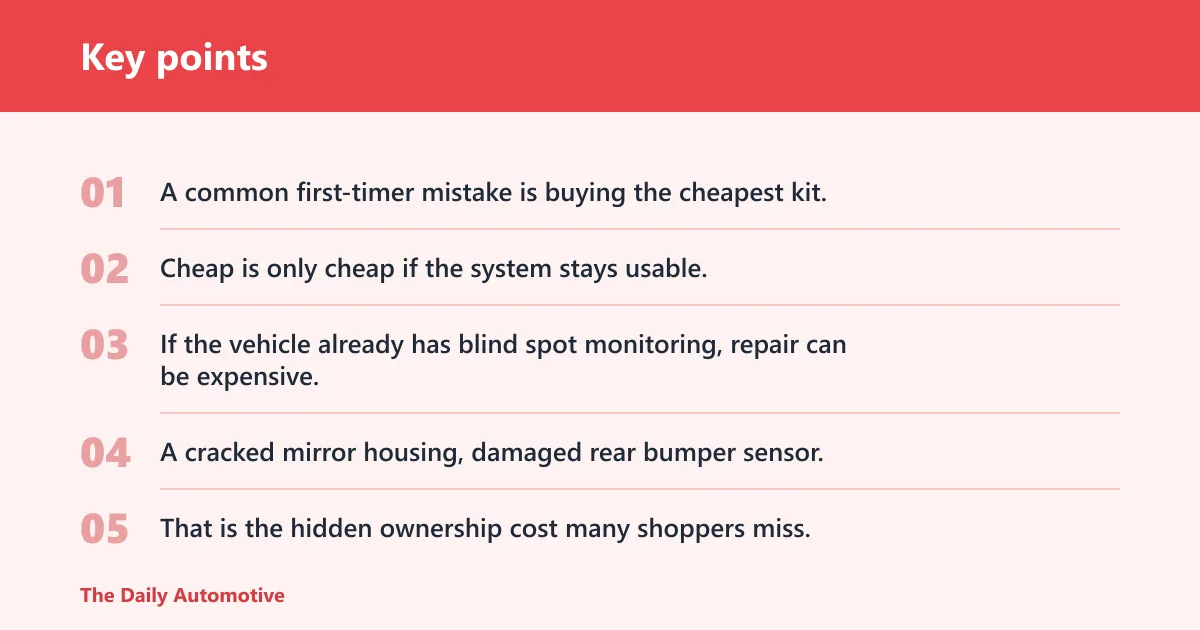
A common first-timer mistake is buying the cheapest kit, then discovering the mirror light is not bright enough in daylight or the buzzer is buried under road noise. Cheap is only cheap if the system stays usable.
Repair-risk scenarios after sensor or mirror damage
If the vehicle already has blind spot monitoring, repair can be expensive. A cracked mirror housing, damaged rear bumper sensor, or failed control module can push the bill well above the price of a basic kit. That is the hidden ownership cost many shoppers miss.
Weather and road conditions matter too. AAA found blind-spot monitoring had difficulty detecting fast-moving vehicles on busy highway merges, and AAA reported motorcycles were detected 26 percent later than passenger vehicles. Road spray, dirty sensors, and odd lane geometry can add false alerts or delayed warnings. (AAA)
Is blind spot monitoring worth it?
For many drivers, yes, especially if you spend time on multi-lane highways or drive a taller vehicle with larger blind zones. It is most valuable when it comes factory-installed or as a clean OEM-style retrofit. A lower-cost universal kit can still be worthwhile, but only if you accept its limits.
Who gets the most value from it
Drivers of SUVs, vans, and pickup trucks usually get the most obvious benefit because those vehicles have larger blind zones. Newer-car shoppers also benefit when the feature is already bundled into a trim package, since the cost is spread into the vehicle price rather than added later.
When a lower-cost kit makes sense
For an older commuter car, a basic aftermarket kit can be the sensible choice. It can add an audible or mirror-based warning without the cost of OEM parts and programming. That is often enough for a driver who wants extra help, not a fully integrated driver-assistance package.
When buying the feature already installed is better
If you are shopping used and one trim already includes blind spot monitoring, that is usually the cleaner buy. You avoid retrofit labor, coding, and compatibility surprises. You also reduce the chance of future repair work after a failed sensor or damaged mirror module.
Does blind spot monitoring lower insurance? Sometimes, but not reliably enough to count on. Some insurers may recognize driver-assistance features, while others do not give a clear discount. Treat any savings as a possible bonus, not part of the purchase math.
Frequently asked questions
How much does blind spot detection cost?
The final price depends on sensors, mirror indicators, wiring, labor, and whether the vehicle needs programming after installation.
How much does it cost to add blind spot monitoring?
The gap comes from vehicle-specific parts, mirror replacements, rear bumper modules, and software coding.
How much does it cost to install blind spot monitoring?
Installation alone often runs $100 to $500, but it can go higher if the car needs disassembly, mirror replacement, or programming. A shop may charge more on vehicles that need rear bumper work or factory-level calibration after the sensors go in.
How much does it cost to fix blind spot monitoring?
Repair cost can start near $150 for a simple sensor or connector issue and climb past $1,500 if a mirror assembly, bumper module, or control unit needs replacement. If the vehicle already has the system, damage repair is often more expensive than adding a basic aftermarket kit.
Can you add blind spot monitoring to a car after purchase?
Yes, but the best route depends on the car. Older vehicles often suit aftermarket kits, while newer models may support dealer or OEM-style retrofits. Compatibility, trim level, and programming requirements decide whether the job is straightforward or expensive.
Products related to this article
Sponsored / affiliate links. As an Amazon Associate I earn from qualifying purchases. I may earn additional commission from eligible campaigns.