How Much Does a Car Alarm Cost?
A basic car alarm often costs about $100 to $300 with installation, while premium systems can cost $300 or more. If you buy the wrong tier, you can end up with false alerts, thin theft protection, or labor charges that make the “cheap” system expensive. This guide breaks down buy, install, and replace costs by alarm tier so you can match the system to your car and budget.
Cost breakdown by alarm tier

The clearest way to budget is by tier, not by brand name. Basic hardware costs less because it has fewer modules and simpler wiring, while advanced systems add sensors, interfaces, and setup time that can matter as much as the unit itself on newer or harder-to-wire vehicles.
| Tier | Hardware range | Labor range | Likely features | Best fit |
|---|---|---|---|---|
| Alarm-only | $30-$300 | None if DIY; basic install labor often $50-$200+ | Siren tied into existing wiring, one or two remotes, basic shock or door triggers, sometimes a back-up battery or starter immobilizer | Older commuter cars, budget-minded owners, and drivers who want a simple deterrent |
| Basic installed | $30-$300 | $50-$200+ | Alarm, siren, remote control, and optional starter disable | Daily drivers where you want professional wiring without remote start or app controls |
| Advanced installed | $300-$850 | $100-$450+ | More sensors, more varied sensors, possible camera or remote ignition starter, and vehicle immobilizer integration | Higher-value vehicles, newer models, and cars with more complex wiring |
| Premium app/GPS bundle | About $800 for a named example unit, with premium bundles often above standard advanced gear | $100-$450+ or more, depending on remote start and tracking integration | App access, GPS or tracking features, remote start, longer-range control, and richer status feedback | Drivers who want phone access, location features, and stronger convenience on a more expensive vehicle |
For shoppers comparing total installed cost, the common baseline is simple: basic alarm total cost can land between $80-$500, while advanced installation can push a system to $400-$1,300+.
What a basic alarm includes
A basic car alarm usually covers the essentials: a siren, a control unit, and one or two remote controls. Many systems also add a starter immobilizer, and some include a back-up battery so the alarm keeps working if a thief disconnects the main power source.
Sirens and remotes
The siren is the loud alert you hear, and it is typically connected to the vehicle’s existing wiring system. Most basic packages include one or two remotes, which is enough for locking, unlocking, and arming the alarm without paying for app-based control.
Starter immobilizer options
An immobilizer can interrupt the starter circuit so the car will not crank when the system is armed. That feature is useful on a basic system, but it is still not the same thing as a fully integrated remote-start or GPS package.
Back-up battery options
A back-up battery can help keep the alarm active if the vehicle battery is cut. That matters on cars where the owner wants a bit more protection without stepping up to a larger system with more sensors.
What an advanced system adds
Advanced systems usually move past a simple siren and remote pair. They add more sensors, more varied sensors, and more integration with the vehicle, which is why hardware alone can run from $300-$850 before labor.
More sensors
Common add-ons include door, hood, trunk, shock, tilt, and glass-break sensing. Some systems also add other inputs, but the value comes from how well the installer sets them up, not from piling on every available sensor.
Remote start and app features
Advanced bundles may include remote start, app access, or GPS tracking. Those features help on a car that sits outside often, but they also add wiring and configuration time that basic systems do not require.
Vehicle immobilizer integration
Better systems can disable the starter circuit and tie into more of the car’s electronics. That can be useful on newer vehicles, but it also raises labor cost because the installer has to work around tighter packaging and more complex access.
How much does installation cost?
Installation labor often costs as much as the hardware on a basic setup, and it can cost far more on a more advanced one. Basic install labor is typically another $50-$200 or more, while advanced installation labor can run $100-$450 or more.
What makes labor higher
Labor rises when the vehicle is harder to access, the wiring is tighter, or the system needs more integration. Luxury cars, newer cars, and vehicles with limited dash access usually take longer, and that extra time is where the bill grows.
Hidden add-ons matter too. Bypass modules, adapter harnesses, and extra sensors can raise the final bill even if the alarm itself looks inexpensive on the shelf.
- Check whether the system needs a bypass module for your car.
- Ask if the quote includes adapter harnesses or extra sensors.
- Confirm whether remote start, GPS, or app setup is part of labor.
- Compare the quoted total against the vehicle’s age and electrical complexity.
Car alarm cost examples
Model prices help anchor the budget, but they can change by seller and install date. Use them as snapshots, not permanent price tags.
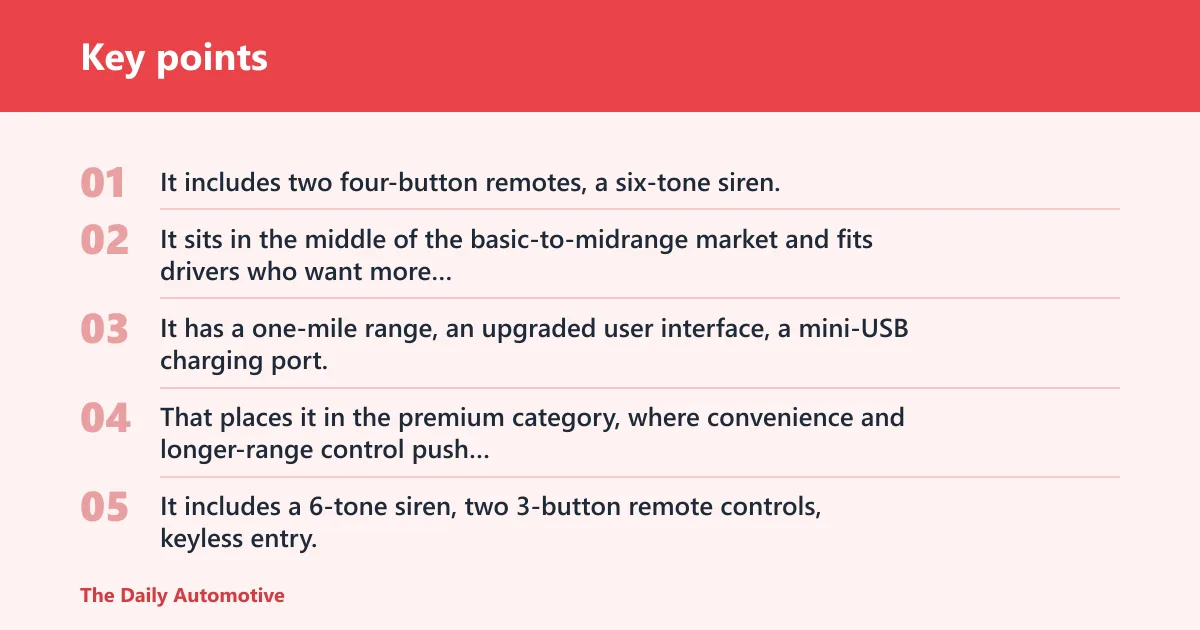
Viper 350 Plus 1-Way security System 3105V
The Viper 350 Plus costs $240. It includes two four-button remotes, a six-tone siren, and an operating range up to 1,500 feet. It sits in the middle of the basic-to-midrange market and fits drivers who want more than a bare-bones alarm without paying for app control.
Viper 5904 responder HD superCode SST 2-Way vehicle security and remote start system
The Viper 5904 costs $800. It has a one-mile range, an upgraded user interface, a mini-USB charging port, and a keychain remote. That places it in the premium category, where convenience and longer-range control push the price well above a basic alarm.
Avital 3100L security system with geek squad installation
The Avital 3100L package costs $150. It includes a 6-tone siren, two 3-button remote controls, keyless entry, a 1,500-foot range, and a warn-away feature. That package is a good example of how a modestly priced system can still include professional installation.
Say your 12-year-old sedan only needs a simple siren and starter disable. A basic installed system may be enough. Suppose you drive a newer SUV with remote start already in the vehicle network. In that case, the install time and module count can justify a much higher quote.
DIY vs professional install
DIY can save money, but the extra parts and tools can shrink that gap. Panel removal tools, a wire cutter and stripper, a soldering iron or crimping tool, heat-shrink tubing or electrical tape, and a multimeter are part of a proper install kit.
Hidden DIY parts costs
Many owners forget the small parts. Wiring harnesses, connector pins, bypass modules, and extra sensors can add up quickly, especially if the car needs a more vehicle-specific interface to keep warning lights and immobilizer logic happy.
When professional install is worth it
A professional install makes more sense when the car is newer, the dash is hard to remove, or the system includes remote start or app control. That is where labor can jump from a simple basic job to an advanced one at $100-$450+.
Common install tools
At minimum, the job usually calls for panel removal tools, a wire cutter/stripper, a soldering iron or crimping tool, heat-shrink tubing or electrical tape, and a multimeter or voltmeter. Those tools help confirm wire identity before anything is cut.
Repair, replacement, and removal costs
Repair, replacement, and removal matter because many shoppers are not starting from zero. If an alarm is acting up, the next bill may be smaller than a full new install, or it may be close to it if the wiring is a mess.
Fixing an alarm
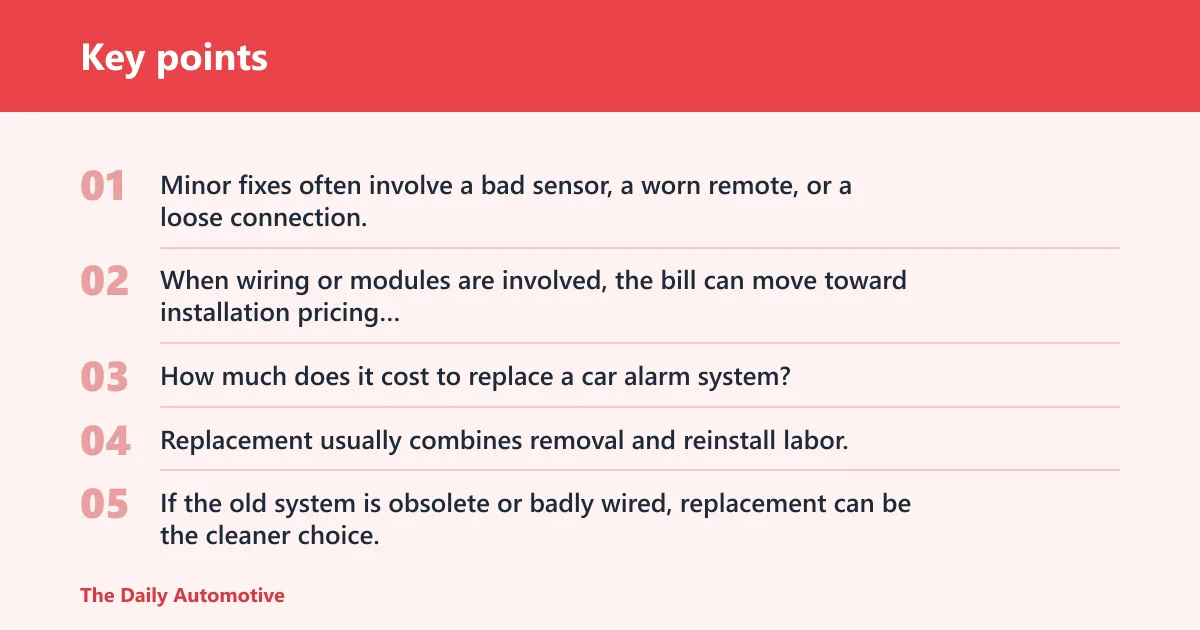
How much does it cost to fix a car alarm? Minor fixes often involve a bad sensor, a worn remote, or a loose connection, and those can run lower than a full replacement. When wiring or modules are involved, the bill can move toward installation pricing because the labor overlaps.
Replacing an old system
How much does it cost to replace a car alarm system? Replacement usually combines removal and reinstall labor, so the total often lands somewhere between a repair and a fresh install. If the old system is obsolete or badly wired, replacement can be the cleaner choice.
Removing an alarm system
How much does it cost to remove a car alarm? Removal is often cheaper than replacement, but the exact cost depends on how deeply the system was integrated. A clean removal is faster than undoing splices, extra modules, or aftermarket starter disable wiring.
What should you spend?
For an older daily driver, a basic installed alarm is often the sensible choice. It keeps the budget in the $80-$500 range while covering the common theft-deterrent needs without paying for features you may never use.
For a higher-value car, a more advanced system is easier to justify. The extra labor and hardware cost buy more sensors, better integration, and more control options, which is why the total can move into the $400-$1,300+ range.
If you want remote start, phone access, or GPS features, spend for the premium tier. That is the point where the alarm becomes part security system and part convenience upgrade, and the install cost reflects that complexity.
Frequently asked questions
How much does a car alarm system cost?
A car alarm system can cost $30-$300 for basic hardware and $300-$850 for advanced hardware.
How much does a car alarm cost to install?
Basic installation labor is typically $50-$200 or more. Advanced installation labor can run $100-$450 or more, especially on newer, luxury, or hard-to-access vehicles. Remote start, GPS, and extra sensors usually push the price higher.
How much does a good car alarm cost?
A good alarm depends on the car and the goal. For a straightforward deterrent, a basic installed system can be enough. For better sensor coverage or remote start, many shoppers should expect to spend in the advanced range, which starts around $300 in hardware alone.
How much does a Viper car alarm cost?
The Viper 5904 costs $800 and sits in the premium category with one-mile range and remote-start features.
How much does it cost to replace a car alarm system?
Replacement usually means paying to remove the old system and install a new one. The total often depends on how much of the old wiring can be reused. If the previous installation was complex, replacement can approach the cost of a full install.
How much does it cost to remove a car alarm?
Removal is usually cheaper than installation, but the price depends on how the alarm was wired in. A basic system with simple access is easier to pull out than one tied into starter circuits, extra sensors, or a bypass module.
Products related to this article
Sponsored / affiliate links. As an Amazon Associate I earn from qualifying purchases. I may earn additional commission from eligible campaigns.