How Much Does Adaptive Cruise Control Cost?
Adaptive cruise control cost varies by vehicle, install path, repair needed, and whether calibration is required. Skip calibration or repair the wrong sensor, and ACC can brake late, fail to resume, or shut off entirely. This guide breaks down factory pricing, retrofit reality, repair bills, and calibration costs so you can decide whether to add ACC, fix it, or leave it alone.
Acc price ranges for factory options, retrofits, and repairs
| Scenario | Low cost | Typical cost | High cost | When it makes sense |
|---|---|---|---|---|
| Factory option | $500 | $1,000 to $1,800 | $2,500 | Best on a new or nearly new car when ACC is bundled into a trim or package you already want. |
| Aftermarket retrofit | $1,200 | $2,000 to $3,000 | $3,500+ | Works when the car was designed with ACC in mind and the wiring, modules, and brackets are already close. |
| Repair | $150 | $350 to $700 | $1,000 | Makes sense when one part failed and the rest of the system is intact. |
| Calibration | $100 | $200 to $300 | $400 | Needed after windshield replacement, bumper work, or collision repair when sensor aiming must be restored. |
How much does adaptive cruise control cost?
For most shoppers, ACC lands in one of four buckets: factory option, retrofit, repair, or calibration. A factory setup is usually the cleanest path, while retrofit pricing rises fast once you add parts, labor, coding, and body work. The more the car was originally built to support ACC, the better the odds that the bill stays near the low end.
Typical price ranges by scenario
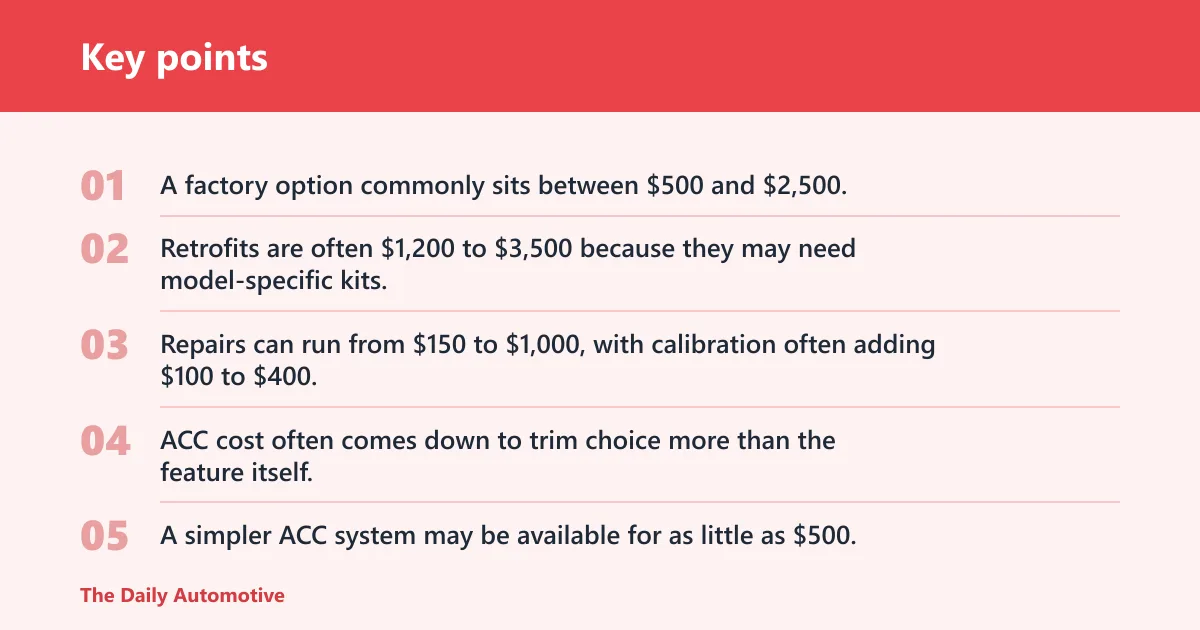
A factory option commonly sits between $500 and $2,500. Retrofits are often $1,200 to $3,500 because they may need model-specific kits, extra modules, and programming. Repairs can run from $150 to $1,000, with calibration often adding $100 to $400.
ACC cost often comes down to trim choice more than the feature itself. A simpler ACC system may be available for as little as $500, but more advanced setups with stop-and-go behavior and navigation input tend to cost more.
What pushes the bill higher
Labor is a major factor. ACC installation is a specialized job that can sit at the higher end of local labor pricing. Some retrofits also require modifying the grille, bumper, electrical system, and other components, which adds both time and risk.
Parts matter too. A forward radar sensor behind the grille or bumper is not the same bill as a windshield-mounted camera, and a damaged bracket or wiring loom can add hidden cost. Coding and programming also show up on invoices when the car needs software setup after installation or repair.
When the total cost is hard to justify
ACC becomes difficult to justify when the retrofit price approaches the difference between trims. Suppose a used sedan needs a $2,800 retrofit, but a higher trim with factory ACC costs $2,500 more at purchase. In that case, buying the better-equipped car usually makes more sense than tearing into the lower trim.
That same logic applies to older cars. If the vehicle lacks the right wiring, control modules, steering wheel controls, grille mounts, or camera support, the retrofit can turn into a body-and-electrical project. At that point, the cost can exceed the value of the car.
Can you add adaptive cruise control to any car?
No. Some vehicles are straightforward candidates, but many are poor retrofit choices. The easiest installs usually happen on cars that were already engineered for ACC in higher trims, because the needed wiring, mounting points, and module support are closer to what the system expects.
Which vehicles are easier to retrofit?
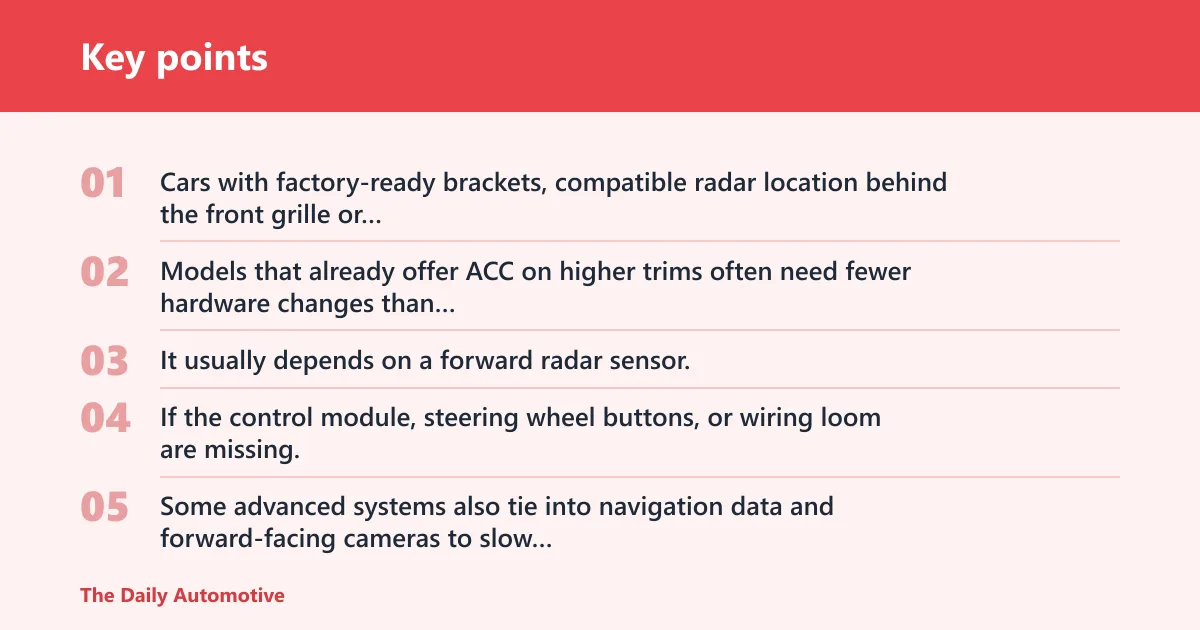
Cars with factory-ready brackets, compatible radar location behind the front grille or bumper, and software support are the best bets. Models that already offer ACC on higher trims often need fewer hardware changes than older vehicles that never offered the feature at all. That lowers both labor and coding time.
Why wiring and module support matter
ACC does not run on one sensor alone. It usually depends on a forward radar sensor, often a forward camera near the rear-view mirror, and vehicle software that can interpret their signals. If the control module, steering wheel buttons, or wiring loom are missing, the install can stall or become expensive fast.
Some advanced systems also tie into navigation data and forward-facing cameras to slow for curves and speed changes. If that support is not already in the car, the retrofit may need extra parts and software work. That is where the cost starts climbing beyond a simple parts swap.
Why some older cars become uneconomical
Older vehicles often need more than the ACC hardware itself. They may require custom wiring, body modifications, bumper work, coding, and a post-install calibration. Once those pieces stack up, the total cost can exceed the market value of the car, especially on basic trims or high-mileage vehicles.
Picture a compact hatchback without radar mounting points or camera support. If the job needs a bumper change, a module swap, and programming at a shop charging near the top of local labor rates, the bill can quickly rival a newer used car with ACC already installed from the factory.
What parts does adaptive cruise control use?
ACC systems usually use radar, camera input, or both to maintain set speed and follow traffic. Most systems let the driver adjust following distance from close to far, often in time gaps rather than feet. Stop-and-go versions can brake to a full stop in traffic, and some will resume automatically within a short stop window while others require the driver to press resume after stopping.
Forward radar sensor
The forward radar sensor is commonly mounted behind the grille, bumper, or badge. It measures distance and relative speed to the vehicle ahead, which is why it is central to following-distance control. Radar can struggle on sharp curves or when obstructions block the beam.
Radar damage is one reason repair costs rise. A cracked radar unit, bent bracket, or misaligned mount can push the bill from a minor repair into the several-hundred-dollar range. If the bumper was repaired after a collision, the sensor may also need recalibration even if it still works.
Forward camera
The forward camera is often mounted near the rear-view mirror. It helps identify lane markings and vehicles, and in some systems it works with radar to improve speed control and curve behavior. Performance can drop with glare, grime, snow, or fog.
A windshield replacement can disturb the camera’s aiming even when the glass work looks perfect. That is why calibration after windshield repair often matters as much as the glass itself. If the camera is out of aim, ACC may react late or disable itself.
Stop-and-go control logic
Stop-and-go ACC can bring the car to a complete stop in traffic. Behavior varies by vehicle, though, and many systems still require the driver to press resume after the car has been stopped for a short period. That difference matters when you compare trims or shop for a retrofit.
It is useful in slow traffic, but it is not a substitute for attention. ACC rates at SAE Level 1, or Level 2 when coupled with lane centering, so the driver still needs to supervise every part of the drive. (Motortrend)
Following distance settings
Following distance settings are usually adjusted as time gaps, not feet. Common settings range from close to far. Longer gaps are useful in rain, darkness, or heavy traffic because they leave more time to react if the vehicle ahead slows suddenly.
That setting can also change the feel of the system on the highway. A shorter gap may seem more responsive, but a longer gap is often a safer choice in poor visibility or on slick roads where stopping distance grows.
What drives repair and calibration costs
ACC repair prices swing widely because the failed part can be small or expensive. A sensor issue, wiring problem, or calibration need may be a minor bill. A damaged radar unit, broken camera mount, or collision-related alignment problem can move the repair into the high end quickly.
Radar sensor damage
Radar sensor replacement is often one of the priciest fixes. The part itself may be costly, and access can be awkward because it sits behind the front fascia, grille, or badge. If the bumper cover or mounting bracket was damaged too, the repair total rises with labor and parts.
Windshield camera issues
When the forward camera is the problem, the cost can include the camera, glass work, and programming. A cracked windshield can make the issue look like a camera failure when the real need is sensor recalibration after glass replacement. Dirty glass and glare can also cause temporary ACC faults.
Bumper repair and misalignment
Bumper damage matters because radar sensors depend on clean alignment. Even a small shift in the bumper cover or grille can change sensor aim enough to trigger warning lights or erratic behavior. That is why body repair shops often need to coordinate with calibration after the paint and panel work are done.
Post-repair calibration and programming
Calibration may be required after windshield replacement, bumper work, or collision repair. It restores sensor aiming and accuracy, and it can also include software setup after parts replacement. If the shop skips this step, the car may drive with incorrect following distance or disable ACC entirely.
Suppose a midsize SUV gets a new windshield and the camera is left uncalibrated. The car may still start and drive normally, but ACC can give false alerts or refuse to engage. The repair bill then becomes glass work plus calibration, not glass work alone.
Adaptive cruise control cost matrix details
The matrix above is built around four cost drivers: parts, labor, coding or programming, and calibration-related add-ons. Factory option pricing usually folds most of that into the purchase price. Retrofit and repair jobs separate those pieces, which is why the invoice can look much longer than the parts list suggests.
Parts versus labor versus calibration
For a retrofit, the major cost categories are the radar unit or camera, brackets and mounts, wiring, programming, and calibration. Labor can dominate if the installer has to modify the grille, bumper, or electrical system. That is also where local labor rates matter most.
For a repair, the bill depends on what failed. A steering angle sensor problem can affect ACC behavior and may require diagnosis, replacement, and setup. A simple calibration is cheaper than a radar replacement, but a damaged sensor plus calibration can easily reach the upper end of the repair range.
When it makes sense
ACC makes the most sense when you value highway comfort, stop-and-go traffic help, and the car already supports the hardware. It is especially appealing if the factory option is available at purchase and the price difference between trims is modest. That is usually cheaper than adding it later.
A common first-timer mistake is chasing retrofit savings without checking the hidden pieces. If the car needs a grille change, radar bracket, camera support, and a calibration session, the “cheap” retrofit is no longer cheap. Compare that total against a trim that already includes ACC before you commit.
Frequently asked questions
How much does it cost to add adaptive cruise control?
Adding ACC usually costs $1,200 to $3,500 when done as a retrofit, though the total can run lower on vehicles designed for the feature and higher when body work or programming is needed. Factory-installed ACC is often cheaper overall because the cost is folded into the trim price.
How much does it cost to install adaptive cruise control?
Installation cost depends on the car and the shop. ACC installation is a specialized skill that can require higher-end labor pricing. Parts, coding, and calibration often sit on top of the labor bill.
How much does it cost to fix adaptive cruise control?
Repair bills often fall between $150 and $1,000, but the total depends on whether the issue is a radar sensor, camera, wiring fault, or alignment problem after body damage. If the fix also needs calibration, that can add another $100 to $400.
How much does it cost to calibrate adaptive cruise control?
Calibration often adds $100 to $400, especially after windshield replacement, bumper repair, or collision work. The exact price depends on whether the shop needs static aiming, software setup, or both. Skipping calibration can leave the system inaccurate or inoperative.
Is adaptive cruise control worth it?
ACC is worth it if you drive long highway miles or spend time in stop-and-go traffic and the price gap is reasonable. It is less attractive when the retrofit cost approaches the price of a better-equipped trim. In that case, buying the car with ACC already installed usually makes more financial sense.
Products related to this article
Sponsored / affiliate links. As an Amazon Associate I earn from qualifying purchases. I may earn additional commission from eligible campaigns.